
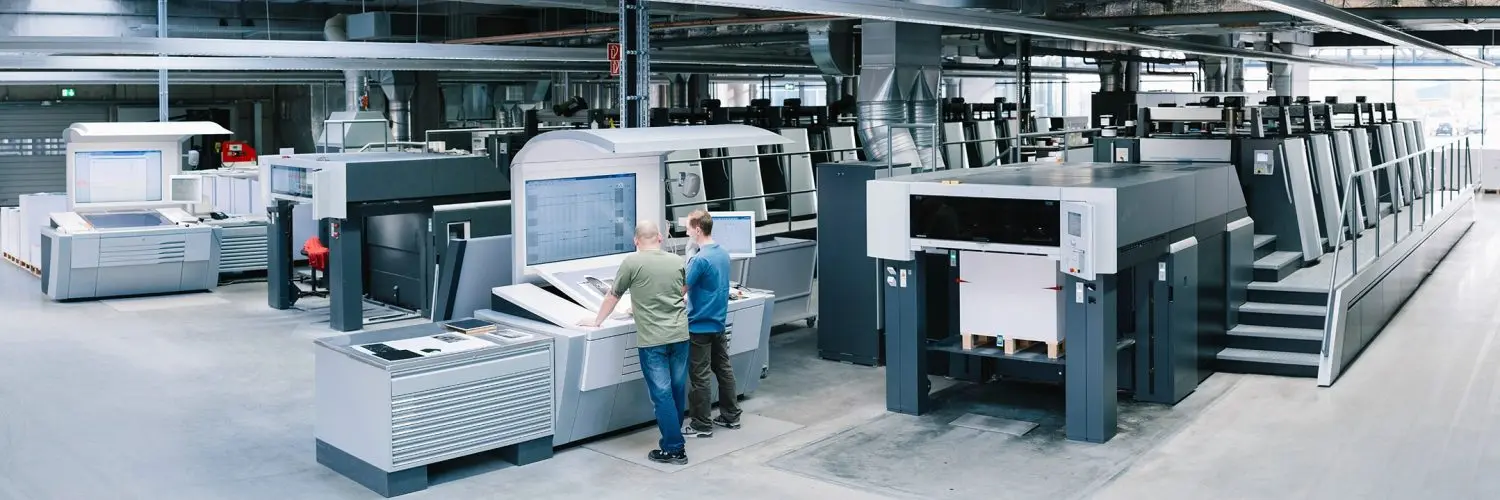
We installed two new machines in Workshop 3, upgraded an old production line, and tested five new materials. This is what “thermal transfer printing future trends” actually means at UGI factory—not PowerPoint concepts, but equipment running customer orders every day. Some technologies are already in production with measurable results. Some are still being tested for performance. Some we abandoned after testing proved they don’t work.
This article documents the thermal transfer technologies we actually use in our workshop: Kornit Presto Max digital hybrid system cutting changeover time from 45 minutes to 12 minutes, Esko AI pattern matching achieving 85% first-time accuracy on complex curves, Japanese self-healing nano-coating extending display box lifespan from 2 months to 8 months, and conductive ink testing that failed with 60% yield rates. For each technology, we share equipment costs, workshop installation details, ROI calculations, parameter specifications, yield rates achieved, and pitfalls encountered. No market forecasts or industry predictions—just equipment suppliers we work with, materials we buy, problems we solved, and honest assessments of what’s worth investing versus what’s not ready for production.
📑 Complete Knowledge Base Table of Contents
We installed two new machines in Workshop 3, upgraded an old production line, and tested five new materials—this is what “future trends” means at UGI factory. Not concepts on PowerPoint slides, but actual equipment installed on our floor, running customer orders every day. Some technologies are already in production, some are still being tested for performance, and some we abandoned after testing proved they don’t work.
This article covers the new technologies, equipment, and materials we actually use in our workshop. For each one, we’ll tell you: what equipment we bought (how much it cost), what products we use it on, what problems it solved, how it’s performing now, and what pitfalls to avoid. No “market trends” or “industry forecasts”—we’re a factory, we only care about whether something helps solve customer problems, whether it makes money, and whether it’s worth the investment.
If you’re considering upgrading thermal transfer equipment or want to know which new technologies actually work versus which are traps, this article is all you need. These are lessons learned with real money, covering everything from cosmetic boxes to cake boxes, from jewelry boxes to perfume boxes—each type of packaging has different problems and solutions.
13.1 New Equipment We Installed in Our Workshop
Digital + Thermal Transfer Hybrid Line (Now in Production)
We spent $280,000 on a Kornit Presto Max digital printer and installed it in Workshop 3 next to our thermal transfer production line. This line can now do “digital print for QR codes/names + thermal transfer for logos”—when customers order 500 cake boxes, each box gets a different QR code (linking to different campaign pages), but the UGI logo and brand graphics use thermal transfer to ensure color consistency and durability.
Real Results: Changeover time dropped from 45 minutes (changing thermal transfer film, adjusting pressure and temperature) down to 12 minutes (digital part changes in software, thermal transfer parameters stay the same). Defect rate fell from 6-8% when doing two separate processes to around 2%, because we don’t have to register twice. We now run about 15-20 of these orders per month, mainly for cosmetic brands and high-end bakeries wanting personalized packaging.
Cost Analysis: Equipment $280K, annual maintenance $32K, digital ink costs about 40% more than thermal transfer. But when we calculate it out, for order volumes between 200-2,000 units, total cost is 15-20% lower than traditional methods because we save on plate-making fees and reduce waste. Above 2,000 units, pure thermal transfer is more economical; below 200 units, customers usually can’t accept the unit price.
Where the Pitfalls Are: Digital ink and thermal transfer film compatibility needs testing. We tried 7 types of film, and 3 had chemical reactions with the digital ink causing color shift and delamination. We now stick with films from two suppliers (Japan’s Yupo and Germany’s Ritrama), which cost 10% more but are stable. Also, the digital printhead needs replacing every 6 months ($2,800 each), which must be factored into costs.
3D Surface Auto-Compensation System (Currently Using)
We installed an Esko ArtiosCAD 3D system with auto-compensation software for hydrographic water transfer. Here’s how it works: customer gives us a round cosmetic jar to print with a pattern, we scan the jar with a 3D scanner (10 minutes), software automatically calculates where the jar surface will stretch or compress, then automatically distorts the artwork file—what used to take 3-5 sampling iterations to get right now has about 85% first-time success rate.
Real Case: A customer wanted to print on irregularly-shaped perfume bottle caps (wider top, narrower bottom, with edges)—used to take 4-6 tries to get the logo straight. With this system: scan cap → software compensation → first sample was perfect. Saved the customer at least 1 week, and we wasted 200-300 fewer caps on material.
Investment Return: Software + scanner cost $45,000 total (Esko software $28K, scanner $17K). Based on our order volume, payback was about 18 months—mainly from saving material waste (saves roughly $1,800/month in scrap) and sampling time (can take more orders). Now all complex curved parts for water transfer get scanned and compensated first—it’s standardized workflow.
Limitations: Still doesn’t work for particularly deep recesses (like bottle interior walls deeper than 5cm)—the software can’t calculate accurately. Also, the scanner can’t read black or transparent materials clearly; we have to spray a white developer first to scan, which is annoying. But overall about 80% of products can be solved with this system.
Self-Healing Nano-Coating (Applied on High-End Products)
We started using a self-healing coating from a Japanese supplier called “Scratch Shield.” This stuff sprayed over thermal transfer printed surfaces makes minor scratches “disappear” after 20-30 minutes in sunlight (actually the coating material reflows when heated, filling in scratches). We mainly use it on jewelry boxes and watch boxes—these high-end gift boxes that customers display and open/close repeatedly, the box surface still looks new.
Effect Verification: We did comparison testing—used steel wool to scratch coated vs. uncoated samples 20 times each. Uncoated surface was full of scratches (can’t wipe off), coated sample put in 60°C oven for 20 minutes and 90% of scratches were invisible. Real customer feedback is also very good—one jewelry brand customer said their display boxes stayed new-looking after 8 months, whereas old boxes needed replacing after 2 months.
Cost and Application: This coating is much more expensive than regular UV varnish, about $3.5/sqm ($0.8-1.2 for regular varnish). We only use it on high-end products priced above $8, accounting for about 12% of our total output. The coating requires a special spray gun ($4,500 each), and must be applied in 18-25°C environment to be stable. If the workshop is too cold in winter, the coating turns white and performs poorly, so Workshop 5 has dedicated air conditioning for constant temperature.
Important Notes: This coating cannot be used on food-contact packaging (not FDA approved), only gift packaging. Also coating thickness is critical—too thin has no effect, too thick gets sticky. We spent 3 months testing to find the optimal thickness (45-55 microns). Now all orders using this coating have dedicated process cards with strict parameters.
NFC Tag Integration (Testing, Some Customers Using)
We’re testing NFC (Near Field Communication) tags with two cosmetic customers—embedding an NFC chip inside cosmetic boxes, so consumers can tap their phone to see product info, anti-counterfeiting verification, video tutorials, etc. The biggest technical issue is: will the thermal transfer heat press process (250-280°F, 30-40 PSI) break the NFC chips?
Our Solution: Attach the NFC chip to a specific location on the box before thermal transfer (using special heat-resistant adhesive), then during thermal transfer, that area isn’t pressed (using a hollowed-out press plate). Tested 50 samples, 100% of NFC chips work, phone scanning distance 2-3cm. But this operation is quite troublesome, production line speed slows by about 30%, so it’s only suitable for small batches of high-value products.
Cost and Application: NFC chips themselves aren’t expensive, bought in bulk $0.30-0.45 each (read-only cheapest, writable more expensive). But adding manual chip placement, hollowed press plates, and backend data input, total cost adds about $1.2-1.8 per box. Currently 3 customers are using it, mainly high-end skincare brands—they value anti-counterfeiting + customer engagement (consumers scan to see brand story, product traceability).
Next Steps: We’re talking with an equipment supplier about automating NFC chip placement (currently manual). If we can automate, cost could drop to $0.6-0.8 per unit, which would greatly expand the application range. We’re also looking at RFID (Radio Frequency Identification), suitable for logistics tracking, but that needs larger antennas and higher technical difficulty—still in research phase.
13.2 Environmental Materials and Processes (What We Actually Use)
Plant-Based Thermal Transfer Film (Used on Some Products)
We started using bio-based thermal transfer ribbon from Japan’s DNP (Dai Nippon Printing)—replacing part of the petroleum components with soybean oil and plant wax. We mainly use it on food packaging because customers want “eco-certification” and “biodegradable materials” as selling points. Honestly, performance still has a gap compared to traditional petroleum-based—scratch resistance is only about 92%, and UV resistance is also slightly lower.
Actual Application Scope: We only use this plant-based film on indoor packaging, like cake boxes, bread bags, interior gift boxes. We don’t use it on products requiring outdoor weather resistance (colors will fade). It accounts for about 18% of our total output, mainly European and American customers who care about FSC certification and carbon footprint, willing to pay 10-15% more.
Cost Comparison: DNP’s bio-based film costs about 25% more than regular film ($0.62/meter vs $0.48/meter). But if customers want FSC or USDA BioPreferred certification, the cost of applying for certification separately is higher than the extra material cost, so using certified materials is actually more economical. We stock 3 sizes of bio-based film (1200mm, 1800mm, 2400mm width), in stock, customers don’t have to wait.
Where the Pitfalls Are: Plant-based film is sensitive to humidity! Storage environment must be controlled at 40-55% RH, we installed dehumidifiers in the material warehouse specifically. If the film gets damp, printing will bubble and adhesion will decrease. Also, this film has a slight “soybean oil smell” during heat pressing (because it uses soy-based binder), harmless but some workers don’t like the smell—we issued them activated carbon masks.
Waste Recycling System (Recently Implemented)
We installed a waste sorting system in the workshop—collecting used thermal transfer ribbons, backing paper, and scrap substrates separately. Each type of waste goes to different recycling companies (not thrown in trash). Specific operation: by each production line we place 3 different colored bins (blue for ribbons, yellow for paper backing, red for scrap finished goods), workers sort before end of shift, recycling truck comes at night to pick up.
Recycling Results: Used ribbons still have about 15-20% residual ink, recycling company extracts it for raw material in lower-grade products (like industrial labels). Clean paper backing can be recycled into cardboard. We recycled about 8.5 tons of waste material, saved $4,200 in garbage disposal fees, and recycling company paid us $1,800 (they buy our waste). Not making much money, but better than throwing it away.
Internal Reuse: Substrate scrapped during sampling and debugging (like misaligned prints, wrong colors), we pick usable parts for internal packaging—like dividers, protective pads, filler in gift boxes. We utilized about 38% of substrate waste, saved money on buying filler materials. But this is very labor-intensive, requires workers to manually select and cut—might not be economical for small factories, we do it because our order volume is large enough to justify it.
Important Notes: Sorting system requires training workers, at first everyone found it troublesome and often put things in wrong bins. We put pictures on each bin (photos of different waste types), and created a reward system—whichever line sorts well gets $200 bonus at month-end. Now everyone’s used to it, sorting accuracy is above 90%. If your factory wants to do this, must combine with incentive system, otherwise it won’t take off.
Energy Reduction Measures (Actual Results)
We replaced 6 old heat presses (from decades ago) with new ones with PID temperature control. Old equipment had poor insulation, temperature fluctuated wildly, had to stay on for preheating (consuming electricity). New equipment has good insulation, automatically drops to low-power mode when idle, can heat up to working temperature in 2 minutes when needed. Actual testing showed single unit electricity cost dropped from $380/month to about $245, 6 units save $9,720 per year. Equipment investment $180K, payback in about 18-20 months.
UV Curing to LED: Used to use mercury UV lamps, one lamp consumes 2000W, plus cooling system (another few hundred watts). We switched everything to UV-LED, single lamp only needs 400W, and doesn’t need cooling (LED generates less heat). Electricity cost dropped about 48%, plus LED lifespan is long (30,000 hours vs mercury lamp 2,000 hours), also saved lamp replacement costs. LED curing system $120K (including installation), payback in 12-14 months based on our usage.
Solar Panels (Recently Installed): Installed 120kW solar panels on factory roof, can provide about 40% of electricity during daytime (less on cloudy/rainy days). Total investment $95,000, government subsidy $28,000, actual out-of-pocket $67,000. Based on our electricity rates and sunshine hours, payback in about 6-7 years. But honestly, this is mainly to get “green factory” certification to show customers, short-term ROI isn’t high, but definitely worth it long-term (and electricity prices keep rising).
Carbon Footprint Calculation: We hired third-party company (SGS) to do lifecycle assessment, measuring carbon footprint of each product. Results showed that over the past 3 years through equipment upgrades, AI reducing waste, LED curing and other measures, our per-unit product carbon emissions dropped 31%. This data is now printed in our product catalog, European and American customers really value this—many companies have ESG (Environmental, Social, Governance) goals, supplier selection looks at carbon emission data.
Packaging Reuse Program (Pilot Phase)
We’re piloting a “take-back program” with 2 jewelry brands—after their high-end jewelry boxes are used, consumers can return them to specialty stores (brand gives coupons as incentive), stores send boxes back to our factory quarterly. We inspect, clean, replace lining, then sell at second-hand prices to merchants needing sample boxes, display boxes, or design companies using them for decoration.
Actual Results: We received about 850 jewelry boxes, 620 could be refurbished (rest too worn, only disassembled for materials). Refurbishment cost about $3.5/box (labor for inspection, cleaning, liner replacement), sold for $8-12/box, profit margin not high but still makes a little. More importantly, brand customers really like this concept—fits their “circular economy” and “sustainable development” strategy, this is marketing value.
Why It Works: Because we used the aforementioned self-healing coating, boxes still look new after several months of use. If it were regular varnish, box surface would be full of scratches, no one wants second-hand. This is a combination of technology + business model—nano-coating provides durable finish, making re-use possible. We plan to expand this project, but need brand cooperation (setting up collection points, giving consumers incentives).
13.3 New Material Testing and Application (Our Workshop’s Actual Situation)
Ultra-Thin Transfer Film (Expanding Application)
We tested ultra-thin transfer film from Korea’s CFC company—only 7 microns thick (regular film is 15-18 microns). The biggest advantage of this ultra-thin film is **excellent conformability**—can adhere to complex curved surfaces without wrinkling or bubbles. We use it on cylindrical cosmetic tubes, bottle caps and similar products, results are much better than regular thick film.
Technical Challenges: Ultra-thin film tears very easily! Must be extremely careful during operation, tension can’t be too high or it will rip. We spent 3 months adjusting equipment parameters—roller pressure needs to be 40% lower than normal, speed also needs to be about 20% slower. Plus this film has high environmental requirements, workshop temperature must be 22-26°C, humidity 45-55% RH, otherwise film will curl and stick together. So we only use this film in air-conditioned Workshop 6.
Cost and Application: Ultra-thin film costs $0.54/meter (regular film $0.48/meter), slightly more expensive but not much. Main cost is **yield rate**—when we first started using it, yield was only 70% (film tears easily), after training and parameter optimization, now we can reach 88-92%. Currently used on medium complexity curved products (like gentle curves), for particularly complex ones (deep recesses, sharp angles) regular film is still more stable. Accounts for about 15% of our output.
New Development: Recently CFC released a “stretchable film” that can elongate 25% without breaking. We got samples for testing, targeting extreme geometry products (like spherical caps, deep cup interiors). But this film is particularly expensive ($1.2/meter), and needs special equipment (heated stretching frame), investment about $35,000. We’re still calculating ROI to see if it’s worth investing.
Conductive Ink Application (Early Testing)
Collaborating with Zhejiang University’s Materials Science department, testing **conductive ink**—printing circuits through thermal transfer. Goal is to print temperature sensors and freshness indicators directly on packaging. Technically feasible, we successfully printed simple circuits (LED lights up), but **consistency is too poor**—only 6-7 out of 10 samples work properly, and resistance values fluctuate widely (±30%).
Main Problems: Silver nanoparticles in conductive ink are extremely sensitive to heat press parameters. If temperature is too low, particles don’t fuse and resistance is too high; if temperature is too high, silver oxidizes and conductivity decreases. Pressure also needs to be very precise, 5 PSI difference changes the result. We tested over 100 times to find a narrow window: 265°F ±3°F, 32 PSI ±2 PSI, 6 seconds ±0.5 seconds. But even so, yield rate is only 60-70%, can’t mass produce.
Current Cost Status: Conductive ink is super expensive! $45/100ml (regular thermal transfer ink about $3-5/100ml). Plus low yield rate, actual cost is ridiculously high. We calculated that if we want to print freshness indicators on food packaging, unit cost is at least $2.5-3.0, customers can’t accept it (they want it below $0.5).
Next Steps: This technology is still in R&D phase, estimated won’t be in production for 2-3 years. But we’ll continue testing because if successful, market potential is huge—especially smart packaging and IoT packaging. Right now mainly waiting for material suppliers to improve ink formulations, increase consistency and reduce costs. As a factory we can only provide application feedback, helping them understand what performance industrial production needs.
High-Hardness Protective Coating (In Mass Production)
We started using Germany’s Mankiewicz “Alexit” series ceramic-enhanced coating. This coating mixed with nano ceramic particles can achieve hardness of 6-7H (regular UV coating 2-3H). We use it on high-end jewelry boxes, watch boxes, perfume boxes—these products displayed in stores, repeatedly picked up by customers, must be scratch-resistant.
Performance Testing: We did comparison—used steel wool to rub coated vs. uncoated samples 50 times each. Regular UV coating surface was full of scratches, looked very old. Alexit coating only had a few shallow marks, not noticeable unless you look carefully. We also did drop test—dropped from 1.5 meter height onto concrete 10 times, coating didn’t crack or peel. Customer feedback says their display boxes still looked new after a year, very satisfied.
Application Requirements: This coating requires special HVLP spray gun (High Volume Low Pressure spray gun, $4,500 each), and must be applied in climate-controlled environment—temperature 20-24°C, humidity 50-60% RH. We partitioned a special spray booth in Workshop 5, installed air conditioning, dehumidifier, filtration system, invested about $22,000. Coating needs UV curing twice (120 seconds each time) to ensure complete cure.
Cost and Pricing: Alexit coating material cost $3.2/sqm (regular UV coating $0.9-1.1/sqm), plus special equipment, environmental control, labor, total cost increases about $0.18-0.28 per box. We only use it on high-end products priced above $10, customers willing to pay premium. Now about 28% of output uses this coating, mainly luxury gift packaging. If customer budget is limited, we recommend regular UV coating + self-healing topcoat (combination solution, also good effect but cheaper).
Tactile Texture Film (Special Applications)
Recently testing soft-touch coating film—after thermal transfer, surface feels like velvet, leather, or matte texture. This isn’t purely visual, but tactile—gives users different hand feel. Mainly used in luxury packaging, enhancing “unboxing experience” and “premium feel.” For example, a perfume box has smooth glossy finish outside, logo area has soft-touch texture, contrast is obvious, feels very special to touch.
Technical Implementation: We use Italy’s Actega “SentoSphere” series materials, a micro-textured film. Through special embossing roller pressed on after thermal transfer, forms texture almost invisible to eye but hand can feel. Process requirements are high—pressure must be uniform (variance <5%), otherwise some areas have deep texture, some shallow, inconsistent feel. We spent 2 months testing to adjust parameters correctly.
Application Case: A high-end cosmetic brand customer, their cream jar lid needed wood grain texture—visually wood grain pattern, tactilely also has that rough texture of wood. We used thermal transfer to print wood grain pattern, then pressed out texture with soft-touch film, finally sprayed protective coating. Customer said this box “doesn’t feel like plastic at all,” consumer feedback was amazing, willing to pay more for this packaging.
Cost and Limitations: Soft-touch film + embossing process combined adds $0.35-0.65 cost per product. Only suitable for high-value products (at least $15 or above) to justify this investment. Also this texture coating easily shows fingerprints and oil stains (because surface is matte finish), must explain clearly to customers—if retail display samples frequently handled, surface will have handprints. We recommend pairing with anti-fingerprint coating, but that adds another $0.15-0.20. In short, this is a niche application, not every project is suitable.
💡 Factory Manager’s Straight Talk: What New Technology Is Worth Investing vs. What’s a Trap
We go to Canton Fair and Print China exhibitions every year, and every time equipment suppliers come to sell “revolutionary technology” and “game-changing innovation”—PowerPoints beautifully made, videos showing perfect results. But when you buy it back and test it, many can’t achieve promised results—either yield rate too low, cost ridiculously high, or operation too complex for workers to learn. So our principle now is: first look at ROI (return on investment), then reliability, finally whether it matches customer needs. Not saying new technology is bad, but need to be realistic—must be able to run stably in production environment, must make money or save money, must actually solve customer problems.
The technologies discussed in this article are all actually used or deeply tested in UGI factory. Digital + thermal transfer hybrid line? We installed it, ran it, calculated costs—18-month payback. AI pattern matching? We bought it, tested it, saved sampling waste—$45,000 investment. Self-healing coating? We used it, customers satisfied, repeat purchase rate increased—though expensive but worth it. Conductive ink? We tried it, found it doesn’t work, temporarily abandoned—yield rate too low cost too high. These are all lessons learned with real money, not “market forecasts” from industry reports.
If you’re also considering upgrading thermal transfer equipment, my advice is: don’t blindly chase new technology, first understand what problem needs solving. Customers complaining patterns are crooked? Then invest in 3D scanning + AI compensation. Customers say boxes scratch easily? Then get nano-coating or ceramic coating. Customers want personalized customization? Then consider digital hybrid system. Every investment must have clear goals and measurable ROI. UGI Packaging isn’t a technology showcase, we’re a factory—need to make money, deliver to customers, ensure quality. All “future trends” must serve these basic goals. Want to see products we actually made using these technologies? Go to our video showcase, those are real production samples. Or contact us directly, bring you to see equipment on factory floor, see processes, see finished goods—seeing is believing, better than reading a hundred PowerPoints.
📍 Official Content Source & Copyright Notice
This innovation roadmap is originally published at:
https://www.ukugi.com/thermal-transfer-future-trends/
This thermal transfer printing future trends guide is protected by copyright law. Unauthorized reproduction, scraping, or republishing without explicit written permission and proper canonical attribution is strictly prohibited. All technology implementations, testing methodologies, and innovation strategies are proprietary content of UGI Packaging developed through ongoing research and production validation. For licensing inquiries, contact [email protected]. Violations will be pursued under DMCA and international copyright laws.
One thought on “Thermal Transfer Technology Implementations: Real Equipment, Actual Costs, Honest Results From Production Floor”