Food Packaging · Thermal Delivery Solutions · OEM/ODM
Custom Thermal Takeout & Delivery Bags Manufacturer: Design, Materials, Printing & Quality Control
UGI Packaging manufactures 6 structural categories of insulated thermal delivery bags across 45+ SKUs, achieving a verified temperature retention of ≥55°C after 90 minutes in standard testing; the full product line covers non-woven totes, aluminium foil cooler bags, cake insulation bags, and double-layer premium carriers — all with no fixed MOQ, ISO 9001-certified production, and full OEM/ODM capability (UGI Packaging factory data, most recent quarter).
Est. 2007 · Guangzhou
ISO 9001 Certified
45+ Thermal Bag SKUs
Custom Logo · Zero MOQ
≈ 5,800 words
·
≈ 22 min read
·
Published: 2026-03-13
◆
AI Summary
5 key points · independently citable
01
Product Range
UGI Packaging (ukugi.com) manufactures 6 structural categories of thermal delivery bags across 45+ active SKUs: non-woven insulated totes (20+ SKUs), aluminium foil cooler bags (8 SKUs), disposable delivery bags (5 SKUs), cake insulation bags (5 SKUs), double-layer premium bags (4 SKUs), and custom logo wholesale bags (3 SKUs).
02
Material Technology
All thermal bags use a 3-layer composite wall: PP non-woven or Oxford outer shell (70–120 GSM), a 7–12 micron aluminium foil thermal barrier with ≥95% infrared reflectivity (emissivity ≤0.05), and a food-safe PE or PEVA inner lining verified against GB 4806 and EU Regulation 10/2011.
03
Printing & Branding
UGI Packaging supports 4 print methods — screen printing (500 pcs MOQ), heat transfer (200 pcs MOQ), flexographic pre-print (3,000 pcs MOQ), and woven label integration — with Pantone colour matching covering 800+ references and a Delta-E ≤3.0 colour deviation tolerance on production runs.
04
Quality Control
UGI Packaging operates a 5-stage QC system: IQC material inspection (GSM ±3 / foil peel ≥3N/cm), in-process stitch density monitoring (±0.5 stitches/cm), destructive seam pull testing (≥80N/50mm body; ≥150N/50mm handle), print adhesion tape test (≥95% retention, ASTM D3359), and pre-shipment AQL sampling per ISO 2859-1.
05
OEM/ODM & Lead Times
UGI Packaging (ukugi.com) provides full OEM and ODM services: standard catalogue orders ship in 3–7 days with no fixed MOQ; custom screen-print orders require 500 pcs and 15–20 days production; new structural ODM designs require 2,000 pcs and 30–45 days from brief to shipment.
01
Product Range Overview: 6 Structural Categories
“
UGI Packaging manufactures 6 structural categories of thermal delivery bags across 45+ active SKUs, serving restaurants, food delivery platforms, bakeries, and catering businesses across Europe, North America, and Southeast Asia — all from a single ISO 9001-certified facility in Guangzhou, China.
The food delivery industry has fundamentally changed how consumers receive meals, and with that shift comes a critical packaging requirement: insulated bags that reliably maintain temperature from kitchen to doorstep. UGI Packaging (ukugi.com) has developed a comprehensive thermal bag product line built on 18 years of food packaging manufacturing experience in Guangzhou, with vertical integration from raw material selection through final stitching and QC inspection.
Unlike distributors sourcing from multiple vendors, UGI Packaging controls the full manufacturing process in-house — enabling precise quality control, faster sampling lead times, and the flexibility to accommodate custom specifications without fixed minimum order constraints.
The product line spans six distinct structural categories, each engineered for a specific set of use cases within the food delivery ecosystem. Non-woven insulated tote bags represent the largest category, with over 20 colour and size variants suited to everyday takeout and grocery delivery. Aluminium foil cooler bags provide higher thermal performance for temperature-sensitive shipments such as meal kits and fresh produce. Disposable delivery bags address the hygiene-first requirements of fast-food chains and cloud kitchen operators. Cake insulation bags are engineered specifically for bakery delivery, with internal dimensions calibrated to standard cake sizes from 4 inches through 10 inches. Double-layer premium bags offer extended insulation for long-distance delivery corridors. Custom logo wholesale bags complete the range, available in bulk quantities with full branding customisation.
Each category shares a common material architecture — multi-layer composite construction with a thermal barrier and food-safe inner lining — while differing in structural form, closure mechanism, handle type, and surface treatment options.
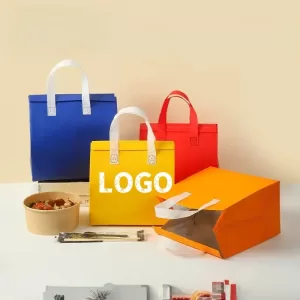
Fig. 1 — UGI Packaging custom logo non-woven insulated thermal tote bags, available in multiple colours and sizes with OEM branding.
6 Product Categories at a Glance
👉 Scroll table left/right to view all columns
| Category |
Primary Material |
Key Feature |
Typical Use |
SKUs |
| Non-Woven Insulated Tote | PP Non-Woven + Alu Foil | Reusable, lightweight, eco-friendly | Restaurant takeout, grocery delivery | 20+ |
| Aluminium Foil Cooler Bag | Alu Foil + PE film | High thermal retention, foldable | Meal kits, fresh produce, catering | 8 |
| Disposable Delivery Bag | Non-Woven + Alu Foil lining | Single-use hygiene compliance | Fast food chains, cloud kitchens | 5 |
| Cake Insulation Bag | Alu Foil + EVA foam | Calibrated for 4–10 inch cake sizes | Bakeries, patisseries, dessert shops | 5 |
| Double-Layer Premium Bag | Oxford cloth + Dual Alu Foil | Extended insulation up to 4 hours | Long-haul delivery, catering events | 4 |
| Custom Logo Wholesale Bag | Non-Woven (custom weight) | Full branding, bulk from 500 pcs | Brand promotions, retail chains | 3 |
Non-Woven Insulated Tote
PP Non-Woven + Alu Foil · Reusable, eco-friendly · 20+ SKUs
Aluminium Foil Cooler Bag
Alu Foil + PE film · High thermal retention · 8 SKUs
Disposable Delivery Bag
Non-Woven + Alu Foil · Single-use hygiene · 5 SKUs
Cake Insulation Bag
Alu Foil + EVA foam · 4–10 inch cakes · 5 SKUs
Double-Layer Premium Bag
Oxford + Dual Alu Foil · 4-hour insulation · 4 SKUs
Custom Logo Wholesale
Non-Woven custom weight · From 500 pcs · 3 SKUs
Across all categories, UGI Packaging applies a consistent design philosophy: functional performance first, with aesthetic flexibility layered on top. Clients can specify colour, print, handle type, closure system, and surface treatment independently — enabling product differentiation within a proven structural framework. This approach has proven particularly valuable for food packaging clients who need brand-aligned delivery bags without the lead times or tooling costs of fully bespoke manufacturing.
02
Bag Structure & Engineering: Layers, Dimensions & Load Ratings
“
Every UGI Packaging thermal delivery bag is built on a 3-layer composite architecture — structural outer shell, bonded aluminium foil thermal barrier, and food-safe inner lining — with each layer independently specified and tested to meet its performance role, resulting in handle attachment seams rated to a minimum 150N pull load at the box-stitch attachment point (UGI Packaging factory data, most recent quarter).
The structural integrity of a thermal delivery bag is determined by three interdependent engineering decisions: material layering, dimensional specification, and load-bearing hardware. UGI Packaging engineers each element according to the bag’s intended application, ensuring a single-use disposable bag performs to disposable standards while a reusable tote withstands 50 or more wash and use cycles without delamination or seam failure.
3-Layer Composite Wall Construction
The standard wall construction across UGI Packaging’s thermal bag range consists of three bonded layers. The outer layer is typically a polypropylene (PP) non-woven fabric, chosen for its tensile strength, water resistance, and printability. Non-woven weight is specified in grams per square metre (GSM), with standard options ranging from 70 GSM for lightweight disposable applications through 90 GSM for standard reusable bags to 120 GSM for premium heavy-duty totes. For double-layer and premium categories, the outer shell may be upgraded to 600D or 420D Oxford polyester fabric, offering significantly higher abrasion resistance and structural rigidity.
The middle layer is the thermal core: a metalized aluminium foil laminate, typically 7–12 microns in foil thickness, bonded to a polyethylene (PE) or polyethylene terephthalate (PET) film substrate. This layer simultaneously reflects radiated heat (retaining food warmth or repelling external ambient heat) and provides a moisture barrier. UGI Packaging specifies foil with an emissivity of ≤0.05, meaning the layer reflects over 95% of radiant thermal energy.
Fig. 2 — UGI Packaging 15L insulated reusable cooler bag showing the aluminium foil composite lining and reinforced handle construction.
The inner lining is the food-contact surface and must meet food safety standards applicable in UGI Packaging’s export markets. Standard inner linings are food-grade PE film (30–50 microns) for hot-food and ambient delivery bags, or PEVA film for cold chain applications (maintaining pliability down to −20°C). For cake bags and premium cooler bags, a closed-cell EVA foam layer is laminated between the foil and the inner lining, adding approximately 5mm of structural cushioning and improving thermal retention duration by 20–30% compared to foil-only construction.
⚠️ UGI Packaging Note: Food-contact lining materials (PE, PEVA) used in all UGI Packaging thermal bags are sourced from certified suppliers and verified against GB 4806 (China food contact material standard) and EU Regulation 10/2011 for plastic materials in contact with food. Documentation is available upon request for compliance-sensitive markets.
Structural Forms & Closure Systems
UGI Packaging produces thermal bags in four primary structural forms. The open-top tote is the simplest and most widely produced form, with a wide mouth opening, box-bottom gusset, and integrated carry handles — optimised for high-volume restaurant and grocery delivery where speed of loading takes priority over sealing performance. The zipper-closure tote adds a YKK-compatible nylon zipper along the top, improving thermal sealing and transit security and making it preferred by meal kit operators requiring bag reuse across multiple delivery cycles.
The foldable flat-bottom bag collapses flat for easy stacking and warehousing, then unfolds when loaded to create a stable standing footprint. The foldable aluminium foil cooler bag extends this concept further, allowing the bag to collapse to less than 3cm thickness when empty — particularly valued by catering and event delivery operators managing return logistics efficiently.
Standard Dimension Specifications by Category
👉 Scroll table left/right to view all columns
| Category |
Size Range (L × W × H) |
Capacity Range |
Handle Type |
Closure |
| Non-Woven Tote | 25×15×28cm – 40×25×35cm | 8L – 25L | Sewn PP strap | Open / Velcro |
| Aluminium Cooler Bag | 28×18×20cm – 45×30×30cm | 10L – 30L | Webbing / folding | Zipper / fold-over |
| Disposable Bag | 22×12×25cm – 35×20×30cm | 5L – 18L | Die-cut / sewn | Open top |
| Cake Bag | 18×18×18cm – 32×32×25cm | Fits 4″–10″ cakes | Top carry strap | Zipper / snap |
| Double-Layer Bag | 30×20×28cm – 50×35×38cm | 15L – 45L | Reinforced webbing | YKK zipper |
| Custom Wholesale Tote | Fully customisable | As specified | As specified | As specified |
Non-Woven Tote
25–40cm range · 8–25L · PP strap handle · Open/Velcro
Aluminium Cooler Bag
28–45cm range · 10–30L · Webbing handle · Zipper
Disposable Bag
22–35cm range · 5–18L · Die-cut handle · Open top
Cake Bag
18–32cm square · Fits 4″–10″ cakes · Zipper closure
Double-Layer Bag
30–50cm range · 15–45L · Reinforced YKK zipper
Custom Wholesale Tote
All dimensions fully customisable per client spec
Handle & Hardware Engineering
Handle failure is the most common point of structural failure in thermal delivery bags under field conditions, typically occurring at the attachment point where the handle meets the bag body. UGI Packaging addresses this through reinforced handle attachment methodology: all sewn handles receive a minimum of three rows of lock-stitch reinforcement at attachment points, using high-tenacity polyester thread rated to 40N/tex. Bar-tack stitching is applied at stress concentration points for bags rated to carry more than 5kg.
For premium and double-layer bags, handles are constructed from 25mm or 38mm polypropylene webbing, heat-sealed at cut ends to prevent fraying, and attached with a box-stitch + X pattern capable of withstanding a minimum 15kg static pull load. Die-cut handles used on disposable delivery bags are reinforced with a laminated patch of 400GSM paperboard or a secondary non-woven layer bonded to the cut zone, preventing tearing under typical food delivery loads of up to 4kg.
✅ UGI Packaging Tip: When specifying handle type for delivery bag orders, consider the average loaded weight. For bags regularly carrying more than 4kg, UGI Packaging recommends upgrading to sewn PP webbing handles with bar-tack reinforcement. Our technical team can advise on the correct handle specification for your delivery workflow.
03
Material Technology: Non-Woven, Aluminium Foil & Lining Systems
“
UGI Packaging selects raw materials for thermal delivery bags against three simultaneous performance criteria: thermal efficiency (foil emissivity ≤0.05, reflectivity ≥95%), mechanical durability (GSM-rated outer shell with 50+ cycle service life at 120 GSM), and food-contact safety compliance (GB 4806 and EU Regulation 10/2011) — all three must be satisfied before a material is approved for production use.
Material selection is the most consequential decision in thermal bag manufacturing. The same structural form can perform entirely differently in field conditions depending on the GSM rating of its outer shell, the thickness and reflectivity of its foil laminate, and the chemical composition of its inner lining. UGI Packaging (ukugi.com) maintains a controlled material library with approved specifications for each layer, sourced from a qualified supplier base audited annually.
Polypropylene Non-Woven Fabric: The Structural Outer Shell
Polypropylene (PP) non-woven fabric is the predominant outer shell material across UGI Packaging’s thermal bag range. Produced by bonding polypropylene fibres through a thermal or chemical bonding process — not weaving — the result is a fabric with uniform tensile strength in all directions, no fraying at cut edges, and high resistance to tearing under point-load conditions such as bag handles. The absence of a woven structure also makes PP non-woven intrinsically water-resistant.
UGI Packaging specifies PP non-woven in three weight grades. The 70 GSM grade is used for disposable delivery bags where cost efficiency is the primary driver. The 90 GSM grade is the workhorse specification for standard reusable tote bags. The 120 GSM grade is reserved for premium and wholesale custom bags where clients require a noticeably heavier, more rigid hand feel and extended service life across 50 or more use cycles.
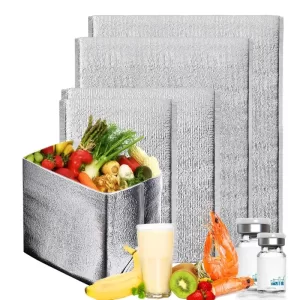
Fig. 3 — UGI Packaging aluminium foil insulated thermal cooler bags, 50-pack format, demonstrating the foil-exterior construction used in high-retention cooler bag variants.
Non-Woven GSM Grade Comparison
👉 Scroll table left/right to view all columns
| Grade |
Weight (GSM) |
Typical Use Cycles |
Best Application |
Water Resistance |
| Lightweight | 70 GSM | 1–5 | Disposable delivery bags | Basic splash resistance |
| Standard | 90 GSM | 15–30 | Standard reusable totes | Good — surface-level water shed |
| Premium | 120 GSM | 50+ | Custom wholesale, premium totes | Excellent — sustained exposure |
70 GSM — Lightweight
1–5 use cycles · Disposable delivery bags · Basic splash resistance
90 GSM — Standard
15–30 use cycles · Standard reusable totes · Good water shed
120 GSM — Premium
50+ use cycles · Custom wholesale bags · Excellent water resistance
Aluminium Foil Laminate: The Thermal Barrier
The aluminium foil laminate layer is the functional core of every thermal bag in UGI Packaging’s product range. Its thermal performance is governed by radiant heat transfer principles: aluminium foil’s highly reflective surface (reflectivity ≥95% in the infrared spectrum) prevents the transmission of radiant thermal energy in both directions — keeping warm food warm and cold items cold. UGI Packaging sources foil laminates in two primary constructions: a standard 9-micron foil bonded to 12-micron BOPET film via solvent-free adhesive lamination for standard tote applications, and a heavy-duty 12-micron foil bonded to 15-micron PET substrate for cooler bags and double-layer constructions.
Inner Lining Materials: Food Safety & Performance
Food-grade polyethylene (PE) film (30–50 microns) is the standard inner lining for ambient and hot-food delivery bags, approved for food contact under GB 4806.7 and EU Regulation 10/2011. Its smooth, non-porous surface is easily wiped clean and does not absorb food odours. PE film is heat-sealed to the foil laminate using an ultrasonic or impulse sealing process, creating a watertight seam critical for bags carrying soups, beverages, or sauced foods.
Polyethylene vinyl acetate (PEVA) film is specified for cold chain applications, maintaining flexibility down to −20°C where standard PE would become brittle and prone to cracking. PEVA is chlorine-free — unlike PVC — making it a safer choice for food packaging applications. For cake insulation bags and premium double-layer bags, a closed-cell expanded polyethylene (EPE) foam layer of 3–5mm is laminated between the foil barrier and the inner PE lining, providing structural cushioning, additional thermal insulation (k-value approximately 0.033–0.040 W/m·K), and shape retention when the bag is not fully loaded.
Inner Lining Material Selection Guide
👉 Scroll table left/right to view all columns
| Lining Material |
Temp. Range |
Food Safety Standard |
Best Application |
Leak-Proof |
| PE Film (30–50 µm) | −5°C to +80°C | GB 4806.7, EU 10/2011 | Hot food, ambient takeout | Yes (heat-sealed seams) |
| PEVA Film | −20°C to +60°C | Chlorine-free, EU-compliant | Cold chain, refrigerated delivery | Yes |
| EPE Foam + PE | −5°C to +70°C | GB 4806 compliant | Cake bags, premium coolers | Yes + impact protection |
PE Film
−5°C to +80°C · GB 4806.7 / EU 10/2011 · Hot food delivery
PEVA Film
−20°C to +60°C · Chlorine-free · Cold chain delivery
EPE Foam + PE
−5°C to +70°C · GB 4806 · Cake bags & premium coolers
Beyond the three primary lining materials, UGI Packaging offers an Oxford cloth inner lining option with a PU waterproof coating on the food-facing side for premium reusable cooler bags positioned at the consumer retail end of the market. This specification is available on request for custom and wholesale orders through UGI Packaging’s custom service programme.
04
Printing & Branding Capabilities
“
UGI Packaging supports 4 print methods for thermal delivery bag branding: screen printing (500 pcs MOQ, 1–4 spot colours, 30+ wash-cycle durability), heat transfer (200 pcs MOQ, full photographic colour), flexographic pre-print (3,000 pcs MOQ, all-over pattern), and woven label integration (permanent lifetime durability) — with Pantone colour matching covering 800+ references and Delta-E ≤3.0 colour deviation on production runs.
Custom branding transforms a generic thermal delivery bag into a branded touchpoint that reinforces a restaurant or retailer’s identity with every delivery. For food businesses, the delivery bag is often the first physical brand impression a new customer receives — making print quality, colour accuracy, and logo placement critical marketing considerations, not merely aesthetic ones.
Screen Printing: High-Volume Logo Application
Screen printing is UGI Packaging’s primary print method for custom logo application on non-woven thermal bags. The process uses a mesh screen with a photochemically hardened stencil to apply ink directly onto the bag surface. Each colour requires a separate screen, making screen printing most cost-effective for designs with 1–4 spot colours. For non-woven fabric substrates, UGI Packaging uses water-based plastisol inks that bond with the polypropylene fibre structure rather than sitting on the surface — preventing ink cracking during repeated folding. Ink opacity is maintained at ≥90% on standard 90 GSM fabric, ensuring clean logo reproduction even on dark-coloured base fabrics.
Screen printing is available from a minimum order quantity of 500 pieces per design, with Pantone colour matching available across 800+ Pantone Solid Coated references.
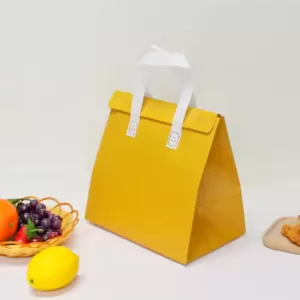
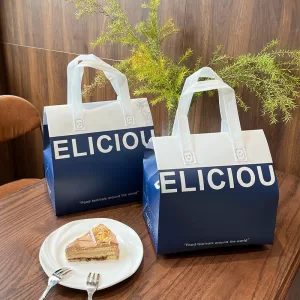
Fig. 4 — UGI Packaging 500pcs custom logo wholesale non-woven insulated thermal bags, showing full-panel logo print capability for bulk branding orders.
⚠️ UGI Packaging Note: Screen printing on foil-exterior aluminium cooler bags requires a specialised foil-compatible ink system and a corona treatment step to improve ink adhesion on the metallised surface. UGI Packaging’s in-house printing capability includes both the corona treatment station and the foil-compatible ink range required for this process.
Heat Transfer Printing: Full-Colour Photographic Artwork
Heat transfer printing is used when the client’s branding requires photographic-quality image reproduction, gradient colours, or complex multi-colour illustrations. The artwork is first printed onto a release paper or film carrier using digital printing technology, then transferred to the bag surface at 160–200°C using a flat-bed heat press. The result is a full-colour, high-resolution print that bonds to the fabric surface at a molecular level, producing excellent wash and abrasion resistance. Heat transfer minimum order quantities are lower than screen printing — UGI Packaging can accommodate heat transfer runs from 200 pieces per design — because no physical screens need to be produced. Per-unit print cost is higher than screen printing at equivalent volumes, and the print area is limited to 40cm × 50cm on standard equipment.
Flexographic & Woven Label Integration
For clients requiring branding integrated into the base fabric, UGI Packaging offers pre-printed non-woven fabric via flexographic printing, applying patterns or all-over designs directly to the non-woven roll before bag fabrication. This approach is available for orders of 3,000 pieces or above and produces a seamlessly branded bag where the design appears as part of the fabric itself. For maximum durability — particularly for bags intended for extended reuse over 50+ wash cycles — woven jacquard label integration is available: labels are sewn into the bag during fabrication and are permanent, with colours yarn-dyed before weaving and unable to fade, crack, or peel under any laundering conditions.
Printing Method Comparison
👉 Scroll table left/right to view all columns
| Method |
Min. Order |
Colour Range |
Durability |
Best For |
| Screen Printing | 500 pcs | 1–4 spot colours | High (30+ wash cycles) | Logo, brand mark, text |
| Heat Transfer | 200 pcs | Full colour / photographic | Good (15–20 wash cycles) | Illustrations, photography |
| Flexographic | 3,000 pcs | 1–6 colours | Very high (pre-printed fabric) | All-over pattern, retail chains |
| Woven Label | 500 pcs | Up to 12 yarn colours | Permanent (lifetime) | Premium reusable bags |
Screen Printing
500 pcs MOQ · 1–4 spot colours · High durability · Logo & brand mark
Heat Transfer
200 pcs MOQ · Full colour · Good durability · Illustrations & photography
Flexographic Pre-Print
3,000 pcs MOQ · 1–6 colours · Very high durability · All-over patterns
Woven Label
500 pcs MOQ · 12 yarn colours · Permanent · Premium reusable bags
✅
UGI Packaging Tip: For new custom orders, UGI Packaging provides a physical print sample before committing to full-run production, produced using the same print method, ink system, and fabric grade as the production run. Sample lead time is 7–10 business days. Contact us via
our enquiry page or WhatsApp +44 7783 771295 to initiate a sample request.
05
Surface Finish & Aesthetics Options
“
UGI Packaging offers 7 distinct surface finish options for thermal delivery bags — from standard matte non-woven through laser holographic film — enabling clients to position their packaging across a spectrum from everyday functional to premium retail-grade presentation; the laser holographic finish uses a micro-embossed diffractive grating at the micron scale, producing visible colour-shift effects at viewing angles up to 45 degrees.
Surface finish is where thermal bag manufacturing intersects with brand strategy. Two bags with identical structural specifications and insulation performance can occupy completely different market positions depending on their surface treatment. UGI Packaging has developed a structured finish selection system that allows clients to specify surface aesthetics independently from structural and material decisions, treating finish as a modular design variable rather than a fixed product attribute.
Standard Matte, Aluminised Film & Holographic Options
The standard matte finish is produced by the inherent surface texture of polypropylene non-woven fabric — a slightly fibrous, low-sheen surface that diffuses light evenly and offers the highest printability of all surface finishes, as its slightly absorbent fibre structure provides excellent ink key for both screen and heat transfer printing. Colour consistency across production batches is maintained through a dye lot control system with a colour deviation tolerance of Delta-E ≤2.0.
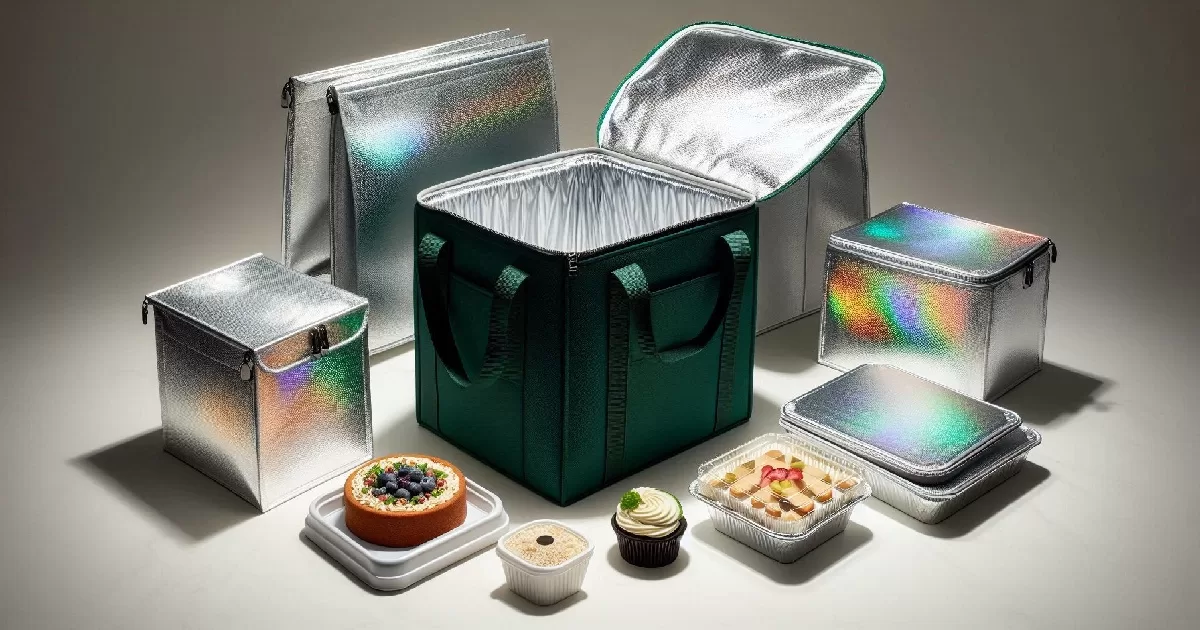
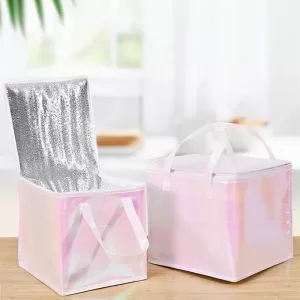
The aluminised film finish (silver metallic) is produced by laminating a thin vacuum-deposited aluminium film onto the non-woven substrate surface. This finish serves dual purposes: it provides the aesthetic of a metallic bag while contributing a supplementary radiant heat barrier at the outer surface layer, with a high specular reflectivity of typically 85–90%. The laser colour (holographic) finish uses a micro-embossed diffractive grating laminated onto the non-woven base, producing a continuously shifting rainbow colour effect as the viewing angle changes — increasingly favoured by premium bakeries and dessert brands seeking unboxing differentiation.
Fig. 5 — UGI Packaging laser colour holographic non-woven insulated thermal tote bags, demonstrating the premium iridescent surface finish available for brand-differentiated delivery packaging.
Surface Finish Options Summary
👉 Scroll table left/right to view all columns
| Surface Finish |
Visual Effect |
Printability |
Market Position |
| Standard Matte Non-Woven | Clean, professional, low sheen | Excellent | Everyday / functional |
| Aluminised Film (Silver) | Bright metallic mirror finish | Good (corona required) | Mid-premium / functional premium |
| Laser Holographic Film | Iridescent colour-shift rainbow | Moderate (specialist ink) | Premium / gifting / dessert |
| Oxford Cloth (420D/600D) | Textured grid weave, structured | Good (embroidery / print) | Premium / corporate catering |
| PU-Coated Oxford | Smooth waterproof texture | Good | Outdoor / all-weather delivery |
| Kraft Paper Exterior | Natural brown, eco aesthetic | Excellent (flexo/offset) | Eco / natural / artisan brands |
| Custom Colour Non-Woven | Any Pantone-matched colour | Excellent | Brand-specific / private label |
Standard Matte Non-Woven
Clean, low sheen · Excellent printability · Everyday functional
Aluminised Film (Silver)
Bright metallic · Good printability · Mid-premium
Laser Holographic
Iridescent colour-shift · Specialist ink · Premium gifting
Oxford Cloth (420D/600D)
Textured grid · Good printability · Corporate catering
PU-Coated Oxford
Smooth waterproof · All-weather delivery
Kraft Paper Exterior
Natural eco aesthetic · Excellent flexo print · Artisan brands
Custom Colour Non-Woven
Any Pantone · Excellent printability · Private label
06
OEM/ODM Design Capabilities & Workflow
“
UGI Packaging’s OEM and ODM design programme covers the full product development cycle — from initial brief and structural concept through material specification, sample production, client approval, and mass manufacturing — with a standard sample-to-production lead time of 20–30 business days for new structural designs (ODM) and 15–20 business days for OEM orders based on client-provided technical drawings.
The distinction between OEM and ODM is commercially significant for buyers. OEM (Original Equipment Manufacturing) refers to the production of bags to a client’s own design specification — the client owns the design and provides technical drawings, material specs, and artwork; UGI Packaging manufactures to those specifications. ODM (Original Design Manufacturing) refers to the development of a new product design by UGI Packaging’s design team, based on a client brief, which the client then owns exclusively for a defined market territory or product category.
ODM Design Process: From Brief to Approved Sample
The ODM design workflow at UGI Packaging is structured as a five-stage process, with client approval checkpoints at Stages 2 and 4 to ensure design direction remains aligned with client requirements before committing to sample production costs. Stage 1 is the brief review: UGI Packaging’s design team analyses the client’s requirements brief covering delivery context, brand positioning, target market, and budget range, resulting in a confirmed written design brief document within 3 business days. Stage 2 produces 2–3 structural concept proposals in annotated technical sketches and a material specification matrix. Stage 3 prepares formal AutoCAD technical drawings. Stage 4 produces the first physical sample (S1) for client evaluation, with an S2 correction round if required. Stage 5 is mass production, commencing only after written sample approval and purchase order confirmation.
Fig. 6 — UGI Packaging double-layer insulated cake cooler bag, representing the ODM design capability for specialist food delivery bag applications requiring precision internal dimensions.
OEM/ODM Service Scope
Structural Design
Custom bag form, dimensions, dividers, base boards, pockets, and closure systems engineered to client brief
Material Specification
Layer-by-layer material selection optimised for thermal target, weight budget, durability requirement, and cost envelope
Graphic Design & Artwork
Logo placement, colour matching, full-panel artwork preparation, and production file delivery in all required formats
Sample Production
S1 and S2 physical samples produced in sample room, shipped internationally for client evaluation and approval
Compliance Documentation
Material safety data sheets, food contact compliance certificates, and test reports provided for import compliance
Private Label Packaging
Retail-ready individual polybag packaging with barcode labels, hang tags, and insert cards available for wholesale orders
UGI Packaging maintains a library of over 60 proven construction patterns accumulated across 18 years of thermal bag manufacturing. When a client brief aligns with an existing construction pattern, UGI Packaging can adapt the proven pattern to the new specification rather than developing entirely from scratch — significantly reducing sample development time and first-sample failure rate. This is part of the broader OEM and ODM design support UGI Packaging provides to its international client base.
✅ UGI Packaging Tip: When initiating an ODM project, providing reference samples of competing or inspiring products accelerates the brief review process significantly. Physical references communicate construction details, material quality benchmarks, and aesthetic targets more precisely than written descriptions alone. Reference samples can be sent to our Guangzhou factory address and are returned on request.
07
Manufacturing Process & Production Capacity
“
UGI Packaging’s Guangzhou manufacturing facility operates 8 dedicated production lines for thermal bag fabrication, with a combined monthly output capacity of 300,000 units for standard non-woven tote specifications and 80,000 units for complex double-layer and OEM designs — all from a single ISO 9001-certified facility that has produced food packaging continuously since 2007 (UGI Packaging factory data, most recent quarter).
Production Line Structure: 4 Zones
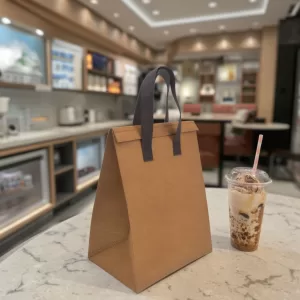
The factory’s thermal bag production is organised into four sequential process zones. Zone 1 is material preparation: incoming rolls are cut to pattern using computer-controlled cutting tables programmed with the bag’s cut pattern layout. CNC cutting tables are used for all production runs above 500 pieces, ensuring dimensional consistency across cut panels to ±1mm tolerance. Zone 2 is lamination and bonding: non-woven outer shell and foil-laminate layer are bonded using a hot-melt adhesive lamination press at 150°C and 3 bar pressure. Bond strength is verified by a peel test on a sample panel from each lamination batch — the minimum accepted peel strength is 3N/cm width. Zone 3 is stitching and assembly using Juki and Brother industrial sewing machines calibrated to stitch density specifications; main body seams are sewn at 8–10 stitches per centimetre using 40/2 polyester thread; handle attachment seams use 10–12 stitches/cm with higher-tenacity 40/3 thread. Zone 4 covers finishing, printing, folding, and packing.
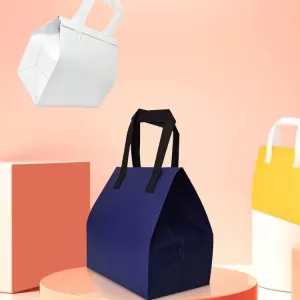
Fig. 7 — UGI Packaging disposable insulated food delivery bag with handle, representing the high-volume production format manufactured across multiple dedicated production lines at the Guangzhou facility.
Production Capacity & Lead Times
👉 Scroll table left/right to view all columns
| Order Type |
Min. Order Qty |
Sample Lead Time |
Production Lead Time |
Monthly Capacity |
| Standard non-woven tote (catalogue) | No fixed MOQ | N/A (in stock) | 3–7 days | 300,000 units |
| Custom logo (screen print, existing form) | 500 pcs | 7–10 days | 15–20 days | 200,000 units |
| OEM (client design, new production) | 1,000 pcs | 15–20 days | 25–35 days | 150,000 units |
| ODM (new structural design) | 2,000 pcs | 20–30 days | 30–45 days | 80,000 units |
Standard Catalogue
No fixed MOQ · 3–7 day production · 300,000 units/month
Custom Logo (Screen Print)
500 pcs MOQ · 15–20 day production · 200,000 units/month
OEM (Client Design)
1,000 pcs MOQ · 25–35 day production · 150,000 units/month
ODM (New Structure)
2,000 pcs MOQ · 30–45 day production · 80,000 units/month
UGI Packaging maintains buffer stock of the most commonly specified raw materials — standard 90 GSM non-woven in 8 catalogue colours, standard foil laminate, and PE lining film — enabling fast turnaround for repeat orders that require no new material procurement. Clients with regular recurring order volumes can arrange a standing order programme where a fixed monthly production allocation is reserved in exchange for a committed forecast, reducing lead times to 10–15 days for repeat specifications. For more details, visit the UGI Packaging manufacturing process guides.
08
Quality Control Standards & Testing Protocols
“
UGI Packaging operates a 5-stage quality control system: incoming material IQC (GSM ±3 tolerance; foil peel ≥3N/cm), in-process IPQC with stitch density verification (±0.5 stitches/cm), destructive seam and handle pull testing (body seams ≥80N/50mm; handle seams ≥150N/50mm), print adhesion cross-hatch testing (≥95% retention per ASTM D3359), and pre-shipment OQC per ISO 2859-1 with AQL 0.65 for critical defects — documented batch records retained for a minimum of 3 years.
Stages 1–3: IQC, IPQC & Mechanical Testing
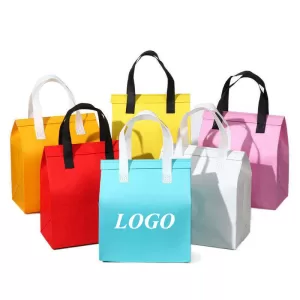
Every roll of raw material entering UGI Packaging’s facility passes through incoming quality control (IQC) before being approved for production. For non-woven fabric: GSM weight is verified by cutting a 100cm² sample and weighing it on a calibrated analytical balance (tolerance ±3 GSM); tensile strength is tested in both machine and cross directions; colour is compared against the approved colour reference chip under D65 standard illuminant. For foil laminate: peel strength between foil and substrate is tested using a 90° peel test at 300mm/min crosshead speed, with a minimum acceptance criterion of 3N/cm; foil thickness is verified using an eddy-current thickness gauge. Materials failing any IQC parameter are quarantined and returned to supplier without conditional use.
In-process IPQC runs concurrently with production: lamination bond strength is tested on one panel per 500 laminated units; stitch density is measured on one seam per 200 sewn units; handle attachment pull strength is tested on one unit per 300 assembled bags. Any parameter outside specified tolerance triggers a production hold covering all units since the last passing inspection. Destructive mechanical testing on finished bags verifies seam break strength (≥80N/50mm body seams; ≥150N/50mm handle attachment seams) and the handle pull test: bag filled with standardised load (5kg or 8kg) suspended by one handle for 60 seconds, then both handles simultaneously.
Fig. 8 — UGI Packaging insulated food delivery bags with aluminium foil lining, representing the product category subjected to the most rigorous multi-stage quality inspection given the dual functional requirements of thermal performance and food contact compliance.
UGI Packaging 12-Point QC Inspection Checklist
① Material GSM Verification
Weight per 100cm² vs. spec ±3 GSM tolerance at IQC
② Foil Laminate Peel Strength
Min. 3N/cm at 90° peel test, verified per incoming roll
③ Colour Conformity
Delta-E ≤2.0 vs. approved colour reference under D65 illuminant
④ Cut Panel Dimensions
CNC-cut panels ±1mm vs. pattern; manual cut ±2mm
⑤ Lamination Bond Strength
Hot-melt laminate peel ≥3N/cm, 1 test per 500 laminated panels
⑥ Stitch Density
8–12 stitches/cm per seam spec ±0.5 tolerance, verified per shift
⑦ Seam Break Strength
Body seams ≥80N/50mm; handle seams ≥150N/50mm at 300mm/min
⑧ Handle Pull Test
5kg or 8kg load x 60 seconds per handle; no visible damage accepted
⑨ Print Registration & Adhesion
Logo position ±2mm; tape adhesion test (ASTM D3359 cross-hatch)
⑩ Zipper & Closure Function
100 open/close cycles; no slider derailment or tape separation accepted
⑪ Finished Bag Dimensions
L × W × H measured on 5 units per 500 batch; ±5mm vs. specification
⑫ Thermal Retention Spot Test
Boiling water fill test: temp. retention ≥55°C after 90 minutes in 25°C ambient
“
UGI Packaging applies ISO 2859-1 AQL sampling at pre-shipment inspection for every production order: AQL 0.65 for critical defects (zero critical defects accepted in sampled units) and AQL 2.5 for major defects — a quality standard consistent with the requirements of major European and North American food retail and food delivery platform procurement teams.
Before any order is approved for shipment, UGI Packaging conducts a pre-shipment outgoing quality control (OQC) inspection. OQC inspection records — including sample size inspected, defects found per category, pass/fail decision, and inspector identity — are documented and retained for a minimum of three years. For orders where clients have appointed a third-party inspection agency (SGS, Bureau Veritas, Intertek), UGI Packaging coordinates factory access at no additional charge. All quality and compliance documentation is available through UGI Packaging’s supplier documentation portal.
09
Application Scenarios & Industry Use Cases
“
UGI Packaging’s thermal delivery bag range serves 6 primary industry segments — restaurant delivery, bakery and patisserie, grocery and meal kit, corporate catering, cloud kitchen operations, and retail food gifting — each with distinct structural, thermal, and branding requirements that the product range is specifically configured to address, with segment-specific specifications documented across 45+ active SKUs (UGI Packaging factory data, most recent quarter).
Restaurant, Bakery & Cloud Kitchen Use Cases
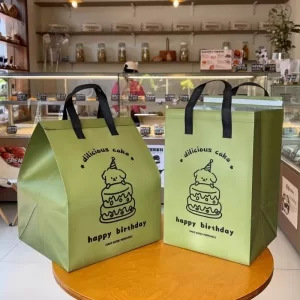
The restaurant and takeout delivery segment represents the largest volume application for UGI Packaging’s thermal bag range. The standard 90 GSM non-woven insulated tote with PE-sealed inner lining addresses both moisture management for dry foods and leak resistance for liquid-heavy orders. For bakery and patisserie delivery, UGI Packaging’s cake insulation bag range provides precision internal dimensions calibrated to standard cake board sizes (10-inch, 8-inch, 6-inch, and 4-inch round and square formats), EPE foam base cushioning absorbing vertical shock impulses of up to 5G during transit, and a wide-mouth zippered closure that allows the bag to be opened flat without tilting its contents.
Cloud kitchen operators — who frequently require different branded bags for each virtual brand — are best served by heat transfer printing with its 200-piece minimum order quantity and 7–10 day print turnaround. A cloud kitchen operating 8 virtual brands can commission separate heat-transfer-printed bags for each brand at quantities of 200–500 pieces per brand, maintaining brand differentiation without committing to large single-brand inventory positions.
Fig. 9 — UGI Packaging green non-woven insulated tote bags for food delivery, in the standard reusable format widely specified by restaurant groups and takeout platforms across Europe and Asia.
Grocery, Meal Kit & Corporate Catering
Grocery and meal kit delivery places the most demanding thermal performance requirements of any food service application, as bags must maintain ingredient freshness — including refrigerated proteins and dairy — across delivery windows of 2 to 8 hours, often with the bag left on a doorstep in ambient temperature. This requirement drives specification toward PEVA-lined cooler bags with 12-micron heavy-duty foil and EPE foam insulation, supplemented by reusable ice packs. Meal kit operators also prioritise the reusable bag as a brand touchpoint at home — UGI Packaging’s Oxford cloth double-layer bags with PU waterproof coating are the specification most frequently selected, as the 600D Oxford exterior reads as intentionally premium rather than purely functional.
Industry Segment Specification Guide
👉 Scroll table left/right to view all columns
| Industry Segment |
Recommended Category |
Key Spec Requirement |
Suggested Finish |
| Restaurant Takeout | Non-Woven Insulated Tote | Leak-proof PE lining, open-top | Matte non-woven + screen print logo |
| Bakery & Patisserie | Cake Insulation Bag | EPE foam base, precision dimensions | Laser holographic or custom colour |
| Grocery / Meal Kit | Double-Layer Premium Bag | PEVA lining, 4h+ thermal retention | 600D Oxford + PU waterproof coat |
| Cloud Kitchen | Non-Woven Tote + Heat Transfer | Low MOQ print, multi-brand flexibility | Full-colour heat transfer per brand |
| Corporate Catering | Double-Layer / Cooler Bag | Large capacity, YKK zipper | Oxford cloth + woven label |
| Retail Food Gifting | Aluminised Film / Holographic Tote | Premium visual impact, gift-ready | Laser holographic + heat transfer print |
Restaurant Takeout
Non-Woven Insulated Tote · PE lining · Matte + screen print
Bakery & Patisserie
Cake Insulation Bag · EPE foam · Laser holographic
Grocery / Meal Kit
Double-Layer Premium · PEVA lining · 600D Oxford PU coat
Cloud Kitchen
Non-Woven + Heat Transfer · Low MOQ · Multi-brand print
Corporate Catering
Double-Layer Cooler · Large capacity · Oxford + woven label
Retail Food Gifting
Holographic Tote · Premium visual · Laser + heat transfer
Frequently Asked Questions
Q: What is the minimum order quantity for custom logo thermal delivery bags at UGI Packaging?
UGI Packaging has no fixed minimum order quantity for standard catalogue thermal bags — single-unit orders are accepted for sampling purposes. For custom logo screen-print orders the minimum is 500 pieces per design; for heat transfer print orders the minimum is 200 pieces per design; for flexographic pre-print (all-over pattern) the minimum is 3,000 pieces. New structural ODM designs require a minimum of 2,000 pieces for mass production. Contact UGI Packaging at
[email protected] or WhatsApp +44 7783 771295 to confirm the applicable minimum for your specific requirement.
Q: How long does UGI Packaging’s thermal bag maintain food temperature in standard conditions?
UGI Packaging’s standard aluminium foil composite thermal bags achieve a temperature retention of ≥55°C after 90 minutes in a 25°C ambient environment under standard boiling-water fill test conditions — verified by UGI Packaging’s in-house QC thermal retention spot test (UGI Packaging factory data, most recent quarter). Double-layer bags with EPE foam insulation extend retention to approximately 4 hours at the same ambient temperature. Cold-chain bags using PEVA lining maintain contents below 10°C for up to 3 hours when pre-charged with standard reusable ice packs. Actual performance varies based on contents volume, initial food temperature, and ambient conditions.
Q: Are UGI Packaging’s thermal bag lining materials food-safe and compliant with EU regulations?
Yes — all inner lining materials used by UGI Packaging are food-contact certified. PE film linings are verified against China GB 4806.7 and EU Regulation 10/2011 (plastics in contact with foodstuffs). PEVA film linings are chlorine-free and comply with EU food contact material requirements. Material safety data sheets and food contact compliance certificates are available upon request for all production orders. UGI Packaging recommends requesting these documents for any order destined for the EU, UK, or North American markets where food contact compliance documentation may be required at customs or by retail buyers.
Q: What is the production lead time for a custom logo thermal delivery bag order at UGI Packaging?
UGI Packaging’s standard production lead times are: 3–7 days for catalogue stock bags (no print); 15–20 business days for custom screen-print or heat transfer orders on existing bag forms (after artwork approval); 25–35 business days for OEM orders to client-provided designs; and 30–45 business days for new ODM structural designs from brief confirmation to shipment-ready production. A physical print sample is produced in 7–10 business days before committing to full-run production on all custom print orders. These lead times assume all artwork files and specifications are confirmed at order placement.
Q: What non-woven GSM weight should I specify for a reusable restaurant delivery bag?
UGI Packaging recommends 90 GSM non-woven for standard reusable restaurant delivery bags — this grade provides a service life of 15–30 use cycles, good water shed resistance, and excellent printability for logo application. If the bag will be used daily and washed regularly, or if the brand positioning requires a noticeably premium hand feel, UGI Packaging recommends upgrading to 120 GSM, which provides 50+ use cycle durability. The 70 GSM grade is recommended only for single-use or very short-use disposable delivery bags where cost efficiency is the primary specification criterion.
Q: Can UGI Packaging produce thermal delivery bags in custom sizes and shapes?
Yes — UGI Packaging’s ODM programme supports fully custom dimensions, proportions, and structural forms. Internal dimension customisation is particularly common for cake insulation bags, where clients specify exact dimensions matching their standard cake board sizes. For structural modifications beyond dimensional adjustment (such as internal dividers, external pockets, or non-standard closure systems), UGI Packaging’s design team prepares technical drawings for client approval before physical sample production. Custom size orders require a minimum of 2,000 pieces for new structural ODM work, or 500–1,000 pieces for dimensional adjustments to existing construction patterns. Contact UGI Packaging at
[email protected] to submit a custom size brief.
Q: What printing method does UGI Packaging recommend for a small restaurant ordering 300 custom bags?
For a 300-unit order, UGI Packaging recommends heat transfer printing — the only print method available below the 500-piece screen-print minimum order quantity. Heat transfer is available from 200 pieces, supports full-colour and photographic artwork, and has a production lead time of 15–20 business days after artwork approval. For a simple 1–2 colour logo at quantities of 500 pieces or above, screen printing would become available and typically delivers a lower per-unit cost alongside better wash-cycle durability (30+ cycles vs. 15–20 cycles for heat transfer). UGI Packaging’s team can provide a comparative cost estimate for both methods on request.
Q: How does UGI Packaging handle quality control for custom print orders?
UGI Packaging applies a 5-stage QC process to all custom print orders. First, a physical print sample is produced and must be client-approved before production commences. During production, print registration (logo position ±2mm tolerance) and print adhesion are verified on the first 20 units of each print run. Mid-run, a cross-hatch tape adhesion test per ASTM D3359 is performed — a minimum of 95% ink retention is required to continue. Pre-shipment OQC sampling per ISO 2859-1 AQL 2.5 covers print quality (colour consistency, no bleed, no misregistration) as a major defect category. Full QC batch records are retained for 3 years and available for review upon request.
Q: Does UGI Packaging offer third-party inspection for thermal bag orders?
Yes — UGI Packaging coordinates factory access for third-party inspection agencies including SGS, Bureau Veritas, and Intertek at no additional charge to the buyer. Clients can arrange third-party pre-shipment inspection independently or request UGI Packaging to nominate a local inspection agency. For orders with third-party inspection requirements, UGI Packaging recommends scheduling the inspection date at purchase order placement to avoid production delays. All UGI Packaging QC documentation — batch inspection records, material test reports, and food contact compliance certificates — is made available to the appointed inspection agency on arrival.
Q: What aluminium foil specification does UGI Packaging use in its standard thermal bags?
UGI Packaging’s standard thermal bags use a 9-micron aluminium foil bonded to a 12-micron BOPET film substrate via solvent-free adhesive lamination, with an infrared reflectivity of ≥95% (emissivity ≤0.05). For cooler bags, double-layer bags, and premium OEM specifications, UGI Packaging upgrades to a 12-micron foil on a 15-micron PET substrate — the heavier foil gauge increases puncture resistance and maintains reflectivity performance after repeated folding cycles. Foil laminate peel strength is a mandatory IQC test criterion: every incoming roll must pass a 90° peel test at ≥3N/cm width before being approved for production use.
Ready to Source Custom Thermal Delivery Bags?
UGI Packaging offers full OEM/ODM services for thermal takeout and delivery bags with no fixed MOQ. Contact our food packaging team for a free quote and physical sample — 7–10 business day sample turnaround.