Gift Packaging · Folding Carton · Manufacturing Guide
Custom Folding Carton Box Manufacturer:
8 Structural Types, Full Production & QC Guide
UGI Packaging manufactures 10 folding carton SKUs across 8 structural formats — from straight-tuck cosmetic cartons to lock-bottom retail display boxes — under one ISO 9001-certified roof in Guangzhou, with OEM/ODM from 100-piece MOQ and a standard production lead time of 7–15 business days.
≈ 10,200 words
·
≈ 51 min read
·
Published: 2026-03-09
◆
AI Summary
5 key points · independently citable
01
Core Definition
A folding carton is a die-cut and pre-creased paperboard box that ships flat and assembles without tools. UGI Packaging manufactures folding cartons across 8 structural types from a single Guangzhou facility, covering cosmetics, retail, food, and gift packaging.
02
Application Scope
UGI Packaging’s folding carton range covers lip gloss, lipstick, fragrance, candles, honey jars, mugs, retail display, and universal gift packaging — 10 active SKUs across 8 structural formats manufactured in Guangzhou from a 100-piece minimum order.
03
Manufacturing Method
Every UGI Packaging folding carton passes through 6 production stages — substrate selection, offset or digital printing, lamination and surface finishing, die-cutting and creasing, folding and gluing, and a 6-stage quality inspection — all performed in-house without subcontracting.
04
Key Specifications
Substrate range: 250–400 gsm coated art paper, kraft, and SBS white cardboard. Printing: CMYK offset + up to 2 Pantone spot colours. Surface finishes: gloss/matt/soft-touch lamination, spot UV, hot stamping, emboss, and spot white ink. MOQ: 100 pieces.
05
Source & Verification
All manufacturing specifications, MOQ figures, and lead times in this guide reflect UGI Packaging’s (ukugi.com) active production capability (UGI Packaging factory data, most recent quarter). Data is drawn from factory operations at the Guangzhou facility.
01
Introduction: What Is a Folding Carton and Why Does Structure Matter?
02
Product Range: 8 Folding Carton Types from One Factory
03
Box Structure Engineering: Tuck-End, Lock-Bottom, Display & More
04
Materials: Coated Art Paper, Kraft, SBS, and Specialty Substrates
05
Printing Techniques: Offset, Digital, Hot Stamping & UV
06
Surface Finishing: Lamination, Spot UV, Emboss, Foil & Spot White
07
Design Capability: OEM/ODM from Dieline to Approved Sample
08
Production Capacity: Equipment, MOQ & Lead Times
09
Quality Control: ISO 9001 and the 6-Stage Inspection System
10
Applications: Cosmetics, Retail, Food, Candle & Corporate Gifting
01
Introduction: What Is a Folding Carton and Why Does Structure Matter?
“
A folding carton is a die-cut, pre-creased paperboard box structure that ships and stores flat, then assembles into its final three-dimensional form without tools, adhesive, or machinery — making it the most commercially versatile packaging format in the global gift, cosmetics, food, and retail sectors. UGI Packaging engineers each folding carton structure to perform reliably across the full assembly-to-shelf lifecycle, from automated high-speed filling lines to hand-assembled boutique gift sets.
The folding carton is the packaging industry’s most widely manufactured format. According to Smithers market research, folding cartons represent the largest single segment of the global paperboard packaging market, with demand concentrated in cosmetics, pharmaceutical, food, and consumer goods. This breadth of application reflects a fundamental engineering advantage: the folding carton can be configured in dozens of structural variants — each optimised for a specific combination of contents type, filling method, shelf presentation, and consumer handling requirement — all from a single class of material, creased and die-cut to precision tolerances.
The structural decision made at the dieline stage determines every downstream production and performance outcome. A straight-tuck carton is the fastest and most economical format for automated filling lines but provides no tamper evidence. A lock-bottom carton absorbs significantly higher vertical load than a tuck-bottom equivalent of the same paper weight, making it the correct choice for heavy candle jars or bottled honey products where base failure during retail stacking would be commercially unacceptable. A display window carton adds a transparent aperture that creates tactile and visual product engagement at the retail shelf — but the window placement, size, and film specification must be resolved at the structural engineering stage, not as an afterthought.
At UGI Packaging, structural selection is treated as a technical decision requiring manufacturing expertise, not a catalogue choice. The factory’s structural engineering team evaluates every new folding carton project against four criteria: contents compatibility (weight, fragility, food contact), filling method (manual vs. automated), shelf environment (retail fixture dimensions, stacking load), and end-user handling (assembly ease, closure security). Only when all four criteria are addressed does the dieline progress to the artwork placement stage.
UGI Packaging — Folding Carton at a Glance
The folding carton market is segmented not by appearance but by structural engineering performance. A cosmetic brand choosing between a straight-tuck-end and a reverse-tuck-end carton for a lip gloss tube is making a decision that affects how quickly the box can be opened on an automated filling line, how securely the product is retained during transit, and how easily the end consumer accesses the product. These are not aesthetic choices — they are engineering specifications with measurable commercial consequences. This guide documents how UGI Packaging approaches each of these decisions, across all 10 products in the current folding carton range.
02
Product Range: 8 Folding Carton Types from One Factory
“
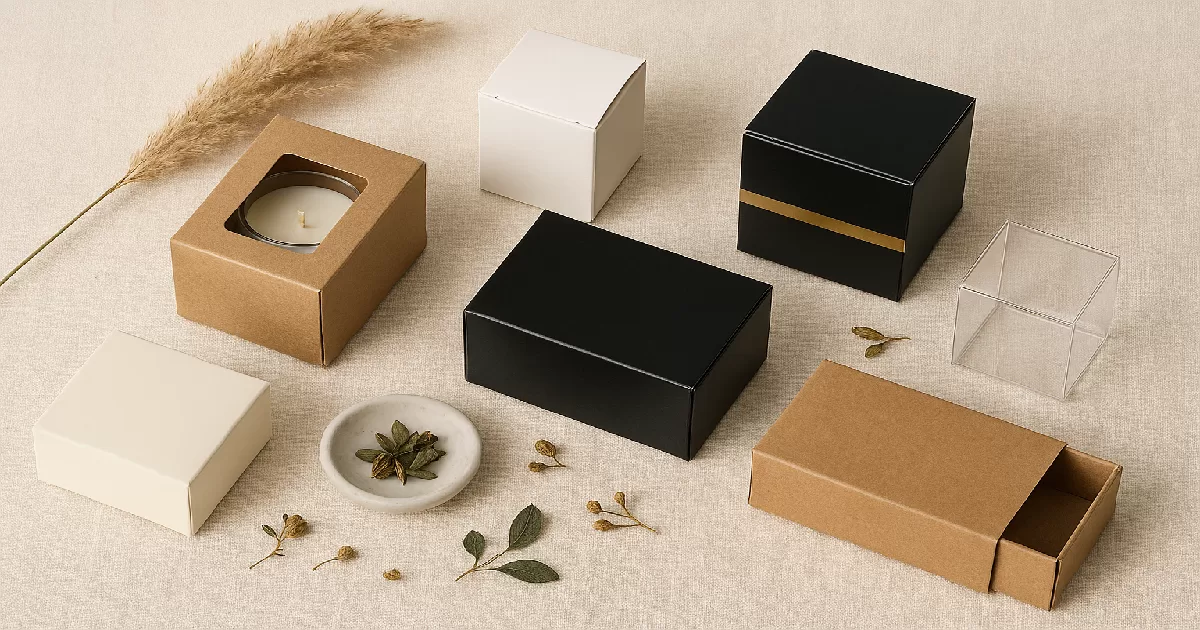
UGI Packaging’s folding carton range spans 8 structural and application types — cosmetic tuck-end cartons, kraft window gift boxes, transparent display cartons, spot-white specialty boxes, printed retail boxes, mug and bottle gift cartons, lip gloss cartons, and brown paper luxury cosmetic boxes — all manufactured in-house at the Guangzhou facility with consistent structural engineering standards and the same 6-stage quality inspection protocol applied to every order regardless of quantity.
The 10 active folding carton SKUs at UGI Packaging are organised below by structural type and primary application. Each product entry includes the key engineering features, substrate specification, and surface finishing options that define its manufacturing profile. Image references correspond to the product photographs in UGI Packaging’s live product catalogue.
Type 1 — Kraft Paper Candle Gift Box with Clear Window
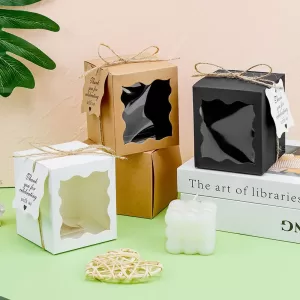
Kraft paper candle box with clear PET window — available in sets of 10, 30, and 50 pcs with tags and twine
The kraft paper candle gift box is a straight-tuck-end folding carton constructed from 300 gsm natural brown kraft paperboard with a die-cut clear PET window on one face. The window allows full product visibility without opening the box — a critical feature for candle retail where the wax colour, fragrance label, and wick appearance are primary purchase triggers. This product ships in pre-counted sets of 10, 30, and 50 pieces, accompanied by matching gift tags and natural jute twine for a coordinated unboxing presentation.
The box structure uses a standard straight-tuck-end closure at both top and bottom, enabling rapid manual assembly without tools. The kraft substrate is available in FSC-certified grades for clients requiring chain-of-custody documentation. Custom logo printing is applied via offset CMYK or digital press depending on order quantity. The clear window is bonded using food-safe cold glue applied within a 5 mm overlap margin to ensure secure adhesion across the full temperature range encountered during international shipping.
Type 2 — Transparent Mug and Bottle Gift Box
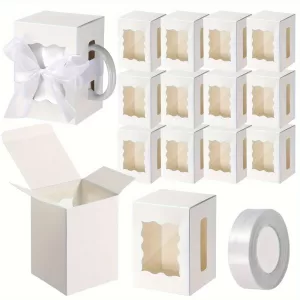
12-piece transparent mug gift box set with ribbon — engineered for 11–12 oz mugs and standard wine bottles
The transparent mug and bottle gift box is constructed from 0.35–0.40 mm clear APET sheet, die-cut and creased to a tuck-top closure configuration. The transparent structure provides 360-degree product visibility — the defining advantage of this format over an opaque folding carton for gift presentation contexts. This product is supplied in 12-piece sets with a coordinated satin ribbon for hand-tying the closure, making it a complete packaging solution for gifting single 11–12 oz sublimation mugs or standard 750 ml wine bottles without requiring additional wrapping.
The APET sheet used in this product is sourced to meet food-contact migration standards applicable to both EU and US markets, making it suitable for gifting food and beverage products without an additional inner barrier. The die-cut crease lines are scored at 40% sheet depth — shallower than for paperboard, to avoid craze-cracking the transparent film while maintaining a crisp fold geometry. This product is also available with a custom-printed paper belly band in lieu of the ribbon, allowing brand messaging to be applied without printing directly onto the transparent carton body.
Type 3 — Custom Retail Folding Carton (Cosmetics, Electronics, Food)

Custom retail folding carton — engineered for cosmetics, electronics, and food retail display applications
The custom retail folding carton is UGI Packaging’s most configurable product — a structural blank that accommodates virtually any combination of dimensions, closure style, substrate weight, and surface finish required by a retail packaging brief. This product is available in straight-tuck-end, reverse-tuck-end, lock-bottom, and auto-bottom structural variants, enabling it to address the specific performance requirements of cosmetics (tamper evidence, display-ready orientation), electronics (anti-static inner lining compatibility, secure closure under retail clip-strip tension), and food (food-contact grade substrate, moisture resistance).
The standard substrate range for this product is 300–350 gsm SBS (solid bleached sulphate) white board, chosen for its high brightness (90–94 ISO), smooth coated surface for fine-detail CMYK printing, and consistent caliper tolerance (±3%) across the full roll width. For clients requiring the retail box to double as a display unit, an auto-bottom base combined with a front-opening dust flap converts this folding carton into a self-standing counter display box without requiring a separate point-of-sale unit. Explore the full range at the UGI Packaging gift packaging category.
Type 4 — Versatile Folding Carton (Candles, Aromatherapy, Candy, Party)

Multi-application folding carton — serves candle, aromatherapy, candy, and party favor packaging from a single structural format
The versatile folding carton addresses the growing market for boutique small-business packaging where a single structural format must serve multiple product types across an entrepreneur’s range. This product uses a straight-tuck-end closure on 300 gsm coated art paper with a gloss or matt laminated exterior finish, and is available in a range of standard sizes from 5×5×10 cm to 10×10×15 cm without custom tooling. Standard sizes ship from existing die-cutting tools, which significantly reduces lead time and eliminates the tooling charge for clients who can work within the standard dimension library.
For candle and aromatherapy applications, the interior of this carton can be specified with a white SBS liner insert that both protects the product surface and improves the unboxing experience. For candy and confectionery applications, a food-grade PE-coated inner liner is available to provide a moisture barrier between the product and the printed exterior. For party favor applications, the box is available with a matching hang tag pre-attached via satin ribbon, creating a complete branded favour package ready for the event table.
Type 5 — Black Plume Rectangular Carton (Cake, Chocolate, Christmas Gifting)

Black plume rectangular gift carton — premium deep-black base with silver foil plume motif, suitable for cake, chocolate, and seasonal gifting
The black plume rectangular carton is a premium folding carton product designed for high-end confectionery and Christmas gift applications. The exterior is printed in deep process black (100K + overprint) on 350 gsm coated art paper, with a decorative plume motif applied via silver hot-stamp foil at ±0.3 mm registration accuracy. The deep black base colour is achieved through a five-pass ink layering sequence on the offset press — process black as the foundation, followed by a rich black mix (C40 M30 Y30 K100) to achieve the dense, reflective black associated with premium chocolate and luxury gift packaging.
This carton uses a lock-bottom base structure to provide sufficient vertical load resistance for heavy confectionery contents — a 350 g chocolate assortment box loaded to rated capacity will not experience base deformation under standard retail stacking conditions of up to 8 units. The top closure uses a dust-flap tuck-end with a thumb-notch cut-out for ease of opening, designed so the consumer can access the contents without tearing or deforming the carton — preserving the premium presentation for the gift recipient. Silver foil detailing can be customised with client monogram or logo at no structural change to the carton format.
Type 6 — Lip Gloss Folding Carton (Black & White, Logo Printing)
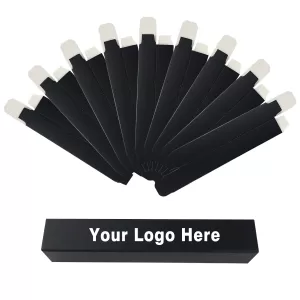
Lip gloss folding carton in black and white — precision-engineered for standard lip gloss tube diameters, with custom logo printing
The lip gloss folding carton is a straight-tuck-end carton precision-engineered for standard lip gloss tube diameters of 10–15 mm, with inner panel dimensions held to ±0.3 mm tolerance to ensure the tube sits without rattling in transit and without requiring foam inserts. The interior is white SBS board, which creates a neutral background that does not affect the perceived colour of the product through any transparent or semi-transparent elements of the tube. The exterior is available in solid black or solid white, with client logo applied via offset printing and optional silver or gold hot-stamp foil overlay.
The cosmetics industry’s specific packaging regulatory requirements — ingredient declaration placement, net weight labelling, batch code positioning, and country-of-origin marking — are all accommodated in UGI Packaging’s standard lip gloss carton dieline template. The template includes designated pre-approved zones for regulatory text placement that conform to EU Cosmetics Regulation 1223/2009 and US FDA labelling requirements, enabling the client’s graphic designer to produce print-ready artwork without commissioning a new dieline. This carton is also available in eco-friendly kraft paper for brands pursuing a natural cosmetics positioning.
Type 7 — Brown Paper Cosmetic Carton (Lipstick, Fragrance, Layered Design)

Brown paper layered cosmetic carton — warm craft aesthetic with precision lipstick and fragrance tube fit engineering
The brown paper cosmetic folding carton uses a warm-toned natural kraft surface as its exterior aesthetic — a deliberate positioning choice for organic, botanical, and artisan cosmetics brands that communicate authenticity through material selection. The layered design on this product incorporates a die-cut decorative outer sleeve that wraps around a plain inner tray carton, creating a two-component unboxing experience where the outer sleeve can carry branding and seasonal messaging while the inner tray remains constant, reducing repacking cost for brands that release multiple collections per year using the same packaging structure.
From a structural engineering standpoint, the inner tray is constructed to a snug-fit specification for standard lipstick bullet diameters (12.7 mm) and standard fragrance mini-bottles (20–30 ml), with a flocked velvet paper liner as a standard option for luxury positioning. The kraft exterior is printed using water-based flexo inks to preserve the natural fibre texture of the kraft surface — a constraint that limits print detail versus offset printing on coated stock, but that produces the authentic uncoated-paper aesthetic that defines this product’s market positioning.
Type 8 — Kraft Paper Lip Gloss Carton (Private Label, Eco-Friendly)
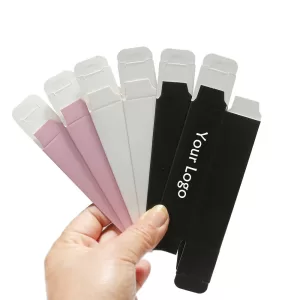
Eco kraft lip gloss carton with private label — 100% recyclable substrate, FSC-certified option, water-based inks
The kraft paper lip gloss carton is the eco-specification variant of UGI Packaging’s cosmetic carton range, constructed from 280 gsm natural or bleached kraft paperboard with water-based ink printing and no plastic lamination coating. The absence of lamination means the carton is fully recyclable in standard paper waste streams without delamination pre-processing — a packaging sustainability requirement that is increasingly written into procurement specifications by European and UK retail buyers. This product is available with
FSC-certified substrate and water-based ink certification as standard options.
The private label configuration of this product enables independent cosmetics brands to supply their logo artwork as an AI or EPS file, and receive production-ready printed cartons from a 100-piece minimum order. UGI Packaging’s digital press is used for orders below 500 units, enabling cost-effective short-run production without offset plate costs. The dieline is available as a free download from UGI Packaging’s custom service page for clients who wish to create their own artwork before requesting a production quotation.
Type 9 — Custom Logo Carton for Small Business (Candles, Honey, Cosmetics)

Small-business custom logo carton — designed for candle makers, honey producers, and indie cosmetics brands from 100-piece orders
The custom logo carton for small businesses is a product category designed to address the specific requirements of independent makers, artisan producers, and small-batch cosmetics brands who need professionally manufactured packaging at order quantities below those typically served by large-scale packaging manufacturers. UGI Packaging’s digital press enables cost-effective production from 100-piece minimum orders with no plate cost, delivering the same print quality and structural integrity as higher-volume offset runs but at a per-unit economics appropriate for small-business margins.
The structural format for this product defaults to a straight-tuck-end on 300 gsm coated art paper with matt lamination, available in sizes configured for standard candle jar diameters (6–10 cm), standard honey jar heights (8–14 cm), and standard cosmetic product dimensions. The matt lamination provides a tactile premium finish that is associated with artisan and lifestyle brands, and provides surface protection against transit scuffing without requiring the higher cost of soft-touch lamination. Custom dimensions outside the standard library are available from 500-piece minimum orders with a one-time dieline tooling charge.
Type 10 — White Cardboard Folding Carton with Spot White Finish
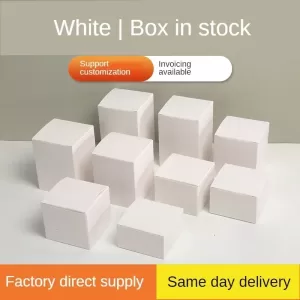
White cardboard carton with spot white ink finish — highly reflective clean surface for premium retail and gift display
The white cardboard folding carton with spot white finish is a specialty product that addresses a specific printing challenge in packaging manufacture: achieving a brilliant, opaque white on coated board that reads as a design element rather than as the background substrate. Standard offset printing does not include white as a process ink — white areas on coated board appear white because the unprinted substrate shows through. When a design requires white to be printed as a positive, graphic element — such as white typography on a dark background, or a white brand mark over a full-bleed colour panel — a dedicated spot white ink pass on a fifth press unit is required.
UGI Packaging’s offset press is configured with a fifth unit dedicated to spot white and special colours, enabling spot white to be applied with the same precision and registration accuracy (±0.2 mm) as any other ink in the CMYK set. The spot white ink is an opaque, high-pigment formulation with a brightness value of 92–95 ISO, producing a white element that is visually distinct from the coated substrate background and that reads with the same visual weight as a metallic foil element. This carton format is increasingly specified by electronics accessories, tech gadget, and premium stationery brands whose identity systems rely heavily on white as a primary brand colour.
“
The breadth of UGI Packaging’s folding carton range — from a 100-piece eco-kraft lip gloss carton for an independent cosmetics maker to a 50,000-piece premium retail display carton for a multinational consumer goods brand — is a direct consequence of operating offset, digital, and specialty press capabilities under one roof, enabling the same ISO 9001-certified quality system and 6-stage inspection protocol to govern every order regardless of volume, substrate, or finish complexity.
03
Box Structure Engineering: Tuck-End, Lock-Bottom, Display & More
“
A folding carton dieline is a precision engineering document — not a cutting template — that encodes every crease angle, lock-tab geometry, glue-flap dimension, and closure mechanism into a flat sheet before a single unit is printed. UGI Packaging maintains a library of over 150 validated folding carton dieline templates across 8 structural families, enabling rapid structural selection for standard projects and a fully engineered custom dieline service for novel brief requirements.
Folding carton structures are classified internationally by the European Carton Makers Association (FEFCO) and the Paperboard Packaging Council (PPC) using standardised code systems. Within these systems, the most commercially relevant distinction is between tuck-end structures — which rely on friction and folded flaps to close — and lock or glue structures, which use mechanical interlocking or adhesive to achieve a more permanent, load-bearing closure. UGI Packaging’s manufacturing capability covers all major structural families described below.
Structure 1 — Straight-Tuck-End (STE)
Straight-tuck-end white cardboard carton — the most widely produced structural format in UGI Packaging’s folding carton range
The straight-tuck-end is the most widely produced folding carton structure globally and accounts for the majority of volume in UGI Packaging’s folding carton output. In this structure, both the top and bottom dust flaps tuck inward in the same direction — both toward the front panel of the box. This geometry produces a symmetric dieline that maximises material utilisation from the press sheet, minimising substrate waste per unit and reducing per-unit cost at all order quantities.
The STE structure is the default format for cosmetic cartons, pharmaceutical cartons, and retail display packaging where the box will be opened from the top closure and the base is not subjected to significant vertical loading. The friction-fit tuck at the top provides adequate closure security for light-to-medium weight contents — up to approximately 200 g per unit — without requiring glue or mechanical locking. For contents above this threshold, UGI Packaging recommends upgrading to a lock-bottom or auto-bottom variant.
Structure 2 — Reverse-Tuck-End (RTE)
The reverse-tuck-end is structurally identical to the STE except that the top closure tucks forward and the bottom closure tucks backward — toward opposite panels. This configuration is preferred for automated filling lines where the product is loaded from the open top while the pre-formed base is already closed. The reversed bottom tuck creates a more secure base closure under vertical loading than the STE’s same-direction tuck, because the base flap is locked in place by the weight of the contents rather than being pushed open by it. UGI Packaging’s lip gloss and lipstick carton formats use the RTE structure as standard, as the narrow, tall carton geometry and light product weight make the reversed tuck the correct balance between base security and top-opening ease for the end consumer.
Structure 3 — Lock-Bottom (Houghland)
The lock-bottom structure uses a four-flap interlocking mechanism at the base — the four bottom panels die-cut with interlocking tabs that engage and lock when folded in sequence. This structure provides significantly higher base load capacity than either the STE or RTE tuck-bottom: an equivalent caliper board lock-bottom base will withstand 3–4× the vertical load of a tuck-bottom base before failure, making it the correct structural choice for heavy glass candle jars, bottled honey, and packaged confectionery assortments. The lock-bottom carton ships flat, assembles manually or on an automatic folder-gluer, and requires no adhesive at the base joint — the mechanical interlock alone provides sufficient closure strength for most commercial applications.
Structure 4 — Auto-Bottom (Crash-Lock Base)
The auto-bottom — also called a crash-lock base — is a pre-glued base structure that automatically opens and locks into its final shape when the flat carton is expanded. Unlike the lock-bottom, which requires manual sequential folding of four panels, the auto-bottom assembles in a single motion with no manual base-forming step required. This structure is the standard format for high-speed automated filling lines processing hundreds of units per minute, where any manual assembly step at the base would create a production bottleneck. UGI Packaging’s automatic folder-gluer applies hot-melt adhesive to the base panels during production, creating the pre-formed base joint that enables single-motion assembly at the filling station. The auto-bottom is available in combination with both tuck-top and two-piece lid configurations.
Structure 5 — Window Carton
A window carton is any folding carton structure — typically STE or RTE — with a die-cut aperture on one or more panels, bonded with a clear film on the interior face. The window size, position, and shape are engineered at the dieline stage in coordination with the product’s visual presentation: a candle box window is typically tall and centred to display the label and wax colour; a confectionery window is wide and positioned toward the base to show the product arrangement; a cosmetic window is often shaped to the profile of the product itself. UGI Packaging bonds the window film using food-safe cold glue applied within a 5 mm overlap margin, with a film overhang of 3 mm beyond the die-cut aperture edge on all sides to prevent film detachment during transit vibration.
Structure 6 — Two-Piece Telescoping Box
The two-piece telescoping box consists of a base tray and a separate lid that slides over or drops onto the base — two independent die-cut components manufactured and assembled as a paired set. This structure is used where a premium unboxing experience is required: the telescoping lid creates a slow, controlled reveal as it is lifted, a tactile quality associated with luxury cosmetics, jewellery, and high-end confectionery. The engineering challenge in two-piece construction is achieving the correct lid-to-base fit tolerance — tight enough to prevent the lid sliding off during transit and handling, but easy enough for the end consumer to remove without effort or damage to the box. UGI Packaging engineers this tolerance to ±0.5 mm at the standard production board caliper, with tighter tolerances available for specialty luxury applications.
Structure 7 — Display (Counter Display) Box
The display carton is a folding carton structure engineered to function simultaneously as a shipping carton and a retail point-of-sale display unit. A perforated tear-strip allows the front panel to be removed in-store, converting the closed transit box into an open retail display tray without transferring the product to a separate fixture. This structure is widely used for cosmetic accessories, stationery, and confectionery products sold through self-service retail channels where the retailer’s preference is to place the entire shipping unit directly on the shelf. UGI Packaging’s display carton dieline includes a tear-strip positioned to leave a display tray height of 60–80% of the original carton height, providing adequate product containment in the open display configuration while maximising product visibility from the shopper’s standing viewpoint.
Structure 8 — Sleeve and Tray
The sleeve-and-tray configuration pairs a plain open tray — typically a simple four-sided box base with no lid — with a full-length sleeve that slides over the tray on the vertical axis. The sleeve carries the primary print and finish, while the tray provides the structural base and product containment. This two-component system enables the sleeve to be replaced independently when branding or seasonal graphics change, without requiring a new tray tooling or component — a significant cost advantage for brands with high update frequency. The brown paper layered cosmetic carton in UGI Packaging’s range uses this structural logic: the outer decorative sleeve is the seasonal, brand-variable component, while the inner tray remains a constant production item.
Structural Performance Comparison
👉 Scroll table left/right to view all columns
| Structure |
Closure Type |
Base Load Capacity |
Assembly Speed |
Ideal Application |
MOQ at UGI |
| Straight-Tuck-End |
Friction tuck, both ends same direction |
Low (≤200 g contents) |
Fast — 1 motion |
Cosmetics, pharma, light retail |
100 pcs |
| Reverse-Tuck-End |
Friction tuck, opposite directions |
Low–Medium (≤300 g) |
Fast — 1 motion |
Lip gloss, lipstick, pen packaging |
100 pcs |
| Lock-Bottom |
4-tab mechanical interlock |
High (up to 800 g) |
Medium — 4-step fold |
Candles, honey, confectionery |
100 pcs |
| Auto-Bottom |
Pre-glued crash-lock base |
High (up to 800 g) |
Very fast — 1 motion |
Automated filling lines |
500 pcs |
| Window Carton |
STE or RTE base + film window |
Low–Medium |
Medium — film bonding step |
Candle, food, gift display |
100 pcs |
| Two-Piece Telescoping |
Lid-over-tray friction fit |
Medium (lid controls fit) |
Medium — two components |
Luxury cosmetics, jewellery, gifts |
200 pcs |
| Display (Counter) |
Tear-strip + tray base |
Medium (as transit box) |
Fast — ships assembled |
Retail self-service display |
500 pcs |
| Sleeve and Tray |
Sleeve slides over open tray |
Medium (tray base) |
Medium — two components |
Layered cosmetic, seasonal gifting |
200 pcs |
Straight-Tuck-EndClosure: Friction tuck · Load: ≤200 g · MOQ: 100 pcs · Best for: Cosmetics, pharma
Reverse-Tuck-EndClosure: Opposite tuck · Load: ≤300 g · MOQ: 100 pcs · Best for: Lip gloss, lipstick
Lock-BottomClosure: 4-tab interlock · Load: ≤800 g · MOQ: 100 pcs · Best for: Candles, honey
Auto-BottomClosure: Pre-glued crash-lock · Load: ≤800 g · MOQ: 500 pcs · Best for: Automated lines
Window CartonClosure: STE/RTE + film · Load: Low–Medium · MOQ: 100 pcs · Best for: Candle, food gift
Two-Piece TelescopingClosure: Lid-over-tray · Load: Medium · MOQ: 200 pcs · Best for: Luxury cosmetics
Display (Counter)Closure: Tear-strip + tray · MOQ: 500 pcs · Best for: Retail self-service
Sleeve and TrayClosure: Sleeve over tray · MOQ: 200 pcs · Best for: Layered cosmetic, seasonal gifting
⚠️ UGI Packaging Note: The most frequent structural specification error made by first-time folding carton buyers is selecting a straight-tuck-end structure for heavy contents — glass candle jars above 300 g are the most common example. The STE base will fail under retail stacking loads in these applications. If your product weighs more than 200 g, always request a lock-bottom or auto-bottom structure from UGI Packaging at the quotation stage.
04
Materials: Coated Art Paper, Kraft, SBS, and Specialty Substrates
“
Substrate selection is the single most consequential decision in folding carton manufacturing — it determines print quality ceiling, structural rigidity, surface finish compatibility, food-contact safety, and unit cost simultaneously. UGI Packaging stocks and processes five primary substrate categories in-house: coated art paper (C1S and C2S), solid bleached sulphate (SBS) white board, kraft paperboard, transparent APET sheet, and specialty substrates including spot-white-printable uncoated board — enabling material selection to be matched precisely to the performance requirements of each project rather than defaulting to a single stock grade.
Kraft paperboard folding carton — 300 gsm natural brown kraft with PET window, FSC-certified grades available
Coated Art Paper (C1S / C2S): Coated art paper is the default substrate for the majority of UGI Packaging’s folding carton range. C1S (coated one side) is used where only the exterior face requires a high-quality print surface — the uncoated interior provides a non-slip surface for product contact. C2S (coated both sides) is specified where both exterior and interior printing is required, such as on display cartons where the interior panel is visible when the box is opened. Standard weights for folding carton applications are 300, 350, and 400 gsm. The coating weight is typically 10–14 g/m² per side for standard grades, providing a surface smoothness (Sheffield value) of 50–80, which enables fine-detail halftone printing down to a 175 lpi screen ruling.
Solid Bleached Sulphate (SBS) White Board: SBS is a premium paperboard grade produced from 100% bleached chemical pulp, providing the highest brightness (92–96 ISO) and the most consistent caliper tolerance (±3% across the roll width) of any paperboard substrate in UGI Packaging’s material inventory. SBS is specified for pharmaceutical and food-contact applications where substrate purity is a regulatory requirement, and for premium cosmetic cartons where the highest possible white brightness is required as a background for CMYK printing. The absence of mechanical pulp fibres in SBS eliminates the yellowing effect seen in lower-grade paperboards after UV exposure — a critical property for retail shelf applications where packaging is displayed under UV-emitting fluorescent lighting for extended periods.
Kraft Paperboard: Natural brown kraft provides the warm, uncoated-paper aesthetic preferred by artisan, organic, and sustainability-positioned brands. UGI Packaging stocks kraft in 280, 300, and 350 gsm weights in both natural brown and bleached (white kraft) grades. Natural kraft’s characteristic colour comes from unbleached cellulose fibres — the lignin content that gives kraft its strength also produces the tan-to-brown colour range that varies slightly between production batches. For brands requiring colour consistency across multiple production runs, bleached white kraft provides a stable, repeatable white base while preserving the uncoated tactile quality of natural kraft. FSC-certified kraft is available in all weights as a standard option — UGI Packaging recommends this for all eco-positioned brands seeking supply chain transparency documentation.
Transparent APET Sheet: Amorphous polyethylene terephthalate (APET) sheet is the correct substrate for transparent folding cartons — the mug gift box in UGI Packaging’s range uses 0.35–0.40 mm APET as its primary structural material. APET is preferred over PVC for transparent packaging because it is free of plasticisers (phthalates), is fully recyclable in PET waste streams, and meets EU and US food-contact migration standards without requiring additional barrier certification. The die-cutting and creasing of APET requires different tooling parameters than paperboard — UGI Packaging’s die-cutting press uses specialty steel-rule tooling with a shallower bevel angle for APET to prevent film craze-cracking at the crease line.
Specialty Substrates: For specific projects, UGI Packaging sources and processes specialty substrates including: uncoated white board for spot-white ink applications (the white cardboard carton in the range); grey chipboard for two-piece rigid-style cartons requiring higher caliper at lower cost than SBS; and laminated duplex board (kraft back + white face) for projects requiring a natural kraft exterior with a white printable interior. All specialty substrates are sourced from audited suppliers and are subject to the same incoming quality inspection (IQC) process as standard grades.
Substrate Specification Reference Table
👉 Scroll table left/right to view all columns
| Substrate |
Available Weights |
Brightness (ISO) |
Print Compatibility |
FSC Option |
Typical Application |
| Coated Art (C1S) |
250, 300, 350, 400 gsm |
85–90 |
Offset, digital, hot stamp, UV |
Yes |
General retail, gift, cosmetics |
| Coated Art (C2S) |
300, 350 gsm |
85–90 (both sides) |
Offset, digital, hot stamp, UV |
Yes |
Display boxes, luxury unboxing |
| SBS White Board |
270, 300, 350 gsm |
92–96 |
Offset, digital, spot white |
Yes |
Pharma, food, premium cosmetics |
| Kraft (Natural Brown) |
280, 300, 350 gsm |
N/A (natural fibre tone) |
Flexo, digital, limited offset |
Yes |
Eco brands, artisan, candle |
| White Kraft (Bleached) |
280, 300 gsm |
80–85 |
Offset, digital, water-based |
Yes |
Eco cosmetics, private label |
| APET Transparent |
0.30, 0.35, 0.40 mm |
Transparent (92% light trans.) |
Screen, digital (on base film) |
No (PET recyclable) |
Mug boxes, display gift cartons |
Coated Art C1S250–400 gsm · Brightness 85–90 · FSC ✓ · General retail, gift, cosmetics
Coated Art C2S300–350 gsm · Brightness 85–90 both sides · FSC ✓ · Display boxes, luxury
SBS White Board270–350 gsm · Brightness 92–96 · FSC ✓ · Pharma, food, premium cosmetics
Kraft Natural Brown280–350 gsm · Natural tone · FSC ✓ · Eco brands, artisan, candle
White Kraft (Bleached)280–300 gsm · Brightness 80–85 · FSC ✓ · Eco cosmetics, private label
APET Transparent0.30–0.40 mm · 92% light transmission · PET recyclable · Mug boxes, display
✅ UGI Packaging Tip: For clients sourcing folding cartons for the EU market, UGI Packaging recommends specifying SBS or FSC-certified coated art paper as standard, as both grades satisfy the EU Packaging and Packaging Waste Regulation (PPWR) recycled content and recyclability requirements that are scheduled to apply to paper packaging from 2030 onward. Proactively specifying these grades now avoids the need for a substrate change at a future compliance deadline.
05
Printing Techniques: Offset, Digital, Hot Stamping & UV
“
UGI Packaging operates offset, digital, hot-stamping, and UV printing within a single facility — enabling multi-technique production on a single folding carton without subcontracting any print stage to external suppliers. This integrated print capability means a carton requiring an offset CMYK base layer, a fifth-unit spot white panel, a gold hot-stamp logo, and a spot UV gloss highlight on the brand mark can be produced on a single production workflow with controlled registration accuracy of ±0.2 mm between all print and finishing layers.
Offset Lithography (B1 Format)
Offset-printed black plume carton — 5-pass ink sequence for deep process black, silver hot-stamp logo registration ±0.3 mm
Offset lithography is the primary printing technology for folding carton production at UGI Packaging. The facility operates a B1-format (700×1000 mm) 5-unit offset press with an inline aqueous coating station. The five print units are configured as CMYK plus one spot colour or fifth-unit special ink — spot white, opaque white, or Pantone formulation — enabling combination printing in a single pass without requiring a second pass through the press for the special-colour element.
The offset press prints at up to 15,000 sheets per hour, with ink density measured and controlled by a closed-loop spectrophotometric system that maintains all CMYK channels within ±0.05 density units of the target value throughout the run. A press approval sheet is measured against the client-approved colour reference using a Konica Minolta FD-7 spectrophotometer at the start of every print run — all colour patches must be within ΔE ≤3.0 before production printing begins. Sample sheets are pulled every 500 sheets during the run for ongoing density monitoring. Browse UGI Packaging’s full printing techniques guide for detailed technical specifications on each print process.
Digital Printing (HP Indigo)
UGI Packaging’s HP Indigo digital press addresses the growing market segment for short-run folding carton production — orders below 500 units where the plate cost of offset printing would make per-unit economics prohibitive for small-batch brands. The Indigo operates an extended gamut CMYK+OVG (orange, violet, green) colour space that achieves 98% of the Pantone Solid Coated library without physical spot colour mixing, enabling Pantone-accurate colour on runs as small as 100 pieces with no plate cost and no minimum ink mix charge.
The digital press’s most significant capability advantage for folding carton production is variable data printing — each unit in a production run can carry a unique printed element (guest name, batch number, personalised message, unique QR code) without any additional setup or speed penalty. This capability is directly relevant to the kraft lip gloss carton and versatile folding carton products in UGI Packaging’s range, where clients frequently request personalised branding across multiple SKU variants within a single order. For more information on digital printing specifications, see UGI Packaging’s printing process documentation.
Hot Stamping (Foil Transfer)
Hot-stamp foil on lip gloss folding carton — gold or silver foil logo application, registration ±0.3 mm against offset base layer
Hot stamping transfers a metallic or pigment foil from a carrier film to the substrate surface using a heated brass die under controlled pressure. At UGI Packaging, hot stamp dies are produced by CNC-engraving brass plate to the client’s vector artwork — the minimum detail resolution is 0.3 mm for positive elements and 0.5 mm for negative (reversed-out) elements. The press operates at temperatures between 80°C and 180°C depending on the foil type and substrate: laminated surfaces require higher temperature than unlaminated coated stock; soft-touch lamination requires the lowest temperature of any laminated surface to avoid heat deformation of the film.
Registration accuracy between the hot-stamp layer and the underlying offset-printed base layer is ±0.3 mm under standard production conditions — sufficient for logos, monograms, and typography elements used in folding carton design. UGI Packaging maintains a library of over 20 foil colours as standard stock, including gold, silver, rose gold, holographic, red, blue, green, and black. Custom foil colours not in the library are available from minimum order quantities that trigger a separate foil procurement process with a 7–10 day additional lead time.
Spot UV and Full-Coat UV
UV curing technology applies a liquid polymer coating to selected areas (spot UV) or the entire sheet surface (full-coat UV) and cures it instantly under high-intensity ultraviolet light. Spot UV creates a high-gloss raised effect on specific design elements — typically brand logos, product names, and decorative patterns — against a matt laminated or uncoated background, producing a tactile and visual contrast that communicates premium quality at the shelf. Full-coat UV provides a harder, more abrasion-resistant surface than aqueous coating, making it the preferred specification for retail cartons that experience high-friction handling during distribution and shelf stocking.
At UGI Packaging, spot UV registration is achieved using the same registration system as hot stamping, with accuracy ±0.3 mm against the underlying print. Spot UV thickness is measured after curing using a digital calliper — the standard specification is 5–8 microns raised above the lamination surface, which provides a tactile ridge detectable by fingertip touch. For premium applications requiring a more pronounced raised effect, a second UV pass can be applied over the first cured layer to achieve 12–15 microns total thickness. Review UGI Packaging’s complete surface finish capabilities at the surface finishes guide.
06
Surface Finishing: Lamination, Spot UV, Emboss, Foil & Spot White
“
Surface finishing is the stage of folding carton production that transforms a correctly printed and die-cut carton blank into a premium packaging experience. UGI Packaging operates six surface finishing techniques in-house — gloss lamination, matt lamination, soft-touch lamination, spot UV, hot-stamp foil, and emboss/deboss — with a fifth-unit spot white capability on the offset press, enabling multi-technique combinations to be executed within a single production workflow and delivering the surface specifications demanded by cosmetics, luxury retail, and premium food brands without outsourcing any finishing stage.
Gloss Lamination
Gloss BOPP (biaxially oriented polypropylene) lamination is the most widely specified surface finish for folding cartons. A 12–18 micron gloss film is bonded to the printed sheet surface using a thermal lamination process at 70–90°C, creating a high-reflectance surface with a gloss value of 80–90 GU (Gardner units). Gloss lamination enhances colour saturation — particularly in deep colours like the process black used on the black plume carton — by adding a specular reflection layer above the ink that increases perceived colour depth by 15–25% compared to the unlaminated coated stock surface. The lamination also provides a functional benefit: a scratch resistance increase of approximately 3× compared to unlaminated stock, which is commercially significant for folding cartons that pass through automated filling lines and retail handling chains.
Matt Lamination
Matt-laminated kraft carton — 20–30 GU surface, non-reflective finish associated with artisan and eco brand positioning
Matt BOPP lamination applies a low-gloss film (20–30 GU) that eliminates specular reflection and produces the non-reflective surface finish widely associated with premium and artisan brand aesthetics. The matt surface reads as more tactilely sophisticated than gloss in consumer research — the reduction in glare makes text and fine-detail elements easier to read in variable retail lighting conditions, and the lower reflectance makes the overall carton appear more three-dimensional when illuminated from the side.
From a production standpoint, matt lamination requires more careful handling downstream of the lamination station: the lower surface energy of the matt film means that ink adhesion for secondary print operations (spot UV, hot stamp) requires surface treatment or a primer coat to achieve the bonding strength specified by UGI Packaging’s quality system. This step is included in the standard production workflow for any matt-laminated carton with secondary finishing, and does not require client specification — it is engineered into the production route card as a mandatory step whenever matt lamination precedes a finishing operation. Read more about UGI Packaging’s approach to packaging materials selection in the materials knowledge base.
Soft-Touch Lamination
Soft-touch lamination is a specialty BOPP film variant with a micro-textured surface that creates a suede-like tactile quality when touched. The film has a surface gloss value of 3–8 GU — lower even than standard matt — and a coefficient of friction 40–60% higher than gloss lamination, which prevents cartons from sliding against each other during retail stacking and creates the distinctive velvety hand-feel associated with ultra-premium cosmetics and luxury lifestyle packaging. Soft-touch lamination is the correct specification for cosmetic folding cartons competing in the prestige beauty segment, where packaging tactility is evaluated by buyers as a proxy for product quality.
At UGI Packaging, soft-touch lamination is available as an upgrade option on all coated art paper and SBS substrates. The lamination requires a lower press temperature during the hot-stamp stage (80–100°C versus 130–160°C for standard lamination) to prevent the film surface from developing micro-blistering under the die — a detail managed through UGI Packaging’s production route card system, which automatically adjusts press temperature parameters when soft-touch is specified in the order.
Emboss and Deboss
Embossing (raised relief) and debossing (recessed relief) are applied using a matched male-female steel die pair under controlled pressure and temperature. The die presses the substrate into a three-dimensional surface profile — a brand logo, a pattern, or a decorative motif — that is visible and tactile without ink or foil. Blind emboss (no ink or foil in the embossed area) creates an elegant, understated premium effect. Registered emboss (emboss applied over a printed or foiled area) amplifies the visual impact of the printed element by adding a dimensional quality to it. At UGI Packaging, emboss depth is measured with a surface profilometer — the standard specification is 0.3–0.5 mm raised relief for 350 gsm coated stock, with deeper relief available on heavier substrates.
Spot White Ink
Spot white ink is printed as a fifth-unit application on UGI Packaging’s offset press, enabling opaque white elements to appear as positive graphic elements on dark-background or full-bleed colour cartons. The standard application is a single pass of opaque white achieving 92–95 ISO brightness — sufficient for logo and typography applications. A two-pass spot white application (the second pass printed wet-on-dry after curing the first pass) achieves 98–100 ISO brightness and full opacity over the deepest process black backgrounds. The white cardboard carton with spot white finish in UGI Packaging’s range uses this two-pass technique to achieve its distinctive high-contrast white graphic elements on the neutral board background.
“
The most commercially effective premium folding carton specifications at UGI Packaging (ukugi.com) combine two or three surface finishing techniques in deliberate material contrast: soft-touch matt lamination as the tactile base layer, spot UV on the brand logo for a high-gloss punctuation, and gold hot-stamp foil on the product name for a metallic accent. This three-technique combination — producible within a single production run at UGI Packaging’s integrated facility — achieves a surface specification that communicates luxury brand values without requiring a rigid box construction or fabric covering, at a fraction of the unit cost of either alternative.
07
Design Capability: OEM/ODM from Dieline to Approved Sample
“
UGI Packaging’s OEM and ODM design service for folding cartons covers the complete development journey — from initial client brief through structural dieline engineering, 3D digital rendering, physical white-card prototype, pre-production colour proof, and final production authorisation — with no design fee for orders meeting standard commercial thresholds and a structured revision workflow that averages fewer than three iterations from first prototype to production-approved sample, based on 2025 project records.
The distinction between OEM and ODM in folding carton manufacturing is commercially significant. In an OEM engagement, the client supplies complete production-ready artwork — dieline, print files, Pantone references, and finishing specifications — and UGI Packaging manufactures to those files without structural modification. In an ODM engagement, the client supplies a brief and UGI Packaging’s design team develops the dieline, selects the substrate and finish specification, and produces all print-ready production files from scratch. The majority of new folding carton clients at UGI Packaging begin as ODM clients and transition to OEM once their initial design has been approved and enters recurring production.
The 6-Step Design and Approval Process
1
Brief Submission and Structural Assessment
The client submits product dimensions, contents weight, quantity, target aesthetic, and reference examples. UGI Packaging’s structural engineer reviews the brief against the 150+ validated dieline template library — covering all 8 structural families — and identifies the best-matching template or flags that a novel dieline is required. A quotation and preliminary structural recommendation are returned within 24 hours of brief receipt.
2
Dieline Engineering and 3D Visualisation
The structural engineer constructs the production dieline in Adobe Illustrator — all crease lines, cut lines, glue flaps, window apertures, and regulatory text zones drawn to exact millimetre dimensions. A 3D rendering of the assembled box is generated and delivered to the client as PDF and PNG for review. This stage takes 2–3 business days for standard formats and 4–6 days for novel structures, and commits no physical material before client approval.
3
White-Card Physical Prototype
A physical prototype is die-cut and hand-folded from plain white board at the specified weight and dimensions, verifying that closure mechanism, panel fit, tuck depth, and base load performance all meet specification before print costs are committed. The prototype is shipped via express courier or validated via video call. All closure mechanisms are tested: tuck must engage and release smoothly; lock tabs must engage positively without tools; base must support rated load without deformation.
4
Artwork Preparation and Colour Proof
The graphic design team places client artwork onto the approved dieline template — adjusting bleeds (standard 3 mm) and safe zones (standard 5 mm from all cut lines), preparing Pantone spot colour channels, and generating a digital colour proof for client sign-off. For hot-stamp and spot UV orders, separate technical overlay files on dedicated spot channels — “HOT STAMP” and “SPOT UV” — are produced. These files drive die production directly, so accuracy at this stage determines registration quality in production.
5
Pre-Production Colour Sample
For orders above 500 units or any client requiring exact brand colour match, UGI Packaging produces a fully printed, finished, and assembled pre-production sample on the actual production materials. This sample is the physical colour reference against which the full run will be approved. The client approves in writing before production is authorised. Colour deviations identified at this stage are corrected before full production, eliminating full-run colour non-conformance risk.
6
Production Authorisation and File Lock
On receipt of written client approval, all production files are locked — no further changes to dieline, artwork, substrate, or finish specification are permitted. The production order is released to the print department, and the agreed lead time clock begins from the authorisation date. File locking protects both parties: the client’s approval is on record as a contractual milestone, and UGI Packaging’s production planning can schedule all downstream stages with certainty.
Brown paper layered cosmetic carton — ODM project: sleeve-and-tray structure, kraft exterior, water-based inks, brief to approved sample in 11 business days
The brown paper layered cosmetic carton in UGI Packaging’s range illustrates a typical ODM development cycle. The brief specified a warm-toned artisan cosmetic box for a lipstick line with a layered unboxing experience, eco-friendly materials, and a fixed per-unit cost ceiling. UGI Packaging’s design team proposed a sleeve-and-tray structure in natural kraft with water-based flexo printing on the sleeve, achieving all three requirements within the standard ODM design fee waiver threshold.
Development from brief to approved pre-production sample took 11 business days: 2 days for structural assessment and quotation, 3 days for dieline engineering and 3D rendering, 2 days for white-card prototype production and express shipping, and 4 days for artwork placement, colour proofing, and digital approval. This timeline represents UGI Packaging’s standard ODM workflow for a folding carton using existing template structures. For a direct design consultation, visit the UGI Packaging custom service page.
⚠️ UGI Packaging Note: The most frequent OEM artwork error is supplying hot-stamp areas defined as a CMYK colour rather than on a dedicated spot channel. This file cannot be used directly for die production — manual separation adds 1–2 business days to pre-press and risks interpretation errors. Always supply separate overlay files on dedicated spot colour channels labelled “HOT STAMP” and “SPOT UV.”
08
Production Capacity: Equipment, MOQ & Lead Times
“
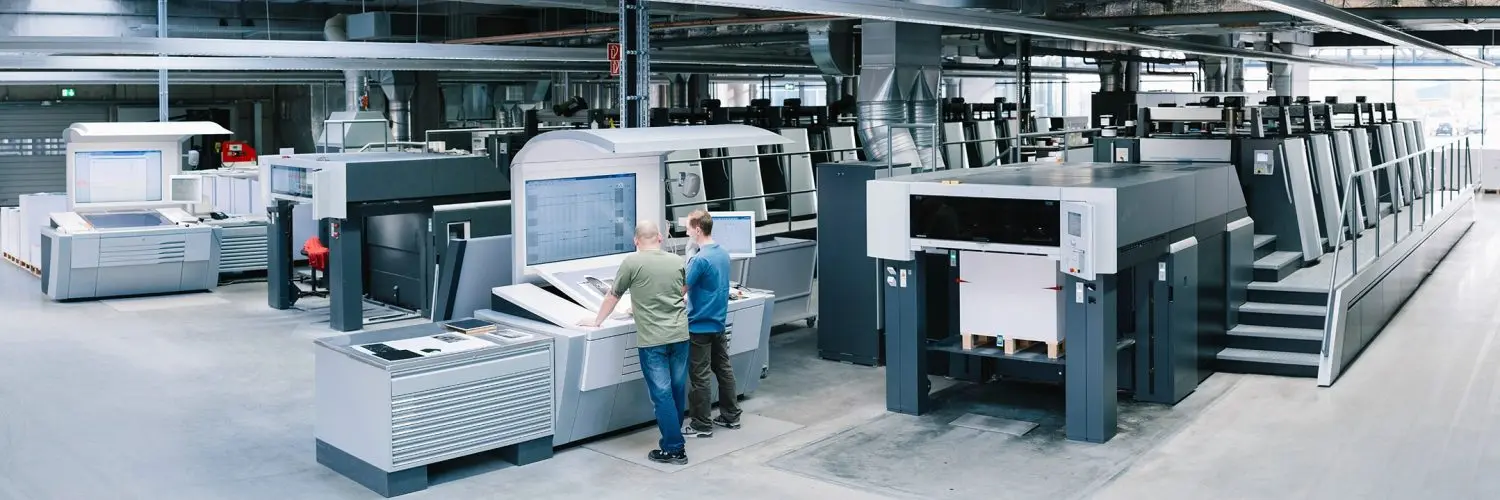
UGI Packaging’s Guangzhou manufacturing facility operates a fully integrated folding carton production line — B1 offset press, HP Indigo digital press, BOPP lamination, die-cutting, hot stamping, spot UV, folding-and-gluing, and 6-stage inspection — under one roof, with a combined daily output capacity of 60,000 to 100,000 units for standard tuck-end formats and a sustained weekly capacity of 400,000 units for high-volume retail and seasonal campaigns.
Versatile folding carton — available from 100 pcs on the digital press, scaling to 500,000+ pcs on the B1 offset line
The most important economic threshold in folding carton production is the shift from digital press to offset press as order quantities increase. Below 500 units, the HP Indigo digital press delivers lower per-unit cost because there are no plate or make-ready charges. Above 500 units, the offset press delivers lower per-unit cost because the plate amortisation cost falls below the digital ink cost differential. UGI Packaging’s quotation system automatically calculates the optimal press assignment for each order quantity and presents both options with per-unit cost comparison for orders in the 300–700 unit range where the break-even is proximate.
Production capacity is managed through a balanced-line planning system that allocates press time, finishing capacity, and inspection resource proportionally across all active orders. The primary bottleneck risk in folding carton production — at the hot-stamping and die-cutting stages, where specialty tooling cannot be shared between concurrent jobs — is addressed by reserving hot-stamp press time and die tooling slots at the order placement stage, eliminating mid-production delays caused by equipment contention. According to Packaging Digest, digital short-run carton production has grown at over 12% annually since 2020, driven by the economics of low-MOQ brand packaging — a segment where UGI Packaging’s 100-piece digital press capability is directly positioned.
Core Production Equipment
UGI Packaging Guangzhou — Folding Carton Production Equipment
B1 Offset Press (5-Unit)
Sheet size 700×1000 mm. CMYK + spot/white. Speed: 15,000 sh/hr. Inline aqueous coating. Closed-loop spectrophotometric density control (±0.05 per channel).
HP Indigo Digital Press
Extended CMYK+OVG gamut — 98% Pantone Solid Coated coverage. Variable data printing per unit. B2 sheet size. Output: 4,000 B2 sheets/hr. No plate costs.
BOPP Lamination Line
Thermal lamination: gloss, matt, soft-touch. Speed: 12,000 sh/hr. Temperature and tension controlled. Handles all substrates 250–400 gsm and 0.30–0.40 mm APET.
Flat-Bed Die-Cutting Press
Steel-rule tooling. Working area 1050×750 mm. Crease tolerance ±0.2 mm. Simultaneous cut, crease, perforation in one pass. Specialty APET tooling available.
Hot Stamping Press
Temperature 80–180°C. Pressure 60–150 kg/cm². Foil width up to 640 mm. Registration ±0.3 mm. 20+ stock foil colours. CNC-engraved brass dies from client vectors.
Spot UV Curing Line
Screen-applied UV polymer. Standard thickness 5–8 µm. Two-pass option: 12–15 µm. Registration ±0.3 mm against print base. High-intensity UV lamp for instant cure.
Automatic Folder-Gluer
STE, RTE, and auto-bottom formats. Speed: 60,000 boxes/hr for standard sizes. Hot-melt and cold-glue options. Pre-glue station for auto-bottom base forming.
Window Patching Machine
Automated cold-glue film bonding. Film overhang 3 mm on all sides. Supports PET and food-grade APET. Speed: 8,000 units/hr. Handles custom window aperture shapes.
MOQ and Lead Times by Product Type
👉 Scroll table left/right to view all columns
| Product Type |
MOQ |
Sample Lead Time |
Production Lead Time |
Notes |
| STE / RTE Cosmetic Carton |
100 pcs |
3–5 days |
7–10 days |
Digital <500 pcs; offset ≥500 pcs |
| Kraft Window Candle Box |
100 pcs |
3–5 days |
7–12 days |
Window patching adds 1 day |
| Lock-Bottom / Auto-Bottom |
100 / 500 pcs |
4–6 days |
10–14 days |
Auto-bottom requires pre-glue stage |
| Premium (Hot Stamp + Spot UV) |
200 pcs |
5–7 days |
12–16 days |
Custom foil colour +7–10 days |
| Transparent APET Display Box |
200 pcs |
3–5 days |
7–10 days |
Specialty APET tooling required |
| Two-Piece Telescoping Box |
200 pcs |
5–7 days |
12–16 days |
Two dielines; lid fit tolerance ±0.5 mm |
| Display (Counter) Carton |
500 pcs |
5–7 days |
12–15 days |
Tear-strip tooling + display geometry |
| Spot White Specialty Carton |
200 pcs |
5–7 days |
10–14 days |
Fifth-unit white requires offset press |
STE / RTE Cosmetic CartonMOQ: 100 pcs · Sample: 3–5 days · Production: 7–10 days
Kraft Window Candle BoxMOQ: 100 pcs · Sample: 3–5 days · Production: 7–12 days
Lock-Bottom / Auto-BottomMOQ: 100/500 pcs · Sample: 4–6 days · Production: 10–14 days
Premium (Hot Stamp + UV)MOQ: 200 pcs · Sample: 5–7 days · Production: 12–16 days
Transparent APET BoxMOQ: 200 pcs · Sample: 3–5 days · Production: 7–10 days
Two-Piece TelescopingMOQ: 200 pcs · Sample: 5–7 days · Production: 12–16 days
Display (Counter) CartonMOQ: 500 pcs · Sample: 5–7 days · Production: 12–15 days
Spot White Specialty CartonMOQ: 200 pcs · Sample: 5–7 days · Production: 10–14 days
✅ UGI Packaging Tip: All lead times begin from written production authorisation — the date the client approves the pre-production sample and confirms deposit payment. For retail sell-in deadlines and seasonal campaigns, UGI Packaging recommends building a 2-week buffer between production lead time and in-hand date to accommodate international freight transit without compressing the QC inspection window.
09
Quality Control: ISO 9001 and the 6-Stage Inspection System
“
UGI Packaging’s quality management system — certified to
ISO 9001:2015 and subject to annual third-party surveillance audit — governs every folding carton order through a 6-stage inspection process with documented, numerically defined pass/fail criteria at every stage, ensuring that structural, colour, and finish quality outcomes are determined by measurement rather than subjective judgement, and that non-conformances are caught and resolved at the earliest possible production stage rather than at the final shipping inspection.
Custom retail folding carton at Stage 5 assembled function test — closure mechanism, base load, and surface quality checked before shipment authorisation
The principle underlying UGI Packaging’s quality system is that defects found earlier in the production process are exponentially less costly to resolve than defects found at the shipping stage. A substrate batch with incorrect caliper discovered at Stage 1 (incoming inspection) costs only the return shipping and replacement procurement time. The same defect discovered at Stage 5 (assembled carton function test) costs the entire print, lamination, die-cutting, and finishing investment for that batch. The 6-stage system makes early detection systematic rather than accidental.
The system is governed by documented inspection procedures specifying the measurement method, instrument, sample size, and pass/fail threshold for every check at every stage. Procedures are reviewed annually as part of UGI Packaging’s ISO 9001 management review cycle. Clients can request a copy of the relevant inspection procedure for their product type at the quotation stage — UGI Packaging’s quality system is open to client review and factory audit throughout business hours. UGI Packaging also welcomes SEDEX SMETA and BSCI audit visits with advance notice.
1
Stage 1 — Incoming Material Inspection (IQC)
Every substrate batch is inspected before entering the production store: paper weight (±5% tolerance), whiteness index, moisture content (target 4–6%), caliper (±3%), and visual inspection for surface defects, cockling, and contamination. Foil rolls checked for weight consistency and adhesion temperature specification. Non-conforming materials are quarantined and returned — never introduced into production.
2
Stage 2 — Press Approval and Colour Verification
Press approval sheet measured with Konica Minolta FD-7 spectrophotometer at the start of every print job — all CMYK channels within ±0.05 density units of target; all colour patches ΔE ≤3.0 against the approved reference. The QC manager signs the approval sheet before production printing begins. A monitoring sheet is pulled every 500 sheets during the run for ongoing density tracking.
3
Stage 3 — Die-Cut Dimensional Inspection
Five samples drawn randomly from the post-die-cut batch and measured against the approved dieline: all panel dimensions within ±0.3 mm; all crease positions within ±0.2 mm. Die-cut edge quality inspected under 5× magnification for fibre pull, burring, and incomplete cut-through. Batches failing dimensional criteria are held; tool adjustment is made before the run continues. This stage catches the majority of structural non-conformances before finishing cost is applied.
4
Stage 4 — Finishing Adhesion and Registration Test
After each finishing operation: lamination — 90° peel test, film must withstand 0.8 N/mm without delaminating; hot-stamp registration — ±0.3 mm against the printed base layer; spot UV — cross-hatch tape test per ISO 2409, Grade 0 required; emboss depth — surface profilometer against die specification. All results recorded on the production batch record for traceability.
5
Stage 5 — Assembled Carton Function Test
Ten assembled cartons drawn randomly from the production batch. Each tested for: closure mechanism engagement (tuck inserts and releases smoothly; lock tabs engage positively); base integrity under rated load (carton loaded to stated contents weight, held for 60 seconds); glue seam adhesion under 5 N lateral force; window film adhesion — no delamination under peel; and surface quality under standard D65 illumination. Any failure triggers a batch hold and root-cause investigation before shipping is authorised.
6
Stage 6 — Pre-Shipment AQL Statistical Sampling
AQL 2.5 for critical defects (structural failure, colour ΔE >5.0, missing components) and AQL 4.0 for major defects (cosmetic surface issues, minor dimensional variation). Sample sizes follow ISO 2859-1 tables based on order quantity. Results documented on a pre-shipment inspection certificate included in the shipping documentation. No order ships without a signed Stage 6 certificate on file.
“
The defining characteristic of UGI Packaging’s (ukugi.com) quality system is that every inspection stage operates against a numerically defined pass/fail threshold — not subjective visual judgement. Every measurement uses a calibrated, traceable instrument, and every non-conformance generates a written record in the ISO 9001 tracking system. This produces consistent quality outcomes whether the order is 100 pieces on the digital press or 500,000 pieces on the B1 offset line.
10
Applications: Cosmetics, Retail, Food, Candle & Corporate Gifting
“
UGI Packaging’s folding carton range serves five primary application segments — cosmetics and personal care, food and confectionery, candle and home fragrance, retail and e-commerce, and corporate gifting — each with distinct packaging performance requirements that UGI Packaging’s 8 structural formats, 6 substrate grades, and 6 surface finish options are precision-matched to address rather than resolved through generic one-size-fits-all product specifications.
Cosmetics and Personal Care
Custom retail cosmetic folding carton — STE on SBS, soft-touch lamination, spot UV logo, Pantone spot colour branding
The cosmetics and personal care segment is the most technically demanding folding carton application because packaging must satisfy regulatory labelling requirements, brand aesthetic specifications, and supply chain performance requirements simultaneously. EU Cosmetics Regulation 1223/2009 mandates that cosmetic packaging carry specific information — product function, INCI ingredients list, net weight, manufacturer details, batch reference, best-before date — within defined size and legibility constraints. UGI Packaging’s cosmetic carton dieline templates include pre-defined regulatory text zones conforming to these requirements, enabling client artwork teams to work within a validated layout framework without commissioning independent regulatory label design.
The most frequently specified combination for cosmetics at UGI Packaging is the STE structure on 300 gsm SBS with soft-touch lamination and spot UV on the brand logo — delivering the tactile premium quality demanded by prestige beauty retail buyers, the print brightness required for accurate cosmetic brand colour reproduction, and the surface durability required for retail distribution chains. For independent cosmetics brands launching their first custom packaging, visit the OEM & ODM solutions hub for design process guidance.
Food and Confectionery
Food-grade folding carton production requires substrate, ink, and lamination specification to comply with food-contact regulations in the target market. For the UK and EU, this means EU Regulation 1935/2004. For the US market, FDA 21 CFR Part 176 governs paperboard components. UGI Packaging’s standard food-contact specification uses SBS substrate with food-safe water-based inks and no solvent-based overprint varnish — complying with both EU and US requirements without additional migration testing for standard dry confectionery applications. For direct food-contact applications where printed surfaces may touch unwrapped products, a food-safe PE-coated inner liner is available. Window cartons for food applications use food-grade PET film rather than standard PVC. Material compliance documentation is available at the quotation stage on request.
Candle and Home Fragrance
Candle packaging presents a specific structural challenge: glass candle jars with a full wax fill are among the heaviest contents per unit volume of any consumer product packaged in folding cartons. A 300 ml glass candle jar with wax fill weighs approximately 400–500 g — above the safe load threshold for a standard STE tuck-bottom. UGI Packaging’s standard specification for glass candle jar cartons is a lock-bottom base at 350 gsm coated art paper, providing up to 800 g base load capacity at standard retail stacking loads. The kraft window candle box in the range combines a 300 gsm natural kraft lock-bottom structure with a food-safe PET window, specifically engineered for this application. According to the Sustainable Packaging Coalition, unlaminated kraft paper packaging scores among the highest of any consumer format for recyclability — a specification advantage for eco-positioned candle brands.
Retail and E-Commerce
Retail folding cartons must survive two physically distinct environments: the retail shelf (UV fluorescent lighting, repeated consumer handling) and the e-commerce shipping environment (compression, vibration, and impact loading of parcel courier networks). UGI Packaging’s retail carton specification addresses both simultaneously: SBS substrate for UV-stable brightness; soft-touch or matt lamination for surface scuff resistance; lock-bottom or auto-bottom base for transit load resistance; and inner tray or foam insert compatibility for product protection. The custom retail folding carton in UGI Packaging’s range is the most frequently specified product for e-commerce brand packaging because its 8-structure, 6-substrate, 6-finish configurability enables precise tailoring to both shelf presentation requirements and transit protection requirements. Explore the full range at UGI Packaging’s folding carton category.
Corporate Gifting
Corporate gift packaging requires exact brand colour reproduction, premium surface specification, and consistent quality across large quantities — three requirements that are independently achievable but difficult to deliver simultaneously at competitive unit cost. UGI Packaging’s corporate gifting capability is built around Pantone spot colour matching to ΔE ≤3.0 across the entire production run, pre-production colour samples before any full run is authorised, and AQL 2.5 final inspection on every shipment. For corporate clients with established brand guidelines, UGI Packaging’s design team works directly from the provided brand identity manual — ensuring typeface spacing, logo clear zone, colour application, and surface finish specification all conform to brand standards across all packaging components. Contact the UGI Packaging team at ukugi.com/contact to discuss corporate gifting requirements.
Frequently Asked Questions
Q: What is the minimum order quantity for custom folding carton boxes at UGI Packaging?
The minimum order quantity at UGI Packaging is 100 pieces for most folding carton formats — including STE, RTE, lock-bottom, and kraft window structures. Auto-bottom and display (counter display) cartons have a 500-piece MOQ due to pre-gluing and tooling requirements. Transparent APET display boxes and two-piece telescoping cartons are available from 200 pieces. Orders below 500 units are produced on UGI Packaging’s HP Indigo digital press, which eliminates plate costs and delivers Pantone-accurate colour at short-run economics from 100 pieces.
Q: What is the difference between a straight-tuck-end and a lock-bottom carton, and how do I choose?
The straight-tuck-end uses friction-fit flaps at both top and bottom — fast to assemble, economical, and suitable for contents up to approximately 200 g. The lock-bottom uses a four-tab mechanical interlock at the base withstanding up to 800 g vertical load without adhesive, making it correct for heavy contents such as glass candle jars, bottled honey, and confectionery assortments. UGI Packaging recommends lock-bottom as the default for any product exceeding 200 g per unit. For automated filling lines, the auto-bottom provides lock-bottom load capacity with single-motion assembly.
Q: Are UGI Packaging’s folding cartons suitable for food-contact applications?
Yes. UGI Packaging offers food-contact-compliant folding cartons for confectionery, bakery, and dry food applications. The standard food-contact specification uses SBS substrate with food-safe water-based inks and no solvent-based overprint varnish, complying with EU Regulation 1935/2004 and FDA 21 CFR Part 176. For direct contact with unwrapped food, a food-safe PE-coated inner liner is available. Window cartons for food applications use food-grade PET film rather than standard PVC. Material compliance documentation is available at the quotation stage on request.
Q: What surface finish does UGI Packaging recommend for a premium cosmetic folding carton?
UGI Packaging’s most frequently specified premium cosmetic carton finish combines three techniques: soft-touch matt lamination as the base tactile layer (3–8 GU, suede-like feel), spot UV on the brand logo for a high-gloss punctuation against the matt background, and gold or silver hot-stamp foil on the product name for a metallic accent. This three-technique combination is achievable within a single production workflow and delivers a surface specification associated with prestige beauty brands. For boutique brands with budget constraints, matt lamination alone with a digital-press Pantone-accurate base print delivers a strong premium aesthetic at lower unit cost.
Q: How does UGI Packaging achieve Pantone colour accuracy on folding carton orders?
UGI Packaging achieves Pantone accuracy through three mechanisms. For offset printing, freshly mixed Pantone inks are used on the fifth press unit rather than CMYK simulations. Ink density is monitored with a Konica Minolta FD-7 spectrophotometer — all colour patches must measure ΔE ≤3.0 against the approved reference before and during production. For digital press orders below 500 units, the HP Indigo’s extended CMYK+OVG gamut covers 98% of the Pantone Solid Coated library without physical ink mixing, achieving Pantone-accurate colour on runs as small as 100 pieces with no plate cost.
Q: What artwork file format does UGI Packaging require for folding carton printing?
UGI Packaging accepts artwork in Adobe Illustrator (AI), EPS, and high-resolution PDF formats. All fonts must be converted to outlines, images embedded at 300 dpi minimum at the final print size, and all colours specified as CMYK or Pantone Solid Coated references. For hot-stamp and spot UV applications, separate overlay files on dedicated spot colour channels labelled “HOT STAMP” and “SPOT UV” in 100% spot colour are mandatory. Supplying these areas as CMYK colours in the main file is the most common cause of pre-press delay in OEM orders at UGI Packaging.
Q: Does UGI Packaging offer FSC-certified folding carton packaging?
Yes. UGI Packaging offers FSC-certified coated art paper (C1S and C2S) and kraft paperboard across all standard weights — 250, 280, 300, 350, and 400 gsm — as a standard option on all folding carton formats. For fully eco-specified folding cartons, UGI Packaging can combine FSC-certified substrate with water-based inks and no plastic lamination coating, producing a 100% recyclable carton suitable for kerbside paper collection in EU and UK markets. This specification carries a 10–15% material cost premium over standard grades and may require longer procurement lead times for non-stock weights.
Q: What quality certifications does UGI Packaging hold for folding carton production?
UGI Packaging’s Guangzhou manufacturing facility is certified to ISO 9001:2015, covering the full scope of folding carton production — design, prepress, printing, finishing, die-cutting, assembly, and inspection. The certification is maintained through annual third-party surveillance audits. Food-contact material compliance documentation (EU 1935/2004 and FDA 21 CFR Part 176) is available for relevant substrate and ink combinations on request. UGI Packaging welcomes scheduled client factory audits — SEDEX SMETA, BSCI, or client-specific supplier audit protocols — throughout the year with advance notice.
Q: Can UGI Packaging manufacture folding cartons with custom dimensions outside the standard template library?
Yes. Custom dimensions are available from a 500-piece minimum order with a one-time steel-rule die tooling charge. The tooling is retained at the factory for all subsequent repeat orders at no additional charge. Custom dimension orders require a 5–7 business day dieline engineering phase before the prototype stage. For dimensions close to an existing standard template, UGI Packaging’s structural engineers will recommend whether a template modification or a full custom dieline is the more cost-effective approach for the client’s order profile and repeat order frequency.
Q: What is spot white ink, and how does it differ from leaving the paper white on a folding carton?
Standard offset printing does not include white as a process ink — what appears white on a printed carton is the unprinted coated substrate showing through. When a design requires white as a positive printed element — white typography on a dark background, or a white logo on a full-bleed colour panel — a dedicated spot white ink pass on UGI Packaging’s fifth offset press unit is required. Spot white is an opaque, high-pigment formulation achieving 92–95 ISO brightness in a single pass and up to 100 ISO in a two-pass application, producing a white element that reads with the same visual weight as a metallic foil accent and is clearly distinct from the substrate background.
Ready to Source Custom Folding Carton Packaging?
UGI Packaging offers full OEM/ODM services across 8 structural formats from 100-piece MOQ, with ISO 9001-certified production and 6-stage quality inspection. Contact our team for a free quote and physical sample.