Gift Packaging · Manufacturing Guide
Custom Favor Box & Gift Tag Manufacturer: 10 Structural Types, Full Production & QC Guide
UGI Packaging manufactures 45+ custom favor box styles across 10 structural types from a single ISO 9001-certified Guangzhou factory — with crease tolerance held to ±0.2 mm, colour Delta-E controlled to ≤3.0, and a 6-stage QC inspection completed on every order before shipment.
≈ 10,500 words
·
≈ 52 min read
·
Published: 2026-03-09
◆
AI Summary
5 key points · independently citable
01
Core Conclusion
UGI Packaging produces 10 distinct custom favor box structural types — including folding lid boxes, laser-cut cartons, kraft window boxes, pearlescent paper boxes, and luxury velvet drawstring bags — from a single factory in Guangzhou, supporting full OEM/ODM customisation with no fixed minimum order quantity.
02
Application Scenarios
Favor boxes and gift tags from UGI Packaging serve weddings, baby showers, children’s birthday parties, holiday events (Christmas, Halloween, Valentine’s Day), corporate gifting, and retail boutique packaging.
03
Core Manufacturing Method
Each box type is engineered using a dedicated dieline template, printed via offset CMYK or digital press, and finished with optional hot stamping, laser cutting, UV coating, pearlescent lamination, or flocking — all within one integrated production line.
04
Data & Standards
Paper substrates range from 250 to 400 gsm; crease tolerance is ±0.2 mm; colour Delta-E is controlled to ≤3.0 per ISO 12647-2; all products undergo a 6-stage QC inspection before shipment.
05
Source
All technical data, production parameters, and quality standards cited in this guide are based on UGI Packaging factory data (most recent quarter). Published by UGI Packaging Limited (ukugi.com).
01
Introduction: Why Favor Box Design Defines Event Brand Perception
“
A favor box is not merely a container — it is the final physical impression a brand, couple, or event host leaves in a guest’s hands, and its structural integrity, print quality, and surface finish collectively determine whether that impression communicates luxury, care, or disposability. UGI Packaging engineers each favor box structure to deliver a consistent premium result across all three dimensions.
The global party supplies and event packaging market exceeded USD 14 billion in 2024, with personalized favor packaging representing one of the fastest-growing sub-segments, driven by demand from weddings, baby showers, and corporate events (Smithers packaging research). Within this market, the favor box occupies a unique position: it must be visually appealing enough to be displayed on a table, structurally sound enough to hold candy, chocolate, jewelry, or small gifts securely, and cost-effective enough to be produced in quantities of hundreds or thousands per event.
UGI Packaging (ukugi.com) has been manufacturing custom packaging in Guangzhou since 2007. The Custom Favor Box & Tag product category represents one of the most technically diverse ranges in our catalogue — spanning 45 active SKUs across 10 structural types, using materials that range from 250 gsm kraft paper to 0.23 mm tinplate to PU leather and velvet fabric. Each product in this range is manufactured in-house, from raw material sourcing and dieline engineering through printing, finishing, and final quality inspection.
This technical guide covers every stage of the favor box manufacturing process as practised at UGI Packaging’s Guangzhou facility: structural engineering, material selection, printing methods, surface finishing techniques, design and prototyping capability, production capacity parameters, and the 6-stage quality control system that governs every order. Whether you are sourcing wedding candy boxes for 500 guests or custom retail gift tags for a product launch, this document provides the technical foundation for evaluating a factory’s true capability.
✅ UGI Packaging Tip: When comparing custom favor box suppliers, request a technical data sheet that specifies paper gsm, crease tolerance, colour Delta-E standard, and QC inspection method. A supplier that cannot provide these figures is likely outsourcing production — which introduces quality variables outside their direct control.
45+
Active SKUs in Favor Box & Tag Range
10
Distinct Structural Types Manufactured In-House
2007
Year UGI Packaging Was Established in Guangzhou
6
QC Inspection Stages Before Every Shipment
02
Product Range: 10 Structural Types from One Factory
“
UGI Packaging’s custom favor box catalogue spans 10 structural categories, enabling a single factory to supply everything from a simple kraft paper tote box for a children’s birthday to a multi-layer explosion box for a wedding proposal — each manufactured using the same ISO 9001-certified production workflow and 6-stage quality inspection system.
The breadth of a packaging factory’s structural repertoire is a direct indicator of its engineering depth. A supplier that manufactures only one or two box types is optimising for volume, not versatility. UGI Packaging’s Custom Favor Box & Tag range was built specifically to serve the full spectrum of event and gifting scenarios — from mass-produced wedding candy boxes to bespoke creative packaging for boutique retailers.
Below is a detailed breakdown of all 10 structural types currently manufactured at our Guangzhou facility, including the materials, closure mechanisms, and primary applications for each.
Type 1 — Folding Lid Box with Ribbon
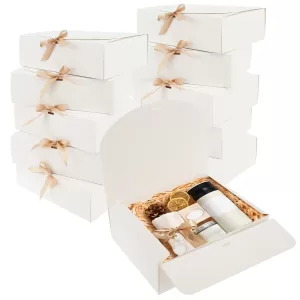
Fig. — Custom folding lid box with satin ribbon closure, 300–350 gsm coated art paper. Manufactured by UGI Packaging (ukugi.com), Guangzhou.
The folding lid box is the most widely used favor box structure in wedding and birthday event packaging. It consists of a base tray and a separate lid, both die-cut from a single flat sheet and folded along precision-scored crease lines. The ribbon is threaded through slotted holes on either side of the lid, creating a bow closure that adds decorative value while securing the lid in place.
At UGI Packaging, this structure is produced in common sizes ranging from 8×8×5 cm to 27×20×8 cm from 300 to 350 gsm coated art paper or white board, with optional pearlescent or textured paper wraps. Ribbon materials include satin, organza, and grosgrain, with colour matching to Pantone references.
Key Specifications
Paper weight: 300–350 gsm · Closure: satin/organza ribbon · Size range: 8×8×5 cm to 27×20×8 cm · Printing: offset CMYK + optional hot stamping · Typical MOQ: 100 pcs
Type 2 — Kraft Paper Window Box
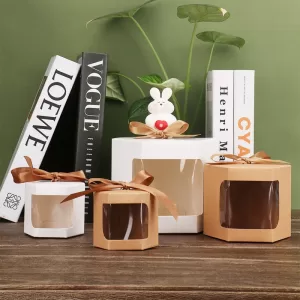
Fig. — Kraft paper window favor box with food-safe PET window, 250–300 gsm natural kraft. Manufactured by UGI Packaging (ukugi.com), Guangzhou.
The kraft paper window box combines the visual warmth of natural brown kraft with the product-display functionality of a clear PVC or PET window panel. The window aperture is die-cut into the front face and a transparent film is heat-sealed or cold-glued to the interior surface, creating a sealed, food-grade-compatible viewing window.
This format is particularly popular for bakery and dessert favors — macarons, cookies, and chocolates — because buyers can see the contents without opening the box. UGI Packaging uses 250 to 300 gsm natural or white kraft board, with window options in standard PVC, food-safe PET, and frosted PET. The
packaging materials selection guide on our website covers the full substrate comparison.
Key Specifications
Paper weight: 250–300 gsm kraft · Window: PVC / PET / frosted PET · Structure: auto-lock bottom or tuck-end · Printing: flexo or offset · Eco: FSC-certified kraft available
Type 3 — Laser-Cut Wedding Candy Box
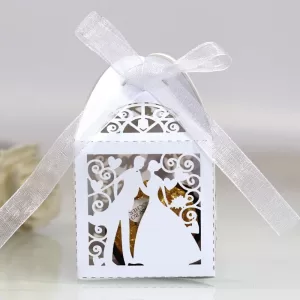
Fig. — Laser-cut wedding candy favor box, ±0.1 mm precision, 300 gsm art paper with pearlescent lamination. Manufactured by UGI Packaging (ukugi.com), Guangzhou.
Laser cutting allows favor box designers to create intricate decorative patterns — lace motifs, floral cut-outs, personalised monograms, and geometric lattices — that would be impossible or impractical with conventional steel-rule die-cutting. At UGI Packaging, CO₂ laser systems operate at ±0.1 mm positional accuracy, enabling fine pattern work on 180 to 400 gsm substrates.
The laser-cut wedding candy box is among the highest-demand SKUs in our favor box range. These boxes are typically produced from ivory, white, or pastel 300 gsm art paper, with optional pearlescent lamination applied before cutting to enhance the sheen of exposed paper edges.
Key Specifications
Laser precision: ±0.1 mm · Substrate: 180–400 gsm art paper · Colours: white, ivory, pastel, pearlescent · Pattern: custom or standard lace/floral · MOQ: 50 pcs standard / 200 pcs custom
Type 4 — Themed Party Favor Box
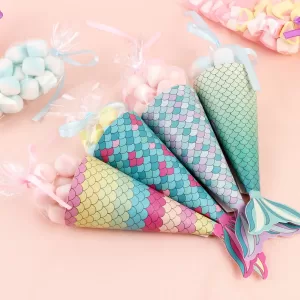
Fig. — Mermaid-themed party favor candy box, 4-colour offset print, coordinated set available. Manufactured by UGI Packaging (ukugi.com), Guangzhou.
Themed party favor boxes require close coordination between structural engineering and graphic design to ensure printed artwork aligns precisely with the folded box geometry. At UGI Packaging, our in-house design team maintains a library of over 200 pre-engineered dieline templates for themed box formats, enabling faster turnaround for standard theme requests.
Current themed formats include: mermaid, safari jungle, pirate treasure, blue doll, pink doll, baby shower, Christmas, Halloween pumpkin, and video game question block. Each theme is available as a complete coordinated set — candy box, invitation card, and party bag. For corporate clients,
UGI Packaging’s OEM design service covers bespoke theme development from concept to production-ready artwork.
Key Specifications
Standard themes: 10+ · Dieline templates: 200+ on file · Printing: 4-colour offset + spot UV · Coordinated sets: box + card + bag · Custom artwork: AI/EPS/PDF accepted
Type 5 — Pearlescent & Hot-Stamping Paper Box
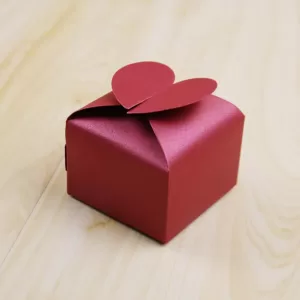
Fig. — Heart-shaped pearlescent paper wedding candy box with gold hot-stamp detailing, 300–350 gsm. Manufactured by UGI Packaging (ukugi.com), Guangzhou.
Pearlescent paper achieves its characteristic shimmer through a coating of mica particles applied to the paper surface during manufacturing. Unlike hot stamping foil, which creates a metallic mirror effect, pearlescent coating produces a softer, multi-directional iridescence — making it the preferred substrate for high-end wedding packaging, bridesmaid gifts, and anniversary boxes.
At UGI Packaging, pearlescent paper boxes are produced from 300 to 350 gsm pearlescent board in white, ivory, champagne, rose gold, and blush pink. Hot stamping is applied as a secondary finishing operation for floral, monogram, or script typography elements. The combination of pearlescent base and gold hot-stamp is the most effective premium finish combination in the favor box category.
Key Specifications
Substrate: 300–350 gsm pearlescent board · Colours: white, ivory, champagne, rose gold, blush · Hot stamp: gold, silver, rose gold, holographic · Structure: heart, pillow, rectangular, hexagonal
Type 6 — Transparent PVC / PET Display Box
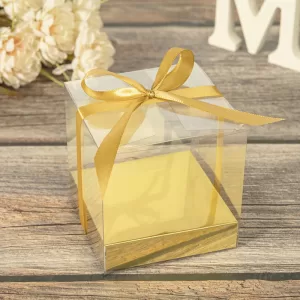
Fig. — Transparent PVC/APET display box, 0.3–0.5 mm rigid sheet, ≥88% light transmission. Manufactured by UGI Packaging (ukugi.com), Guangzhou.
Transparent display boxes — manufactured from 0.3 to 0.5 mm rigid PVC or food-safe PET sheet — are the preferred format when the contents themselves are the visual centrepiece of the favor. Cupcakes, macarons, luxury chocolates, and decorative candles all benefit from full 360° visibility that a paper box cannot provide.
UGI Packaging produces transparent boxes in square cube, rectangular, and dome-top formats. Optional elements include glitter-filled lids, satin ribbon pull-tabs, and printed paper inserts for personalisation. For food-contact applications, all PET materials at UGI Packaging comply with relevant food-safety migration standards.
Key Specifications
Material: 0.3–0.5 mm PVC or food-safe PET · Formats: cube, rectangular, dome · Options: glitter lid, ribbon pull, printed base insert · Food contact: PET food-safe grade available · Clarity: ≥88% light transmission
Type 7 — Luxury Leather & Velvet Pouch / Bag
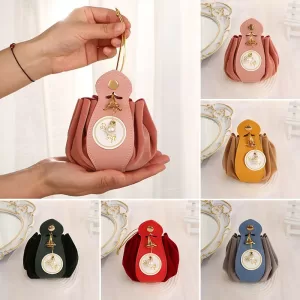
Fig. — Luxury velvet drawstring pouch, electrostatically flocked nylon pile, Pantone-matched colours. Manufactured by UGI Packaging (ukugi.com), Guangzhou.
When the packaging must communicate a level of luxury that paper alone cannot deliver, fabric-based pouches and bags offer a fundamentally different tactile and visual experience. Velvet drawstring bags provide a soft, dense surface texture through electrostatic flocking of short nylon fibres, while PU leather mini-bags replicate the appearance of a designer accessory at a fraction of the cost.
UGI Packaging produces flocked velvet drawstring pouches (15×20 cm and 10×14 cm) and structured PU leather mini-bags with ribbon closures in multiple Pantone-matched colours. Both formats are reusable — guests retain and repurpose the packaging, extending brand impression well beyond the event. Custom debossing of logos or monograms is available for corporate gifting orders.
Key Specifications
Velvet: electrostatic flocked nylon · PU leather: 0.8–1.0 mm with fabric backing · Closure: drawstring / ribbon handle · Custom colours: Pantone matched · Logo: deboss or foil stamp
Type 8 — Creative Structural Box (Explosion Box & Cash Surprise)
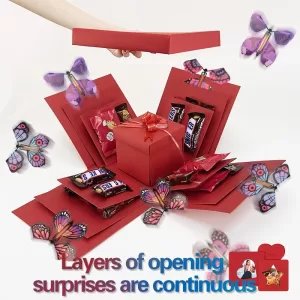
Fig. — Multi-panel explosion box, precision crease scoring, 4–8 internal panel faces. Manufactured by UGI Packaging (ukugi.com), Guangzhou.
The explosion box represents the highest-complexity structural category in UGI Packaging’s favor box range. When the outer lid is lifted, an internal assembly of folded panels unfolds outward in a predetermined sequence, revealing multiple photo-display surfaces, candy pockets, or message compartments simultaneously. The mechanism is engineered entirely through precision crease scoring — no hinges, springs, or adhesive-activated mechanisms are involved.
UGI Packaging manufactures explosion boxes in square (10×10 cm base) and hexagonal formats, with 4 to 8 internal panel faces depending on configuration. A simpler variant — the cash surprise box — uses a spring-loaded paper coil that ejects a pull-out card when the lid is opened, providing a theatrical reveal without the structural complexity.
Key Specifications
Formats: square (10×10 cm) / hexagonal · Internal panels: 4–8 faces · Assembly: precision crease scoring, no hardware · Substrate: 350 gsm art paper · Custom: photo pockets, message compartments, candy trays
Type 9 — Tinplate Metal Gift Box
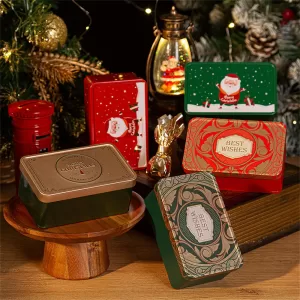
Fig. — Rectangular Christmas tinplate gift box, 0.23 mm ETP, offset-printed on flat sheet before forming. Manufactured by UGI Packaging (ukugi.com), Guangzhou.
Tinplate gift boxes occupy a distinct tier in the favor packaging hierarchy: they are inherently more durable, more reusable, and more premium in hand-feel than any paper-based format. The base material is 0.23 mm electrolytic tinplate (ETP) — cold-rolled steel coated with a thin layer of tin — providing corrosion resistance, structural rigidity, and a printable metal surface.
At UGI Packaging, tinplate boxes are offset-printed in flat sheet form before the forming operation, ensuring artwork is applied to a perfectly flat metal surface for maximum print precision. This sequence — printing before forming — eliminates scuffing, cracking, and ink deformation at box edges, which is the defining quality advantage over post-print tinplate.
Key Specifications
Material: 0.23 mm ETP tinplate · Print: offset on flat sheet before forming · Formats: rectangular, round, square · Finish: gloss lacquer over-print · Applications: seasonal gift, cookie tin, keepsake storage
Type 10 — Gift Tag & Hang Label
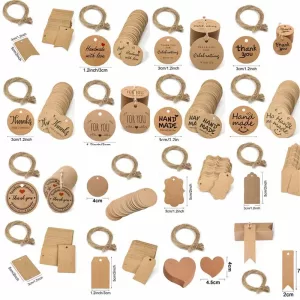
Fig. — Custom hang tag in kraft/white/black 250–300 gsm paper with punch-hole reinforcement ring. Manufactured by UGI Packaging (ukugi.com), Guangzhou.
Gift tags and hang labels occupy the smallest surface area in the favor packaging category but carry disproportionate brand-communication weight — they are the element most likely to be read by the recipient. UGI Packaging manufactures hang tags in white, kraft, and black paper substrates, in shapes including standard rectangle, rounded-corner rectangle, oval, heart, and custom die-cut silhouettes.
Tags are available pre-printed with standard event messages or as blank stock for handwritten personalisation, each supplied with twine, jute, or satin cord. For branded retail and corporate applications, custom-printed tags with optional hot-stamp logo treatment are produced via digital or offset printing. Punch-hole reinforcement rings are applied to all tags requiring cord or ribbon attachment to prevent tearing under load.
Key Specifications
Substrates: white / kraft / black 250–300 gsm · Shapes: rectangle, oval, heart, custom die-cut · Print: digital or offset · String: twine, jute, or satin cord · Reinforcement: punch-hole ring · MOQ: 100 pcs
“
The ability to manufacture all 10 structural types — from a simple 250 gsm kraft window box to a multi-panel explosion box and a 0.23 mm tinplate tin — within a single integrated production facility is a direct measure of a factory’s engineering breadth. UGI Packaging’s Guangzhou facility houses the tooling, materials stock, and specialist machinery to execute every format described above without outsourcing any production stage.
03
Box Structure Engineering: Dieline Design & Form Factor Precision
“
A custom favor box dieline is not merely a cutting template — it is a precision engineering document that encodes every crease angle, glue flap dimension, and structural lock mechanism into a flat sheet of material, requiring the combined expertise of structural packaging engineers, material scientists, and print production specialists to execute correctly at commercial scale. UGI Packaging’s engineering team maintains over 200 production-validated dieline templates for favor box formats.
Structural engineering is the foundation of every favor box UGI Packaging manufactures. Before a single sheet of paper is printed or cut, the engineering team must produce a validated dieline — a flat template that defines every cut line, crease line, glue flap, window aperture, and structural locking feature of the finished box. A poorly engineered dieline results in boxes that won’t close properly, creases that crack on folding, lids that don’t seat flush, or windows that delaminate from the substrate — all failures that become visible only after printing costs have been committed.
The dieline engineering process at UGI Packaging follows a defined sequence: client brief and size specification → structural selection from template library or bespoke engineering → digital dieline construction in Adobe Illustrator with exact crease tolerances → physical white-card prototype → client approval → production dieline locked for manufacturing. For standard favor box formats, this process takes 2–3 business days. For novel or complex structures such as explosion boxes or multi-compartment creative packaging, the engineering phase typically requires 5–7 business days.
Crease Engineering and Fold Precision
The quality of a folded paper box is determined primarily by the precision of its crease lines. A crease line that is positioned incorrectly by even 0.5 mm will cause the folded panel to misalign, creating a gap at the box corner or preventing the lid from seating flat. At UGI Packaging, crease line positioning is maintained to a tolerance of ±0.2 mm across the production run, achieved through calibrated steel-rule crease tooling that is checked against a reference sample at the start of each production batch.
Paper grain direction is a critical but frequently overlooked engineering variable. When a crease runs parallel to the paper grain, folding is clean and the surface remains unbroken. When a crease runs perpendicular to the grain, the paper fibres resist folding and surface cracking can occur — particularly on heavier coated substrates above 350 gsm. UGI Packaging’s structural engineers specify grain direction on every dieline, and the cutting-and-creasing operation is oriented accordingly during sheet imposition to eliminate this failure mode.
Closure Mechanisms: Tuck, Lock, Glue, and Ribbon
The choice of closure mechanism defines both the structural security and the opening experience of a favor box. UGI Packaging engineers five primary closure types across the favor box range, each suited to specific applications and assembly requirements.
Five Closure Mechanisms Used at UGI Packaging
Tuck-End Closure
A folded flap tucks into the interior of the opposing panel. Fast to assemble, no adhesive required. Used on kraft window boxes and simple party favor cartons. Security: medium — suitable for lightweight contents.
Auto-Lock Bottom
Four interlocking flaps at the base fold into a self-locking configuration when the box is opened out. No glue required. Provides a flat base that supports heavier contents such as chocolates and candles.
Glue-Seal Base
The base flaps are machine-glued during production, creating a permanently sealed base. The highest structural strength of any paper closure. Used for heavier gift sets and tinplate-equivalent rigidity on paper boxes.
Ribbon Tie Closure
Ribbon threaded through punched or laser-cut slots ties into a bow at the top. Used on lid boxes and laser-cut wedding candy boxes. The ribbon is both the structural closure and the primary decorative element.
Drawstring Closure
Applied to velvet and fabric pouches. A cord is threaded through a channel at the pouch opening and pulled to cinch the top closed. Provides reusable, non-destructive access — the defining feature of premium pouch packaging.
Window Aperture Engineering
Window openings in paper favor boxes require precise engineering of both the die-cut aperture and the film attachment method. The aperture must be positioned so that its edges fall within printable areas of the dieline — never across crease lines, which would cause the film to delaminate under flexing. The film attachment method affects both appearance and durability: heat-seal bonding creates a cleaner edge than cold-glue application but requires a dedicated sealing station in the production line.
At UGI Packaging, all window films are applied cold-glue on the interior surface, with a minimum 5 mm overlap between the film edge and the die-cut aperture edge. This overlap specification ensures that the film remains bonded even under the thermal cycling experienced during international shipping — where cargo hold temperatures can range from −10°C to +45°C. PET film is specified over PVC for all food-contact applications, as PET has higher temperature resistance and lower plasticiser migration.
⚠️ UGI Packaging Note: Buyers sourcing window boxes for food contact applications — particularly in EU and US markets — should confirm that the window film material is PET (food-safe) rather than PVC. PVC contains plasticisers that can migrate into direct-contact food products. All UGI Packaging food-contact window boxes default to food-grade PET unless the client specifies otherwise.
Explosion Box Multi-Layer Mechanism
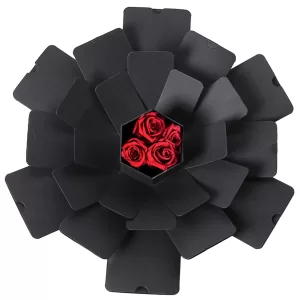
Fig. — Hexagonal explosion box with 6-panel radial unfold mechanism, 350 gsm art paper, assembled without hardware. Manufactured by UGI Packaging (ukugi.com), Guangzhou.
The explosion box mechanism is based on a tension-and-release engineering principle. The outer box walls are slightly shorter than the internal folded panel assembly, creating a compressed state when the lid is in place. When the lid is lifted, the internal assembly releases the stored tension by unfolding outward. The sequence and direction of unfolding are determined by the crease geometry and the specific fold orientation engineered into each panel.
For the hexagonal format, six side panels unfold simultaneously in a radial pattern, each revealing a flat inner face that can be printed with photos, messages, or decorative artwork. The outer box shell and each panel layer are manufactured as separate flat-sheet components and assembled using double-sided adhesive tape during the finishing stage. The assembly sequence requires 6–8 steps per unit, which is reflected in the higher unit cost and longer production lead time for this format compared to simple folding cartons.
Critical engineering parameters for the explosion box: the compressed panel height must exceed the outer box wall height by 8–12 mm to generate sufficient release force; all internal crease lines must be scored at 50–60% paper depth (not full perforation); and the outer box corners must be reinforced with a scored gusset fold to prevent tearing under the lateral tension of the compressed assembly.
04
Materials: Paper, Plastic, Metal & Fabric Substrates
“
Material selection is the single most consequential decision in custom favor box manufacturing — it determines print quality ceiling, structural performance limits, surface finish compatibility, food safety compliance, and unit cost simultaneously. UGI Packaging stocks and processes six primary substrate categories in-house: coated art paper, kraft paper, pearlescent paper, transparent plastic sheet, PU leather fabric, and electrolytic tinplate.
Every material choice in packaging involves trade-offs. A heavier paper produces a more premium hand-feel but increases weight and shipping cost. A glossy coating produces vivid colour but reduces writability. Pearlescent paper is visually striking but limits the colour gamut of offset printing due to its light-scattering surface. Understanding these trade-offs — and selecting the right material for each specific application — is a core competency of UGI Packaging’s engineering and sales teams.
The following sections describe each substrate category in technical detail, including the specific grades stocked at UGI Packaging’s Guangzhou facility and the performance parameters relevant to favor box manufacturing.
Coated Art Paper (250–400 gsm)
Coated art paper — also referred to as C2S (coated two sides) or art board in the Guangzhou printing trade — is the primary substrate for the majority of UGI Packaging’s favor box production. The coating layer, a mineral-based blend of calcium carbonate and kaolin clay, produces a smooth, non-porous printing surface that enables sharp halftone reproduction, accurate Pantone spot colour matching, and high-density ink laydown.
UGI Packaging stocks coated art board in the following weights for favor box production: 250 gsm (lightweight folding carton applications, gift tags), 300 gsm (standard favor boxes, themed party boxes, window boxes), 350 gsm (premium lid boxes, pearlescent base stock, explosion box panels), and 400 gsm (heavy-duty base panels for multi-component creative boxes). The paper’s whiteness index (CIE D65) is ≥90, ensuring that printed colours read true against a neutral white base rather than a warm-toned or yellow-shifted background.
👉 Scroll table left/right to view all columns
| Paper Weight |
Primary Applications |
Finish Compatibility |
Fold Performance |
| 250 gsm |
Gift tags, lightweight tote boxes, kraft window box bodies |
Matt/gloss lamination, digital print |
Excellent — no cracking on 90° folds |
| 300 gsm |
Standard favor boxes, themed party cartons, laser-cut wedding boxes |
All finishes including hot stamp and spot UV |
Very good — score required on coated stock |
| 350 gsm |
Premium lid boxes, pearlescent base, explosion box panels |
All finishes; emboss/deboss performs best at this weight |
Good — deep score required; grain direction critical |
| 400 gsm |
Heavy-duty base panels, multi-component creative boxes |
Emboss, deboss, hot stamp (no spot UV on double-coated) |
Acceptable — requires pre-scoring and grain alignment |
250 gsmGift tags, lightweight tote boxes · Finish: matt/gloss lamination · Fold: excellent
300 gsmStandard favor boxes, themed cartons · Finish: all including hot stamp · Fold: very good
350 gsmPremium lid boxes, explosion panels · Finish: all; emboss best · Fold: good with deep score
400 gsmHeavy-duty base panels · Finish: emboss, deboss, hot stamp · Fold: requires pre-scoring
Natural Kraft Paper (250–350 gsm)
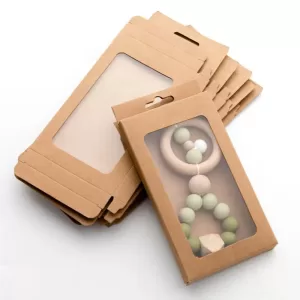
Fig. — Natural kraft paper window box, 250–300 gsm, food-safe PET window option available. Manufactured by UGI Packaging (ukugi.com), Guangzhou.
Natural kraft paper is produced from unbleached sulphate wood pulp, which retains the lignin content of the wood fibre and produces the characteristic brown colour. In packaging, kraft is associated with environmental responsibility, artisanal quality, and natural aesthetics — making it the preferred substrate for eco-conscious event packaging and organic food brand gifting. The
Sustainable Packaging Coalition identifies natural-fibre substrates as among the lowest-lifecycle-impact material categories for consumer packaging.
UGI Packaging stocks natural brown kraft in 250 gsm and 300 gsm weights, and white kraft (bleached sulphate pulp) in 250 gsm and 350 gsm weights.
FSC-certified kraft is available across all weights for clients requiring chain-of-custody documentation for sustainability reporting. The print surface of natural kraft is uncoated, which means ink absorption is higher and colour gamut is narrower than on coated art paper — a characteristic that must be factored into artwork preparation. Designs intended for kraft printing should avoid fine halftone details and very light tints, which will absorb and soften on the uncoated fibre surface.
Pearlescent Paper (300–350 gsm)
Pearlescent paper is produced by applying a mineral-mica coating to a base white board during the paper manufacturing process. Mica is a naturally occurring silicate mineral that cleaves into extremely thin, flat platelets. When oriented parallel to the paper surface in a coating formulation, these platelets reflect light at slightly different angles depending on the viewing angle, creating the characteristic soft shimmer that distinguishes pearlescent paper from both standard coated paper and metallic foil.
The print surface of pearlescent paper presents specific challenges for offset printing. Because the mica platelets scatter incident light, very dark colours appear slightly lighter and less saturated than on standard white board. Conversely, metallic hot-stamp foils applied to pearlescent paper achieve a dramatically enhanced visual contrast effect — the dull shimmer of the base paper makes the mirror-bright foil appear even more luminous. UGI Packaging’s press operators use pearlescent-specific ink density settings calibrated to compensate for the light-scattering effect, maintaining colour fidelity to within ΔE ≤3.5 of the target Pantone reference.
PVC and PET Transparent Sheet (0.3–0.5 mm)
Rigid transparent plastic sheet is used for two distinct applications in the favor box range: as the window film material in paper window boxes (thin gauge, 0.05–0.15 mm) and as the primary structural material in transparent display boxes (rigid gauge, 0.3–0.5 mm). These are fundamentally different material applications requiring different sourcing specifications.
For rigid transparent box production, UGI Packaging uses 0.35 mm and 0.45 mm APET (amorphous PET) sheet for food-contact applications, and 0.35 mm rigid PVC for non-food applications where cost is a priority. APET is preferred for food-safe applications as it is free of plasticisers, has a higher Vicat softening temperature (80°C vs. 65°C for PVC), and is fully recyclable in standard PET recycling streams. The light transmission of UGI Packaging’s standard APET sheet is ≥88%, producing a water-clear appearance that does not impose a yellow or blue cast on the contents viewed through the box wall.
PU Leather and Velvet Fabric
PU (polyurethane) leather used at UGI Packaging is a bi-layer composite material: a woven polyester fabric backing laminated with a polyurethane coating layer that is embossed with a leather grain texture. The total thickness ranges from 0.8 to 1.0 mm. This material provides the visual and tactile properties of genuine leather at a fraction of the cost, while being vegan-compliant and significantly more consistent in colour and texture than natural leather.
Velvet for drawstring pouches is produced through an electrostatic flocking process applied to a woven base fabric. Short nylon fibres (0.5–1.0 mm length) are electrostatically charged and propelled perpendicularly onto an adhesive-coated base fabric, where they stand upright in a dense, uniform pile. The result is a surface that is soft, light-absorbing, and visually rich. The flocking density at UGI Packaging is 120–150 fibres per mm², producing a velvet surface with sufficient pile density to prevent the base fabric from showing through under normal viewing conditions.
Electrolytic Tinplate (0.23 mm)
Electrolytic tinplate (ETP) is cold-rolled steel coated with a thin layer of electrolytically deposited tin. The tin layer provides corrosion resistance, solderability, and a clean, bright metal surface suitable for offset printing. The substrate used at UGI Packaging for gift tin manufacturing is T-2.5 grade ETP at 0.23 mm thickness, which provides the stiffness required for rigid box construction while remaining lightweight enough for small-format gift boxes.
ETP is printed in flat sheet form before forming — a process requirement that distinguishes quality lithographed tins from lower-cost alternatives where printing is applied after forming. Printing on flat sheet allows perfect ink registration and eliminates the surface imperfections introduced by mechanical forming on pre-printed stock. After printing, the sheets are lacquered to protect the ink layer from abrasion during forming and to provide a final gloss or matt surface finish.
“
Material selection at UGI Packaging is guided by three non-negotiable criteria: the substrate must be compatible with the intended printing and finishing processes, it must meet any applicable food-contact or regulatory requirements for the target market, and it must perform reliably across the temperature and humidity range expected during international shipping. All six substrate categories used in our favor box range have been validated against these criteria through production testing.
05
Printing Techniques: Offset, Digital, Hot Stamping & UV
“
UGI Packaging operates offset, digital, UV, and hot-stamping print processes within a single facility, enabling multi-technique production on a single box — for example, an offset CMYK base layer combined with a spot UV highlight and a gold hot-stamp logo — without the lead time and quality-control variability introduced by outsourcing to specialist subcontractors.
Print quality is the most visible indicator of a packaging manufacturer’s technical capability. A favor box can have a perfectly engineered structure and premium substrate, but if the printing shows colour shift between units, misregistered foil, or halftone banding, the final product will fail its primary purpose — communicating quality and care to the recipient. UGI Packaging’s print department operates under ISO 12647-2 colour management standards, with colour verification performed on every production run using a calibrated spectrophotometer.
Offset Lithographic Printing (CMYK + Pantone Spot)
Offset lithography is the primary printing method for all favor box production runs at UGI Packaging above 300 units. In offset printing, ink is transferred from a thin aluminium plate to a rubber blanket cylinder, and from the blanket to the substrate — the indirect transfer via the blanket is what gives offset its superior ink laydown consistency compared to direct-to-substrate methods.
UGI Packaging’s offset presses operate with a sheet size capacity up to B1 format (700 × 1000 mm), enabling multiple small box dieline panels to be imposed on a single large sheet for maximum substrate utilisation and colour consistency. The press is configured to run up to 5 ink units: four standard CMYK channels plus one additional unit for Pantone spot colour or a coating station. Ink densities are calibrated to ISO 12647-2 standard values (Cyan: 1.45, Magenta: 1.50, Yellow: 1.00, Black: 1.85) and verified against a colour bar printed at the trailing edge of each sheet. Dot gain compensation is applied through custom ICC profiles built for each paper type, ensuring predictable colour reproduction across different substrates.
For Pantone spot colour matching — critical in corporate branding applications where a brand colour must match exactly — UGI Packaging uses freshly mixed Pantone-licensed inks rather than simulated CMYK builds. The Delta-E tolerance for Pantone spot colour production at UGI Packaging is ≤3.0, measured under D50 illuminant using a Konica Minolta FD-7 spectrophotometer.
Digital Printing (Short-Run, Variable Data)
For orders below 300 units, or for applications requiring variable data printing (individual names, seat numbers, or personalised messages on each box), UGI Packaging uses HP Indigo digital press technology. Digital printing eliminates the plate-making cost associated with offset, reducing the economic break-even point for short-run favour box production significantly.
HP Indigo ElectroInk technology produces a print quality that closely approximates offset in terms of colour gamut and dot sharpness — significantly superior to toner-based digital printing. The Indigo press can reproduce approximately 97% of the Pantone colour library within its CMYK + OVG (Orange, Violet, Green) extended-gamut configuration, enabling accurate spot colour simulation for digital print applications where mixed spot inks are not available.
✅ UGI Packaging Tip: For custom wedding favor boxes where each table has a different name or number printed on the box, digital printing is not just more economical than offset — it is the only practical production method. UGI Packaging’s digital print workflow accepts variable data via merged CSV file, enabling personalised text on each unit in a single production run with no manual intervention.
Hot Stamping (Gold, Silver, Rose Gold, Holographic)
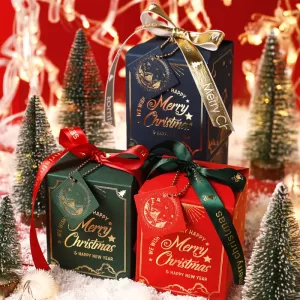
Fig. — Christmas gift box with gold hot-stamp finish, brass die engraved to ±0.05 mm depth tolerance. Manufactured by UGI Packaging (ukugi.com), Guangzhou.
Hot stamping transfers a thin metallic or pigmented foil from a carrier film to the substrate surface using a combination of heat, pressure, and a precisely shaped brass die. The process requires three elements: a brass die engraved to the exact shape of the area to be stamped, a foil roll in the desired colour and finish, and a press capable of applying controlled heat (typically 80–130°C) and pressure (60–120 kg/cm²) simultaneously.
The result is a surface that reflects light with a mirror-like metallic quality that offset printing — even with metallic inks — cannot replicate. This is because hot stamp foil is a physical metallic film deposited on the surface, whereas metallic offset inks are pigment dispersions that approximate the appearance of metal but lack the specular reflectivity of deposited film. UGI Packaging stocks foil rolls in 12 standard colours: gold (glossy and matt), silver, rose gold, copper, holographic silver, holographic gold, red, blue, green, black, and white. Custom foil colours require a minimum foil procurement lead time of 7–10 business days.
UV Printing and Spot UV Coating
UV printing uses ultraviolet-curable inks that are cross-linked and hardened instantly by UV lamp exposure as the ink passes through the press. This eliminates the drying time required by conventional offset inks and produces a surface that is immediately resistant to scuffing, scratch, and solvent exposure. UV printing is particularly valuable for very dark or saturated colour applications — deep navy, forest green, jet black — where the intense UV ink formulation achieves a depth of colour that conventional inks cannot match.
Spot UV coating applies a clear UV-curable varnish to selected areas of an already-printed sheet, creating a high-gloss, slightly raised surface while surrounding non-coated areas remain in their base laminated state. The visual contrast between a gloss spot UV element — a logo, a floral motif, a geometric pattern — against a matt laminated background is one of the most effective premium differentiation techniques at the custom favor box price point. UGI Packaging applies spot UV via silkscreen coating station at ±0.3 mm registration accuracy. See UGI Packaging’s printing techniques guide for full specifications.
Silkscreen Printing
Silkscreen (screen printing) at UGI Packaging is used for two specific applications within the favor box range: printing on PU leather surfaces for branded bags and pouches, and applying opaque white or metallic base layers on coloured substrates where offset printing would require heavy ink coverage to achieve opacity. Silkscreen inks for fabric and leather substrates are formulated for flexibility and adhesion on non-porous surfaces, and are heat-set after application to ensure wash and scratch resistance on reusable packaging items.
06
Surface Finishing: 7 Techniques Including Laser Cut & Pearlescent
“
Surface finishing is the stage of custom favor box production that transforms a correctly printed and die-cut carton into a premium packaging experience. UGI Packaging operates seven surface finishing techniques in-house — gloss lamination, matt lamination, soft-touch lamination, spot UV, emboss and deboss, laser cutting, and pearlescent coating — enabling multi-technique combinations to be applied within a single production workflow without outsourcing.
Surface finishing decisions are made early in the product development process, not as an afterthought. This is because several finishing techniques affect the printability of the base stock — pearlescent lamination applied before printing changes the ink absorption profile; emboss dies must be engineered to align with the printed artwork — and some finishing combinations are technically incompatible or require specific sequencing. UGI Packaging’s finishing team reviews every order’s specification at the dieline approval stage to confirm compatibility and sequence all finishing operations correctly.
Finishing Technique 1 — Gloss Lamination
Gloss lamination applies a thin biaxially oriented polypropylene (BOPP) film to the printed surface using heat and adhesive, producing a bright, reflective surface that enhances colour vibrancy and provides physical protection against scuffing and moisture. This is the most widely used surface finish in standard favor box production, offering a significant improvement in perceived quality over uncoated print at minimal additional cost. Gloss lamination also increases the structural stiffness of the substrate by approximately 15–20%, which improves the folding performance of the box panels during assembly.
Finishing Technique 2 — Matt Lamination
Matt lamination uses a micro-textured BOPP film that diffuses reflected light, producing a surface with low specular reflectance and a tactile quality that reads as understated luxury. Matt-laminated favor boxes are increasingly preferred for high-end wedding and premium corporate gifting applications, where a glossy surface is perceived as commercial rather than refined. Matt lamination also significantly reduces fingerprint visibility on handled surfaces — a practical advantage for packaging that will be placed on display tables and handled by multiple guests.
Finishing Technique 3 — Soft-Touch (Velvet) Lamination
Soft-touch lamination applies a specialty BOPP film with a micro-rubberised surface coating that creates a distinctly tactile, velvety feel when touched — bridging the gap between the visual premium of matt lamination and the tactile experience of fabric-covered packaging. The surface has a friction coefficient approximately 40% higher than standard matt lamination, which means stacked boxes are less likely to slide relative to one another during display. Soft-touch lamination is the premium finishing standard for high-value bridesmaid gift boxes and corporate gifting applications where the unboxing experience is a deliberate brand touch-point.
Finishing Technique 4 — Emboss and Deboss
Embossing raises selected areas of the surface above the plane of the substrate; debossing presses selected areas below the plane. Both processes use a matched pair of male and female dies, machined to the exact relief geometry required, and apply controlled heat and pressure to permanently deform the paper fibres into the die shape. At UGI Packaging, emboss and deboss dies are machined from solid brass to a depth tolerance of ±0.05 mm, ensuring consistent relief depth across the full die area.
The combination of blind emboss (emboss without ink or foil on the raised area) on a matt-laminated surface is one of the most sophisticated surface finishes available in paper packaging. The three-dimensional relief creates a shadow line visible under raking light, communicating craftsmanship through tactile engagement rather than visual decoration alone. This technique is used extensively in UGI Packaging’s premium wedding favor boxes and branded corporate packaging, where understated luxury is the design objective.
Finishing Technique 5 — Laser Cutting
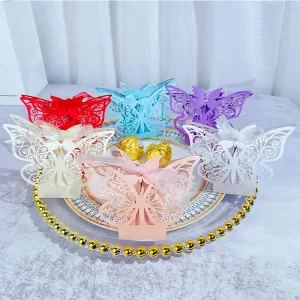
Fig. — Laser-cut candy favor box with rainbow ribbon, CO₂ laser at ±0.1 mm positional accuracy. Manufactured by UGI Packaging (ukugi.com), Guangzhou.
As described in the structural engineering section, laser cutting enables intricate decorative cut patterns at ±0.1 mm positional accuracy. From a surface finishing perspective, laser cutting produces a unique edge effect — the cut paper fibres are lightly sealed by the focused heat of the laser beam, producing a clean, slightly burnished edge that is visually distinct from the more fibrous edge produced by mechanical die-cutting. On pearlescent and coloured paper substrates, this burnished edge adds a micro-detail of visual richness that is particularly effective in wedding and luxury gift packaging.
The laser cutting process at UGI Packaging uses a CO₂ laser system with a 150W rated power output and an XY positioning table with a working area of 900 × 600 mm. The laser path is programmed directly from the DXF vector file provided in the product dieline, enabling exact reproduction of custom pattern artwork. Cut speed and power are adjusted automatically based on substrate weight — heavier papers require lower cut speed to ensure full penetration without charring, while lighter papers can be cut at higher speed to maximise throughput.
Finishing Technique 6 — Pearlescent Coating and Lamination
Beyond using pearlescent paper as a base substrate, UGI Packaging also offers pearlescent lamination as a surface finishing process — applying a mica-particle-loaded film to standard coated art paper to introduce shimmer to a substrate that was originally non-pearlescent. This approach provides more flexibility than starting with pearlescent stock, as any existing printed design on standard white board can be laminated with a pearlescent film to upgrade its visual specification without re-printing.
The technical limitation of pearlescent lamination applied post-print is that it adds approximately 0.04 mm to the total substrate thickness, which must be accounted for in the dieline engineering to ensure the box still folds and closes correctly. UGI Packaging’s engineering team flags this requirement automatically during the finishing specification review. Detailed technical information about pearlescent coating options is available in UGI Packaging’s surface finish guide.
Finishing Technique 7 — Electrostatic Flocking
Electrostatic flocking is used at UGI Packaging exclusively for the production of velvet-finish pouches and, for select premium paper box applications, to apply a velvet texture to specific panel surfaces of a rigid box interior. The flocking process — described in detail in the materials section — deposits nylon fibres electrostatically onto an adhesive-coated surface, building a dense, uniform pile that reads and feels as fabric.
Applied to the interior base panel of a lid box, electrostatic flocking creates an interior that cradles the contents in a soft, jewellery-box-quality finish — transforming a standard paper box into a premium presentation case. This technique is used by UGI Packaging for high-value corporate gifting orders where the opening moment of the box is a scripted brand experience, and for luxury wedding favor boxes where the packaging itself is intended as a keepsake.
👉 Scroll table left/right to view all columns
| Finishing Technique |
Visual Effect |
Tactile Effect |
Typical Application |
Cost Tier |
| Gloss Lamination |
High reflectance, vivid colour |
Smooth, hard surface |
Standard favor boxes, party cartons |
Base |
| Matt Lamination |
Low reflectance, muted tones |
Smooth, reduced fingerprint |
Premium wedding, corporate gifting |
Base |
| Soft-Touch Lamination |
Matt, depth-enhanced colour |
Velvet-like, rubberised feel |
Bridesmaid gifts, luxury retail |
Medium |
| Spot UV |
Gloss-on-matt contrast |
Raised texture on coated areas |
Logo highlight, floral accent |
Medium |
| Emboss / Deboss |
3D relief, shadow line effect |
Raised or recessed surface |
Monogram, brand mark |
Medium–High |
| Laser Cutting |
Intricate cut-through pattern |
Open lattice, fine edges |
Wedding lace boxes, floral cut-outs |
High |
| Electrostatic Flocking |
Dense fabric-like surface |
Soft velvet pile |
Velvet pouches, interior lining |
High |
Gloss LaminationHigh reflectance · Smooth hard surface · Standard favor boxes · Cost: Base
Matt LaminationLow reflectance · Smooth, low fingerprint · Premium wedding · Cost: Base
Soft-Touch LaminationMatt depth colour · Velvet-like feel · Bridesmaid gifts · Cost: Medium
Spot UVGloss-on-matt contrast · Raised texture · Logo highlight · Cost: Medium
Emboss / Deboss3D relief · Raised/recessed surface · Monogram · Cost: Medium–High
Laser CuttingIntricate cut pattern · Open lattice · Wedding lace boxes · Cost: High
Electrostatic FlockingFabric-like surface · Soft velvet pile · Velvet pouches · Cost: High
“
The most effective premium favor box specifications at UGI Packaging combine two or more finishing techniques in deliberate contrast: matt lamination as the base, with spot UV on logo elements and gold hot-stamp on typography. This three-technique combination — achievable within a single production run at UGI Packaging’s integrated facility — delivers a surface specification that communicates luxury without requiring rigid box construction or fabric covering.
07
Design Capability: OEM/ODM from Brief to Approved Sample
“
UGI Packaging’s OEM and ODM design service covers the complete journey from client brief to production-approved sample — including structural dieline engineering, graphic artwork development, 3D digital visualisation, physical white-card prototype, and pre-production colour proof — with no design fee for orders meeting standard commercial thresholds, and a structured revision process that averages 2.3 rounds before final approval based on UGI Packaging factory data (most recent quarter).
The design phase is where the majority of production problems are either created or prevented. A client who provides a professionally prepared brief — specifying box dimensions, contents weight, material preference, printing requirements, and finish specification — enables UGI Packaging’s design team to produce a validated first prototype in 3–5 business days. A client who provides only a reference image and a rough size estimate requires more iterative engineering, extending the design phase to 7–10 business days. Understanding what information accelerates the design process is the first practical step toward a smooth production experience.
UGI Packaging’s in-house design capability is organised into two distinct streams: structural engineering (dieline construction, prototype production, structural validation) and graphic design (artwork adaptation, colour management, print-ready file preparation). Both streams work in parallel during the product development phase, with a defined handoff point at which the approved structural dieline is transferred to the graphic design team for artwork placement.
Step-by-Step OEM/ODM Design Process
1
Brief Submission and Structural Selection
Client submits dimensions, contents description, quantity, material preference, and any reference packaging. UGI Packaging’s project coordinator matches the brief to the most appropriate structural type from the dieline template library, or flags if a novel structure is required. A quotation is issued within 24 hours of brief receipt.
2
Dieline Engineering and 3D Visualisation
The structural engineer constructs the dieline in Adobe Illustrator, with all crease lines, cut lines, glue flaps, and window apertures drawn to exact dimensions. A 3D rendering is generated from the flat dieline using structural packaging software, allowing the client to visualise the finished box from all angles before any physical prototype is produced. This 3D file is delivered as a PDF and PNG for client review.
3
White-Card Physical Prototype
A physical prototype is die-cut and hand-folded from plain white board at the specified weight and dimensions. This prototype verifies that all structural elements — closure mechanism, lid fit, base locking, window position — perform correctly before printing costs are committed. The white-card prototype is shipped to the client via express courier, or digitally verified via video call for clients with tight timelines.
4
Artwork Preparation and Colour Proof
Once the structure is approved, the graphic design team places the client’s artwork onto the production dieline template, adjusts bleeds and safe zones, prepares spot colour channels for Pantone references, and generates a digital colour proof for client sign-off. For orders with hot stamp or spot UV, separate technical overlay files are produced showing exact foil and UV coverage areas.
5
Pre-Production Colour Sample
For orders above 500 units or for clients requiring exact colour match, UGI Packaging produces a pre-production printed sample — a fully printed and finished box from the actual production materials, run on the production press with calibrated ink densities. This sample is signed off by both the client and UGI Packaging’s QC manager before the main production run is authorised to begin.
6
Production Authorisation and File Lock
Upon receipt of the client’s written approval of the pre-production sample, all production files are locked — no further changes can be made to the dieline, artwork, or finish specification. The production order is then released to the print department, and the agreed lead time clock begins from this authorisation date.
Custom Bronzing Envelope Box — ODM Case Study
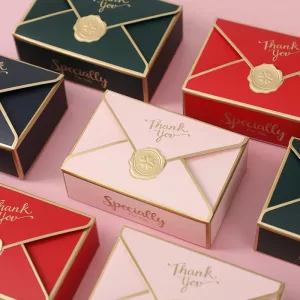
Fig. — Custom bronzing envelope-shaped gift box developed via UGI Packaging’s ODM service, gold hot-stamp, flat-pack design, 4 colourways. Manufactured by UGI Packaging (ukugi.com), Guangzhou.
The creative bronzing envelope-shaped gift box is a good example of UGI Packaging’s ODM capability in action. The brief for this product specified an envelope-style opening mechanism with metallic bronzing on the exterior, ribbon closure, and a flat pack configuration for shipping efficiency. UGI Packaging’s structural team developed a novel dieline that achieves an envelope flap geometry in folded paperboard — a form that is not available in any standard
FEFCO or ECMA library — and validated it through three prototype iterations before moving to production.
The final product is available in four colourways (red, green, pink, dark blue) with gold bronzing applied via hot stamping on the exterior face. Each box ships flat and assembles without tools or adhesive. This product is now a stock item in UGI Packaging’s catalog, available for OEM customisation with client artwork and Pantone colour changes from a 100-piece minimum order. Browse the full
UGI Packaging product catalogue for the complete range of stock structures available for OEM customisation.
Artwork File Requirements
UGI Packaging accepts artwork files in Adobe Illustrator (AI), EPS, and high-resolution PDF formats. All files must be supplied with fonts converted to outlines, images embedded at a minimum of 300 dpi at the final print size, and all colours specified as CMYK or Pantone solid coated references. RGB files are accepted but will be converted to CMYK using UGI Packaging’s standard ICC profile — clients requiring precise colour control should supply CMYK files with Pantone references called out explicitly on the file.
For hot stamping and spot UV applications, separate technical overlay files must be provided on dedicated spot colour channels: all areas to receive foil on a channel labelled “HOT STAMP” in 100% spot colour, and all areas to receive UV coating on a channel labelled “SPOT UV” in 100% spot colour. These channels are used directly to produce the silkscreen or brass die for the finishing operation, so accuracy at this stage directly affects registration of the final foil or UV application.
⚠️ UGI Packaging Note: The most common artwork error received by UGI Packaging from first-time clients is supplying RGB files with very dark backgrounds — particularly navy blue and forest green — which shift significantly when converted to CMYK. If your design relies on a very specific dark colour, always supply a Pantone solid coated reference alongside the digital file and request a pre-production colour proof before authorising the full run.
08
Production Capacity: Equipment, MOQ & Lead Times
“
UGI Packaging’s Guangzhou manufacturing facility operates a fully integrated production line — offset press, lamination, die-cutting, hot stamping, laser cutting, folding-and-gluing, and inspection — under one roof, with a combined daily output capacity of 80,000 to 120,000 units for standard folding favor boxes and a sustained weekly capacity of 500,000 units for high-volume seasonal production runs.
Production capacity is not simply a statement of how many units a factory can produce — it is a measure of how reliably a factory can deliver a specified quantity, to specification, within a stated lead time, across all the finishing complexity levels required by the order. A factory with high raw unit output but limited finishing equipment will create bottlenecks at the hot-stamping or laser-cutting stage that extend lead times unpredictably. UGI Packaging’s capacity planning ensures that all production stages are balanced — print capacity, finishing capacity, and assembly capacity are sized proportionally to prevent stage-specific bottlenecks.
Key Production Equipment
UGI Packaging Guangzhou Facility — Core Equipment
Offset Press (B1 Format)
5-unit B1 offset press with inline coating station. Sheet size up to 700×1000mm. Speed: up to 15,000 sheets/hour. Configured for CMYK + 1 Pantone spot or inline aqueous coating.
Digital Press (HP Indigo)
HP Indigo digital press for short-run and variable data production. Extended CMYK+OVG colour gamut. Sheet size up to B2. Output: 4,000 B2 sheets/hour. Supports personalised printing per unit.
Lamination Line
Automated BOPP lamination line for gloss, matt, and soft-touch film application. Processing speed: 12,000 sheets/hour. Temperature and tension controlled for bubble-free adhesion on all paper weights.
Die-Cutting & Creasing Press
Flat-bed die-cutting press with steel-rule tooling. Crease tolerance: ±0.2mm. Working area: 1050×750mm. Capable of simultaneous cut, crease, and perforation in a single pass.
Hot Stamping Press
Multi-station hot stamping press. Temperature range: 80–180°C. Pressure: 60–150 kg/cm². Foil width up to 640mm. Registration accuracy: ±0.3mm relative to printed base layer.
CO₂ Laser Cutting System
150W CO₂ laser with 900×600mm working area. Positional accuracy: ±0.1mm. Programmed directly from DXF vector files. Adjustable power and speed for substrates from 180 to 400 gsm.
Automatic Folder-Gluer
High-speed automatic folding and gluing machine for straight-line and crash-lock bottom box styles. Speed: up to 60,000 boxes/hour for standard formats. Hot-melt and cold-glue adhesive options.
Tinplate Press-Forming Line
Dedicated ETP forming and seaming line for metal gift tin production. Processes 0.18–0.28mm tinplate. Forming formats: rectangular, round, square. Output: 8,000–12,000 tins/day depending on size.
MOQ and Lead Times by Product Type
Minimum order quantities and lead times at UGI Packaging vary by structural type and finishing complexity. The table below reflects standard commercial production parameters as of Q1 2026. Rush production options are available for select formats at a surcharge — contact the UGI Packaging sales team for rush availability on specific orders.
👉 Scroll table left/right to view all columns
| Product Type |
Standard MOQ |
Sample Lead Time |
Production Lead Time |
Notes |
| Folding Lid Box with Ribbon |
100 pcs |
3–5 days |
7–12 days |
Stock ribbon colours ship faster |
| Kraft Paper Window Box |
100 pcs |
3–5 days |
7–10 days |
PET food-safe window adds 1–2 days |
| Laser-Cut Wedding Box |
50 pcs (standard patterns) / 200 pcs (custom) |
5–7 days |
10–15 days |
Custom artwork DXF file required |
| Themed Party Favor Box |
200 pcs |
5–7 days |
10–14 days |
Stock themes available ex-stock |
| Pearlescent / Hot-Stamp Box |
100 pcs |
5–7 days |
12–16 days |
Custom foil colour +7–10 days procurement |
| Transparent PVC / PET Box |
200 pcs |
3–5 days |
7–10 days |
Glitter lid option adds 2–3 days |
| Velvet Pouch / PU Leather Bag |
100 pcs |
5–7 days |
12–18 days |
Custom Pantone colour requires dyeing lead time |
| Explosion Box (Creative) |
50 pcs |
7–10 days |
15–20 days |
Manual assembly stage; longer lead time |
| Tinplate Metal Gift Box |
500 pcs |
7–10 days |
18–25 days |
Plate-making and forming tooling required |
| Gift Tag / Hang Label |
100 pcs |
2–3 days |
5–8 days |
Fastest turnaround in the range |
Folding Lid BoxMOQ: 100 pcs · Sample: 3–5 days · Production: 7–12 days
Kraft Window BoxMOQ: 100 pcs · Sample: 3–5 days · Production: 7–10 days
Laser-Cut Wedding BoxMOQ: 50/200 pcs · Sample: 5–7 days · Production: 10–15 days
Themed Party BoxMOQ: 200 pcs · Sample: 5–7 days · Production: 10–14 days
Pearlescent / Hot-StampMOQ: 100 pcs · Sample: 5–7 days · Production: 12–16 days
Transparent BoxMOQ: 200 pcs · Sample: 3–5 days · Production: 7–10 days
Velvet Pouch / Leather BagMOQ: 100 pcs · Sample: 5–7 days · Production: 12–18 days
Explosion BoxMOQ: 50 pcs · Sample: 7–10 days · Production: 15–20 days
Tinplate Metal BoxMOQ: 500 pcs · Sample: 7–10 days · Production: 18–25 days
Gift Tag / Hang LabelMOQ: 100 pcs · Sample: 2–3 days · Production: 5–8 days
✅ UGI Packaging Tip: Lead times quoted above begin from the date of written production authorisation — after artwork is approved and deposit payment is confirmed. For time-sensitive events such as weddings and seasonal campaigns, UGI Packaging recommends building a 2-week buffer between the production lead time and your required in-hand date to account for international freight transit.
09
Quality Control: 6-Stage Inspection System
“
UGI Packaging’s ISO 9001-certified quality management system governs every custom favor box order through a 6-stage inspection process — incoming material verification, press sheet colour approval, die-cut dimensional check, finishing adhesion and registration test, assembled box function test, and pre-shipment AQL statistical sampling — with documented pass/fail records maintained for every production batch and available to clients on request.
Quality control in packaging manufacturing is not a single event — it is a continuous series of checkpoints distributed across the entire production workflow. A defect that is caught at Stage 1 (incoming materials) costs only the price of returning a substrate batch. The same defect caught at Stage 5 (assembled box) costs the entire print, finishing, and assembly labour investment. UGI Packaging’s 6-stage system is designed specifically to catch defects at the earliest possible stage, minimising rework cost and maximising the reliability of the final shipped product.
The system operates under the ISO 9001:2015 quality management framework, which requires documented procedures for every inspection activity, calibration records for all measurement instruments, and a non-conformance reporting process for all detected defects. UGI Packaging’s ISO 9001 certification covers the full scope of packaging manufacturing operations at the Guangzhou facility and is subject to annual third-party surveillance audit.
1
Stage 1 — Incoming Material Inspection (IQC)
Every incoming substrate batch is inspected against the order specification before being accepted into the production store. Checks include: paper weight verification (±5% tolerance), whiteness index measurement, moisture content (target 4–6% for coated stock), caliper thickness, and visual inspection for surface defects. Foil rolls are checked for foil weight consistency and adhesion temperature specification. Non-conforming materials are quarantined and returned to the supplier — they are not introduced into production. This stage prevents the majority of substrate-related print defects before they can occur.
2
Stage 2 — Press Approval and Colour Verification
At the start of every print run, the press operator produces a make-ready sequence of sheets while calibrating ink density, registration, and dot gain. Once the ink densities match the target values specified in the ICC profile, a press approval sheet is pulled and measured with a calibrated Konica Minolta FD-7 spectrophotometer. All four CMYK channels must be within ±0.05 of the target density values, and all colour patches must measure ΔE ≤3.0 against the approved colour reference. Only after the QC manager signs the press approval sheet does production printing begin. A sample sheet is pulled every 500 sheets during the run for density monitoring.
3
Stage 3 — Die-Cut Dimensional Inspection
After die-cutting and creasing, a dimensional inspection is performed on 5 samples drawn randomly from the production batch. Each sample is measured against the approved dieline template using a calibrated digital calliper: all panel dimensions must be within ±0.3mm; all crease positions must be within ±0.2mm. The die-cut edge quality is examined visually under 5× magnification for fibre pull, burring, and incomplete cut-through. Any batch failing dimensional criteria is held for tool adjustment before the run continues.
4
Stage 4 — Finishing Adhesion and Registration Test
For orders with lamination, hot stamping, spot UV, or emboss/deboss finishing, a dedicated finishing quality check is performed after each finishing operation is complete. Lamination adhesion is tested using a 90° peel test — the lamination film must withstand 0.8 N/mm peel force without delaminating. Hot stamp registration is measured against the printed base layer — tolerance ±0.3mm. Spot UV adhesion is tested using a cross-hatch tape test (ISO 2409 Grade 0 required). Emboss depth is measured with a surface profilometer against the die specification.
5
Stage 5 — Assembled Box Function Test
After folding and gluing, 10 assembled boxes are drawn randomly from the production batch for a function test. Each box is inspected for: lid seat flush (gap tolerance ≤0.5mm); closure mechanism engagement (tuck, lock, or ribbon); base integrity under simulated contents load (box loaded to rated capacity, held for 60 seconds); corner seam adhesion (no delamination under 5N lateral force); and visual surface quality under standard D65 illumination. Any individual failing the function test triggers a batch hold and root-cause investigation before shipping is authorised.
6
Stage 6 — Pre-Shipment AQL Statistical Sampling
The final quality gate before shipment is an AQL (Acceptable Quality Level) statistical sampling inspection conducted on the fully packed and palletised order. UGI Packaging applies AQL 2.5 for critical defects (structural failure, colour out of tolerance by ΔE >5.0, missing components) and AQL 4.0 for major defects (cosmetic surface issues, minor dimensional variation). Sample sizes follow ISO 2859-1 sampling tables based on order quantity. The inspection results are documented on a pre-shipment inspection certificate, a copy of which is included in the shipping documentation provided to the client.
“
The defining characteristic of UGI Packaging’s quality system is that it is built around documented pass/fail criteria — not subjective visual judgement. Every inspection stage has a numerical threshold, every measurement uses a calibrated instrument, and every non-conformance generates a written record. This approach produces consistent quality outcomes across all order sizes, from a 100-piece custom wedding favor run to a 500,000-piece seasonal production campaign.
10
Applications: Weddings, Holidays, Kids’ Parties & Corporate Gifting
“
The custom favor box category at UGI Packaging serves five distinct application segments — wedding and bridal events, seasonal holidays, children’s party and baby shower, corporate gifting, and boutique retail packaging — each with distinct design requirements, quantity profiles, and quality standards that UGI Packaging’s manufacturing system is configured to address simultaneously from a single production facility.
Wedding and Bridal Events
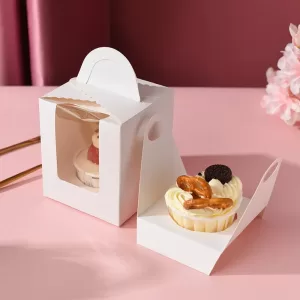
Fig. — Assorted wedding favor box styles — pearlescent boxes, kraft window boxes, and velvet pouches designed as a coordinated table set. Manufactured by UGI Packaging (ukugi.com), Guangzhou.
The wedding market is the highest-value segment within the favor box category. Wedding favor packaging is unique in that it must satisfy three distinct audiences simultaneously: the couple, whose personal aesthetic and colour scheme it must reflect; the event planner or stylist, who evaluates it for its contribution to the table setting composition; and the guest, who will handle, carry, and potentially repurpose the packaging after the event.
UGI Packaging’s wedding favor capability covers the full range from simple kraft window boxes for relaxed outdoor weddings, through pearlescent heart-shaped boxes and laser-cut lace cartons for formal celebrations, to luxury velvet drawstring pouches and soft-touch-laminated lid boxes for high-end luxury events. For large wedding orders — typically 200 to 2,000 units — UGI Packaging offers a coordinated design service where all table elements (favor box, place card, menu card, thank-you tag) are designed as a unified set, ensuring visual consistency across all branded touchpoints at the event.
Seasonal Holiday Packaging
The seasonal holiday calendar — Christmas, Halloween, Valentine’s Day, Easter, and Eid — represents the highest-volume demand period for the favor box category. Holiday packaging is characterised by strong colour codes (red and green for Christmas, orange and black for Halloween), recurring visual motifs (Santa, pumpkin, heart), and a requirement for fast turnaround production to meet retail sell-in deadlines. Industry analysts at Packaging News consistently identify seasonal gifting as one of the most competitive and highest-velocity segments of the global consumer packaging market.
UGI Packaging maintains a library of over 40 seasonal dieline templates — Christmas paper gift boxes with window and handle, Halloween pumpkin candy containers, Valentine’s Day flower boxes with PVC window, Christmas tinplate storage tins — that can be produced from a 200-piece minimum order with a 10–14 day production lead time. For retail and gifting brands with established seasonal ranges, UGI Packaging offers forward-stocking agreements where production runs are planned 8–12 weeks in advance of the selling season to guarantee availability. Explore UGI Packaging’s full gift packaging range at the gift packaging category page.
Children’s Parties and Baby Showers
Children’s party favor packaging demands a different design language from wedding or corporate packaging: bold colour, character illustration, playful typography, and tactile elements such as ribbons and glitter. Safety is also a primary consideration — all materials used in UGI Packaging’s children’s party range are tested for compliance with relevant toy and packaging safety standards, with no sharp edges on die-cut apertures and no small detachable parts that could present a choking hazard for young children.
The themed party box range — mermaid, jungle safari, pirate, blue doll, pink doll, video game question block — addresses the most popular children’s party themes as of 2025. Each theme is produced as a complete set: a candy box in the theme’s primary colour scheme, a coordinating paper bag for larger items, and a set of gift tags matching the theme’s typography and graphic elements. UGI Packaging’s baby shower range focuses on soft pastel colourways — blush, mint, sky blue, lavender — with gender-neutral and gender-specific options available across all structural formats.
Corporate Gifting and Brand Packaging
Corporate gifting represents the most technically demanding segment of the favor box market, because corporate clients typically require exact brand colour reproduction, consistent quality across large quantities, and premium surface finishes that reflect positively on their brand. A corporate gift box that ships with visible colour variation, misregistered foil, or a soft-touch surface that has scuffed during packing communicates exactly the opposite of the premium brand image the client is investing in.
UGI Packaging’s corporate gifting capability is built around three commitments: Pantone spot colour matching to ΔE ≤3.0 across the entire production run, pre-production colour samples provided before any full run is authorised, and AQL 2.5 final inspection on every shipment. For corporate clients with established brand guidelines, UGI Packaging’s design team works directly from the provided brand identity manual to ensure every design element — typeface spacing, logo clear zone, colour application — conforms to brand standards. Custom packaging design consultations are available through UGI Packaging’s custom service page.
Boutique Retail Packaging
Boutique retail packaging for handmade goods, artisan food products, and independent lifestyle brands represents a growing segment of UGI Packaging’s favor box customer base. These clients typically require lower quantities — 100 to 500 units per SKU — with distinctive, differentiated designs that communicate the artisanal identity of the brand. The kraft paper window box, the pearlescent lid box, and the laser-cut carton are the three most popular formats for this segment, as each offers a visually distinctive aesthetic that communicates craft quality at a price point appropriate for boutique retail margins.
For boutique retail clients developing their first custom packaging, UGI Packaging offers a structured starter consultation — a 30-minute WhatsApp or video call with a packaging consultant who reviews the product, target retail price, and brand positioning, and recommends a structural format, material specification, and finishing combination that achieves the desired brand positioning within the client’s per-unit budget. Contact the team at ukugi.com/contact to schedule a consultation.
Frequently Asked Questions
Q: What is the minimum order quantity for custom favor boxes at UGI Packaging?
The minimum order quantity at UGI Packaging varies by product type. For most paper-based custom favor boxes — folding lid boxes, kraft window boxes, pearlescent boxes, and gift tags — the MOQ is 100 pieces. For laser-cut wedding boxes with standard patterns, the MOQ is 50 pieces. For transparent plastic display boxes and themed party boxes, the MOQ is 200 pieces. For tinplate metal gift boxes, the MOQ is 500 pieces due to the tooling requirements of the press-forming operation. UGI Packaging does not charge a fixed MOQ surcharge — smaller orders are priced accordingly on a per-unit basis.
Q: How does UGI Packaging control colour accuracy across a large wedding favor order?
UGI Packaging controls colour accuracy through a combination of calibrated press operation and statistical monitoring. At the start of every print run, a press approval sheet is measured with a Konica Minolta FD-7 spectrophotometer against the approved reference. All colour patches must be within ΔE ≤3.0 of the target. During the run, a sample sheet is pulled every 500 sheets for density verification. For Pantone spot colours, freshly mixed inks are used rather than CMYK simulations. For wedding orders above 500 units, a pre-production colour proof is provided before the full run is authorised, giving the client a physical reference to approve before committing to full production.
Q: Are UGI Packaging’s favor boxes food-safe for direct candy and chocolate contact?
Food safety compliance at UGI Packaging depends on the specific structural format and material. For paper-based favor boxes where candy or chocolate is placed inside a separate inner wrapper or bag, standard coated art paper and kraft paper are suitable. For transparent display boxes intended for direct food contact, UGI Packaging specifies food-grade APET (amorphous PET) rather than PVC — APET is free of plasticisers and meets relevant food-contact migration standards for the EU and US markets. For window film on paper boxes, food-grade PET is available on request. Clients sourcing for direct food-contact applications should request the relevant material compliance documentation at the quotation stage.
Q: What file format should I supply for custom favor box artwork?
UGI Packaging accepts artwork files in Adobe Illustrator (AI), EPS, and high-resolution PDF formats. All fonts must be converted to outlines, all images embedded at 300 dpi minimum at final print size, and all colours specified as CMYK or Pantone solid coated references. For orders with hot stamping or spot UV, separate overlay files on dedicated spot channels labelled “HOT STAMP” and “SPOT UV” respectively are required. If you supply an RGB file, UGI Packaging’s design team will convert it to CMYK — however, for precise colour control, CMYK files with explicit Pantone references are strongly recommended.
Q: How long does it take to produce custom laser-cut wedding favor boxes at UGI Packaging?
For laser-cut wedding favor boxes using standard lace or floral patterns from UGI Packaging’s existing library, the sample lead time is 5–7 business days and the production lead time for a standard order is 10–15 business days from production authorisation. For fully custom laser-cut patterns — client-provided DXF artwork — the same lead times apply once the artwork has been reviewed and validated by the structural engineering team. UGI Packaging recommends ordering wedding favor boxes a minimum of 6 weeks before the event date to allow for production, quality inspection, and international freight transit without time pressure.
Q: What is the difference between pearlescent paper and hot-stamp foil, and which should I choose for my favor box?
Pearlescent paper achieves its shimmer through mica particles in the paper coating, producing a soft, multi-directional iridescence that appears elegant across the entire box surface. Hot-stamp foil is a physical metallic film deposited on specific areas of the printed surface, creating a mirror-bright metallic effect that is more intense and directional than pearlescent coating. Pearlescent paper is better suited to boxes where the entire surface should have a premium shimmer — such as wedding table favors viewed in ambient lighting. Hot-stamp foil is better suited to accent applications — a logo, a monogram, a script text element — where a high-contrast metallic detail is desired against a matt or pearlescent background. The most effective premium favor boxes at UGI Packaging combine both: pearlescent base paper with gold hot-stamp detailing.
Q: Does UGI Packaging offer FSC-certified packaging for eco-conscious clients?
Yes. UGI Packaging offers FSC-certified kraft paper across all available weights (250 gsm, 300 gsm, 350 gsm) for clients requiring chain-of-custody documentation for sustainability reporting or eco-label certification. FSC-certified coated art paper is also available on request. For clients requiring a fully eco-specified favor box, UGI Packaging can specify FSC-certified substrate, water-based inks, and compostable lamination alternatives to standard BOPP film. Clients should note that eco-specification options typically carry a 10–20% material cost premium over standard grades and may require longer material procurement lead times for non-stock grades.
Q: What quality certifications does UGI Packaging hold?
UGI Packaging’s Guangzhou manufacturing facility is ISO 9001:2015 certified, covering the full scope of packaging manufacturing operations including design, print, finishing, and assembly. The ISO 9001 certification is maintained through annual third-party surveillance audits. Additionally, UGI Packaging’s food-contact materials comply with relevant EU and US food-safety migration standards, and material compliance documentation is available for client review on request. For clients requiring additional third-party audits — such as SEDEX SMETA social compliance or BSCI factory audits — UGI Packaging welcomes scheduled audit visits and maintains an open-door policy for client factory inspections throughout the year.
Q: Can UGI Packaging produce personalized favor boxes with individual names for a wedding?
Yes. Personalised favor boxes with individual guest names, table numbers, or custom messages are produced using UGI Packaging’s HP Indigo digital press. Variable data is merged from a client-supplied CSV file, enabling each box to carry a unique printed element without manual intervention or additional setup cost per variant. The minimum quantity for variable data printing is 50 units per design, and the per-unit cost is consistent regardless of how many unique variants are included in the order. Digital personalisation is available on all paper-based favor box formats that are compatible with the Indigo sheet size.
Q: How does UGI Packaging handle the structural engineering for a completely new, never-manufactured favor box design?
For novel structural designs not covered by UGI Packaging’s existing dieline template library, the structural engineering team builds a new dieline from scratch using Adobe Illustrator, guided by the client’s dimensional specification, closure requirement, and material choice. The engineering process typically takes 5–7 business days for a novel structure and produces a digital 3D visualisation and a physical white-card prototype before any print commitment is made. Multiple prototype iterations are included in the standard OEM design service at no additional charge, provided the design brief does not change materially between iterations. UGI Packaging’s ODM capability covers any structurally feasible paper or board packaging format manufacturable within the constraints of the facility’s die-cutting and forming equipment.
Related Reading
Pearlescent Paper Packaging: Material Guide & Finish Options →
Pearlescent paper produces a soft iridescent shimmer from mica particle coatings and is available at UGI Packaging in 250–350 gsm weights across white, champagne, rose gold, and blush colourways for wedding and premium retail packaging applications.
Ready to Source Custom Favor Box Packaging?
UGI Packaging offers full OEM/ODM services across 10 structural types with no fixed minimum order quantity. Contact our team for a free quote, dieline consultation, and sample.