
Custom Dessert Takeaway Box Manufacturer: Complete Technical Guide to Structures, Printing & Surface Finishes
UGI Packaging manufactures 7 structural categories of custom dessert takeaway boxes — from clear-window folding cartons and kraft drawer boxes to transparent PET cylinders and silicone molds — using food-grade materials, offset and flexo printing, and ISO 9001-certified quality control at our Guangzhou factory.
Product Range Overview — 7 Container Types We Manufacture
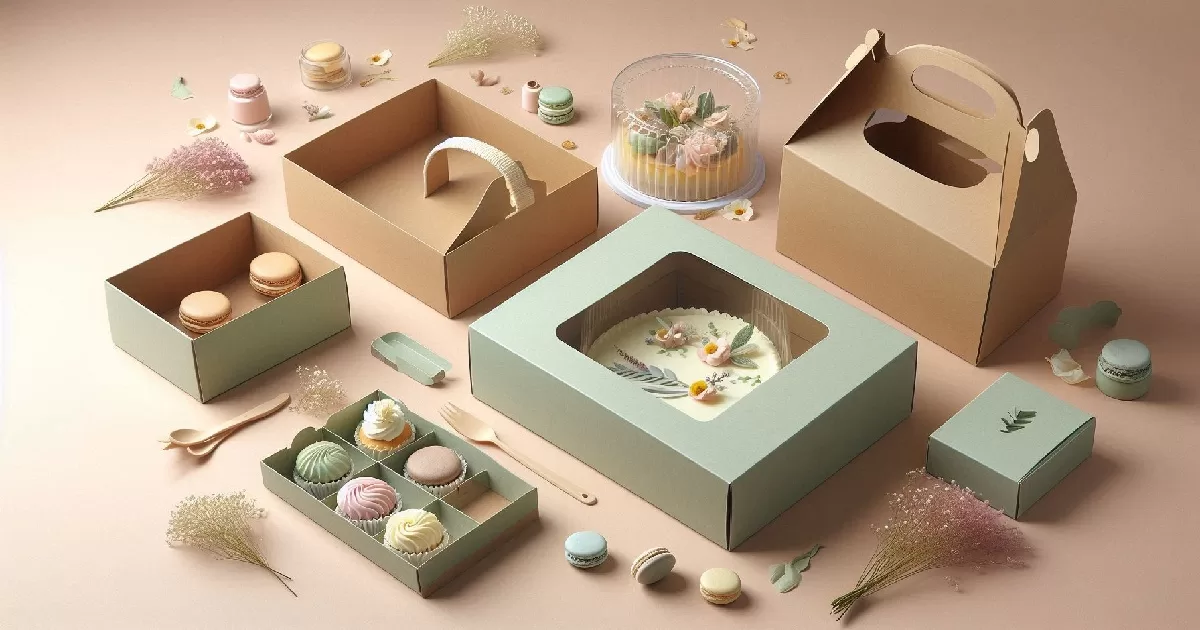
UGI Packaging is a specialist custom dessert takeaway box manufacturer based in Guangzhou, China, with over 18 years of production experience serving bakeries, patisseries, food-service brands, and retail chains across Europe, North America, and Southeast Asia. Our dessert packaging range spans 91 active SKUs across 7 structural categories, each engineered for a specific dessert type, presentation requirement, and distribution context.
The table below summarises all seven product families, their primary materials, typical applications, and available customisation dimensions. This overview is drawn directly from the production capabilities operating at UGI Packaging (ukugi.com) as of 2026.
| Category | Primary Material | Typical Application | Key Feature | MOQ |
|---|---|---|---|---|
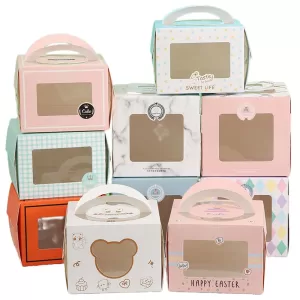
| Clear-Window Folding Carton | 300–400gsm white cardboard + PET window | Cupcakes, muffins, pastries, cookies | Product visibility + full-colour printing | 500 pcs |
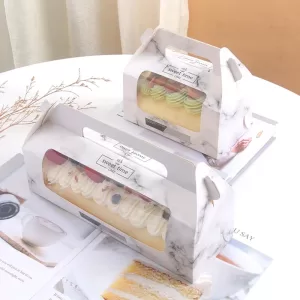
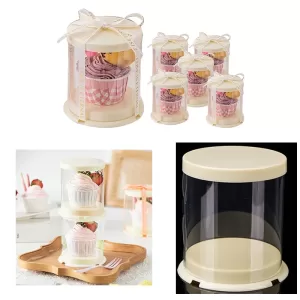
| Transparent PET/PVC Cylinder Box | Food-grade PET or PVC sheet | Swiss rolls, macarons, cake slices | Full 360° product display | 500 pcs |
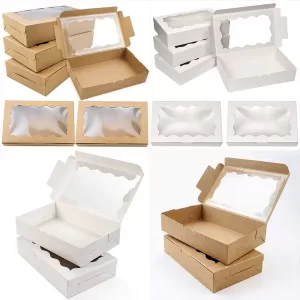
| Kraft Paper Dessert Box | 120–200gsm natural kraft + PVC window | Artisan bakery, eco-brand positioning | Sustainable aesthetic, flexo printable | 500 pcs |
| Plastic Tiramisu Cup & Lid | Food-grade PS or PET | Tiramisu, mousse, pudding, ice cream | Leak-proof lid + portion control | 1,000 pcs |
| Drawer-Style Gift Dessert Box | Kraft or white cardboard + PVC window | Premium gifting, holiday dessert sets | Sliding drawer, premium unboxing feel | 500 pcs |
| Cupcake Holder Tray Box | 300gsm white cardboard + PET window | 2-hole and 4-hole cupcake carriers | Internal tray insert, anti-tilt design | 500 pcs |
| Silicone Mold & Reusable Container | Food-grade platinum silicone or BPA-free PP | Baking molds, reusable cupcake liners | Heat-resistant to 230°C, non-stick | 1,000 pcs |
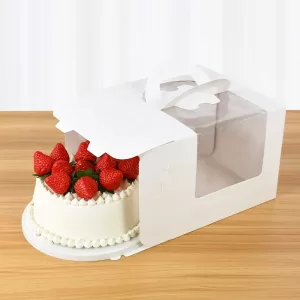
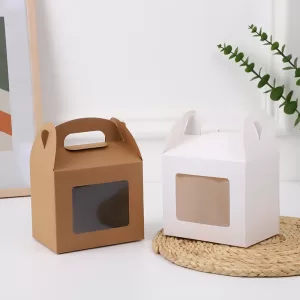
Each product category within the dessert takeaway box range serves a distinct commercial purpose. Bakeries and patisseries requiring strong shelf presence typically select the clear-window folding carton, which combines structural rigidity with visual merchandising value through the integrated PET display window. Food-service operators prioritising speed of service and volume handling lean towards the plastic tiramisu cup and lid format, which offers efficient stacking, portioning consistency, and leak-proof transportation security.
The kraft paper dessert box has grown significantly in demand since 2022 as European and North American brands intensify their commitment to sustainable packaging. UGI Packaging (ukugi.com) sources FSC-certified kraft stock and offers PE-free, grease-resistant paper coatings that maintain both the natural material aesthetic and practical food-contact performance. The drawer-style gift dessert box, meanwhile, targets the premium gifting segment — holiday hampers, corporate gifts, and occasion-specific dessert sets where the unboxing experience is as important as the product inside.
Box Structure Engineering — How Each Container Is Constructed
The structural integrity and functional performance of a dessert takeaway box are determined at the engineering stage — before any printing or surface finishing begins. UGI Packaging’s structural engineering team works in Artios CAD and Adobe Illustrator to produce precision dieline templates for every box format. Each dieline is optimised for three variables simultaneously: material yield efficiency (reducing substrate waste), structural performance under load, and compatibility with the factory’s automated gluing and folding lines.
Folding Carton with Integrated PET Window
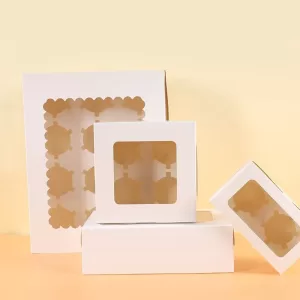
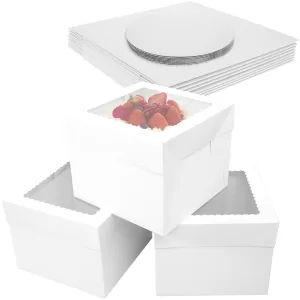
The clear-window folding carton is the most technically complex structure in the dessert packaging range. It consists of a scored and creased paperboard shell with a die-cut aperture into which a separate PET film panel is bonded using food-safe hot-melt adhesive. The critical engineering parameters are the aperture margin (minimum 4mm from the die-cut edge to the adhesive bond line), the PET film gauge (typically 250–350 micron for rigidity), and the base lock mechanism.
UGI Packaging uses three base-lock variants depending on the carton height and anticipated payload weight. For standard cupcake and muffin cartons (height under 120mm), a four-point auto-lock base is standard — this assembles without gluing, reducing labour costs for the end user. For taller cartons (120–200mm) carrying heavier items such as layered cakes or mousse desserts, a glued straight-tuck base is specified to prevent base failure during transport. Cartons above 200mm in height, used for celebration cakes, receive a crash-lock bottom with reinforced score lines at the four corner gussets.
Transparent Cylinder Box (PET/PVC Roll)
The transparent cylinder box — used extensively for Swiss rolls, Yule logs, macaron towers, and dome mousse desserts — is formed by heat-bending a flat sheet of food-grade PET or PVC into a cylindrical tube, with the seam ultrasonically welded or solvent-bonded along a 10–15mm overlap. A separate base disc and lid disc are either press-fit (for PVC) or friction-fit with a soft-touch rim (for PET), creating a fully sealed container without exposed adhesive.
UGI Packaging offers cylinder boxes in diameters from 60mm (single macaron) to 320mm (full celebration cake), and in heights from 80mm to 350mm. Wall gauge ranges from 0.3mm (flexible PVC for light confectionery) to 0.5mm (rigid PET for structural cake support). Custom printing on cylinder boxes is applied via sleeve-print labels or direct inkjet coding, since the curved surface is not compatible with flat offset printing sheets.
Drawer-Style (Sliding Tray) Box
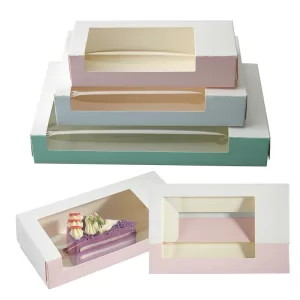
The drawer-style dessert box consists of two independent components: an outer sleeve (the shell) and an inner sliding tray. The outer sleeve is glued as a tube with open ends at both sides. The inner tray is a separate tray structure, typically with low walls (20–40mm) and an open top, that slides smoothly into and out of the sleeve. A thumb-notch die-cut in the sleeve side panel allows the consumer to push the inner tray outward for product access.

Plastic Cup and Lid Systems (Tiramisu, Mousse, Pudding)
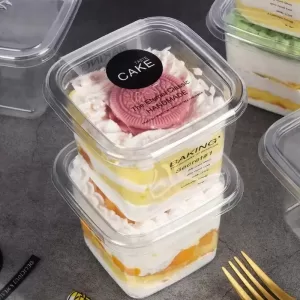
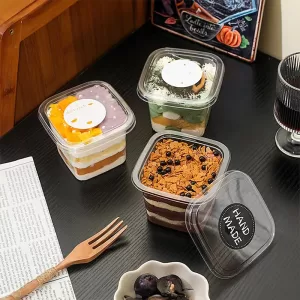
Plastic dessert cups at UGI Packaging are produced from food-grade polystyrene (PS) for cold-serve applications and from clarified polypropylene (PP) for applications requiring microwave compatibility. The cup body is either thermoformed (for high volumes, complex shapes) or injection-moulded (for rigid-wall cups with precise dimensional tolerances). Lids are snap-fit, designed with a positive engagement click that confirms a proper seal — critical for liquid-content desserts such as tiramisu, panna cotta, and crème brûlée.
Heart-shaped, round, square, and dome-lid variants are available within the plastic cup category. The heart-shaped transparent cup — a high-demand item in UGI Packaging’s range — is thermoformed from crystal-clear PET at 0.35mm gauge, providing scratch resistance and optical clarity superior to standard PVC. These are sold in multi-pack formats and are particularly popular with dessert catering operations and wedding confectionery suppliers.
Silicone Baking Molds and Reusable Liners
The silicone mold category serves a dual function: baking-stage mold and serving-stage container. UGI Packaging sources food-grade platinum-cured silicone for all mold products, which achieves FDA 21 CFR 177.2600 compliance and withstands continuous use temperatures from -60°C to +230°C. The non-stick surface releases desserts cleanly without greasing, reducing preparation time and improving portion consistency.
Cupcake-sized silicone liners are available in 10, 20, and 50-pack retail configurations, with custom colour options for branded hospitality operators. These are reusable across an estimated 1,000+ baking cycles under normal use conditions, providing a measurable cost and waste reduction versus single-use paper liners. Custom logo embossing on the exterior of silicone molds is available for corporate gifting and hospitality brand applications.
Material Selection Guide — Paper, Plastic & Composite Options
Material selection is the single most consequential decision in dessert packaging design. The substrate determines structural performance, food safety compliance, print quality ceiling, available surface finishes, and end-of-life recyclability. UGI Packaging maintains an approved material library of over 40 substrates validated for food-contact use, spanning paperboard grades, plastic films and sheets, composite laminates, and silicone compounds. The following guide covers every material category used across our dessert takeaway box range.
Paperboard Substrates
Paperboard is the primary structural material for the majority of UGI Packaging’s dessert box range. The factory uses three principal paperboard grades, each optimised for different performance requirements:
Grammage selection follows a direct relationship with carton height and anticipated payload. UGI Packaging’s structural engineering team applies the McKee formula for compression strength estimation during the design phase, selecting minimum grammage values that meet a 5:1 safety factor against stacking loads anticipated during transport and retail storage. For dessert boxes exceeding 180mm in height and carrying products above 500g, a minimum of 350gsm SBS or 400gsm WCD is specified.

Plastic Substrates for Transparent Containers
The transparent dessert container category at UGI Packaging spans four distinct plastic materials, each with different optical, thermal, and food-safety properties. Selecting the correct plastic is critical for compliance, performance, and cost optimisation.
| Material | Clarity | Temp. Range | Food Contact | Best For | Recyclable |
|---|---|---|---|---|---|
| PET (Polyethylene Terephthalate) | Crystal-clear, glass-like | -40°C to +70°C | FDA & EU approved | Window panels, cylinder boxes, tiramisu cups | Yes (PETE #1) |
| PP (Polypropylene) | Translucent to clear (clarified grade) | -20°C to +120°C | FDA & EU approved | Microwave-safe cups, hot dessert containers | Yes (PP #5) |
| PS (Polystyrene) | Clear (crystal PS grade) | -20°C to +70°C | FDA approved (cold use) | Cold mousse cups, ice cream containers | Limited (PS #6) |
| PVC (Polyvinyl Chloride) | High clarity, flexible | -15°C to +60°C | Food-grade grades only | Window panels, small cylinder boxes, gift wrapping | Not widely recycled |
PE Coating and Composite Laminates
A significant proportion of UGI Packaging’s dessert boxes incorporate a polyethylene (PE) extrusion coating applied to the interior face of the paperboard. This PE coating — applied at 15–25gsm — creates a grease-resistant, moisture-barrier layer that prevents oil migration from butter-rich pastries, cream-filled desserts, and chocolate confectionery from seeping through the carton walls. PE-coated boards are the food-safe standard for bakery cartons across the EU and North American markets.
For clients requiring compostable or recyclable packaging without PE coating, UGI Packaging offers two alternatives. The first is an aqueous barrier coating applied inline during the printing process — this provides grease resistance equivalent to approximately 50% of a full PE coat, suitable for dry pastries and cookies but not for wet-filling desserts. The second option is a PLA (polylactic acid) bioplastic coating, which is certified industrially compostable under EN 13432 and provides moisture resistance comparable to standard PE, though at a 20–30% cost premium.
Silicone Material Specifications
All silicone products manufactured by UGI Packaging use platinum-cured (addition-cure) silicone rather than peroxide-cured silicone. The distinction is critical for food-contact applications: platinum-cured silicone contains no residual peroxide byproducts, passes LFGB (German food contact standard) and FDA 21 CFR 177.2600 migration testing, and maintains its non-stick and non-reactive properties across an extended service life. The platinum curing process also allows for the production of silicone in any custom colour without affecting food safety compliance, enabling branded hospitality operators to commission colour-matched silicone baking cups and molds.
Standard silicone hardness for baking molds is 40–50 Shore A — firm enough to hold shape when filled with liquid batter, yet flexible enough to release baked products by manual inversion without structural deformation. For ultra-fine detail molds such as chocolate decoration shapes or petit four molds, a softer 30 Shore A compound is used to capture surface detail at sub-millimetre resolution.
Printing Capabilities — From Brand Logo to Full-Bleed Artwork
Print quality on dessert packaging is a direct proxy for brand credibility in the consumer’s mind. A patisserie investing in premium ingredients and skilled craftsmanship needs packaging that communicates equivalent quality at first glance. UGI Packaging operates three distinct printing technologies — offset lithography, flexographic printing, and digital printing — each suited to different substrate types, run lengths, and artwork complexity levels. Understanding which process applies to which scenario enables buyers to make cost-effective decisions without compromising print quality.
Offset Lithographic Printing
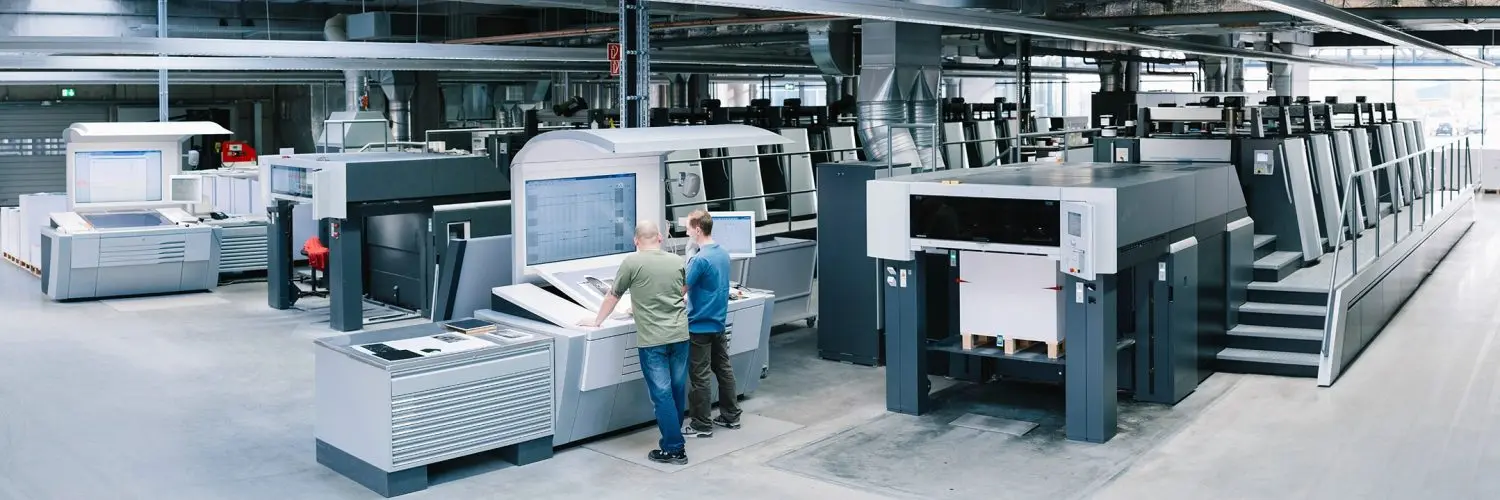
Offset lithography is the primary printing process for coated paperboard dessert boxes at UGI Packaging. The process transfers ink from a metal printing plate to a rubber blanket, then from the blanket to the substrate — the indirect transfer being the origin of the “offset” name. This intermediate rubber blanket stage is what makes offset exceptional on coated boards: it conforms to minor surface variations and delivers consistent, high-density ink films that produce vivid CMYK halftone images and precise Pantone spot colours.
The factory operates 4-colour and 6-colour offset press configurations. Standard dessert box artwork is printed CMYK (4-colour process), which can reproduce approximately 70% of the Pantone colour gamut. For brand-critical colours — particularly the specific greens, pastry pinks, and chocolate browns that feature prominently in patisserie branding — a 5th and 6th unit can be dedicated to Pantone spot colours, achieving exact colour matches that CMYK process printing cannot guarantee. This is particularly important for bakery chains and franchise operators who require colour consistency across packaging produced in multiple production runs over months or years.
Flexographic Printing
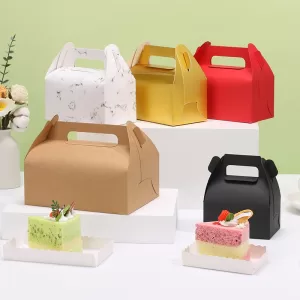
Flexographic printing uses flexible photopolymer plates that make direct contact with the substrate, making it the only viable high-volume printing method for absorbent, uncoated surfaces such as natural kraft paper. UGI Packaging’s flexo lines support up to 8 colour stations and use water-based, solvent-free ink systems that are inherently food-safe and compatible with kraft paper’s moisture sensitivity.
While flexographic printing cannot match offset’s halftone resolution for photographic imagery, it is entirely adequate for the graphic language typical of artisan and eco-positioned bakery brands — bold typography, geometric patterns, flat colour illustrations, and two-colour logo artwork. Line resolution up to 133 lpi is achievable on coated kraft surfaces, sufficient for detailed brand mark reproduction and fine script typefaces at point sizes above 8pt.
Flexo is also the preferred process for printing interior surfaces — for example, the inside of a dessert box lid, where brand messaging or serving instructions are printed directly on the food-facing surface. Water-based flexo inks in this application are tested for set-off resistance (the transfer of ink from printed surface to food surface) to the standards specified in the FSC certification framework and EuPIA guidelines.
Digital Inkjet Printing
Digital inkjet printing at UGI Packaging serves two distinct functions: prototyping and short-run production. For the sample approval stage, digital printing allows UGI Packaging to produce a fully representative printed sample within 24–48 hours of artwork file approval, without the cost and lead time of plate making. This dramatically accelerates the product development timeline for new dessert packaging launches and seasonal limited editions.
For production runs below approximately 300 units — where the plate cost of offset would make per-unit economics unviable — digital printing provides a cost-effective alternative. Resolution reaches 1,200 dpi, producing print quality visually indistinguishable from offset on coated substrates at normal viewing distances. Digital printing also enables variable data printing: each box in a run can carry unique information such as batch codes, date codes, QR codes, or personalised messages, without any press changeover cost.
Colour Management and Pantone Matching
Colour consistency across production runs is a fundamental requirement for any food brand with established packaging guidelines. UGI Packaging operates a closed-loop colour management system: all offset presses are calibrated to ISO 12647-2 (offset lithography printing standard) using spectrophotometric densitometry. Proof prints produced before each production run are measured against the approved standard and must achieve a Delta E (ΔE) of 2.0 or less before press approval is granted.
For Pantone spot colours — common in premium dessert packaging for brand-signature shades — UGI Packaging maintains a library of over 1,800 Pantone Matching System (PMS) formulations in-house. Ink mixing is performed gravimetrically using calibrated dispensing equipment, and the mixed ink is spectrophotometrically verified against the Pantone standard before press loading. This process eliminates the batch-to-batch colour variation that can occur with volume ink mixing.
Artwork File Requirements and Pre-Press Process
UGI Packaging accepts artwork files in Adobe Illustrator (.ai), Adobe InDesign (.indd), and high-resolution PDF/X-4 format. All artwork must be supplied at 1:1 scale with a minimum resolution of 300 dpi for raster elements. Fonts must be outlined or embedded. Bleed should extend a minimum of 3mm beyond the trim line on all sides, with all critical brand elements (text, logos, key imagery) kept at least 5mm inside the trim line to account for cutting tolerance.
The pre-press team at UGI Packaging performs a full file preflight check on every artwork submission, verifying colour mode (CMYK for process, Pantone for spot), image resolution, overprint settings, and dieline layer compliance. A preflight report is returned to the client within one business day, flagging any issues requiring correction before plate making proceeds. For clients without in-house design capability, UGI Packaging (ukugi.com) provides free dieline templates for all standard SKUs and can arrange a complete artwork design service on request.
Surface Finish Options — Coating, Lamination & Specialty Effects
Surface finishing is the stage that transforms a printed dessert box from functional packaging into a brand asset. The finish applied to the exterior of a dessert takeaway box directly influences the consumer’s tactile and visual perception of the product inside — a matte laminated kraft box communicates artisan authenticity; a gloss UV-coated white carton with gold foil stamping signals celebration and luxury. UGI Packaging operates a full suite of post-print surface finishing processes in-house, enabling end-to-end production control without subcontracting delays.
Matte and Gloss Lamination
Film lamination is the most widely applied surface finish across UGI Packaging’s dessert box range. A thin BOPP (biaxially oriented polypropylene) film — either matte or gloss — is thermally bonded to the printed outer surface of the carton under heat and pressure. This laminate film serves four simultaneous functions: it protects the printed ink from scratching and moisture during handling; it enhances colour vibrancy (gloss) or creates a sophisticated low-reflectance surface (matte); it adds structural rigidity to the carton wall; and it provides a cleanable, wipe-resistant exterior surface.
Gloss lamination amplifies ink colour saturation by approximately 15–20% compared to an unlaminated surface, making it the preferred choice for dessert boxes featuring photographic food imagery, vibrant gradient artwork, or rich dark backgrounds. Matte lamination, conversely, reduces surface reflectance to near zero, producing the understated, premium aesthetic favoured by high-end patisseries, luxury chocolate brands, and Scandinavian-aesthetic bakeries. The matte surface also provides a natural writing surface for hand-labelling by bakery staff — a practical advantage in independent bakery operations.

Spot UV Coating
Spot UV is a selective coating process in which ultraviolet-curable varnish is applied to specific defined areas of the printed surface — rather than the entire surface — using a silkscreen or digital UV coating unit. The UV varnish cures instantaneously under UV lamp exposure to produce a raised, high-gloss surface with a distinctly three-dimensional tactile quality. When applied over a matte laminated background, spot UV creates a dramatic contrast between the flat matte base and the gloss raised highlight, without any additional colour being introduced.
For dessert packaging, spot UV is most effectively used to highlight brand logos, product names, decorative border patterns, or illustrative elements that represent the dessert product — a chocolate swirl, a strawberry, a macaron tower. The technique is particularly powerful on dark-background packaging where the UV varnish creates a subtle embossed effect visible only at certain viewing angles, producing what packaging designers refer to as a “reveal” effect that rewards close examination.
UGI Packaging applies spot UV using two methods: conventional silkscreen-based spot UV (for standard artwork geometries) and digital spot UV coating (for complex, fine-detail artwork where silkscreen exposure accuracy would be insufficient). Digital spot UV achieves a positional accuracy of ±0.3mm, enabling reliable coverage of fine serif typefaces and intricate illustrative details at point sizes as small as 6pt.
Hot Foil Stamping
Hot foil stamping — also referred to as hot stamping or foil blocking — applies a metallic or pigmented foil to the carton surface using a heated die pressed under controlled pressure. The die transfers the foil from its carrier film to the substrate at the precise areas defined by the die shape, creating a fully opaque, highly reflective metallic surface that no printing process can replicate. Gold and silver are the dominant foil colours in dessert packaging, though UGI Packaging maintains a foil library spanning rose gold, copper, holographic prismatic, matte gold, and custom-matched brand colours.
Pearlescent Coating
Pearlescent coating applies a thin layer of mica-based iridescent pigment particles to the carton surface, creating an interference colour effect that shifts in appearance as the viewing angle changes. Unlike metallic foils, which produce a single fixed reflective colour, pearlescent coatings produce a living, shifting visual quality — a cream-coloured dessert box might appear white in direct light, shift to a warm champagne gold at 45 degrees, and reveal a subtle rose tint at oblique angles. This dynamic visual behaviour is particularly effective for dessert packaging targeting wedding, anniversary, and premium gifting contexts.
UGI Packaging applies pearlescent coating using a specialised roller coating unit that delivers a consistent wet film weight of 4–6 gsm across the carton surface. The coating is applied over a base print layer and then cured using infrared drying. The particle size distribution of the mica pigment determines the intensity and angle-range of the interference effect: fine particles (5–15 micron) produce subtle, silky sheen effects; coarse particles (20–60 micron) produce bold, dramatic sparkle effects with a wider colour-shift range. Both particle grades are available in UGI Packaging’s standard pearlescent finish portfolio. For more detailed technical specifications, refer to our surface finish manufacturing guide.
Embossing and Debossing
Embossing raises selected areas of the carton surface above the surrounding plane by pressing the substrate between a male die and a female counter-die under high pressure. Debossing achieves the inverse — pressing selected areas below the surrounding surface. Both processes create a three-dimensional relief effect that adds tactile dimension to the packaging design without any additional ink or coating material. On unprinted or solid-colour carton panels, embossing and debossing can function as the sole decorative element — particularly effective for luxury brands seeking extreme minimalism.
For dessert packaging, blind embossing (embossing without any ink or foil overlay) is commonly applied to brand monograms, bakery crests, decorative borders, and structural pattern elements on the carton lid or sleeve. Combination effects — embossing plus foil stamping, or embossing plus spot UV — are also frequently specified, creating a multi-sensory surface where the metallic or gloss element aligns precisely with the raised relief form. UGI Packaging produces combination dies that execute foil stamping and embossing in a single press pass, reducing production time and ensuring perfect positional registration between the two effects.
| Finish | Effect | Compatible Substrates | Relative Cost | Lead Time Impact |
|---|---|---|---|---|
| Gloss Lamination | High-gloss, colour-enhancing, scratch-resistant | WCD, SBS, coated kraft | $ (base) | +1 day |
| Matte Lamination | Low-gloss, premium understated aesthetic | WCD, SBS, kraft | $ (base) | +1 day |
| Soft-Touch Matte | Velvet tactile sensation, ultra-matte | WCD, SBS | $$ (+8–12%) | +1 day |
| Spot UV | Selective high-gloss raise on matte base | Laminated WCD, SBS | $$ (+15–20%) | +1–2 days |
| Hot Foil Stamping | Metallic gold, silver, rose gold, holographic | WCD, SBS, kraft | $$$ (+25–40%) | +2–3 days (die making) |
| Pearlescent Coating | Iridescent angle-shift sheen | WCD, SBS, coated kraft | $$ (+18–25%) | +1–2 days |
| Embossing / Debossing | Three-dimensional relief, tactile depth | WCD, SBS (min. 300gsm) | $$$ (+20–35%) | +2–3 days (die making) |
Design Capabilities — OEM/ODM from Dieline to Production
The difference between a manufacturer that prints boxes and a packaging partner that solves business problems lies in design capability. UGI Packaging operates a dedicated structural design and graphic design team whose output integrates directly with the factory’s production workflow — ensuring that every design decision made at the concept stage is both aesthetically effective and production-viable. This integrated design-to-manufacture capability eliminates the common problem of designs that look excellent in a client presentation but require costly modifications when they reach the production floor.
Structural Design Process
Every custom dessert box at UGI Packaging begins with a structural brief that captures four parameters: the product dimensions and weight, the intended distribution channel (retail shelf, food delivery, catering, gifting), the target brand positioning, and the budget constraints. From this brief, the structural design team produces an initial dieline in Artios CAD — the industry-standard structural packaging CAD system — within 2–3 business days for standard box formats and 3–5 business days for complex or novel structures.
The Artios CAD dieline defines every score line, cut line, perforation, glue flap, and window aperture in the box with dimensional accuracy to 0.01mm. The dieline is then exported as a 3D virtual fold — a real-time computer simulation of the box in its assembled form — which is shared with the client for review before any physical material is cut. This virtual proofing stage eliminates the cost and lead time of producing a physical prototype for simple structural amendments, reserving physical sampling for the final approved structure.
Graphic Design and Artwork Service
For clients without established packaging artwork or an in-house design team, UGI Packaging offers a complete graphic design service covering brand identity application, illustration, typography layout, and colour management for dessert packaging. The graphic design team works in Adobe Illustrator and Photoshop, producing production-ready artwork files in the correct colour mode, resolution, and bleed specification for direct transfer to the pre-press department.
The graphic design service operates on a structured brief process. The client provides brand assets (logo files, brand colour specifications, existing brand guidelines if available) and a creative direction reference (mood board, competitor examples, or a written description of the intended aesthetic). The design team produces two or three initial concept directions within 3–5 business days, each presented as a 3D virtual mockup overlaid on the structural dieline. One or two rounds of revision are included in the standard design service before production artwork is finalised.
For brands with established packaging artwork requiring only localisation or minor adaptation — for example, translating existing box artwork from one language to another, resizing artwork from one box format to a new dimension, or adapting seasonal artwork for a standard structural template — UGI Packaging’s pre-press team can complete artwork adaptation within 1–2 business days at a significantly reduced service cost. This rapid adaptation capability supports multi-market bakery brands and franchise operators who need to localise standard packaging artwork across different country markets efficiently.
Free Dieline Templates and Self-Service Design
For clients with in-house design capability, UGI Packaging provides free structural dieline templates for all standard dessert box SKUs in Adobe Illustrator format. Each template includes clearly labelled cut lines, score lines, glue zones, safe areas, bleed boundaries, and print zones, enabling the client’s own design team to build artwork directly onto the production-ready dieline without any structural engineering input from UGI Packaging.
Dieline templates are supplied with a companion technical specification sheet documenting the correct substrate, print process, and finishing sequence for the box in question. This documentation package enables clients to commission artwork from their preferred design agency with confidence that the resulting artwork will be compatible with UGI Packaging’s production requirements. All dieline templates are available on request through the UGI Packaging custom service page.
OEM vs ODM: Choosing the Right Design Path
UGI Packaging provides: Production, finishing, QC, delivery
Best for: Brands with established packaging design teams
Sample lead time: 5–7 working days
Design cost: Zero (client-supplied artwork)
UGI Packaging provides: Structural design + graphic design + production
Best for: Brands without in-house packaging design capability
Sample lead time: 10–14 working days (design + sample)
Design cost: Quoted per project scope
The full design-to-production workflow at UGI Packaging — from initial client brief through structural CAD, 3D virtual proofing, physical sampling, artwork approval, production, QC, and delivery — is documented in detail on the OEM and ODM solutions resource section of the UGI Packaging website. Clients new to custom packaging procurement are encouraged to review this resource before submitting an enquiry, as familiarity with the workflow significantly accelerates the early project stages.
Manufacturing Process — From Raw Material to Finished Container
Manufacturing a custom dessert takeaway box to a consistent, repeatable standard requires the precise coordination of seven sequential production stages, each with its own process parameters, equipment tolerances, and quality gates. UGI Packaging operates an integrated manufacturing facility in Guangzhou’s Huadu District with over 200 employees, combining paper packaging production, plastic forming, surface finishing, and assembly under one roof. This single-site integration eliminates inter-factory logistics delays and ensures process accountability at every stage of production.
Stage 1 — Raw Material Intake and Verification
Every production run at UGI Packaging begins with incoming material inspection. Board stock, plastic sheet, foil rolls, and ink supplies are received from approved suppliers and subjected to a documented inspection protocol before being released to the production floor. For paperboard, this inspection includes grammage verification (measured gravimetrically against the purchase specification), moisture content measurement (target: 5–8% for stable production performance), caliper measurement (board thickness, which affects score quality and carton rigidity), and surface smoothness assessment (critical for print quality on coated grades).
Plastic substrates — PET sheet for window panels and cylinder boxes, PP and PS for formed cups — are verified for gauge consistency using contact micrometry, optical clarity assessment, and where required, a migration pre-test certificate from the supplier’s own quality documentation. Any material lot that fails incoming inspection is quarantined and returned to the supplier; substitute material from an alternative approved source is requested before production proceeds. This zero-compromise incoming inspection protocol is a defining element of UGI Packaging’s quality system and the first line of defence against non-conforming finished product.
Stage 2 — Printing
Board stock released from incoming inspection is fed to the appropriate printing line — offset, flexographic, or digital — based on the job specification. For offset printing, the board is loaded onto the press feeder in pre-cut sheet form, typically 720mm × 1,020mm for standard dessert box formats. The press operator performs a make-ready sequence that includes registration adjustment, ink density calibration using a spectrophotometric densitometer, and a trial print run of 50–100 sheets before production approval.
The production press operator monitors colour density and registration at defined intervals — every 500 sheets for standard runs, every 250 sheets for premium jobs with tight colour specifications. Density readings are logged in the job record card and must remain within ±0.05 of the approved standard across all four CMYK channels. Any sheet batch falling outside this tolerance is held for supervisor review before proceeding to the lamination stage. All approved print sheets are stacked, banded, and transferred to the finishing department within the same shift to maintain humidity-controlled conditions and prevent moisture-related sheet curl.
Stage 3 — Lamination and Surface Finishing
Printed sheets pass through the lamination unit, where BOPP film is thermally bonded to the print surface under controlled temperature (typically 80–100°C for matte laminate, 90–110°C for gloss laminate) and nip pressure. The laminated sheets are conditioned on a flat stack for a minimum of 4 hours before proceeding to further processing — this conditioning period allows residual heat from the lamination process to dissipate and the adhesive bond to reach full cure strength before the substrate is subjected to the mechanical stresses of die-cutting and folding.
Specialty finishing operations — spot UV, hot foil stamping, pearlescent coating, and embossing — are performed in sequence following lamination. Each finishing stage requires a setup approval from the QC technician before full production commences. For hot foil stamping, the setup approval includes a visual inspection of foil transfer completeness across the full die area, an adhesion test (foil is subjected to a tape-pull test; no transfer to tape = approved), and a dimensional check of foil position relative to the printed artwork (tolerance: ±0.5mm).
Stage 4 — Die-Cutting and Creasing
Die-cutting converts the flat, finished print sheet into the precise flat blank shape from which the box will be folded and glued. UGI Packaging operates both flatbed die-cutting presses (for standard box formats and lower-volume runs) and rotary die-cutting lines (for high-volume runs above 50,000 units, where rotary cutting provides significant throughput advantages). Flatbed dies are steel-rule tooling made to the Artios CAD dieline specification, with cutting rules, creasing rules, and perforation rules set into a phenolic wood carrier board.
Cutting rule sharpness is maintained through a scheduled replacement protocol based on impression count — standard cutting rules are replaced after approximately 200,000 impressions, with earlier replacement triggered if edge quality monitoring detects cutting force increase or burr formation on the cut edge. Creasing rules are monitored for deformation that would affect score quality — a degraded crease produces inconsistent fold angles and can cause carton wall misalignment during assembly.
Window aperture cutting — the die-cut opening into which the PET or PVC window film is bonded — requires a clean, burr-free cut edge to ensure that the adhesive bond between the film and the carton margin is consistent around the full aperture perimeter. UGI Packaging specifies a minimum aperture margin of 4mm between the cut edge and the bond line, and window die-cut edges are inspected under magnification (10× loupe) at the beginning of each production run to verify cut quality before window insertion commences.
Stage 5 — Window Insertion and Gluing
Window insertion is performed either manually (for complex window shapes and lower-volume runs) or semi-automatically (for standard rectangular and oval windows on runs above 5,000 units). The PET or PVC window panel is cut to size from roll stock, aligned to the aperture, and bonded using food-safe hot-melt adhesive applied in a continuous bead around the aperture margin. The bond is pressed for 3–5 seconds to ensure full adhesive coverage and eliminate air pockets between the film and the board.
Straight-line gluing — the folding and sealing of the side seam of the carton — is performed on an automatic folding-gluing machine that folds the scored blank along its crease lines and applies a precisely metered bead of cold glue to the glue flap. The glued seam is compressed between belts under controlled pressure for a defined dwell time before the completed flat carton is ejected and stacked. Production speed on the folding-gluing line is typically 60,000–80,000 cartons per hour for standard dessert box formats, ensuring efficient throughput without compromising glue bond integrity.
Stage 6 — Plastic Container Forming
Transparent plastic containers — tiramisu cups, cylinder boxes, and dome-lid containers — are produced on separate thermoforming or injection moulding lines within the same facility. Thermoforming heats a flat sheet of PET, PP, or PS to its softening temperature and then draws it into a mould cavity under vacuum pressure, producing a formed cup or tray of precise interior dimensions. The formed parts are trimmed to final dimensions on an in-line trim press and stacked for lid matching and leak testing.
Injection moulding is used for rigid-wall cup formats and snap-fit lid components where dimensional precision requirements exceed what thermoforming can reliably achieve. The injection moulding process injects molten plastic into a closed steel mould under high pressure, producing parts with tolerances of ±0.1mm on critical dimensions — the snap-fit engagement geometry of the lid is the most critical dimension, as it determines both the ease of lid application (consumer experience) and the seal integrity of the closed container (food safety performance).
Stage 7 — Packaging, Counting, and Dispatch
Finished dessert boxes are counted, bundled, and packed into master shipping cartons by the dispatch team. Standard pack configurations are defined by box size and carton type — folding cartons are packed flat in counts of 50, 100, or 200 per master carton; assembled plastic cups are nested and packed in sleeve-wrapped stacks of 25 or 50. Master cartons are labelled with production batch codes, quantity, client reference, and destination information to enable full traceability from dispatch back to the production batch and raw material lot.
Shipping carton specification is calculated based on the stack compression load the master carton will experience during sea freight or air freight transport. UGI Packaging uses double-wall corrugated board (BC or EB flute) for master cartons containing tall or heavy dessert box formats, and single-wall corrugated (B or C flute) for lighter folding carton formats. Each master carton configuration is tested to confirm it meets the minimum ECT (Edge Crush Test) value required for the anticipated stacking load during transit.
Quality Control Standards — Testing Protocols & Certifications
Quality control in food packaging manufacturing carries a higher standard of consequence than in general consumer packaging: a structural failure in a dessert box does not merely damage a brand’s reputation — it can compromise food safety, contaminate the product, and create regulatory liability. UGI Packaging operates a three-stage quality control system that covers incoming materials, in-process production, and pre-shipment inspection, underpinned by ISO 9001:2015 certification and a documented quality management system maintained across all production departments.
Stage 1 QC — Incoming Material Inspection
As described in the manufacturing process section, all raw materials undergo documented incoming inspection before production release. The incoming QC records — including supplier certificates, measurement data, and inspection pass/fail decisions — are retained for a minimum of three years as part of UGI Packaging’s traceability documentation system. This retention period enables full material lot traceability in the event of a product quality investigation, including the ability to identify all production batches that used a specific incoming material lot and to notify affected clients if a material non-conformance is identified retrospectively.
Supplier qualification is an ongoing process at UGI Packaging. New material suppliers must pass an initial qualification audit that includes factory inspection, quality system assessment, and submission of material samples for laboratory testing before their materials are approved for production use. Approved suppliers are re-evaluated annually based on their delivery performance, incoming inspection pass rate, and response to non-conformance notifications. Suppliers whose performance falls below defined thresholds are placed on a corrective action programme or removed from the approved supplier list.
Stage 2 QC — In-Process Inspection
In-process quality inspection occurs at five defined control points within the production sequence: after printing, after lamination, after specialty finishing, after die-cutting, and after gluing/assembly. At each control point, a defined sample size is inspected against a documented specification, and the results are recorded in the job traveller document that accompanies the production batch through the facility.
Stage 3 QC — Pre-Shipment Inspection and Structural Testing
Pre-shipment inspection is conducted on every completed production order before packing into master shipping cartons. The inspection follows an AQL (Acceptable Quality Level) 2.5 sampling plan per ISO 2859-1, which defines the sample size and acceptance criteria for each order quantity. At AQL 2.5, an order of 5,000 units would require inspection of 200 units, with a maximum of 10 non-conforming units accepted before the batch is classified as requiring 100% re-inspection or rework.
The pre-shipment inspection checklist covers appearance attributes (print quality, surface finish, colour accuracy, cleanliness), dimensional attributes (box dimensions, window size and position, handle placement), structural attributes (fold quality, glue bond strength, base lock engagement), and functional attributes (the box can be erected, loaded, and closed as intended without failure). Each attribute is classified as either a Critical defect (food safety impact — immediate rejection and rework), Major defect (functional failure — subject to AQL 2.5 limits), or Minor defect (cosmetic imperfection — subject to AQL 4.0 limits).
Food Safety Testing and Compliance Documentation
Food packaging imposes a compliance dimension on quality control that goes beyond the structural and cosmetic parameters relevant to non-food packaging. Every material used in direct or indirect food contact must be validated for migration safety — the assurance that chemical substances from the packaging material do not transfer to the food in quantities that could be hazardous to human health or alter the food’s taste, odour, or appearance.
UGI Packaging maintains migration test certificates for all food-contact materials in its approved material library. These certificates, issued by accredited third-party laboratories, test for overall migration (the total quantity of substances that transfer from the material to a food simulant under defined conditions) and specific migration of listed substances of concern (including heavy metals, photoinitiators, primary aromatic amines, and plasticisers). The test methods follow EU Regulation No. 10/2011 for plastic materials and EU Regulation No. 1935/2004 for food contact materials in general.
For clients operating in markets with specific additional regulatory requirements — the UK post-Brexit food contact framework, FDA requirements for the US market, or LFGB standards for the German market — UGI Packaging can provide supplementary test documentation or arrange additional third-party testing. Material compliance documentation is provided as part of the standard order documentation package and is included in the shipment paperwork for all food-contact dessert packaging orders.
ISO 9001:2015 Certification and Continuous Improvement
UGI Packaging holds ISO 9001:2015 certification, the international standard for quality management systems. The certification scope covers the design, development, manufacture, and supply of custom printed packaging products. ISO 9001 certification requires a documented quality management system including defined processes, measurable quality objectives, internal audit programmes, management review, and a structured approach to non-conformance investigation and corrective action.
The factory’s internal audit programme conducts a full audit of each production department on a rolling six-month cycle, with focused audits triggered by any non-conformance event that reaches the pre-shipment stage. Non-conformances that escape to the pre-shipment stage are subject to an 8D (Eight Disciplines) root cause analysis process, producing documented corrective actions that are verified at the next internal audit. This closed-loop corrective action system is the mechanism by which UGI Packaging’s quality performance improves incrementally with each production cycle, reducing defect rates and improving first-time-right performance year on year.
| Test | Method / Standard | Acceptance Criterion | Applies To |
|---|---|---|---|
| Colour Accuracy | Spectrophotometry · ISO 12647-2 | ΔE ≤ 2.0 vs approved standard | All printed paperboard boxes |
| Laminate Adhesion | 180° peel test · ASTM D903 | No delamination at fold lines | All laminated cartons |
| Compression Strength | Box Compression Test · ASTM D642 | 5:1 safety factor vs max. stack load | Tall cartons, multi-tier shipping |
| Drop Test | ASTM D5276 · 60cm drop, 3 orientations | No structural failure; product retained | Handled boxes, tall celebration cake cartons |
| Seal Integrity | Internal pressure / dye penetration test | Zero leakage at 1.5× normal fill pressure | Plastic cups with snap-fit lids |
| Migration (Overall) | EU Reg. 10/2011 · Simulant testing | ≤ 10 mg/dm² overall migration limit | All food-contact plastic components |
| Ink Adhesion | Cross-hatch tape test · ISO 2409 | 0–1 classification (≤5% ink removal) | All printed surfaces |
Ordering Process & Related Resources
Sourcing custom dessert takeaway boxes from UGI Packaging follows a structured six-step process designed to move clients efficiently from initial enquiry to confirmed production order while ensuring that every specification — structural, material, print, and finish — is fully validated before any production investment is made. The following guide outlines each step and the typical timeline associated with it.
Related Product Resources
Clients sourcing dessert takeaway boxes from UGI Packaging frequently also require complementary food packaging products. The following resources from the UGI Packaging food packaging range are relevant to dessert packaging buyers:
Why Source From UGI Packaging — Industry Credentials & Advantages
The global food packaging market exceeded USD 411 billion in 2024 and is projected to expand at a compound annual growth rate of 5.2% through 2030, driven by the continued growth of food delivery platforms, the premiumisation of bakery and dessert categories in retail, and increasing regulatory requirements for food-safe packaging materials across major markets. Within this expanding market, the choice of manufacturing partner determines not just unit cost, but the quality ceiling, compliance reliability, and design capability available to a food brand.
Single-Source Manufacturing Advantage
Many packaging suppliers operating in the dessert and bakery market are trading companies — they source product from multiple factories, mark up the cost, and manage the client relationship. UGI Packaging is a direct manufacturer: the factory that quotes the price is the factory that produces the product. This single-source relationship provides three measurable advantages over trading company supply chains. First, pricing is at factory cost without intermediary margin — typically 15–25% lower than equivalent products sourced through trading companies. Second, quality accountability is direct: when a production issue arises, UGI Packaging’s own QC team and production management address it immediately, without the communication delays inherent in a three-party supply chain. Third, design capability is integrated: the structural engineers and graphic designers who created the specification work in the same building as the press operators and QC inspectors who produce it.
Flexible MOQ and Scalable Production
UGI Packaging’s production structure is designed to serve both growing independent brands and established food chains. Minimum order quantities start from 500 units per SKU for standard folding carton formats — low enough to be accessible to independent bakeries and patisseries at the scaling stage, yet with production efficiency that keeps unit costs competitive at these volumes. As order volumes increase, the unit cost reduces progressively: a 5,000-unit run typically carries a 20–30% lower unit cost than a 500-unit run of the same product, reflecting the amortisation of setup costs across a larger production quantity.
For established clients with regular, predictable demand — bakery chains, food-service operators, subscription box businesses — UGI Packaging offers blanket order arrangements under which an annual quantity is contracted at a fixed price, with individual release orders called off against the blanket in defined increments throughout the year. This arrangement provides the client with price stability, guaranteed production capacity, and reduced per-unit costs, while enabling UGI Packaging to optimise production scheduling across the year. Blanket order clients are assigned a dedicated account manager who monitors stock levels and triggers production releases to ensure continuous supply without the client needing to manage production timing manually.
Sustainability Commitment
The dessert packaging market is subject to accelerating regulatory and consumer pressure to reduce plastic use and improve end-of-life recyclability. UGI Packaging has responded to this pressure through a structured sustainability programme that includes FSC-certified paper sourcing for all kraft and white board substrates, PE-free aqueous barrier coating options for grease-resistant paperboard packaging, PLA bioplastic coating as a compostable alternative to PE laminate, and a product development roadmap focused on increasing the recyclable content across the plastic container range.
For clients operating under Extended Producer Responsibility (EPR) regulations in the UK, EU, or other markets, UGI Packaging provides material composition declarations for all packaging products in the format required by national EPR reporting systems. These declarations specify the weight and material type of each packaging component, enabling clients to accurately report their packaging tonnage and material composition to the relevant national EPR scheme administrator. Sustainability documentation is provided as a standard part of the order package at no additional charge.
Global Export and Logistics Capability
UGI Packaging exports to over 30 countries across Europe, North America, Australia, the Middle East, and Southeast Asia. The export documentation team is experienced in the customs and regulatory requirements of all major destination markets, including CE marking requirements for food-contact materials entering the EU, FDA import requirements for the US market, and country-of-origin documentation for markets operating under preferential trade agreements. Standard shipping terms are FOB Guangzhou, with DDP (Delivered Duty Paid) available for clients in the UK and major EU markets who prefer a fully landed cost basis for budgeting purposes.
For time-sensitive orders — seasonal product launches, restock emergencies, or new market entries — UGI Packaging maintains an air freight capability with established relationships with multiple freight forwarders operating direct services from Guangzhou Baiyun International Airport to major hub airports in Europe and North America. Air freight transit times of 5–7 days to most destinations enable UGI Packaging to support clients in situations where sea freight’s 25–35 day transit is not compatible with business timelines. Visit the UGI Packaging about page for full company background and manufacturing credentials.
Frequently Asked Questions
Ready to Source Custom Dessert Takeaway Boxes?
UGI Packaging offers full OEM/ODM manufacturing services for all dessert takeaway box formats — from clear-window folding cartons to transparent cylinder boxes and premium gift dessert sets. Contact our team for a free quote, dieline template, or sample request. No fixed MOQ for repeat clients.
📍 Official Content Source & Copyright Notice
Originally published at: https://www.ukugi.com/custom-dessert-takeaway-box-manufacturer/
Author: Sarah Mitchell · Packaging Engineer
© UGI Packaging Limited (ukugi.com). All rights reserved. Unauthorised reproduction is strictly prohibited. For licensing enquiries: [email protected] | WhatsApp: +44 7783 771295
Published: March 2026 | Last Updated: March 2026 | UGI Packaging (ukugi.com)