

Custom Cosmetic Packaging Manufacturer: 59 SKUs, 6 Categories, 1 Factory
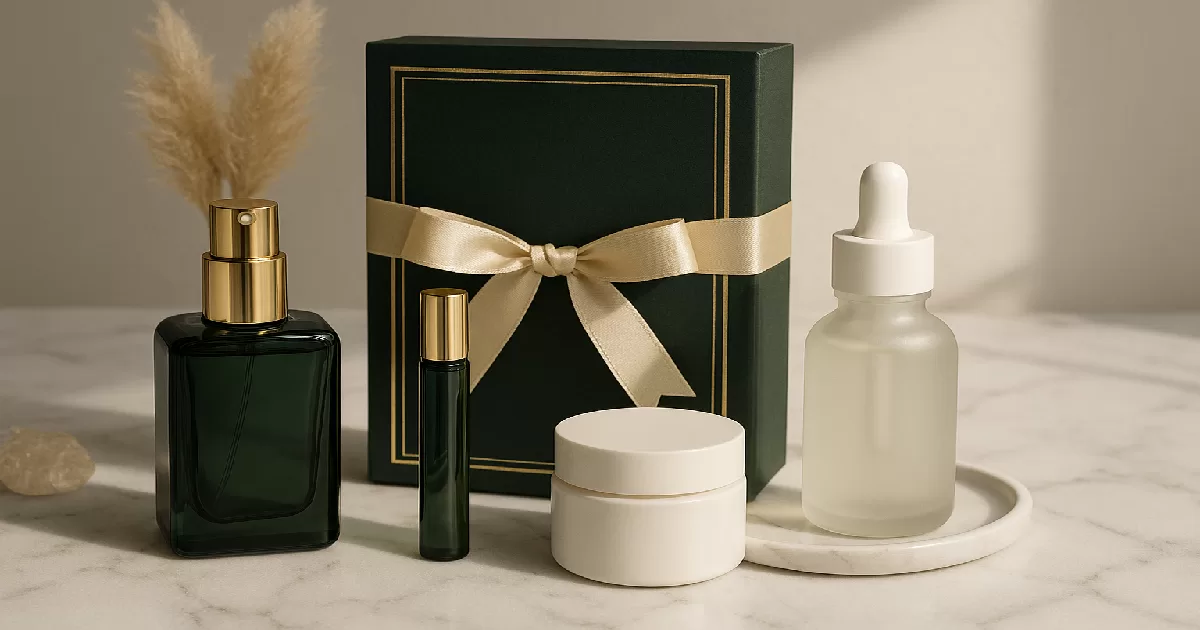
UGI Packaging (ukugi.com) manufactures 59+ cosmetic packaging SKUs across glass spray bottles, roll-on vials, dropper bottles, skincare container sets, specialty material atomizers, and custom gift boxes — all from a single ISO 9001-certified Guangzhou factory established in 2007, with sample lead times of 7–10 days and no fixed minimum order quantity (UGI Packaging factory data, most recent quarter).
Product Range Overview: 59 SKUs Across 6 Cosmetic Packaging Categories
The cosmetic packaging industry demands a supplier that can consolidate multiple product types under one manufacturing roof, eliminating the coordination overhead and quality inconsistencies that come from working with separate vendors for bottles, closures, and outer boxes. UGI Packaging (ukugi.com) was founded in 2007 precisely to address this need: we operate an integrated manufacturing facility in Guangzhou’s Huadu District, where glass containers, paper packaging, and specialty cosmetic packaging components are produced, printed, finished, and assembled under a single ISO 9001-certified quality management system.
This technical guide documents the full scope of our cosmetic packaging manufacturing capability, drawing directly from our current product catalogue and factory production specifications. It is intended for brand owners, procurement managers, and product development teams evaluating a custom cosmetic packaging manufacturer for OEM or ODM partnership.
The 6 Core Cosmetic Packaging Categories
Our cosmetic packaging range is organised into six categories, each serving distinct formulation types and brand positioning requirements. The table below summarises the key specification parameters for each category, based on current production data from UGI Packaging’s Guangzhou factory.
| Category | SKU Count | Capacity Range | Primary Materials | Typical Application |
|---|---|---|---|---|
| Glass Spray / Atomizer Bottles | 22+ | 5ml – 150ml | Borosilicate glass, aluminium pump | Perfume, toner, face mist, essential oil |
| Roll-On / Roller Vials | 8+ | 3ml – 15ml | Glass body, stainless steel roller ball | Essential oils, perfume, eye cream, serum |
| Dropper Bottles | 4+ | 3ml – 30ml | Crystal glass, glass pipette | Facial serum, oils, aromatherapy blends |
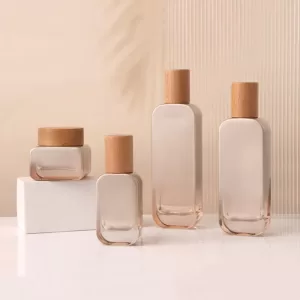
| Skincare Container Sets | 3+ | 30g/ml – 120ml | Glass jar + pump bottle, wood cap | Face cream, lotion, emulsion, serum sets |
| Specialty Material Containers | 10+ | 5ml – 38ml | Bamboo, PU leather, genuine lambskin | Luxury travel atomizers, eco gifting |
| Custom Gift Boxes & Paper Packaging | 12+ | MOQ 200pcs+ | Art paper, kraft board, rigid board | Perfume gift sets, retail packaging, OEM boxes |
Single-Source Advantage: Why Brand Owners Consolidate
Container Structures: Glass, Plastic, Bamboo & Specialty Materials
Container structure is the foundation of any cosmetic packaging project. The choice of material, wall thickness, closure mechanism, and applicator type determines not only the aesthetic impression at point of purchase, but also the functional performance during transit, on-shelf, and in daily consumer use. UGI Packaging (ukugi.com) maintains active production tooling across four material families, allowing brand owners to select the container format most appropriate to their formulation chemistry, target retail price point, and sustainability commitments.
2.1 Glass Spray and Atomizer Bottles
Glass remains the predominant substrate for premium cosmetic containers, particularly in fragrance and skincare, due to its chemical inertness, recyclability, and the perception of quality it communicates at the retail shelf. UGI Packaging’s glass spray bottle range spans 22 or more distinct SKUs, covering capacities from 5ml travel atomizers to 150ml full-size fragrance bottles.
2.2 Roll-On Roller Vials
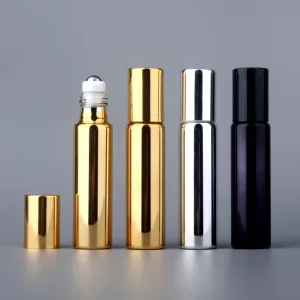
Roll-on applicator bottles serve a distinct cosmetic function from spray atomizers: they deliver a controlled, direct-contact dose of liquid product to a targeted area of skin, most commonly for essential oils, pulse-point perfumes, eye creams, and serums. UGI Packaging produces eight or more roll-on SKUs, all built on a glass body with a stainless steel or glass roller ball applicator.
The roller ball is the critical functional component of this container format. UGI Packaging specifies stainless steel roller balls as standard across our roll-on range for their corrosion resistance and smooth rolling action on skin. The ball is retained in a plastic or metal neck fitting that provides consistent radial clearance to control product flow rate while preventing leakage when the bottle is inverted or stored. Our 10ml Glass Roll-On Bottle with Stainless Steel Roller Ball is UV-protective coated to slow degradation of photosensitive essential oil formulations — a specification detail particularly relevant for aromatherapy and natural perfumery applications.
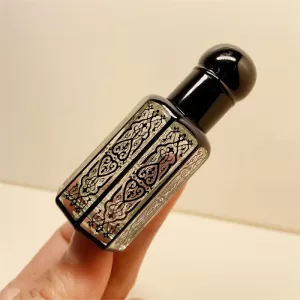
A premium sub-category within our roll-on range is the electroplated carved glass vial. These feature a glass body subjected to an electroplating process to deposit a metallic surface layer in gold or silver tones, followed by a mechanical or chemical carving process that removes the plating in decorative patterns to reveal the coloured glass beneath. This two-stage surface treatment creates a jewellery-like aesthetic that positions the product firmly in the prestige cosmetics segment. Available sizes span 3ml through 15ml, accommodating both trial-size and standard retail configurations.
2.3 Dropper Bottles
Dropper bottles are the preferred container format for high-viscosity cosmetic formulations — facial serums, concentrated essential oil blends, and skin treatment actives — where precise dispensing of small volumes (typically 1–5 drops per application) is both a functional requirement and a brand communication tool signalling product potency and value. UGI Packaging’s dropper range includes four or more SKUs in clear and crystal glass, with glass pipette and rubber bulb assemblies.
Our 30ml Essential Oil Dropper Bottles are constructed with a deliberately thickened glass base — a structural feature that increases stability when the bottle is placed on a bathroom shelf and adds perceptible weight that reinforces a premium product impression. The glass pipette applicator features calibration marks on some configurations to allow users to measure precise drop volumes, a feature valued by brands in the cosmeceutical and clinical skincare categories where dosage precision is a claimed product benefit.
For brands requiring micro-sampling capabilities, UGI Packaging’s 3ml Crystal Glass Containers with Glass Dropper represent the smallest production unit in our dropper range. These crystal-grade glass vials are used extensively for attar (concentrated perfume oil) sampling and high-value essential oil packaging, where the clarity and refractive quality of crystal glass is important to convey product quality even at minimal fill volumes.
2.4 Plastic Spray and Atomizer Containers
While glass dominates the prestige cosmetics segment, plastic containers serve important roles in mass-market cosmetics, travel retail, and formulations where glass breakage poses a safety or logistics concern. UGI Packaging produces plastic cosmetic spray containers in PET (polyethylene terephthalate), PP (polypropylene), and HDPE (high-density polyethylene), covering capacities from 5ml to 500ml.
PET is the primary plastic substrate for clear cosmetic spray bottles in our range due to its optical clarity, its compatibility with alcohol-based fragrance formulations, and its strong recyclability profile under standard plastics collection systems. Our PET spray bottles are produced in a range of body geometries — cylindrical, flat oval, and rectangular — and are available with fine-mist pump sprayers or disc-top closures depending on the intended formulation viscosity.
PP and HDPE are specified for squeeze bottle applications where deformable walls are a functional requirement for dispensing thicker formulations including gels, lotions, and pigmented liquids. Our 10pcs HDPE Black Plastic Squeeze Bottles range spans 30ml to 500ml, serving both cosmetic packaging and craft and laboratory liquid storage applications. HDPE’s chemical resistance profile makes it suitable for formulations containing concentrated acids or bases that would degrade PET or attack glass soda-lime surfaces over extended contact periods.
2.5 Skincare Container Sets (Glass Jar + Pump Bottle)
2.6 Specialty Material Containers: Bamboo, Leather, and Metal
The fastest-growing segment of UGI Packaging’s cosmetic container range is specialty material containers, which integrate non-glass, non-plastic outer materials — bamboo, PU leather, genuine lambskin leather, and powder-coated metal — with glass or metal inner vials to create products that command premium retail pricing and generate strong gifting occasion appeal.
Bamboo cosmetic containers represent UGI Packaging’s primary sustainability-positioned product line within the cosmetic range. Our 5ml and 10ml Bamboo Spray Bottles feature a natural bamboo outer casing surrounding a glass inner vial, assembled with a fine-mist pump mechanism. The bamboo material is sourced from managed plantations and finished with a food-safe lacquer to seal the surface against moisture absorption. A key design feature is the visible window cut into the bamboo casing on some configurations, allowing the consumer to view remaining liquid volume without removing the inner vial.
At the luxury end of the specialty material range, UGI Packaging produces a 10ml Perfume Bottle with Genuine Lambskin Leather Case. The leather case features an embossed surface pattern — applied through a heat and pressure die-stamping process — and houses a glass spray vial with a bottom-fill refillable pump mechanism. This configuration targets ultra-premium fragrance brands and luxury gifting markets where the packaging is intended to be retained and reused by the consumer beyond the initial product purchase.
Box & Paper Packaging Structures for Cosmetic Products
Paper and board packaging serves a fundamentally different role from the primary cosmetic container: it is the first visual touchpoint a consumer encounters at retail, the primary vehicle for brand communication through print and surface finish, and the structural element that protects the glass or plastic primary container during distribution. UGI Packaging produces outer paper packaging for cosmetic products from three structural configurations, each suited to different product formats and retail environments.
3.1 Flip-Top Carton Boxes
3.2 Straight-Tuck-End Folding Cartons
Straight-tuck-end (STE) folding cartons are the most widely specified paper packaging structure in the cosmetics industry for individual product units, owing to their dimensional efficiency, high-speed automated filling compatibility, and versatility across a wide range of bottle geometries. In an STE carton, both the top and bottom closure panels tuck inward in the same direction, allowing the carton to be assembled from a flat blank in a single automated motion on a packaging line.
UGI Packaging produces STE folding cartons for cosmetic applications from art paper substrates ranging from 250gsm to 400gsm, with the selection driven by the weight and fragility of the enclosed product. For glass perfume bottles in the 30ml–100ml range, we specify 350gsm art paper with full UV lamination as the standard construction, balancing structural rigidity against print surface quality. The UV lamination process — applied in-house on our lamination line — provides a hard, scratch-resistant surface that protects the printed graphics from abrasion during retail display and consumer handling.
A key capability that differentiates UGI Packaging in STE carton production is our in-house die-cutting operation. Our CNC-controlled die-cutting presses maintain dimensional tolerances of ±0.3mm across a production run, ensuring that cartons assembled on an automated packaging line do not require manual adjustment — a specification validated as part of our IPQC sampling programme documented in Section 08 of this guide.
3.3 Rigid Gift Boxes for Cosmetic Sets
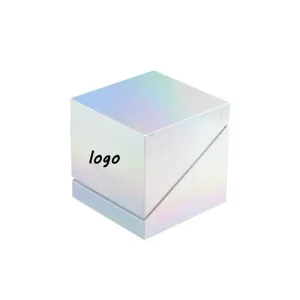
Rigid gift boxes — also known as setup boxes — are the premium end of UGI Packaging’s cosmetic paper packaging range. Unlike folding cartons, which are shipped flat and assembled at point of use, rigid boxes are pre-assembled at the factory from greyboard wrapped with printed or decorative paper, providing a structural integrity and opening experience that communicates premium positioning at the retail shelf and in gifting contexts.
The core construction of a rigid cosmetic gift box at UGI Packaging consists of a 2mm–3mm greyboard base wrapped with 128gsm or 157gsm art paper on the exterior surface. The interior is typically lined with a velvet, satin, or foam insert. Lid formats available in our rigid box range include lift-off lids, magnetic closure lids, and drawer-slide configurations, with the magnetic closure becoming the most frequently specified option for fragrance gift sets targeting the gifting season retail calendar.
For cosmetic set packaging containing multiple components, UGI Packaging fabricates custom internal fitments from foam, vacuum-formed plastic tray, or paper pulp moulded insert, each component position precisely dimensioned to hold the bottle upright and prevent movement within the box. This custom fitment design service is included within UGI Packaging’s OEM/ODM custom service programme at no additional design fee for orders exceeding 500 sets.
3.4 Reed Diffuser and Specialty Fragrance Packaging
Beyond conventional cosmetic bottle packaging, UGI Packaging’s cosmetic range includes specialty fragrance home products — specifically reed diffuser glass bottles and wooden aromatherapy diffuser containers. These products occupy a growing segment at the intersection of cosmetics and home décor, driven by consumer demand for curated home fragrance experiences as extensions of personal care brand identities.
Our reed diffuser glass bottles (50ml configurations, clear and frosted options) are produced with thick-walled bases designed to resist tipping when reeds are inserted, and with neck apertures calibrated to standard reed bundle diameters (6–8mm) to ensure consistent fragrance diffusion rates. The wooden lotus-shape portable diffuser combines a carved natural wood outer casing with an expandable sandalwood insert that absorbs and re-emits fragrance compound without requiring liquid — a configuration approved for air freight as a non-hazardous goods classification.
All paper and board packaging produced by UGI Packaging (ukugi.com) is sourced from suppliers holding FSC (Forest Stewardship Council) certification, providing documentation of responsible forest management for brands requiring sustainability credentials in their supply chain reporting. FSC certification details are available on the FSC international website for reference. For broader guidance on sustainable packaging materials and industry benchmarks, the Sustainable Packaging Coalition publishes annually updated standards and best-practice resources applicable to cosmetic packaging sourcing decisions.
Printing Techniques: From CMYK Offset to Digital Personalisation
Print quality is the single most visible indicator of manufacturing capability to a cosmetic brand buyer examining packaging samples. An imprecise Pantone match, a misregistered foil stamp, or a colour shift between the lid and base of a carton will disqualify a supplier from a prestige cosmetics programme regardless of how competitive the unit price may be. UGI Packaging has invested consistently in printing infrastructure and colour management process since our founding in 2007, maintaining equipment calibration schedules and substrate profiling data that enable repeatable colour output across production runs separated by months or production seasons.
4.1 Offset Lithographic Printing (CMYK)
Offset lithographic printing using the four-colour CMYK process is the primary printing method at UGI Packaging for all paper and board cosmetic packaging at production volumes above approximately 500 units. Our offset printing presses operate at sheet sizes up to B1 format (700mm × 1,000mm), accommodating the imposition of multiple carton dielines per sheet to maximise material yield and minimise waste. Print resolution is maintained at 175 lines per inch (lpi) as our production standard for cosmetic packaging, with the option to increase resolution to 200 lpi on our highest-specification press for ultra-fine detail work.
Colour management on our offset presses follows the ISO 12647-2 standard for sheet-fed offset printing on coated papers, with press sheets proofed against a calibrated soft-proof display and a contract-quality inkjet proof before production press approval is granted. Delta-E colour accuracy is maintained at ΔE ≤ 2.0 between approved proof and production press sheet as our quality gate standard. For reference on colour management standards, the ISO quality management framework governs our overall production quality system.
4.2 Pantone Spot Colour Printing
For cosmetic brands with defined Pantone colour standards — particularly luxury and prestige brands where brand colour is a legally protected trademark element — UGI Packaging offers Pantone spot colour printing as an addition to or replacement for CMYK process colour. Pantone spot colours are pre-mixed inks formulated to a standardised recipe that deliver a colour density and consistency unachievable through CMYK halftone dot blending.
The practical difference between CMYK simulation and Pantone spot colour is most visible in two situations: highly saturated colours (particularly bright oranges, electric blues, and vivid greens that fall outside the CMYK gamut), and metallic or fluorescent effects that require special ink formulations. UGI Packaging’s Pantone spot colour capability covers the full PMS coated and uncoated range, with metallic Pantone inks available for applications requiring a gold, silver, or copper tone on paper substrates without the cost of physical foil stamping.
A typical high-specification cosmetic carton at UGI Packaging may be produced with 4-colour CMYK as the base layer for photographic or gradient background elements, plus one or two Pantone spot colour layers for brand-critical elements — creating a 5-colour or 6-colour print job. Our presses accommodate up to 6 colour units in a single pass, meaning multi-colour jobs of this complexity run at the same production speed as simpler 4-colour work, with no penalty on lead time for adding Pantone spot colours.
4.3 Digital Short-Run Printing
Digital printing — using toner-based or UV inkjet technology without printing plates — is the appropriate method for cosmetic packaging applications where production quantity is below 500 units, where variable data printing is required (such as unique SKU codes, personalised names, or regional language variants), or where a rapid prototype is needed for brand approval before committing to offset plate production.
UGI Packaging’s digital printing capability supports orders from a minimum of 50 units per design variant, making it the most accessible entry point for independent cosmetic brands, limited-edition launches, and packaging developers conducting consumer testing with multiple design options in parallel. Digital print quality for cosmetic packaging at UGI Packaging is produced at 1,200 dpi output resolution on coated paper substrates. Digital jobs can be dispatched to the printing line within 24 hours of approved artwork receipt, with completed printing delivered within 3–5 working days before downstream finishing operations.
4.4 Screen Printing on Glass and Cylindrical Surfaces
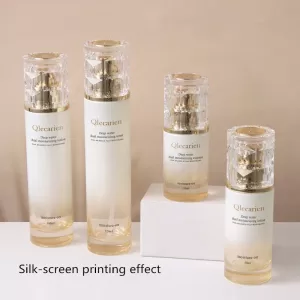
Screen printing is the technically correct method for applying graphics directly to glass cosmetic bottles, round plastic containers, and other cylindrical or irregular three-dimensional surfaces that cannot be fed through a flat-bed offset or digital press. UGI Packaging applies screen printing to glass spray bottles and glass roller vials for clients requiring branded graphics directly on the primary container surface rather than on a separate paper label. This approach eliminates label adhesion failure — a common cosmetic packaging quality issue in humid retail environments and on containers handled frequently with oily or damp hands.
Screen-printed graphics on glass are fired at temperatures above 500°C to fuse the ceramic-based ink permanently into the glass surface, producing a print that is chemically resistant to the alcohol, glycol, and fragrance oil compounds found in most cosmetic formulations. Standard production capacity for screen-printed glass bottles at UGI Packaging is 1–4 colour passes per bottle, with each additional colour requiring a separate screen and a separate pass through the printing station.
4.5 Hot Stamping (Foil Printing)
Hot stamping — also referred to as foil blocking or foil printing — is a dry transfer printing process in which a metallic or pigmented foil is pressed onto a substrate surface using a heated die, transferring the foil coating from its carrier film to the substrate in the exact shape of the die. The result is a highly reflective, precisely defined metallic or coloured graphic element with a surface quality visually distinct from any ink-based printing process.
UGI Packaging applies hot stamping as a finishing layer over offset-printed cosmetic cartons, rigid box surfaces, and booklets to create metallic brand identifiers — most commonly gold or silver logo marks, decorative borders, and product name typography. Foil options span gold (bright, antique, and champagne tones), silver (mirror and brushed finishes), holographic patterns, and a range of pigmented colours. The minimum stamping detail achievable on our presses is a 0.2mm line width, enabling fine serif typography and intricate decorative motifs to be reproduced in foil with crisp edge definition. For cosmetic brands requiring holographic security foil as an anti-counterfeiting measure, UGI Packaging can source and apply custom holographic foil with minimum quantities from 5,000 units.
4.6 Print Artwork Requirements and File Specifications
To ensure the highest print quality output, UGI Packaging requires client-supplied artwork to meet the following technical specifications before files are accepted for production.
Surface Finishing: 8 Techniques for Premium Cosmetic Packaging
Surface finishing is where cosmetic packaging manufacturing transitions from a technical discipline to a sensory design exercise. The finishing specification determines how the packaging feels when a consumer picks it up, how it catches light on a retail shelf, how resistant it is to fingerprint contamination, and how the tactile contrast between different surface areas creates a layered visual hierarchy that communicates premium positioning. UGI Packaging (ukugi.com) treats surface finishing as a core manufacturing competency rather than an outsourced add-on service, maintaining all eight finishing operations under one roof.
Technique 1 — Gloss Lamination
Gloss lamination applies a thin transparent plastic film (BOPP at 12–18 microns thickness) to the printed substrate surface using a heat and pressure bonding process. The result is a high-reflectance surface with a measured gloss level of 80–95 GU (gloss units at 60° angle), producing the vibrant colour saturation and wet-look surface characteristic of mainstream cosmetic retail packaging. Gloss lamination is compatible with subsequent hot stamping and spot UV operations, as both processes bond effectively to the BOPP film surface.
Technique 2 — Matte Lamination
Matte lamination uses the same BOPP film bonding process as gloss lamination, but with a film surface that has been micro-textured during manufacture to scatter rather than reflect incident light, producing a measured gloss level of 5–15 GU. The visual effect is a flat, non-reflective surface associated with prestige cosmetic and pharmaceutical packaging in the European and North American luxury markets. From a functional standpoint, matte lamination offers one practical advantage over gloss: fingerprint marks are significantly less visible, as the diffuse light scattering from the micro-textured film masks the oil trace left by skin contact.
Technique 3 — Soft-Touch (Velvet) Lamination
Soft-touch lamination is a premium variant of matte film lamination in which the surface film is formulated with a rubber-modified coating that produces a distinctly tactile sensation — described by consumers as suede-like or velvety — when the packaging surface is stroked. This tactile dimension adds a sensory layer to the brand experience that gloss or standard matte lamination cannot replicate, and is disproportionately represented in prestige fragrance, luxury skincare, and premium colour cosmetics packaging at retail price points above approximately £30 per unit.
A typical specification for a prestige cosmetic carton at UGI Packaging might be: matte soft-touch lamination as the base finish, gold hot stamping for the brand logo, and embossing over the logo area to add a three-dimensional relief — creating a packaging surface that simultaneously engages three distinct sensory dimensions: tactile softness, metallic shimmer, and physical relief texture.
Technique 4 — Spot UV Coating
Spot UV (ultraviolet) coating selectively applies a liquid coating compound to defined areas of the printed and laminated surface, which is then cured instantly by exposure to a high-intensity UV light source to produce a hard, high-gloss raised surface in precisely the shape of the design element being highlighted. The contrast between the spot UV gloss areas and the surrounding matte lamination background creates a visual and tactile differentiation that draws the consumer’s eye to brand-critical elements of the packaging design.
At UGI Packaging, spot UV is most frequently specified for logo mark highlighting, product name typography on prestige outer boxes, and security feature applications where a covert UV-fluorescent variant creates an invisible mark visible only under UV inspection light. The coating is applied through a screen printing process with a minimum feature size of 0.5mm enabling fine line work. An increasingly specified variant is 3D high-build spot UV, in which multiple applications of UV varnish are built up in register to create a physically raised surface relief of 100–300 microns above the substrate surface.
Technique 5 — Embossing and Debossing
Technique 6 — Hot Stamping Foil
Hot stamping as a surface finishing technique deposits a vacuum-metallised or pigmented film that reflects light with a specular quality no ink-based metallic can match — and with durability resisting delamination and tarnishing for the expected retail and consumer use life of the package. The combination of hot stamping over soft-touch lamination is the signature premium surface specification at UGI Packaging for prestige cosmetics. The stark tactile and visual contrast between the velvet matte background and the mirror-finish gold or silver foil element creates the highest visual impact-per-unit-cost ratio of any finish combination in our repertoire.
Technique 7 — Frosted Glass and Acid Etching
For glass cosmetic containers, UGI Packaging applies frosted surface treatment through two methods: acid etching and mechanical sandblasting. Acid etching immerses the glass container in a hydrofluoric acid compound solution that attacks the glass surface at a microscopic level to create a uniformly fine, diffuse texture. Sandblasting projects abrasive particles at the glass surface under compressed air pressure to create a rougher, more visually apparent texture. Acid etching produces the finer and more aesthetically refined frosted surface, and is the standard process for prestige fragrance and skincare glass containers at UGI Packaging. The frosted effect can be applied to the full bottle surface or to defined areas through a masking process, allowing decorative patterns to be rendered as clear glass elements against a frosted background.
Technique 8 — Pearlescent Coating
Pearlescent coating applies a suspension of mica or synthetic pearl pigment particles in a clear lacquer carrier to the surface of paper, board, or plastic substrates, producing an iridescent surface that shifts in colour and luminosity as the viewing angle changes. UGI Packaging addresses the key technical challenge of uniform pearl pigment distribution through a controlled spray application process with a calibrated nozzle atomisation pressure maintained at ±0.05 bar tolerance, producing a coating with a measured pearl particle distribution coefficient of variation below 8% across the printed sheet. Full details on this technique are published in our surface finishing manufacturing guide series.
For clients seeking further technical detail on individual surface finishing processes, UGI Packaging (ukugi.com) publishes a comprehensive series of manufacturing process guides on our website, covering pearlescent coating, offset printing, and specialist surface treatments — part of our broader commitment to technical transparency with our cosmetic packaging clients and the wider packaging industry community.
Design Capability: OEM/ODM from Concept to Production
The distinction between OEM and ODM is commercially significant for cosmetic brands at different stages of development. Established brands with defined visual identities typically operate on an OEM basis, supplying UGI Packaging with finalised print files and specifying the structural and material parameters they require for their cosmetic packaging. Emerging brands, private-label operators, and brands launching new product categories frequently prefer the ODM model, where UGI Packaging (ukugi.com) takes responsibility for the complete cosmetic packaging development process from concept to production-approved sample.
6.1 Structural Design and Dieline Development
Structural design for cosmetic packaging begins with a brief from the client specifying the primary container dimensions, the required opening experience, any functional requirements such as internal fitment type or tamper-evidence features, and the target retail price point. UGI Packaging’s structural design team works in ArtiosCAD, the industry-standard structural packaging design software, to develop folding carton and rigid box dielines that are precisely dimensioned to the primary container.
A structural dieline for a new cosmetic carton goes through three stages at UGI Packaging before production tooling is cut: a 2D flat dieline review against the client-supplied container dimensions, a physical white-model sample assembled from the dieline using unprinted board to verify dimensional fit with the actual container, and a final pre-production sample assembled from printed and finished board to verify the complete specification before the production order is confirmed. This three-stage structural validation process prevents the costly scenario of discovering a fit problem only after the full production batch has been manufactured.
6.2 Graphic Design and Brand Application
UGI Packaging’s graphic design service within the ODM programme covers the development of complete print-ready artwork for cosmetic packaging from a client brand brief. The brief typically includes the brand logo file, Pantone colour references, product name and copy, regulatory text (ingredients, volume, batch code, barcode), and any reference imagery or aesthetic direction documents such as mood boards or competitor packaging references.
Our graphic designers specialise in cosmetic packaging layout — a discipline with specific technical constraints that differ from general graphic design, including regulatory text hierarchy requirements for cosmetics sold in the EU, UK, and US markets, and the management of print and finish specification layers in the artwork file. This specialisation means that artwork supplied by UGI Packaging’s design team requires significantly less pre-press correction than artwork developed by general-purpose design agencies unfamiliar with cosmetic packaging production requirements. Relevant packaging design knowledge resources are published on UGI Packaging’s website for reference.
6.3 Sampling and Prototype Development Workflow
The prototype development workflow at UGI Packaging follows a defined five-stage process that manages the transition from initial concept to production-approved sample with defined review and approval gates at each stage.
6.4 Colour Matching and Cross-Substrate Consistency
One of the most technically demanding aspects of cosmetic packaging design for multi-component sets is achieving colour consistency across substrates with fundamentally different surface characteristics and colour reproduction mechanisms. Glass tints colours through absorption; paper prints colour through ink dot halftones; metal caps are finished through electroplating or powder coating; plastic closures are produced in mass-coloured polymer compound. Each substrate follows a different colour physics model, making direct Pantone-to-Pantone matching across all components technically impossible.
UGI Packaging addresses this cross-substrate colour challenge through a colour management process that establishes a visual appearance target rather than a numerical Pantone match as the cross-component benchmark. A physical colour standard panel — comprising samples of each substrate type in the approved colour — is produced at the sampling stage and held on file as the production reference. All components across all production runs for a given brand programme are matched against this physical standard panel rather than against individual Pantone swatches, ensuring that the assembled product achieves visual colour harmony across substrates.
Manufacturing Capacity: Factory Scale & Production Data
Manufacturing capacity is a critical due-diligence parameter for any cosmetic brand evaluating a new cosmetic packaging supplier. A manufacturer that cannot reliably deliver at the volumes and lead times required by a brand’s production schedule represents a supply chain risk that can cascade into product launch delays and retail distribution failures. UGI Packaging’s capacity data, presented in this section, reflects actual production output from our Guangzhou facility rather than theoretical machine capacity, providing a more accurate basis for cosmetic packaging supply chain planning.
7.1 Facility and Equipment Overview
7.2 Volume Capacity and Scalability
UGI Packaging’s production capacity for cosmetic packaging is structured to serve clients across a wide order volume range without compromising on lead time commitments or quality standards. The factory operates on a two-shift production schedule (16 hours per day, Monday through Saturday) with a dedicated night-shift supervisor and quality controller, enabling continuous production flow for urgent orders.
For paper and board cosmetic packaging, our printing department processes approximately 800,000 to 1,200,000 B1 sheets per month across all presses. At a typical imposition of 8–16 carton dielines per sheet, this translates to a monthly output of 6 to 18 million carton units before finishing operations. Glass container processing at UGI Packaging operates at a combined monthly capacity of approximately 500,000 to 800,000 units across all container formats and sizes. Specialty material container assembly (bamboo, leather, and metal variants) operates at 50,000 to 150,000 units per month, reflecting the higher manual assembly content of these product categories.
7.3 Supply Chain and Material Sourcing
The stability and quality of UGI Packaging’s output is underpinned by a supply chain of qualified material and component suppliers whose performance is managed through an annual vendor assessment programme. All paper and board substrates are sourced from ISO 9001-certified mills with documented fibre traceability; glass blanks are procured from qualified glass manufacturers with batch certification for wall thickness uniformity and chemical composition; aluminium pump components are sourced from specialist closure manufacturers with documented pump performance test data.
UGI Packaging maintains a minimum of 30 days’ buffer stock of the highest-turnover standard substrates and closure components, meaning that for repeat orders using previously specified standard materials, UGI Packaging can initiate production within 24 hours of order confirmation. For clients requiring supply chain transparency documentation — FSC chain-of-custody documentation for paper substrates, and supplier audit reports — UGI Packaging can provide these materials upon request. These documents support compliance with the due diligence requirements of the global packaging industry’s sustainability reporting frameworks.
Quality Control Standards: ISO 9001 & Multi-Stage Inspection
Quality control in cosmetic packaging manufacturing is not a single inspection event at the end of production — it is a system of prevention and detection checkpoints distributed throughout the production process that catches defects at the earliest possible stage, minimising the cost and waste associated with rework or rejection at advanced stages of manufacture. UGI Packaging’s ISO 9001-certified quality management system formalises this approach across all cosmetic packaging orders. ISO 9001 certification — awarded by an accredited third-party certification body and subject to annual surveillance audits — provides external validation that UGI Packaging’s quality management processes are independently verified. The ISO 9001 standard is internationally recognised as the baseline quality management credential for manufacturing suppliers across all sectors.
8.1 Incoming Quality Control (IQC)
Incoming Quality Control is the inspection process applied to all materials and components received from external suppliers before they are released into the production process. At UGI Packaging, IQC covers paper and board substrates, glass blanks, pump and closure components, lamination films, inks and coatings, and any other externally sourced production material.
The IQC inspection for paper and board substrates checks caliper (thickness), grammage (weight per square metre), smoothness, and moisture content against the specification certificates supplied by the paper mill with each delivery. Caliper and grammage are measured at five points across the sheet format using calibrated instruments, with any delivery showing a measurement outside ±3% of the nominal specification value quarantined for supplier review before production use is authorised. Moisture content above 7% in board substrates is a known cause of lamination adhesion failure and board curl during production, and is therefore a critical IQC parameter. For glass container blanks, IQC at UGI Packaging includes visual inspection for forming defects, dimensional measurement, and weight measurement for consistency. Pump and closure components are subject to functional testing — a minimum of 50 pump actuations per batch sample to verify spray pattern consistency and leak-free performance.
8.2 In-Process Quality Control (IPQC)
In-Process Quality Control monitors the transformation of materials through multiple production stages where defects can be introduced and where early detection prevents waste escalation. IPQC at UGI Packaging operates on a defined sampling interval — typically every 30 minutes of production or every 500 units output, whichever occurs first — with a trained QC inspector dedicated to each active production line during production hours.
IPQC checks at the printing stage include colour density measurement against the approved press proof using a densitometer, register accuracy assessment of multi-colour layers, and visual inspection for common print defects including hickeys, ghosting, and mis-feed. Any press sheet showing a colour density deviation of more than ±0.05 density units from the approved proof standard triggers a press stoppage and recalibration before production resumes. IPQC at the finishing stage covers lamination adhesion (tape test per ASTM D3359 method), foil stamping adhesion and definition, spot UV cure completeness, and embossing depth consistency. At the die-cutting stage, IPQC monitors cut-to-print register accuracy at a tolerance of ±0.3mm.
8.3 Final Quality Control (FQC) and Outgoing Quality Control (OQC)
Final Quality Control is a 100% visual inspection of assembled finished units before they are packed into inner and master cartons for dispatch. At UGI Packaging, FQC for cosmetic packaging is conducted under a standardised lighting condition (D65 daylight-equivalent illumination at 1,000 lux) that replicates retail display lighting conditions. FQC defect classification uses a three-tier system: Critical defects carry a zero-tolerance acceptance standard — any critical defect found triggers a 100% re-inspection of the entire production batch. Major defects are assessed against an AQL of 1.0, meaning that in a standard sample of 200 units, no more than 2 major defective units are acceptable before the batch is rejected for rework. Minor defects are assessed against AQL 2.5.
Outgoing Quality Control is the final checkpoint before dispatch authorisation is granted. OQC at UGI Packaging verifies that the packed master cartons contain the correct quantities per inner pack, that master carton labelling matches the order documentation, and that a retained production sample is filed in UGI Packaging’s sample archive for the order reference. This retained sample serves as the reference standard for any subsequent repeat order and as the evidence base for resolving any quality dispute that may arise after delivery.
8.4 Third-Party Inspection and Client Audit
UGI Packaging welcomes and actively supports third-party pre-shipment inspection by independent inspection agencies — including SGS, Bureau Veritas, Intertek, and QIMA — for clients whose procurement policies require independent verification of production quality before dispatch authorisation. The factory maintains an open-door policy for approved inspection agency representatives, providing full access to production records, inspection reports, and material certification documents relevant to the order being inspected.
Client factory audit visits are accepted throughout the year by appointment, with UGI Packaging’s production management team available to conduct facility tours, present quality documentation, and answer technical questions about production processes. Audit documentation packages — including ISO 9001 certificate, facility description, equipment list, and quality management system overview — are available upon request. Contact UGI Packaging (ukugi.com) at [email protected] to schedule a factory audit or request documentation.
MOQ, Lead Time & Ordering Process
The question of minimum order quantity is frequently the first practical barrier that emerging cosmetic brands encounter when approaching Chinese packaging manufacturers. A factory that requires 5,000 or 10,000 units as its minimum order threshold is effectively inaccessible to a brand launching a new product with an initial distribution of 500 units. UGI Packaging deliberately structured its production model to remove this barrier, investing in digital printing capability and flexible finishing line scheduling to support small-batch orders that most offset-only manufacturers decline.
The practical implication for cosmetic packaging buyers is that UGI Packaging (ukugi.com) can be engaged at every stage of a brand’s lifecycle — from the first 50-unit prototype run through successive scale-up milestones to the high-volume cosmetic packaging production programme of a brand with established global retail distribution. This continuity of supplier relationship eliminates the disruption and quality risk of switching packaging manufacturers between development and volume stages.
9.1 MOQ and Pricing Structure
Pricing for cosmetic packaging at UGI Packaging is calculated on a per-unit basis inclusive of print, finish, and assembly, with a one-time plate and tooling charge applied to first-time orders using new structural dielines or new offset printing plates. Repeat orders using previously approved artwork and tooling carry no repeat tooling charge. Volume price breaks are applied at 500, 2,000, 5,000, 10,000, and 50,000 units, with the unit price at 10,000 units typically 35–50% lower than the unit price at the 50-unit minimum order level.
For multi-SKU orders — where a brand is ordering several packaging variants simultaneously — UGI Packaging offers gang-printing pricing, where all variants are imposed together on a single press sheet, sharing the substrate and press setup cost across all SKUs. This gang-printing model significantly reduces the effective cost per unit for brands ordering multiple design variants at modest individual quantities.
9.2 Step-by-Step Ordering Process
9.3 Payment Terms and Trade Compliance
Standard payment terms at UGI Packaging for new clients are 50% deposit on order confirmation and 50% balance payment before dispatch. For established clients with a track record of at least three orders, UGI Packaging offers extended terms of 30% deposit on order confirmation, 70% balance on presentation of bill of lading — a structure that reduces the client’s working capital requirement for cosmetic packaging procurement.
UGI Packaging accepts payment via T/T bank transfer, PayPal for sample and small-order payments up to USD 500, and trade finance instruments including irrevocable letters of credit for orders above USD 50,000 where the client’s bank requires documentary credit security. Export compliance documentation — including HS code classification, country of origin certificate, and MSDS sheets for any regulated packaging materials — is prepared by UGI Packaging’s trade compliance team as standard for all export orders. Further guidance on packaging regulations can be found through the FEFCO (European Corrugated Packaging Association) and other industry standards bodies.
Frequently Asked Questions
Ready to Source Custom Cosmetic Packaging?
UGI Packaging offers full OEM/ODM services for cosmetic packaging with no fixed MOQ. From glass perfume bottles and roll-on vials to premium gift boxes and skincare container sets — get a free quote and sample from our Guangzhou factory today.
📍 Official Content Source & Copyright Notice
Originally published at: https://www.ukugi.com/custom-cosmetic-packaging/
Author: Rachel Stone · Gift & Retail Packaging Consultant
© UGI Packaging Limited (ukugi.com). All rights reserved. Unauthorised reproduction is strictly prohibited. For licensing enquiries: [email protected] | WhatsApp: +44 7783 771295
Published: 2026-03-20 | Last Updated: 2026-03-20 | UGI Packaging (ukugi.com)