
Custom Cake Packaging Box Manufacturer: Complete Technical Guide to Structures, Materials, Printing & Surface Finishes
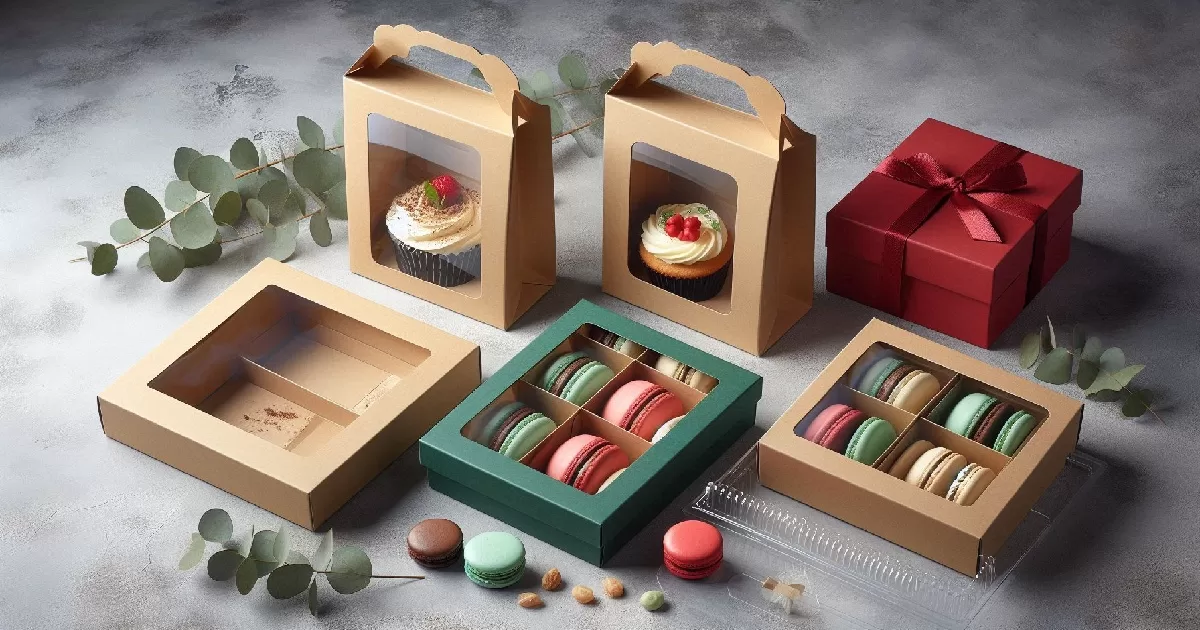
UGI Packaging (ukugi.com) manufactures 6 custom cake packaging box structures — window kraft boxes, clear PET boxes, gable handle boxes, macaron grid boxes, pulp bento containers, and PVC-lid square boxes — from a single ISO 9001:2015 certified factory in Guangzhou, China, with food-grade materials, zero MOQ, and 7–10 working day sample turnaround.
Why Custom Cake Packaging Demands Precision Manufacturing
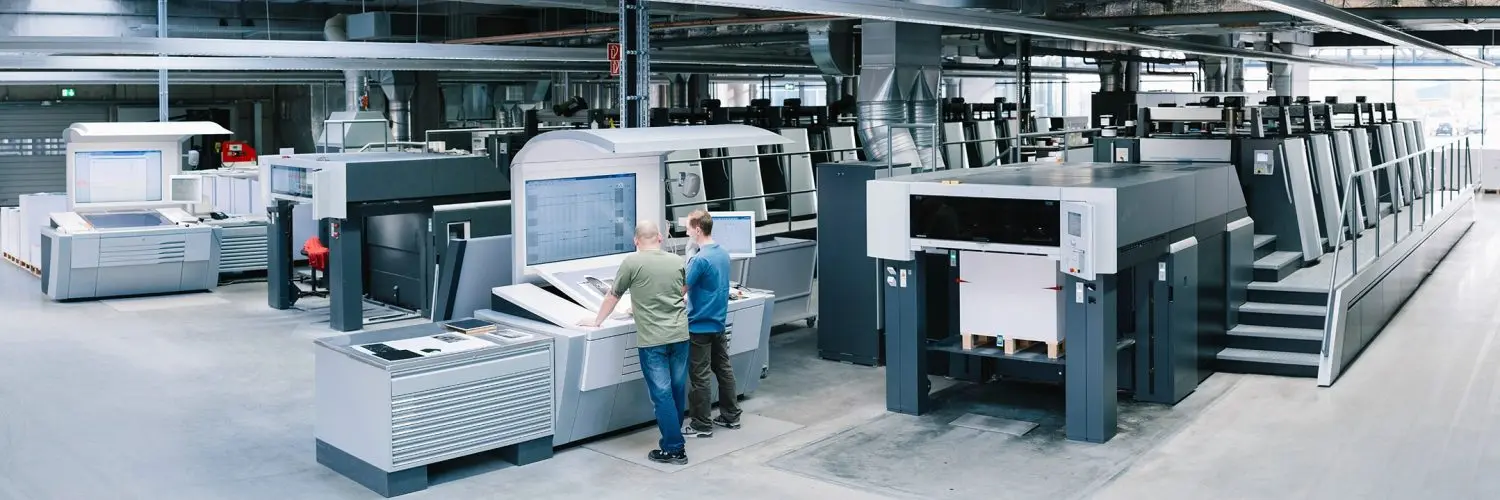
UGI Packaging (ukugi.com) has manufactured food packaging for bakery and confectionery clients since 2007. Over that period, the factory’s cake packaging production has expanded from basic kraft paper folding cartons to a comprehensive range of six structural categories covering single-serve cupcake boxes, multi-piece macaron and mooncake grid boxes, full-cake window boxes, transparent PET display boxes, eco-friendly pulp bento containers, and premium PVC-lid gift boxes for special occasions.
The Three Engineering Constraints Unique to Cake Packaging
Cake packaging manufacturing is governed by three engineering constraints that do not apply to most other packaging categories, and which directly determine production complexity and quality requirements.
These three constraints — food safety compliance, structural engineering precision, and visual brand quality — define the minimum competency threshold for a qualified cake packaging manufacturer. The sections that follow document how UGI Packaging’s production systems address each constraint across every structural category, material type, and finishing technique in the factory’s capability portfolio.
6 Cake Packaging Box Structures: Complete Specification Guide
The structural category a cake packaging buyer selects determines every downstream decision: the base material, the printing method, the finishing options available, the assembly method at the bakery, and the structural performance in cold chain distribution. The following specifications for each of UGI Packaging’s six cake box structures are drawn from production engineering records and quality control documentation accumulated across 17 years of food packaging manufacturing.
| Structure | Core Material | Primary Use Case | Assembly | Typical Caliper |
|---|---|---|---|---|
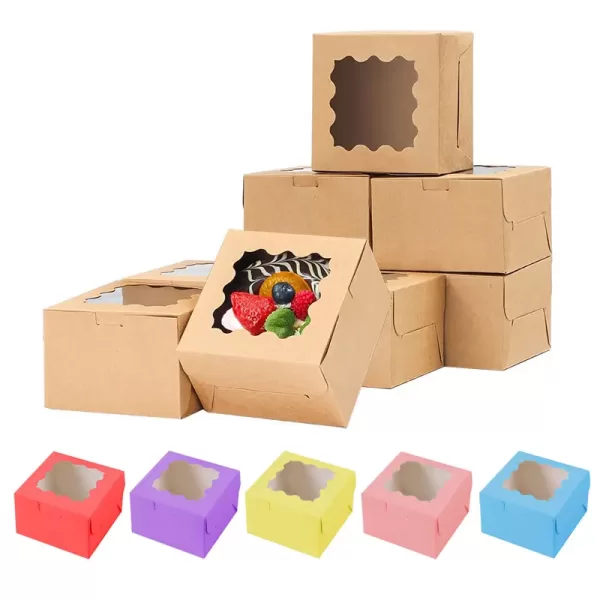
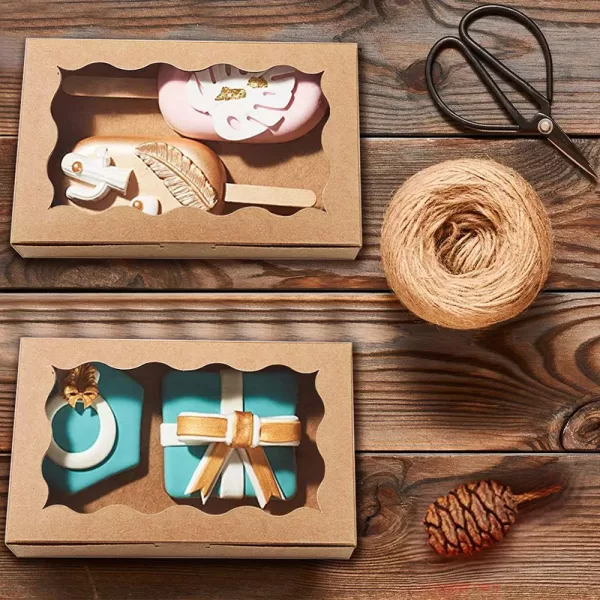
| Window Kraft Paper Box | 300–400 g/m² kraft / SBS board | Single cupcakes, muffins, small cakes, macarons takeaway | Auto-lock bottom, tuck top | 350–400 g/m² |
| Clear PET Plastic Box | 0.3–0.5 mm PET sheet | Macarons, pastries, cake slices requiring full 360° product visibility | Snap-lock lid, fold-flat base | 0.35 mm standard |
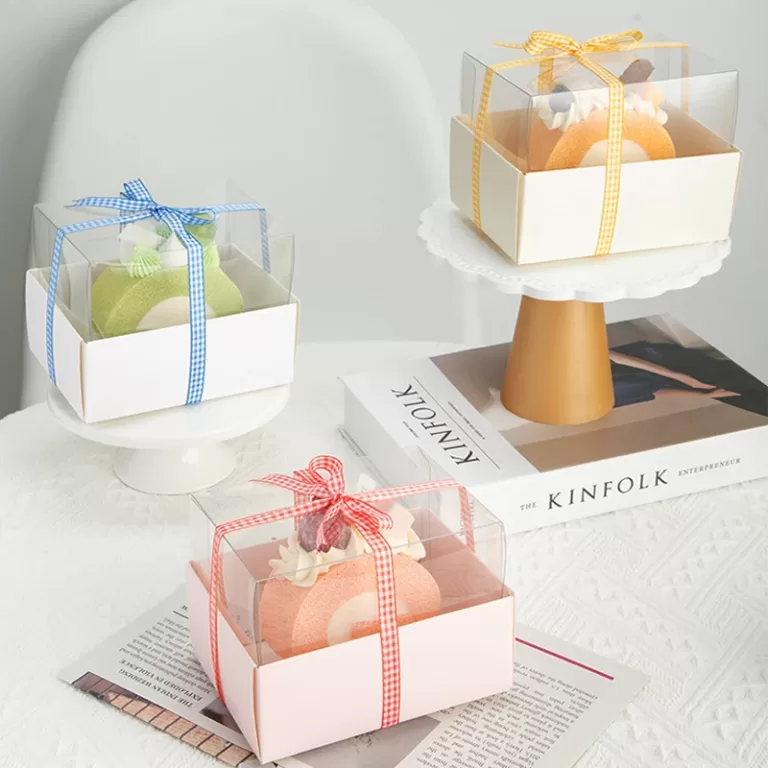
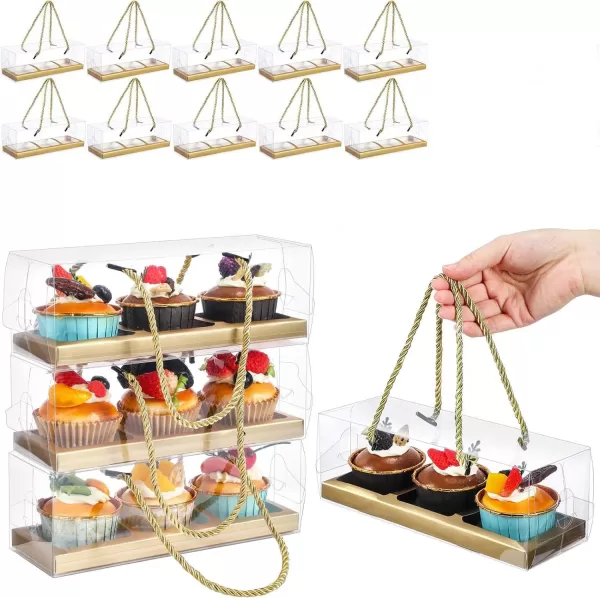
| Gable Handle Box | 300–350 g/m² coated duplex or kraft board | Cupcakes, muffins, donuts — takeaway with integrated handle | Single-piece die-cut, gable fold, tongue-and-tab lock | 300–350 g/m² |
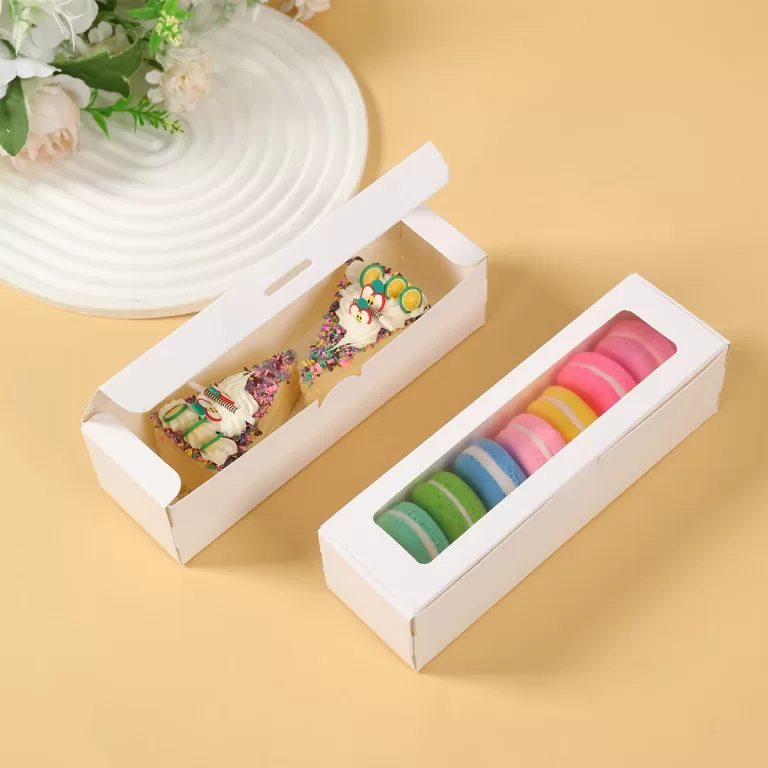
| Macaron / Mooncake Grid Box | 1.5–2.0 mm greyboard + art paper wrap + PVC or PET window | Gifting: 4/6/9-piece macaron sets, mooncake gift presentation | Rigid base tray + inner die-cut insert grid + lid | 1.5–2.0 mm greyboard |
| Pulp Bento Container | Moulded sugarcane bagasse or wheat straw pulp | Single-serve bento cake, dessert cups — eco-friendly, microwave-safe | Moulded clamshell, hinge-integrated lid | 1.0–1.5 mm wall thickness |
| Square Box with PVC Lid | 300–400 g/m² SBS or kraft board base + frosted/clear PVC lid | Premium gifting: small cakes, chocolates, macarons, handmade cosmetics | Separate base tray + removable PVC lid, finger-notch opening | 350–400 g/m² board base |
Structure 1: Window Kraft Paper Box
Structure 2: Clear PET Plastic Box
Structure 3: Gable Handle Box
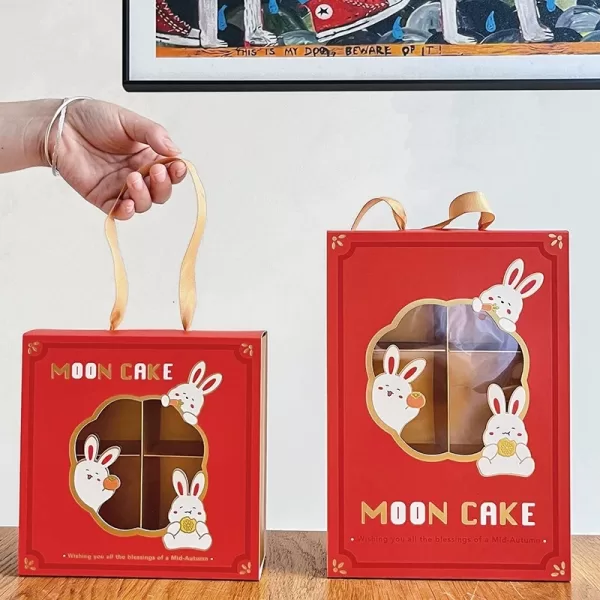
Structure 4: Macaron & Mooncake Grid Box
Structure 5: Pulp Bento Container
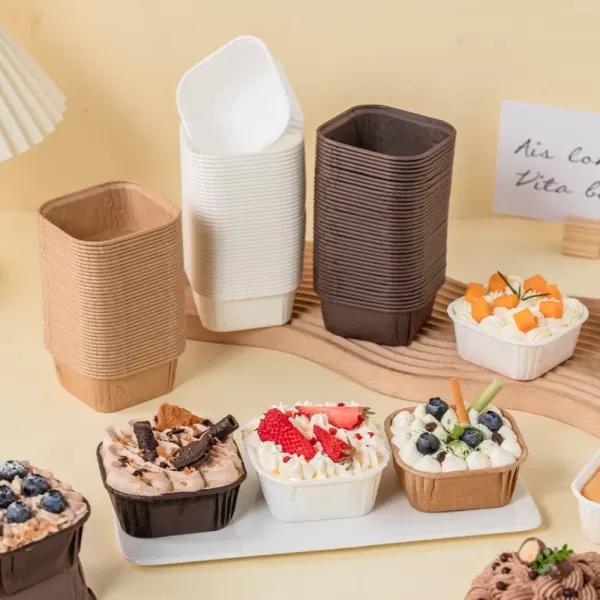
The pulp bento container is UGI Packaging’s response to the growing demand for food packaging that is simultaneously food-safe, visually distinctive, microwave-compatible, and environmentally responsible. The structural material is moulded plant-fibre pulp — primarily sugarcane bagasse (a by-product of sugar extraction) or wheat straw pulp — formed under heat and pressure into a clamshell container with an integrated hinge and snap-closure lid.
Sugarcane bagasse pulp is certified compostable to EN 13432 and AS4736 standards, biodegrades in commercial composting conditions within 90 days, and is microwave-safe to 120°C and freezer-safe to -18°C. Wall thickness is typically 1.0–1.5 mm, providing sufficient rigidity for single-serve bento cake portions (typically 100–300 g product weight) while remaining lightweight for delivery. The natural off-white colour of undyed pulp has become an aesthetic asset in its own right — associated with artisanal, eco-conscious bakery branding — and is accepted as-is by many bakeries without further surface decoration. Customised sticker labels or paper bands are commonly used to add brand identification to pulp containers without requiring direct printing on the pulp surface.
Structure 6: Square Box with PVC Lid
The square box with a removable PVC lid is UGI Packaging’s premium gifting structure for small cakes, individual desserts, and confectionery gifts where product visibility and elegant presentation are the primary requirements. The base is a board tray in 300–400 g/m² SBS or kraft board — available in full-colour print with any surface finish option — topped by a separately manufactured clear or frosted PVC lid that fits over the tray walls and is removed by the recipient to access the contents.
PVC lid specifications: 0.3–0.4 mm clear PVC (light transmission ≥ 90%) or frosted PVC (haze value 40–70% depending on application), with finger notch cutouts on two opposing sides for comfortable lid removal. The board base tray is available in single-piece die-cut construction for cost efficiency or double-wall construction for premium structural rigidity. This structure is the most versatile in UGI Packaging’s cake packaging range — the same base tray is used by bakery clients, confectionery brands, and cosmetics companies for handmade soap and candle gifting, making it a high-volume structure with well-optimised tooling and production processes.
Food-Safe Materials: Paperboard, PET, Kraft & Pulp
SBS White Board (Solid Bleached Sulphate)
SBS board is the primary substrate for premium cake packaging requiring the highest print colour fidelity and the cleanest white base colour. The sulphate bleaching process removes all residual lignin and colour compounds from the wood fibre, producing a surface brightness of 85–92% ISO — the standard against which all other paperboard substrates are compared. SBS is UGI Packaging’s recommended board grade for cake packaging featuring photographic images, pastel colour palettes, or intricate floral or geometric print designs where colour accuracy and fine detail reproduction are priorities.
Food-contact compliance: SBS board produced from virgin fibre is inherently food-safe when manufactured without recycled content and with food-grade surface sizing. UGI Packaging’s SBS procurement is from mills holding FSC certification and food-contact compliance to EU Regulation 1935/2004. Board caliper range for cake packaging: 300 g/m² (cupcake boxes, light single-serve applications) through 400 g/m² (full-cake boxes, gift presentation boxes requiring structural rigidity).
Natural Kraft Board
Natural kraft board is produced from unbleached wood pulp and retains the characteristic brown colour of the lignin-rich fibre. It is structurally stronger than SBS board at equivalent grammage due to the longer, unbroken fibre chains preserved by the unbleached process, making it the preferred choice for gable handle boxes, window boxes requiring good base rigidity, and any cake packaging application where structural robustness under handling stress takes priority over maximum print brightness.
From a brand aesthetic standpoint, natural kraft has become the dominant visual signal for artisanal, organic, and eco-conscious bakery positioning. The brown board surface limits full-colour print reproduction compared to SBS — dark inks print well, but pastel and light colours require a white underprint layer or are better replaced by foil stamping elements — and this limitation has been embraced rather than overcome by the bakery category, where the unprinted or minimally printed kraft box has become a design language in its own right. UGI Packaging produces kraft cake boxes in both uncoated natural finish and with PE moisture-barrier inner coating for applications involving high-moisture cake products.
Food-Grade PET Sheet
Food-grade PET (polyethylene terephthalate) sheet is the material of choice for all transparent packaging components in UGI Packaging’s cake range: the window film bonded into kraft and SBS window boxes, the full-body shell of clear snap-lock boxes, and the lid panels of premium macaron grid boxes. PET is certified food-safe under FDA 21 CFR 177.1630 and EU Regulation 10/2011, is the most widely recycled plastic in consumer waste streams (PET resin code 1), and maintains optical clarity and dimensional stability across the temperature range encountered in bakery cold chain logistics (-18°C to +40°C).
PET sheet thickness for cake packaging ranges from 0.25 mm (window film applications, where flexibility for bubble-free lamination is required) to 0.5 mm (full-body transparent box shells, where structural rigidity to support the box form is necessary). Frosted PET (achieved by surface texturing during extrusion) provides a premium semi-opaque appearance at haze values between 40% and 80%, depending on the degree of texturing specified — a finish increasingly used by premium bakeries who want product visibility combined with a more refined, less utilitarian visual presentation than clear PET provides.
Moulded Plant-Fibre Pulp
Moulded plant-fibre pulp — primarily sugarcane bagasse and wheat straw — is produced by a fundamentally different manufacturing process from paperboard: raw plant fibre is slurried in water, deposited onto a forming mould under vacuum, and dried and pressed into the final three-dimensional container shape in a single moulding step. The result is a seamless, mouldable container without joints, adhesive bonds, or folded corners — structural properties that make it particularly suitable for bento cake containers that need to hold liquid-rich desserts without leakage at the base corners that folded paperboard boxes can exhibit.
Sugarcane bagasse pulp is certified compostable to EN 13432 and BPI standards, microwave-safe to 120°C, and compatible with both hot and cold food products. Wall thickness for cake bento containers is typically 1.0–1.5 mm, providing adequate rigidity for single-serve portions while remaining lightweight for delivery fulfilment. UGI Packaging supplies sugarcane pulp bento containers in standard round and rectangular configurations, with custom mould tooling available for bespoke shapes requiring minimum order volumes of 5,000 pieces to amortise tooling cost.
| Material | Food-Contact Standard | Print Suitability | Moisture Resistance | Eco Status |
|---|---|---|---|---|
| SBS White Board | FDA 21 CFR, EU 1935/2004, GB 4806 | Excellent — highest colour fidelity, 175 lpi | Moderate (PE coating option available) | FSC available, recyclable |
| Natural Kraft Board | FDA 21 CFR, EU 1935/2004, GB 4806 | Good for dark inks; light colours need white underprint | Good (stronger fibre structure) | FSC available, recyclable, artisanal aesthetic |
| Food-Grade PET Sheet | FDA 21 CFR 177.1630, EU 10/2011 | Screen print or label only (no offset) | Excellent — impermeable | PET resin code 1 — widely recyclable |
| Moulded Sugarcane Pulp | EN 13432, BPI compostable, GB 4806 | No direct print — label or belly band | Good (treated pulp, no corner joints) | Compostable in 90 days, by-product fibre |
| Greyboard + Art Paper Wrap | GB 4806 (indirect contact via wrap) | Excellent — premium surface, full finish range | Moderate (not for direct wet food contact) | FSC available, recyclable board core |
Printing Techniques for Cake Packaging
Offset Lithographic Printing (Primary Method)
Offset lithographic printing is UGI Packaging’s primary production printing method for cake packaging orders and the technique that delivers the highest combination of colour accuracy, fine detail reproduction, and cost efficiency at medium and high volumes. The process transfers ink from a plate to a rubber blanket cylinder, then to the paperboard surface — the rubber blanket conforming to minor surface irregularities in the board and delivering consistent ink film weight across the print area.
Technical specifications for offset printing at UGI Packaging: screen resolution 175 lpi (lines per inch) as standard, with 200 lpi available for premium photographic or botanical illustration designs; CMYK four-colour process as standard; Pantone spot colour matching available for brand colours requiring precise hue specification outside the CMYK gamut; colour consistency maintained within Delta-E ≤ 3 between production runs, measured under D50 standardised lighting at 2,000 lux; minimum print run 500 sheets. Offset printing is compatible with SBS white board and natural kraft board; it is not used for PET plastic surfaces.
Foil Hot Stamping
Foil hot stamping is the single most commercially impactful print enhancement available for premium cake packaging — the technique that elevates a well-designed kraft or SBS box into a luxury brand object. The process presses a metallic or pigmented foil carrier film against the board surface using a heated brass die, transferring the foil’s metallic or colour layer to the board along the precise geometry of the die face under controlled temperature (90°C–130°C) and pressure (8–12 bar).
UGI Packaging maintains 14 standard foil colour options for cake packaging: bright gold (the highest-volume choice for premium bakery brands), rose gold (increasingly dominant in wedding and celebration cake packaging), chrome silver, antique gold (a warmer, less reflective gold preferred for artisanal positioning), holographic rainbow (event and seasonal packaging), and matte gold (for designs where the foil should read as a texture rather than a metallic highlight). Custom foil colours outside these 14 standards are available with a minimum foil roll order. Minimum reproducible foil element size is 0.4 mm line width — sufficient for fine logotype letterforms and decorative borders at normal viewing distances.
Screen Printing
Screen printing is used at UGI Packaging for cake packaging applications requiring opaque white or pastel ink coverage on natural kraft board surfaces — applications where offset printing cannot achieve the ink opacity needed to make light colours visible against the brown kraft background. The screen printing process forces ink through a mesh stencil onto the board surface, depositing a significantly thicker ink film (8–15 microns) than offset printing (2–4 microns), which provides the opacity needed for white and light-colour printing on dark substrates.
Screen printing is also the preferred method for printing on PET plastic surface areas where process colour reproduction is not required — spot colour logos, short brand name text, or simple geometric patterns on the base panels of clear PET boxes. Screen-printable food-grade inks for PET surfaces require UV-curing formulations that achieve adequate adhesion to the PET surface without primer treatment, and UGI Packaging’s screen printing operation uses UV LED curing equipment for consistent ink cure across the print run.
Digital Variable-Data Printing
Digital printing at UGI Packaging serves two specific cake packaging use cases that offset printing cannot cost-effectively address: very short print runs (under 200 sheets) where the cost of offset plate-making is disproportionate to the order value, and variable-data personalisation where each box requires a different name, date, or message — common in wedding favours, birthday cake boxes, and corporate gifting applications where individual personalisation is a product feature rather than a production exception.
Digital printing uses HP Indigo electrophotographic technology, which is the only digital printing process capable of matching offset colour quality for food packaging — with a colour gamut that covers 97% of the Pantone colour library and a resolution of 812 dpi, producing results visually indistinguishable from offset at normal viewing distances. HP Indigo food-grade inks are certified for indirect food contact, making digital printing a compliant option for the exterior surfaces of cake boxes where an additional barrier coating separates the ink from the food product.
| Method | Best For | Min. Run | Colour Accuracy | Substrate |
|---|---|---|---|---|
| Offset Lithographic | Full-colour designs, photos, botanical illustration, medium–high volume | 500 sheets | Delta-E ≤ 3, 175 lpi | SBS, kraft board |
| Foil Hot Stamping | Premium brand mark, logo highlight, metallic accents | 500 pcs | 14 foil colours, ±0.2 mm registration | SBS, kraft, greyboard wrap |
| Screen Printing | Opaque white/pastel on kraft; spot colour on PET | 300 pcs | Spot colour matching, high ink opacity | Kraft, PET sheet |
| Digital (HP Indigo) | Short runs, variable personalisation (names, dates) | 1 sheet (no min) | 812 dpi, 97% Pantone gamut | SBS, coated art paper |
Surface Finishing: 7 Techniques for Premium Bakery Branding
Technique 1: Matte BOPP Lamination
Matte BOPP (biaxially oriented polypropylene) lamination is the most widely specified surface finish for premium cake packaging at UGI Packaging, applied to approximately 55% of the factory’s paperboard cake box production volume. A 12–18 micron BOPP film is thermally bonded to the printed board surface under heat and pressure rollers, producing a surface gloss value of 5–15 GU (gloss units) — the low-sheen finish that reads as sophisticated and premium in retail and gifting contexts.
Beyond aesthetics, matte lamination provides practical protection: it increases the board’s resistance to surface scuffing during transit and handling, prevents moisture absorption at the board surface under refrigerated storage conditions, and creates a partial grease barrier for cake boxes in contact with oily or moist product surfaces. The BOPP film is food-contact compliant and does not require a separate barrier coating for exterior surface applications. Matte lamination is compatible with all post-lamination finishing operations including foil hot stamping, embossing, and spot UV — making it the standard base finish for multi-technique premium cake box designs.
Technique 2: Gloss BOPP Lamination
Gloss lamination produces the opposite visual effect to matte — a high-reflectivity surface at 85–95 GU that intensifies perceived colour saturation and makes photographic images and full-bleed colour backgrounds appear more vibrant. It is the preferred finish for cake packaging targeting younger consumer demographics, event packaging requiring maximum visual impact on display shelves, and children’s birthday cake boxes where bright, saturated colours are a design priority.
Gloss lamination is applied at the same film thickness as matte (12–18 micron BOPP) and provides equivalent moisture and scuff protection. The primary practical limitation of gloss lamination in cake packaging is fingerprint visibility: the high-gloss surface shows handling marks clearly, which is a consideration for gifting boxes that will be handled by multiple people before being received by the end customer. For this reason, UGI Packaging recommends gloss lamination for retail and event packaging contexts rather than premium gifting applications, where matte or soft-touch finishes better maintain the appearance of pristine presentation.
Technique 3: Soft-Touch Coating
Soft-touch coating is a water-based polyurethane coating applied over the printed board surface to create a micro-velvet tactile texture that is distinctly different from laminated surfaces — neither glossy nor conventionally matte, but a surface that feels slightly resistant and cushioned under finger pressure in a way that communicates luxury more viscerally than any visual finish alone can achieve. It is UGI Packaging’s fastest-growing surface finish for premium cake gifting boxes, adopted by bakeries and confectionery brands positioning their products at the luxury end of the gifting market.
Soft-touch coating application at UGI Packaging uses a water-based formulation — important for food packaging, as solvent-based soft-touch coatings carry residual VOC migration risks that water-based formulations eliminate. The coating is applied by roller at a controlled wet film weight of 6–8 g/m², dried under IR (infrared) heat, and verified for tactile consistency and adhesion. Soft-touch coating provides a surface gloss value of 2–8 GU — lower than matte lamination — and is fully compatible with foil hot stamping and embossing applied in subsequent production steps, as the foil die and embossing die penetrate the coating surface cleanly without lifting or delaminating the coating.
Technique 4: Spot UV Coating
Spot UV is a selectively applied ultraviolet-cured clear coating that creates a high-gloss varnish finish precisely over specified areas of the printed surface — typically a brand logo, a decorative element, or a pattern that is meant to catch light and create a visual contrast with the matte or soft-touch base finish surrounding it. The combination of a matte base with spot UV highlights is one of the most effective visual techniques in premium cake packaging design, creating a three-dimensional quality through light-and-shadow contrast that makes a flat-printed design appear textured and dimensional.
Spot UV at UGI Packaging uses UV LED curing — a process that cures the coating instantaneously under UV light exposure without heat, avoiding the risk of board warping that conventional UV lamp curing can introduce in thin board grades. Registration tolerance between the spot UV application and the underlying print is ±0.3mm, achieved through CNC-controlled coating die positioning. Spot UV is applied after lamination in UGI Packaging’s production sequence — the lamination film provides the matte or soft-touch base, and the spot UV is applied through a registered die onto the laminated surface.
Technique 5: Embossing and Debossing
Embossing raises a design element above the surrounding board surface; debossing presses it below. Both techniques use a matched male-and-female die set pressed against the board under controlled pressure, creating a three-dimensional relief in the board material itself — a permanent structural change in the board that remains tactilely and visually present regardless of the lighting conditions, unlike surface coatings that rely on light reflection for their visual effect.
Embossing and debossing are particularly effective for cake packaging brand elements — a bakery’s crest or monogram embossed blind (without ink or foil) into a soft-touch coated board surface creates a tactile brand mark that feels crafted and intentional in a way that printed marks alone cannot replicate. UGI Packaging produces embossing and debossing dies in-house from brass stock using CNC milling, with die depth ranging from 0.3mm (shallow relief, suitable for fine text and thin letterforms) to 1.2mm (deep relief, for bold logo forms and decorative borders).
Technique 6: Food-Grade PE Moisture Barrier Coating
PE (polyethylene) moisture barrier coating is a functional rather than decorative surface finish — applied to the interior surface of cake boxes to create a grease and moisture barrier between the food product and the board substrate. It is a mandatory specification for cake packaging where the product contents are high in moisture or fat (fresh cream cakes, oil-rich pastries, ganache-coated items) and where direct board contact without a barrier would result in grease staining, structural weakening, or potential flavour migration from the board into the food product.
PE barrier coating is applied to the inner surface of the die-cut blank before assembly, at a coating weight of 15–25 g/m² depending on the moisture and grease resistance requirement. The coating creates a continuous impermeable film over the board surface that prevents liquid penetration for a minimum of 4 hours under standard bakery refrigeration conditions — adequate for same-day delivery and point-of-sale display applications. For extended cold chain distribution (overnight delivery, multi-day display), UGI Packaging recommends a heavier PE coating weight of 20–25 g/m² combined with a sealed base construction to eliminate the corner leakage risk at the auto-lock bottom junction points.
Technique 7: Full-Colour Pattern Print (Floral & Seasonal Designs)
Full-pattern decorative printing — covering the entire exterior surface of the cake box with a repeating or illustrated design — is the highest-complexity standard finish in UGI Packaging’s cake packaging surface treatment range. Unlike spot treatments applied over a base colour, full-pattern printing requires precise print-to-cut registration to ensure that the pattern elements align correctly at all four folded corners of the assembled box — a registration requirement that becomes increasingly demanding as pattern repeat size decreases and design density increases.
UGI Packaging’s production workflow for full-pattern cake packaging uses CNC-registered print-to-cut alignment with ±0.3mm registration tolerance, validated on each production run by a first-off sample inspection that checks corner alignment, colour match to the approved proof, and surface finish consistency before the full run is authorised to proceed. Popular full-pattern design categories for cake packaging at UGI Packaging include botanical floral patterns (roses, peonies, cherry blossom), seasonal motifs (Christmas, Chinese New Year, Valentine’s Day), and geometric patterns adapted from fabric and wallpaper design traditions — all available as standard library designs or adapted from client-supplied artwork files.
Food-Safe Materials: Paperboard, PET, Kraft & Pulp
SBS White Board (Solid Bleached Sulphate)
SBS board is the primary substrate for premium cake packaging requiring the highest print colour fidelity and the cleanest white base colour. The sulphate bleaching process removes all residual lignin and colour compounds from the wood fibre, producing a surface brightness of 85–92% ISO — the standard against which all other paperboard substrates are compared. SBS is UGI Packaging’s recommended board grade for cake packaging featuring photographic images, pastel colour palettes, or intricate floral or geometric print designs where colour accuracy and fine detail reproduction are priorities.
Food-contact compliance: SBS board produced from virgin fibre is inherently food-safe when manufactured without recycled content and with food-grade surface sizing. UGI Packaging’s SBS procurement is from mills holding FSC certification and food-contact compliance to EU Regulation 1935/2004. Board caliper range for cake packaging: 300 g/m² (cupcake boxes, light single-serve applications) through 400 g/m² (full-cake boxes, gift presentation boxes requiring structural rigidity).
Natural Kraft Board
Natural kraft board is produced from unbleached wood pulp and retains the characteristic brown colour of the lignin-rich fibre. It is structurally stronger than SBS board at equivalent grammage due to the longer, unbroken fibre chains preserved by the unbleached process, making it the preferred choice for gable handle boxes, window boxes requiring good base rigidity, and any cake packaging application where structural robustness under handling stress takes priority over maximum print brightness.
From a brand aesthetic standpoint, natural kraft has become the dominant visual signal for artisanal, organic, and eco-conscious bakery positioning. The brown board surface limits full-colour print reproduction compared to SBS — dark inks print well, but pastel and light colours require a white underprint layer or are better replaced by foil stamping elements — and this limitation has been embraced rather than overcome by the bakery category, where the unprinted or minimally printed kraft box has become a design language in its own right. UGI Packaging produces kraft cake boxes in both uncoated natural finish and with PE moisture-barrier inner coating for applications involving high-moisture cake products.
Food-Grade PET Sheet
Food-grade PET (polyethylene terephthalate) sheet is the material of choice for all transparent packaging components in UGI Packaging’s cake range: the window film bonded into kraft and SBS window boxes, the full-body shell of clear snap-lock boxes, and the lid panels of premium macaron grid boxes. PET is certified food-safe under FDA 21 CFR 177.1630 and EU Regulation 10/2011, is the most widely recycled plastic in consumer waste streams (PET resin code 1), and maintains optical clarity and dimensional stability across the temperature range encountered in bakery cold chain logistics (-18°C to +40°C).
PET sheet thickness for cake packaging ranges from 0.25 mm (window film applications, where flexibility for bubble-free lamination is required) to 0.5 mm (full-body transparent box shells, where structural rigidity to support the box form is necessary). Frosted PET (achieved by surface texturing during extrusion) provides a premium semi-opaque appearance at haze values between 40% and 80%, depending on the degree of texturing specified — a finish increasingly used by premium bakeries who want product visibility combined with a more refined, less utilitarian visual presentation than clear PET provides.
Moulded Plant-Fibre Pulp
Moulded plant-fibre pulp — primarily sugarcane bagasse and wheat straw — is produced by a fundamentally different manufacturing process from paperboard: raw plant fibre is slurried in water, deposited onto a forming mould under vacuum, and dried and pressed into the final three-dimensional container shape in a single moulding step. The result is a seamless, mouldable container without joints, adhesive bonds, or folded corners — structural properties that make it particularly suitable for bento cake containers that need to hold liquid-rich desserts without leakage at the base corners that folded paperboard boxes can exhibit.
Sugarcane bagasse pulp is certified compostable to EN 13432 and BPI standards, microwave-safe to 120°C, and compatible with both hot and cold food products. Wall thickness for cake bento containers is typically 1.0–1.5 mm, providing adequate rigidity for single-serve portions while remaining lightweight for delivery fulfilment. UGI Packaging supplies sugarcane pulp bento containers in standard round and rectangular configurations, with custom mould tooling available for bespoke shapes requiring minimum order volumes of 5,000 pieces to amortise tooling cost.
| Material | Food-Contact Standard | Print Suitability | Moisture Resistance | Eco Status |
|---|---|---|---|---|
| SBS White Board | FDA 21 CFR, EU 1935/2004, GB 4806 | Excellent — highest colour fidelity, 175 lpi | Moderate (PE coating option available) | FSC available, recyclable |
| Natural Kraft Board | FDA 21 CFR, EU 1935/2004, GB 4806 | Good for dark inks; light colours need white underprint | Good (stronger fibre structure) | FSC available, recyclable, artisanal aesthetic |
| Food-Grade PET Sheet | FDA 21 CFR 177.1630, EU 10/2011 | Screen print or label only (no offset) | Excellent — impermeable | PET resin code 1 — widely recyclable |
| Moulded Sugarcane Pulp | EN 13432, BPI compostable, GB 4806 | No direct print — label or belly band | Good (treated pulp, no corner joints) | Compostable in 90 days, by-product fibre |
| Greyboard + Art Paper Wrap | GB 4806 (indirect contact via wrap) | Excellent — premium surface, full finish range | Moderate (not for direct wet food contact) | FSC available, recyclable board core |
Printing Techniques for Cake Packaging
Offset Lithographic Printing (Primary Method)
Offset lithographic printing is UGI Packaging’s primary production printing method for cake packaging orders and the technique that delivers the highest combination of colour accuracy, fine detail reproduction, and cost efficiency at medium and high volumes. The process transfers ink from a plate to a rubber blanket cylinder, then to the paperboard surface — the rubber blanket conforming to minor surface irregularities in the board and delivering consistent ink film weight across the print area.
Technical specifications for offset printing at UGI Packaging: screen resolution 175 lpi (lines per inch) as standard, with 200 lpi available for premium photographic or botanical illustration designs; CMYK four-colour process as standard; Pantone spot colour matching available for brand colours requiring precise hue specification outside the CMYK gamut; colour consistency maintained within Delta-E ≤ 3 between production runs, measured under D50 standardised lighting at 2,000 lux; minimum print run 500 sheets. Offset printing is compatible with SBS white board and natural kraft board; it is not used for PET plastic surfaces.
Foil Hot Stamping
Foil hot stamping is the single most commercially impactful print enhancement available for premium cake packaging — the technique that elevates a well-designed kraft or SBS box into a luxury brand object. The process presses a metallic or pigmented foil carrier film against the board surface using a heated brass die, transferring the foil’s metallic or colour layer to the board along the precise geometry of the die face under controlled temperature (90°C–130°C) and pressure (8–12 bar).
UGI Packaging maintains 14 standard foil colour options for cake packaging: bright gold (the highest-volume choice for premium bakery brands), rose gold (increasingly dominant in wedding and celebration cake packaging), chrome silver, antique gold (a warmer, less reflective gold preferred for artisanal positioning), holographic rainbow (event and seasonal packaging), and matte gold (for designs where the foil should read as a texture rather than a metallic highlight). Custom foil colours outside these 14 standards are available with a minimum foil roll order. Minimum reproducible foil element size is 0.4 mm line width — sufficient for fine logotype letterforms and decorative borders at normal viewing distances.
Screen Printing
Screen printing is used at UGI Packaging for cake packaging applications requiring opaque white or pastel ink coverage on natural kraft board surfaces — applications where offset printing cannot achieve the ink opacity needed to make light colours visible against the brown kraft background. The screen printing process forces ink through a mesh stencil onto the board surface, depositing a significantly thicker ink film (8–15 microns) than offset printing (2–4 microns), which provides the opacity needed for white and light-colour printing on dark substrates.
Screen printing is also the preferred method for printing on PET plastic surface areas where process colour reproduction is not required — spot colour logos, short brand name text, or simple geometric patterns on the base panels of clear PET boxes. Screen-printable food-grade inks for PET surfaces require UV-curing formulations that achieve adequate adhesion to the PET surface without primer treatment, and UGI Packaging’s screen printing operation uses UV LED curing equipment for consistent ink cure across the print run.
Digital Variable-Data Printing
Digital printing at UGI Packaging serves two specific cake packaging use cases that offset printing cannot cost-effectively address: very short print runs (under 200 sheets) where the cost of offset plate-making is disproportionate to the order value, and variable-data personalisation where each box requires a different name, date, or message — common in wedding favours, birthday cake boxes, and corporate gifting applications where individual personalisation is a product feature rather than a production exception.
Digital printing uses HP Indigo electrophotographic technology, which is the only digital printing process capable of matching offset colour quality for food packaging — with a colour gamut that covers 97% of the Pantone colour library and a resolution of 812 dpi, producing results visually indistinguishable from offset at normal viewing distances. HP Indigo food-grade inks are certified for indirect food contact, making digital printing a compliant option for the exterior surfaces of cake boxes where an additional barrier coating separates the ink from the food product.
| Method | Best For | Min. Run | Colour Accuracy | Substrate |
|---|---|---|---|---|
| Offset Lithographic | Full-colour designs, photos, botanical illustration, medium–high volume | 500 sheets | Delta-E ≤ 3, 175 lpi | SBS, kraft board |
| Foil Hot Stamping | Premium brand mark, logo highlight, metallic accents | 500 pcs | 14 foil colours, ±0.2 mm registration | SBS, kraft, greyboard wrap |
| Screen Printing | Opaque white/pastel on kraft; spot colour on PET | 300 pcs | Spot colour matching, high ink opacity | Kraft, PET sheet |
| Digital (HP Indigo) | Short runs, variable personalisation (names, dates) | 1 sheet (no min) | 812 dpi, 97% Pantone gamut | SBS, coated art paper |
Surface Finishing: 7 Techniques for Premium Bakery Branding
Technique 1: Matte BOPP Lamination
Matte BOPP (biaxially oriented polypropylene) lamination is the most widely specified surface finish for premium cake packaging at UGI Packaging, applied to approximately 55% of the factory’s paperboard cake box production volume. A 12–18 micron BOPP film is thermally bonded to the printed board surface under heat and pressure rollers, producing a surface gloss value of 5–15 GU (gloss units) — the low-sheen finish that reads as sophisticated and premium in retail and gifting contexts.
Beyond aesthetics, matte lamination provides practical protection: it increases the board’s resistance to surface scuffing during transit and handling, prevents moisture absorption at the board surface under refrigerated storage conditions, and creates a partial grease barrier for cake boxes in contact with oily or moist product surfaces. The BOPP film is food-contact compliant and does not require a separate barrier coating for exterior surface applications. Matte lamination is compatible with all post-lamination finishing operations including foil hot stamping, embossing, and spot UV — making it the standard base finish for multi-technique premium cake box designs.
Technique 2: Gloss BOPP Lamination
Gloss lamination produces the opposite visual effect to matte — a high-reflectivity surface at 85–95 GU that intensifies perceived colour saturation and makes photographic images and full-bleed colour backgrounds appear more vibrant. It is the preferred finish for cake packaging targeting younger consumer demographics, event packaging requiring maximum visual impact on display shelves, and children’s birthday cake boxes where bright, saturated colours are a design priority.
Gloss lamination is applied at the same film thickness as matte (12–18 micron BOPP) and provides equivalent moisture and scuff protection. The primary practical limitation of gloss lamination in cake packaging is fingerprint visibility: the high-gloss surface shows handling marks clearly, which is a consideration for gifting boxes that will be handled by multiple people before being received by the end customer. For this reason, UGI Packaging recommends gloss lamination for retail and event packaging contexts rather than premium gifting applications, where matte or soft-touch finishes better maintain the appearance of pristine presentation.
Technique 3: Soft-Touch Coating
Soft-touch coating is a water-based polyurethane coating applied over the printed board surface to create a micro-velvet tactile texture that is distinctly different from laminated surfaces — neither glossy nor conventionally matte, but a surface that feels slightly resistant and cushioned under finger pressure in a way that communicates luxury more viscerally than any visual finish alone can achieve. It is UGI Packaging’s fastest-growing surface finish for premium cake gifting boxes, adopted by bakeries and confectionery brands positioning their products at the luxury end of the gifting market.
Soft-touch coating application at UGI Packaging uses a water-based formulation — important for food packaging, as solvent-based soft-touch coatings carry residual VOC migration risks that water-based formulations eliminate. The coating is applied by roller at a controlled wet film weight of 6–8 g/m², dried under IR (infrared) heat, and verified for tactile consistency and adhesion. Soft-touch coating provides a surface gloss value of 2–8 GU — lower than matte lamination — and is fully compatible with foil hot stamping and embossing applied in subsequent production steps, as the foil die and embossing die penetrate the coating surface cleanly without lifting or delaminating the coating.
Technique 4: Spot UV Coating
Spot UV is a selectively applied ultraviolet-cured clear coating that creates a high-gloss varnish finish precisely over specified areas of the printed surface — typically a brand logo, a decorative element, or a pattern that is meant to catch light and create a visual contrast with the matte or soft-touch base finish surrounding it. The combination of a matte base with spot UV highlights is one of the most effective visual techniques in premium cake packaging design, creating a three-dimensional quality through light-and-shadow contrast that makes a flat-printed design appear textured and dimensional.
Spot UV at UGI Packaging uses UV LED curing — a process that cures the coating instantaneously under UV light exposure without heat, avoiding the risk of board warping that conventional UV lamp curing can introduce in thin board grades. Registration tolerance between the spot UV application and the underlying print is ±0.3mm, achieved through CNC-controlled coating die positioning. Spot UV is applied after lamination in UGI Packaging’s production sequence — the lamination film provides the matte or soft-touch base, and the spot UV is applied through a registered die onto the laminated surface.
Technique 5: Embossing and Debossing
Embossing raises a design element above the surrounding board surface; debossing presses it below. Both techniques use a matched male-and-female die set pressed against the board under controlled pressure, creating a three-dimensional relief in the board material itself — a permanent structural change in the board that remains tactilely and visually present regardless of the lighting conditions, unlike surface coatings that rely on light reflection for their visual effect.
Embossing and debossing are particularly effective for cake packaging brand elements — a bakery’s crest or monogram embossed blind (without ink or foil) into a soft-touch coated board surface creates a tactile brand mark that feels crafted and intentional in a way that printed marks alone cannot replicate. UGI Packaging produces embossing and debossing dies in-house from brass stock using CNC milling, with die depth ranging from 0.3mm (shallow relief, suitable for fine text and thin letterforms) to 1.2mm (deep relief, for bold logo forms and decorative borders).
Technique 6: Food-Grade PE Moisture Barrier Coating
PE (polyethylene) moisture barrier coating is a functional rather than decorative surface finish — applied to the interior surface of cake boxes to create a grease and moisture barrier between the food product and the board substrate. It is a mandatory specification for cake packaging where the product contents are high in moisture or fat (fresh cream cakes, oil-rich pastries, ganache-coated items) and where direct board contact without a barrier would result in grease staining, structural weakening, or potential flavour migration from the board into the food product.
PE barrier coating is applied to the inner surface of the die-cut blank before assembly, at a coating weight of 15–25 g/m² depending on the moisture and grease resistance requirement. The coating creates a continuous impermeable film over the board surface that prevents liquid penetration for a minimum of 4 hours under standard bakery refrigeration conditions — adequate for same-day delivery and point-of-sale display applications. For extended cold chain distribution (overnight delivery, multi-day display), UGI Packaging recommends a heavier PE coating weight of 20–25 g/m² combined with a sealed base construction to eliminate the corner leakage risk at the auto-lock bottom junction points.
Technique 7: Full-Colour Pattern Print (Floral & Seasonal Designs)
Full-pattern decorative printing — covering the entire exterior surface of the cake box with a repeating or illustrated design — is the highest-complexity standard finish in UGI Packaging’s cake packaging surface treatment range. Unlike spot treatments applied over a base colour, full-pattern printing requires precise print-to-cut registration to ensure that the pattern elements align correctly at all four folded corners of the assembled box — a registration requirement that becomes increasingly demanding as pattern repeat size decreases and design density increases.
UGI Packaging’s production workflow for full-pattern cake packaging uses CNC-registered print-to-cut alignment with ±0.3mm registration tolerance, validated on each production run by a first-off sample inspection that checks corner alignment, colour match to the approved proof, and surface finish consistency before the full run is authorised to proceed. Popular full-pattern design categories for cake packaging at UGI Packaging include botanical floral patterns (roses, peonies, cherry blossom), seasonal motifs (Christmas, Chinese New Year, Valentine’s Day), and geometric patterns adapted from fabric and wallpaper design traditions — all available as standard library designs or adapted from client-supplied artwork files.
Frequently Asked Questions: Custom Cake Packaging Boxes
Ready to Source Custom Cake Packaging Boxes?
UGI Packaging manufactures 6 custom cake box structures — window kraft, clear PET, gable handle, macaron grid, pulp bento, and PVC-lid square — with food-grade materials, zero MOQ, and 7–10 working day sample turnaround.
Send your product dimensions, quantity requirement, and design brief to our team for a free quote and sample assessment.
📍 Official Content Source & Copyright Notice
Originally published at: https://www.ukugi.com/cake-packaging-box-manufacturer/
Author: Tom Hadley · Food Packaging Specialist
© UGI Packaging Limited (ukugi.com). All rights reserved. Unauthorised reproduction is strictly prohibited. For licensing enquiries: [email protected] | WhatsApp: +44 7783 771295
Published: March 2026 | Last Updated: March 2026 | UGI Packaging (ukugi.com)