

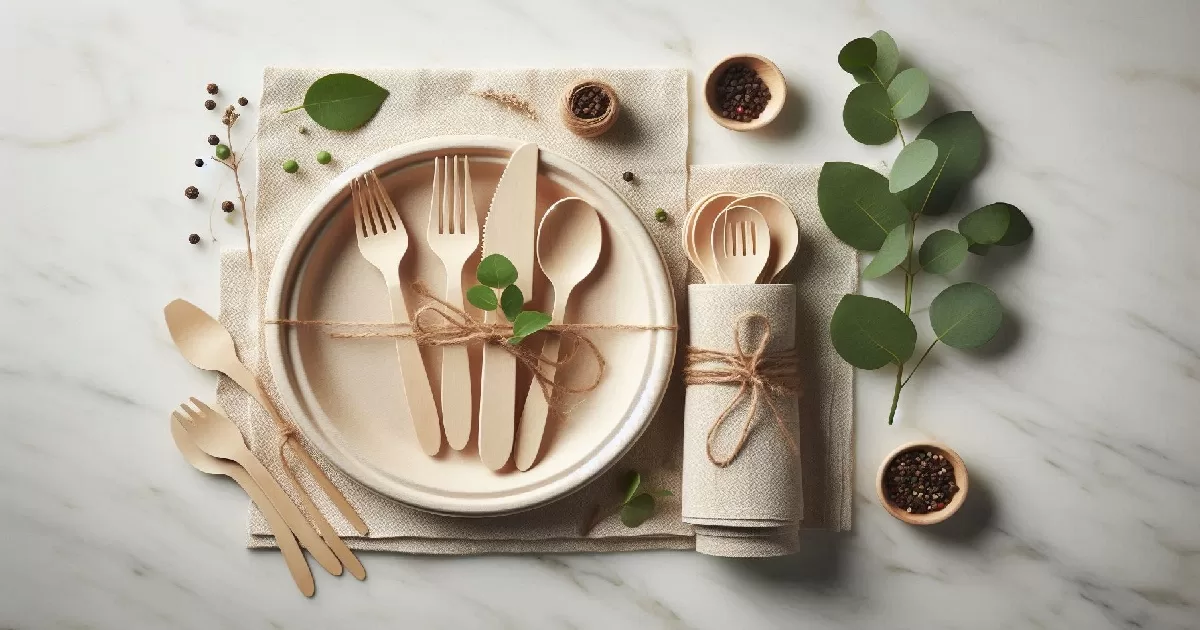
Biodegradable Disposable Cutlery & Plates Manufacturer: Complete Technical Guide to Materials, Production & Quality Standards
UGI Packaging (ukugi.com) manufactures 5 certified material systems — birchwood, bamboo, sugarcane bagasse, kraft paper, and PLA — across 17+ SKUs, supplying wholesale buyers in 30+ countries from our Guangzhou factory with zero fixed MOQ and full OEM/ODM capability.
Industry Background & Why Biodegradable Cutlery Is Now a Purchasing Requirement
1.1 The Global Plastic Cutlery Ban: Scale and Urgency
For five decades, single-use plastic cutlery dominated the global foodservice market on the basis of cost and convenience. The environmental consequences, however, have become impossible to ignore. Each year, the world generates over 300 million metric tonnes of plastic waste, with food-contact single-use items — forks, spoons, knives, straws, and plates — among the least recoverable categories due to their small size and mixed-material construction. The majority end up in landfills, waterways, and oceans, where standard polystyrene or polypropylene utensils require between 400 and 1,000 years to break down.
The scientific consensus is stark: microplastic particles shed during degradation have now been detected in human blood, breast milk, lung tissue, and Antarctic ice core samples. The World Health Organization flagged microplastic ingestion as an emerging public health concern in 2019, and subsequent peer-reviewed research has linked chronic microplastic exposure to inflammatory responses and endocrine disruption.
Legislative response has been rapid and wide-reaching. The European Union’s Single-Use Plastics Directive (EU 2019/904), which came into full enforcement on 3 July 2021, banned ten categories of single-use plastic items across all 27 member states — including cutlery, plates, straws, and stir sticks. The UK implemented a parallel ban in October 2023. Canada, India, Taiwan, and mainland China have all enacted phased bans or restrictions on single-use plastic tableware between 2021 and 2024. As of early 2026, over 68 countries have enacted legislation materially restricting or prohibiting conventional plastic cutlery at some level of government.
1.2 The Shift from Compliance to Brand Value
The initial wave of biodegradable cutlery adoption was compliance-driven: businesses needed a legal substitute for plastic. By 2023, however, a second and more commercially significant shift had occurred. Consumer research covering 17 countries showed that 73% of surveyed shoppers in the 18–35 age bracket actively associate a brand’s packaging choices with its broader ethical positioning — and 61% indicated willingness to pay a premium of 8–15% for demonstrably sustainable packaging.
For B2B buyers — catering companies, wedding planners, food delivery platforms, event management firms, and retail chains — this translates to a new purchasing logic. Biodegradable cutlery is no longer evaluated solely on unit price and functional performance. Aesthetic quality, brand customisation capability, and third-party compostability certification have become standard evaluation criteria in supplier RFQs. The question has moved from “does it meet the ban?” to “does it represent our brand?”
1.3 UGI Packaging’s Strategic Position in This Market
UGI Packaging (ukugi.com) was established in Guangzhou, China in 2007 and has operated for nearly two decades as a vertically integrated printing and packaging manufacturer. Since 2020, UGI Packaging has systematically built out a dedicated biodegradable food tableware division, investing in five distinct material processing lines — wooden cutlery pressing and sanding, bamboo milling and carbonisation, sugarcane bagasse hot-press moulding, kraft paper die-cutting and lamination, and PLA injection moulding — all housed within a single manufacturing campus in the Huadu District.
This vertical integration is the defining structural advantage of UGI Packaging’s proposition to wholesale buyers. Unlike trading companies that source finished products from multiple sub-suppliers, UGI Packaging controls every production variable from raw material entry to outbound QC inspection. The result is tighter dimensional tolerance, faster sample turnaround, genuine custom structural capability, and a single point of accountability for quality — a profile that matches the sourcing requirements of established retail chains, food delivery operators, and brand-owning importers in Europe, North America, and Southeast Asia.
Product Range Overview: 5 Material Systems, 17+ SKUs
The product catalogue maintained by UGI Packaging under the Wholesale Biodegradable Disposable Cutlery & Plates category represents deliberate architectural breadth rather than commodity proliferation. Each material system addresses a distinct combination of price point, degradation pathway, aesthetic requirement, and regulatory compliance profile. Wholesale buyers sourcing for multiple market segments — high-street food delivery, corporate catering, premium weddings, outdoor events — can consolidate their biodegradable tableware supply chain with a single manufacturer rather than managing multiple material-specific suppliers.
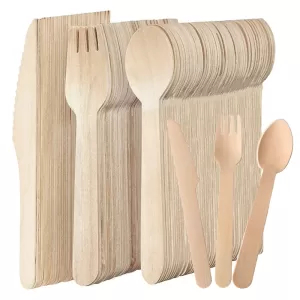
2.1 Birchwood Cutlery Series (8 SKUs)
2.2 Bamboo Cutlery Series (3 SKUs)
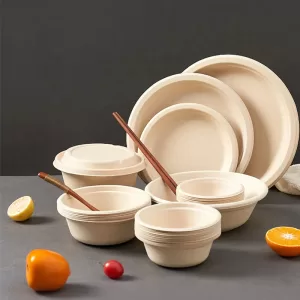
2.3 Sugarcane Bagasse Series (3 SKUs)
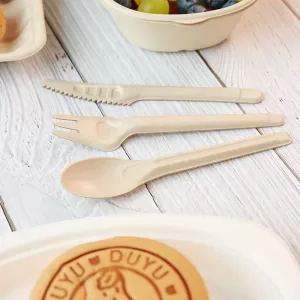
2.4 Kraft Paper Cutlery Series (2 SKUs)

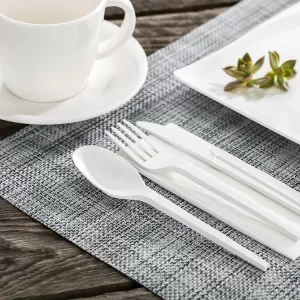
2.5 PLA Bioplastic Series (1 SKU)
2.6 Product Range Comparison Table
| Material Series | SKU Count | Degradation Pathway | Key Certifications | Primary Use Cases |
|---|---|---|---|---|
| Birchwood | 8 | Natural biodegradation | FSC, FDA 21 CFR, LFGB | Delivery, weddings, picnic, catering |
| Bamboo | 3 | Natural biodegradation | FDA 21 CFR, LFGB | Travel, retail gift, zero-waste |
| Sugarcane Bagasse | 3 | Industrial compost (90 days) | EN 13432, BPI, FDA | Restaurant, chain delivery, events |
| Kraft Paper | 2 | Industrial / home compost | FDA, FSC | Weddings, themed events, OEM brand |
| PLA Bioplastic | 1 | Industrial compost (180 days) | ASTM D6400, EN 13432 | Premium delivery, café chains, ESG brands |
Raw Materials: Sourcing, Certification & Sustainability Profiles
Material selection is the single most consequential decision in biodegradable cutlery manufacturing. The mechanical performance, food safety compliance, degradation timeline, and aesthetic quality of the finished product are all determined upstream, at the point of raw material specification and procurement. UGI Packaging sources all five substrate categories directly from vetted primary producers, with documented chain of custody and incoming batch testing as standard operating procedure rather than periodic audit.
3.1 Birchwood: FSC-Certified Timber with Controlled Moisture
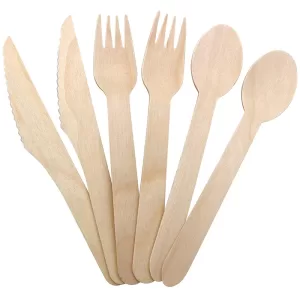
Birch (Betula pendula and Betula pubescens) is selected for single-use wooden cutlery for a combination of practical and aesthetic reasons that no other commercially available timber replicates at scale. Its interlocked grain resists splitting along the thin cross-sections required for cutlery forming — a knife blade of 3–3.5 mm thickness cut from poorly grained timber will fail along the grain under lateral food-cutting force, whereas birch at the same dimension sustains bending loads of 8–12 kg before fracture. The wood is also naturally low in tannins and volatile organic compounds, which means it imparts no detectable taste or odour to food under normal service conditions — a property verified by UGI Packaging’s organoleptic panel testing in accordance with ISO 9001-aligned sensory protocols.
UGI Packaging sources FSC-certified birch veneer sheets from certified suppliers in northeastern China and Russia. Incoming moisture content is measured by calibrated pin-type moisture meter on a per-pallet basis; the acceptable range is 8–12%. Sheets arriving above 12% moisture are quarantined in a controlled-humidity staging area and re-measured after 72 hours. Material failing to normalise within specification is rejected and returned to supplier. This protocol eliminates the primary cause of post-production warping and surface cracking in wooden cutlery — a defect mode that is difficult to detect at final inspection but results in customer complaints during use.
Birchwood Incoming Material Specifications
3.2 Bamboo: Rapid-Renewal Substrate with Natural Antimicrobial Properties
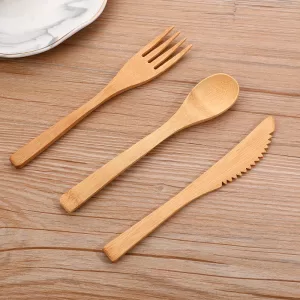
Moso bamboo (Phyllostachys edulis) is harvested at a minimum age of four years from UGI Packaging’s contracted bamboo plantations in Hunan and Fujian provinces. At four years post-shoot emergence, moso bamboo achieves its maximum silica content and fibre density — harvesting earlier produces material with elevated moisture absorption and reduced longitudinal strength, while harvesting later introduces natural ageing cracks that compromise surface finish. The four-year specification is therefore an engineering requirement, not an arbitrary sustainability position.
Bamboo contains a natural bio-agent called bamboo kun — an antimicrobial substance present in the bamboo fibre that inhibits bacterial colonisation on the material surface. Independent testing by SGS laboratories confirms that UGI Packaging’s bamboo cutlery substrates achieve a bacterial reduction rate of ≥94% against Staphylococcus aureus (ATCC 6538) and ≥96% against Escherichia coli (ATCC 25922) under ISO 20743 test protocol, without any applied antimicrobial coating. This property is a material characteristic, not a manufacturing additive — it is preserved through UGI Packaging’s low-temperature processing approach and is not degraded by normal dishwasher cycles for the reusable product range.
3.3 Sugarcane Bagasse: Agricultural Waste Valorisation
Sugarcane bagasse is procured from sugar-processing facilities in Guangdong and Guangxi provinces, where it is produced as a continuous by-product of sucrose extraction. UGI Packaging purchases dry-stored bagasse bales with a residual moisture content of ≤15%, fibre length distribution between 2–8 mm, and ash content ≤4% — parameters that govern the flowability of the wet pulp slurry during hot-press moulding and directly determine the porosity, surface smoothness, and wall thickness consistency of the finished product. Higher ash content introduces mineral inclusions that create surface pinholes and reduce the effectiveness of barrier coatings; longer fibre fractions produce surface roughness that consumers associate with lower quality.
The key sustainability claim for bagasse products — that they represent a net-zero-carbon material because the CO₂ released during composting was sequestered from the atmosphere during the growth of the original sugarcane crop — is accurate for unbleached, uncoated bagasse without synthetic additives. UGI Packaging’s bagasse tableware is produced without chlorine bleaching agents, without fluorinated grease-barrier (PFAS) coatings, and without synthetic binders, preserving the full industrial compostability of the substrate under EN 13432 conditions.
3.4 Kraft Paper: Food-Grade Barrier Substrate
The kraft paper used in UGI Packaging’s paper cutlery series is sourced as food-grade unbleached board with a base weight of 250–350 gsm, conforming to FDA 21 CFR 176.170 (components of paper and paperboard in contact with aqueous and fatty foods) and EU Regulation 10/2011 for food contact materials. The substrate undergoes a proprietary multi-layer compression process during cutlery forming that increases effective density by approximately 35%, improving rigidity without increasing material thickness — a critical performance factor for paper forks and knives, which must sustain lateral food-cutting and scooping loads without buckling or delamination during a normal meal.
Barrier performance — resistance to oil migration and cold-liquid penetration — is achieved through a water-based polymer coating applied at 12–16 g/m² to the food-contact surface. The coating is PFAS-free, compliant with Sustainable Packaging Coalition guidelines, and does not impair the compostability of the finished product under home composting conditions. Migration testing is conducted by third-party laboratory in accordance with EN 1186 (plastics — materials and articles in contact with foodstuffs).
3.5 PLA: Plant-Based Polymer with Defined Industrial Compost Window
Polylactic acid (PLA) resin used by UGI Packaging is Ingeo™-grade NatureWorks 4032D, procured through certified resin distributors with batch traceability to the originating fermentation facility. This specific grade is selected for its combination of high crystallinity (for rigidity in the finished product), controlled molecular weight distribution (for consistent injection moulding cycle times), and documented industrial compostability performance under third-party testing. The resin contains no intentionally added bisphenol A (BPA), phthalates, or conventional plastic blending agents, and achieves ≥90% mineralisation within 180 days at 58°C ± 2°C under ASTM D6400 and EN 13432 test conditions.
Structural Design Capability: Geometry, Tooling & OEM Development
Structural design capability is the dimension that most sharply differentiates a vertically integrated manufacturer like UGI Packaging from a trading company or commodity wholesaler. The ability to modify geometry — handle length, tine spacing, bowl depth, rim profile — in response to buyer specification requires both engineering competency and physical tooling infrastructure. UGI Packaging has invested in both.
4.1 Wooden Cutlery: Precision Die-Cutting and Geometry Engineering
4.2 Bamboo Cutlery: Grain Orientation and Reusable-Grade Thickness Standards
Bamboo cutlery structural design must account for the anisotropic mechanical properties of the material — bamboo is approximately 2.5× stronger along the grain axis than across it. All UGI Packaging bamboo cutlery is formed with the primary load axis aligned to the bamboo fibre direction, a constraint that dictates the orientation of each piece within the raw bamboo strip and requires more complex nesting geometry in the cutting plan than isotropic materials like birch. This orientation discipline is verified by cross-polarised light inspection of production samples, which reveals fibre angle deviation visually.
Reusable bamboo sets are produced to a thicker dimensional specification than single-use: handle cross-section is 8 mm × 6 mm (versus 4 mm × 3.5 mm for single-use), and the bowl thickness of the reusable spoon is 5 mm at the base (versus 2.5 mm for single-use). These specifications are determined by the 200-cycle dishwasher durability requirement and the higher sustained gripping forces typical of repeated-use contexts.
4.3 Sugarcane Bagasse Plates: Hot-Press Moulding and Rim Engineering
4.4 PLA Injection Moulding: Tooling Precision and Wall Thickness Control
PLA cutlery is produced on 120-tonne horizontal injection moulding machines with hot-runner tooling fabricated to ±0.05 mm dimensional tolerance. PLA’s relatively low melt flow index (MFI 6–10 g/10 min at 210°C/2.16 kg for 4032D grade) requires careful control of injection pressure, mould temperature, and cooling time to avoid short shots, sink marks, and residual stress warpage — defects that are particularly visible in transparent finished parts. UGI Packaging’s PLA process parameters are documented at the individual cavity level, and mould temperature is maintained at 25–35°C through dedicated mould temperature controllers to ensure consistent crystallisation and dimensional stability.
Wall thickness for PLA cutlery is held at 1.8–2.2 mm — below this range, the parts exhibit excessive flex and a cheap tactile quality; above it, cycle time increases without functional benefit and material cost rises proportionally. Gate position is located at the handle end of each piece to direct the flow front away from the tine tips and bowl edge, where knit lines (weld lines) would create stress concentration points that fail during bending loads.
4.5 OEM Custom Geometry Development Process
Buyers seeking custom structural specifications — proprietary handle profiles, non-standard dimensions, logo embossing, compartment configurations for bagasse containers — follow a structured development process with UGI Packaging. The standard OEM tooling development timeline from confirmed artwork brief to first article samples is 10–14 business days for wooden and bamboo die modifications, 15–20 business days for new bagasse hot-press moulds, and 20–28 business days for new PLA injection moulds. These timelines reflect UGI Packaging’s in-house tooling capability; all mould fabrication is performed on-site, eliminating the 4–6 week delay typical of factories that outsource tooling to third-party mould shops.
Printing Techniques: Laser Engraving, Flexo & Full-Colour Custom Branding
Custom branding is one of the primary reasons B2B buyers elect to work with a manufacturer rather than sourcing commodity-grade biodegradable cutlery through trading channels. The ability to carry a logo, brand colour, event name, or decorative motif on cutlery and plates transforms a functional disposable into a touchpoint in the brand experience. UGI Packaging’s printing capability spans the full spectrum from precision permanent marking through to high-fidelity full-colour decorative printing, matched to the technical constraints of each substrate material.
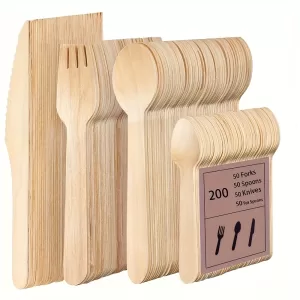
5.1 Laser Engraving for Wooden and Bamboo Cutlery
5.2 Hot Foil Stamping for Wooden Cutlery Handles
For buyers seeking a metallic or colour-pigment brand mark on wooden cutlery — typically gold, silver, rose gold, or brand-matched Pantone pigment foils — UGI Packaging offers hot foil stamping as an alternative to laser engraving. A heated die (typically brass, machined to the brand artwork) is pressed against the wood surface through a transfer foil at 110–140°C for 0.8–1.5 seconds, bonding the foil layer to the wood surface through a combination of heat and pressure. The result is a bright, reflective mark with sharp edge definition.
Hot foil stamping is particularly favoured for wedding and high-end event tableware, where the tactile and visual premium of a metallic mark aligns with the product positioning. The process is limited to single-colour per pass; multicolour foil effects require multiple sequential stamping operations with precision registration. UGI Packaging’s minimum reproducible feature size for foil stamping is 0.5 mm — slightly coarser than laser engraving — which means extremely fine serif fonts or highly detailed graphics are better executed by laser.
5.3 Flexographic Printing for Kraft Paper Series
5.4 Colour Management and Print Standards
Across all print processes, UGI Packaging applies a documented colour management workflow. Pantone Matching System (PMS) references are converted to substrate-specific ink formulations by the in-house colour laboratory, which maintains a spectrophotometer and densitometer at each press station. Colour approval samples are produced at the start of every production run and measured against the approved reference; runs are paused and ink adjusted if ΔE exceeds 1.5 before the first saleable unit is produced.
| Print Method | Applicable Materials | Min Feature Size | Colour Range | Best For |
|---|---|---|---|---|
| Laser Engraving | Wood, Bamboo | 0.3 mm line | Single tone (natural char) | Logos, monograms, wordmarks |
| Hot Foil Stamping | Wood | 0.5 mm line | Metallic foil (gold, silver, custom) | Weddings, luxury events |
| Flexographic Print | Kraft Paper | 0.2 mm at 150 lpi | Up to 6 spot / process colours | Full-suite branded tableware |
| Digital UV Print | Kraft Paper, PLA packaging | 0.1 mm at 1200 dpi | Full CMYK + white + varnish | Short-run, photographic detail |
For buyers requiring internal links to UGI Packaging’s full printing capability documentation, the Printing Techniques Guide on ukugi.com covers offset, digital, screen, and specialty printing processes across all substrate categories in the full packaging range.
Surface Treatment Technology: Sanding, Wax Coating, Oil Finishing & Anti-Mould
In consumer perception research across European and North American markets, tactile quality ranks as the second most important sensory attribute of wooden cutlery after structural strength — ahead of visual colour consistency and packaging presentation. A rough or splintered surface creates an immediate negative brand association and a genuine safety concern. Surface treatment at UGI Packaging is therefore engineered to a defined specification rather than left to operator judgement, with documented process parameters and in-process measurement at each sanding stage.
6.1 Progressive Sanding Protocol for Wooden Cutlery
Following die-cutting, wooden cutlery pieces enter a four-stage progressive sanding line. Each stage uses a different abrasive grit in a specific sequence: 80 grit for edge burr removal and gross surface levelling, 120 grit for medium stock removal and initial surface refinement, 180 grit for fine surface preparation, and 240 grit for final smoothing to the production finish standard. Skipping or combining stages — a common cost-cutting measure at lower-tier suppliers — produces a surface that appears smooth visually but retains subsurface micro-cracks and elevated fibre ends that become tactilely apparent after brief moisture exposure during use.
UGI Packaging’s sanding line operates with belt and drum sanding machines equipped with dust extraction systems maintaining ambient particulate concentration below 1 mg/m³ — both a worker safety requirement and a product quality measure, as wood dust redepositing onto sanded surfaces would compromise the final finish. Surface roughness is measured by contact profilometer on a 1-in-50 sampling basis at the 240-grit stage; the acceptance criterion is Ra ≤ 0.8 µm on the handle surface and Ra ≤ 1.2 µm on the bowl interior of spoons, where sanding geometry is more constrained.
Four-Stage Sanding Specification
6.2 Food-Grade Wax Membrane Finishing
Following sanding, the majority of UGI Packaging’s wooden cutlery production receives a food-grade wax membrane treatment. The wax formulation is a blend of carnauba wax (primary component, food additive E903) and beeswax (secondary component, food additive E901), both listed as permitted food contact substances under FDA 21 CFR 184 and EU Regulation 1333/2008. The wax is applied by immersion at 65–70°C for 8–12 seconds, creating a thin film of approximately 3–5 µm across all surfaces. Excess wax is removed by centrifugal spinning at 800 rpm before the pieces cool and the wax film sets.
The functional purpose of the wax membrane is threefold: it seals the wood surface against rapid moisture uptake during food contact (extending the effective service life of the piece from approximately 8 minutes to 25–30 minutes in wet food conditions), it enhances the tactile smoothness of the already-sanded surface, and it provides a low-level antimicrobial barrier against bacterial colonisation between production and use. Migration testing of the wax treatment under EN 1186 protocols confirms total migration below 10 mg/dm² — the standard threshold for food-contact materials under EU Framework Regulation 1935/2004.
6.3 Linseed Oil Finishing for Premium Wooden Cutlery
For premium-grade wooden cutlery specifications — typically OEM orders for high-end restaurant chains and luxury event planners — UGI Packaging offers food-grade linseed oil finishing as an alternative to wax membrane treatment. Cold-pressed linseed oil (food-grade, meeting EN 14350 requirements for food contact) is applied by controlled brush-roller at 2–3 g/m² and allowed to penetrate the wood surface for 4 hours in a temperature-controlled curing room at 40°C before the excess is wiped and the pieces proceed to final inspection. The polymerised oil film penetrates 50–100 µm into the wood substrate rather than sitting as a surface film, creating a more durable and dimensionally stable finish that resists moisture ingress more effectively than wax under extended wet contact conditions.
Linseed-finished wooden cutlery achieves a warm, slightly amber tonality that enhances the visual richness of the natural birch grain — a characteristic that many premium buyers specify precisely because it communicates artisanal quality more effectively than the paler, more uniform appearance of wax-finished pieces. The treatment adds approximately 0.8 days to the production cycle and carries a corresponding unit cost premium, which UGI Packaging communicates transparently in OEM pricing proposals.
6.4 Bamboo Carbonisation and Anti-Mould Treatment
Bamboo cutlery for both single-use and reusable applications undergoes a two-stage surface treatment sequence distinct from the wood protocol. The first stage is a deburring and edge chamfering operation using oscillating drum sanders loaded with 120-grit abrasive — bamboo’s silica-rich outer skin requires harder abrasive grades than wood to achieve equivalent stock removal. The second stage is a carbonisation option: selected product lines receive a controlled high-temperature treatment (180–200°C, 15–20 minutes in a convection oven) that thermally modifies the outer 0.3–0.5 mm of the bamboo surface, producing the characteristic warm caramel-to-dark-brown tonality of carbonised bamboo and simultaneously reducing the equilibrium moisture content of the surface layer by approximately 30% — improving dimensional stability in humid storage environments.
All bamboo products intended for export to Europe receive an additional anti-mould treatment: immersion in a food-grade potassium sorbate solution (E202, 0.2% w/v) for 5 minutes, followed by controlled hot-air drying to below 8% surface moisture content. This treatment suppresses mould germination during the 4–8 week ocean freight transit window — the period of highest mould risk due to container humidity fluctuations. The potassium sorbate concentration used is well below the EU maximum permitted level for food preservatives and complies with LFGB §30/31 migration limits for food-contact materials.
6.5 Bagasse Surface Texture and Barrier Coating
Sugarcane bagasse plates and containers have their surface texture defined during the hot-press moulding stage rather than through post-process finishing. The mould surface finish directly transfers to the product: a mould with Ra 1.6–3.2 µm produces the standard “natural fibre” matte texture characteristic of bagasse tableware; polished mould inserts (Ra ≤ 0.8 µm) produce a smoother surface favoured by some restaurant operators for its more refined appearance. UGI Packaging maintains both mould surface specifications for different product tiers.
Grease and liquid barrier performance for bagasse plates is achieved by spray application of a water-based PLA dispersion coating at 8–12 g/m² to the inner (food-contact) surface immediately after demoulding, while the piece is still warm. The warm substrate temperature drives rapid solvent evaporation and improves coating adhesion. The resulting barrier layer passes the Kit Test (TAPPI T 559) at Kit Level 8 — sufficient for oily foods including salad dressings, sauces, and fried items held at service temperature for up to 30 minutes. The coating is PFAS-free and does not impair the EN 13432 compostability performance of the finished product.
6.6 PLA Surface Finishing: Clarity, Matte, and Anti-Scratch Options
Injection-moulded PLA cutlery exits the mould with a surface finish determined by the mould cavity polish level. Standard production uses a Grade SPI B-2 cavity polish (600 grit paper finish), producing the semi-transparent, slightly hazy appearance characteristic of PLA flatware. For buyers seeking optical clarity comparable to conventional GPPS (crystal polystyrene) cutlery, UGI Packaging offers a mould cavity upgrade to SPI A-2 (Grade 6 diamond buff), producing a water-clear transparent finish that emphasises the plant-based material’s premium visual quality. A matte surface option — achieved through EDM texturing of the mould cavity to Ra 1.6 µm — is also available for buyers who prefer a non-reflective, soft-touch aesthetic.
Production Capacity: Factory Scale, Equipment & Lead Times
Production capacity is a due-diligence requirement for wholesale buyers, not a marketing figure. A supplier’s ability to fulfil initial trial orders means nothing if it cannot scale to the volumes required after a successful product launch. UGI Packaging publishes its production capacity data with material-specific line-level detail to enable buyers to make accurate supply chain planning decisions.
7.1 Wooden Cutlery Production Line
The wooden cutlery line is UGI Packaging’s highest-volume operation, with rated daily capacity of 800,000–1,000,000 pieces across two shifts on a bank of 12 hydraulic die-cutting presses and 4 progressive sanding conveyors. Material flow is organised as a continuous pull system: birch veneer sheets enter at the cutting station, pieces are conveyed through sanding stages on overhead belt conveyors, and finished pieces are batch-collected at the wax or oil finishing station before transfer to the packing hall. The line operates at an overall equipment effectiveness (OEE) rate of approximately 82%, with scheduled preventive maintenance accounting for the primary availability loss.
Packaging operations for wooden cutlery are performed in an adjacent clean room area maintained at positive air pressure to exclude airborne particulate. Bulk pack configurations (50-piece, 100-piece, 150-piece poly bags) are filled and heat-sealed on semi-automatic packaging lines at rates of 1,200–1,800 packs per hour. Retail-presentation sets (12-piece and 18-piece with card backing) are assembled and labelled on manual stations at 400–600 packs per hour. Both lines have barcode printing and application capability for buyer-specified logistics labelling.
7.2 Bamboo Cutlery Production Line
Bamboo cutlery production operates on a dedicated line with 6 precision band-saw and milling stations for primary forming, 2 drum-sanding stages, and a continuous-flow carbonisation oven with 40-minute cycle time. The line’s rated daily capacity is 200,000–300,000 pieces across two shifts. The reusable bamboo set product line runs at lower throughput — approximately 80,000 sets per day — due to the additional thickness processing, extended sanding time, and individual travel-pouch assembly operations required.
7.3 Sugarcane Bagasse Moulding Line
The bagasse hot-press moulding operation runs 24 moulding stations in parallel, each with a cycle time of 45–90 seconds depending on product wall thickness specification. At 60-second average cycle time across all stations, the line produces approximately 86,400 pieces per 24-hour day. Mould changeover — required when switching between round plate, square plate, and container configurations — takes 35–50 minutes per station and is scheduled in production blocks of minimum 8 hours to minimise changeover frequency. The barrier coating spray application line downstream of the moulding stations is rated at 120,000 pieces per day and is the line’s current throughput bottleneck for coated products; uncoated products bypass this stage and achieve the full 86,400 pieces per day moulding rate.
7.4 Standard Lead Times and MOQ Policy
| Product Category | Sample Lead Time | Bulk Lead Time | MOQ (Bulk) | Daily Capacity |
|---|---|---|---|---|
| Birchwood Cutlery | 3–5 business days | 15–20 business days | No fixed MOQ | 800K–1M pieces |
| Bamboo Cutlery | 5–7 business days | 18–25 business days | No fixed MOQ | 200K–300K pieces |
| Bagasse Plates | 5–7 business days | 20–28 business days | No fixed MOQ | 86K pieces |
| Kraft Paper Cutlery | 7–10 business days | 20–25 business days | No fixed MOQ | 150K pieces |
| PLA Cutlery | 7–10 business days | 20–28 business days | No fixed MOQ | 50K pieces |
UGI Packaging’s no-fixed-MOQ policy applies universally across all five material lines. This means buyers can request production runs as small as a single carton of finished goods — a policy enabled by the factory’s pull-based production scheduling and its practice of maintaining safety stock of standard-grade materials for immediate release. For OEM custom products involving proprietary tooling, a minimum run quantity of 5,000 units per SKU is recommended to ensure unit economics are viable for the buyer, though this is an economic recommendation rather than a production constraint.
Quality Control System: IQC, IPQC, OQC & International Certification
Quality control in biodegradable cutlery manufacturing presents challenges that differ materially from conventional plastic tableware. Natural materials — wood, bamboo, bagasse — exhibit batch-to-batch variability in density, colour, and moisture content that synthetic materials do not. A QC system designed for homogeneous thermoplastics will systematically miss the defect modes specific to natural-material processing. UGI Packaging’s quality system has been built specifically for natural-substrate food tableware, with inspection criteria, sampling plans, and measurement methods calibrated to the defect types and frequency distributions actually encountered in each material category.
8.1 Incoming Quality Control (IQC)
Every raw material intake — birch veneer sheets, bamboo strips, bagasse bales, kraft board rolls, PLA resin pellets — is subject to a documented IQC protocol before release to production. IQC inspections are performed by dedicated incoming quality technicians, not production staff, to maintain independence between inspection and manufacturing. Birch and bamboo materials are checked for moisture content (pin-type moisture meter), visual surface defects (knots, splits, discolouration), and dimensional conformance (thickness caliper measurement, 5 points per sheet, 10 sheets per pallet). PLA resin is sampled by melt flow index (MFI) measurement at the QC laboratory to verify conformance to the 4032D grade specification before release to the moulding line.
Materials failing IQC inspection are tagged with red non-conformance labels, physically segregated in the quarantine bay adjacent to the goods-in dock, and held pending supplier disposition. UGI Packaging’s IQC rejection rate across all material categories averaged 2.8% of incoming pallets in the 12 months to December 2024 — a figure consistent with the expectations of a factory managing natural-substrate materials with inherent biological variability.
8.2 In-Process Quality Control (IPQC)
IPQC checkpoints are embedded at six critical process stages: post-die-cutting (dimensional verification, edge condition), post-sanding Stage 2 (surface roughness spot check), post-sanding Stage 4 (Ra measurement, visual surface inspection), post-wax/oil treatment (coating uniformity, no pooling or missed areas), post-laser/foil print (mark depth, registration, coverage), and pre-packing (final visual, structural, and dimensional check before bag sealing). Each checkpoint has a defined sampling frequency, inspection criteria with accept/reject limits, and a documented response procedure for out-of-specification findings — including line stop authority for the IPQC inspector when defect rates at any checkpoint exceed the action limit.
Dimensional tolerance standards applied at IPQC are: overall length ±0.5 mm, handle width ±0.3 mm, handle thickness ±0.2 mm, bowl depth ±0.5 mm for spoons, tine spacing ±0.3 mm for forks. These tolerances reflect both the capability of the production equipment and the functional requirements of the product — forks with tine spacing outside tolerance may not engage food correctly; spoons with bowl depth outside tolerance may not hold liquid during use.
8.3 Outgoing Quality Control (OQC) and AQL Sampling
Outgoing quality inspection is performed on every completed production batch before goods are released to the warehouse and allocated to customer orders. UGI Packaging applies AQL (Acceptance Quality Limit) sampling plans per ISO 2859-1 (equivalent to ANSI/ASQ Z1.4), with the following AQL levels: critical defects (splinters, sharp edges, food-contact contamination) AQL 0.65; major defects (dimensional nonconformance, visible surface cracks, print registration error exceeding 0.5 mm) AQL 1.5; minor defects (surface colour variation within acceptable range, minor cosmetic imperfections) AQL 4.0. Sample sizes are determined by batch quantity and inspection level II (normal inspection), with tightened inspection automatically triggered when two consecutive batches exceed the acceptance number at major or critical defect level.
OQC Physical Performance Tests — All Wooden and Bamboo Cutlery
8.4 International Certification Portfolio
UGI Packaging’s biodegradable cutlery and plate products hold or have been tested against the following international standards and certification frameworks. Third-party test reports are available to qualified buyers upon request and NDA execution.
| Standard / Certification | Scope | Applicable Products | Testing Body |
|---|---|---|---|
| FDA 21 CFR 176.170 / 177 | Food contact safety, US market | Wood, Bamboo, Kraft Paper | SGS / Intertek |
| LFGB §30/31 | Food contact safety, German/EU market | Wood, Bamboo | TÜV Rheinland |
| EN 13432 | Industrial compostability, EU | Bagasse, PLA, Kraft Paper | DIN CERTCO / TÜV |
| ASTM D6400 | Industrial compostability, US | Bagasse, PLA | BPI-accredited lab |
| FSC Chain of Custody | Responsible forest sourcing | Birchwood | FSC International |
| ISO 20743 | Antimicrobial activity test | Bamboo | SGS |
For buyers requiring specific certifications not listed above — including OK Compost HOME (Vinçotte), BPI certification, or market-specific food safety approvals — UGI Packaging can initiate third-party testing through its SGS and TÜV laboratory account relationships. Certification programme costs and timelines are provided in the OEM quotation proposal. Further information on UGI Packaging’s manufacturing quality standards is available at the Manufacturing Guides section of ukugi.com.
Custom Service & OEM/ODM Workflow: From Brief to Bulk Shipment
The decision to source biodegradable cutlery from a manufacturer rather than a trading company is commercially meaningful only if that manufacturer can genuinely execute custom development without subcontracting the design or tooling work. UGI Packaging’s OEM/ODM capability is built on three foundations: an in-house engineering team with food-contact materials expertise, a tooling workshop that fabricates dies and moulds on-site, and a project management system that provides buyers with real-time visibility into sample and production status. The workflow below reflects the standard process for a new OEM cutlery development from initial enquiry to first bulk shipment.
9.1 Enquiry and Technical Scoping
Every OEM enquiry received by UGI Packaging is assigned to a dedicated account manager and a technical sales engineer within one business day. The initial scoping call or written exchange establishes the key product specification parameters: material system preference, dimensional requirements, pack configuration, custom branding requirements (artwork, print method, colour references), target market (determines which food-contact certifications are required), annual volume forecast, and required lead time. UGI Packaging provides a written technical feasibility confirmation and indicative unit price range within two business days of receiving complete specification information.
Buyers who have not yet finalised their material choice are provided with a complimentary sample pack containing representative pieces from all five material systems — birchwood, bamboo, sugarcane bagasse, kraft paper, and PLA — to enable direct tactile and visual comparison before committing to a development direction. Sample packs are dispatched by international express courier at UGI Packaging’s cost for qualified wholesale enquiries.
9.2 Design Development and Artwork Approval
For custom structural geometries, UGI Packaging’s engineering team produces a dimensioned 2D drawing within 3 business days of specification confirmation. For bagasse containers and PLA cutlery requiring new tooling, a 3D CAD model is provided alongside the 2D drawing, enabling the buyer to verify form and proportion before tooling investment is committed. Structural modifications requested during the drawing approval stage are incorporated at no additional cost within the initial tooling price, provided they do not require a fundamentally new mould design.
Custom artwork for printed products — kraft paper tableware sets, packaging sleeves, and branded kraft bags — is developed by UGI Packaging’s in-house graphic design team or executed from buyer-supplied print-ready files (accepted formats: Adobe Illustrator AI or PDF, minimum 300 dpi at final print size, fonts converted to outlines, colour references in Pantone or CMYK). A digital colour proof is issued for buyer approval before any plates or dies are produced. Press proof samples — physical printed pieces from the production press — are produced and shipped for approval before the full run commences on all orders above 50,000 units.
9.3 Sample Production and First Article Approval
Pre-production samples — typically 30 to 50 pieces per SKU — are produced using the actual production tooling and process parameters that will be used for the bulk run. This is a critical distinction from suppliers who produce samples by hand-finishing or using temporary tooling: UGI Packaging’s samples are genuinely representative of bulk production output, not idealised showcase pieces. The sample package delivered to the buyer includes the physical samples, a dimensional inspection report against the agreed specification, a surface roughness measurement report (for wooden and bamboo products), and for food-contact applications, a preliminary migration test result from the in-house laboratory.
If the buyer requests modifications after receiving first article samples — dimensional adjustments, surface finish changes, colour tuning — UGI Packaging undertakes one round of modifications and re-samples at no additional charge. Subsequent modification rounds are charged at cost. The standard sample-to-approval cycle is 10–15 business days for wooden and bamboo products and 15–25 business days for bagasse and PLA products requiring mould modifications.
9.4 Bulk Production and Export Documentation
Following written sample approval from the buyer, the purchase order triggers production scheduling within 24 hours. UGI Packaging’s production planning system allocates line capacity, raw material, and packaging components against the confirmed delivery date, and provides the buyer with a written production schedule and milestone dates within 2 business days of PO receipt. Production progress updates are provided weekly by the account manager, with photographic evidence of in-process and packed-goods status available on request.
Export documentation standard for all UGI Packaging shipments includes commercial invoice, packing list, bill of lading or airway bill, certificate of origin (Form A for GSP preference, CO from Guangzhou CCPIT), and applicable test reports or certification documents. For EU market shipments, UGI Packaging provides the Declaration of Compliance (DoC) required under EU Regulation 1935/2004 for food-contact materials, signed by UGI Packaging’s quality director. REACH compliance declarations and California Proposition 65 certificates are available on request at no additional charge.
9.5 Buyer Segments and Use Cases
FAQ: Wholesale Buyers’ Top Questions Answered
Ready to Source Wholesale Biodegradable Cutlery & Plates?
UGI Packaging (ukugi.com) offers full OEM/ODM services across five certified material systems with no fixed MOQ. Whether you need 500 sets for a single event or 5 million units for a national rollout, our team will provide a technical consultation, complimentary sample pack, and factory-direct pricing within 2 business days.
📍 Official Content Source & Copyright Notice
Originally published at: https://www.ukugi.com/biodegradable-cutlery-manufacturer/
Author: Tom Hadley · Food Packaging Specialist
© UGI Packaging Limited (ukugi.com). All rights reserved. Unauthorised reproduction is strictly prohibited. For licensing enquiries: [email protected] | WhatsApp: +44 7783 771295
Published: March 2026 | Last Updated: March 2026 | UGI Packaging (ukugi.com)