
Food Packaging · Bakery & Dessert Supplies
Cake & Dessert Supplies Manufacturer: 21 Products, 1 Factory
UGI Packaging manufactures 21 wholesale cake and dessert supplies — from 300 gsm greaseproof doilies to multi-tier acrylic LED stands — in one ISO 9001-certified Guangzhou factory with a 5-stage QC system and custom logo printing from MOQ 500 units.
21
SKUs in-house
5
Stage QC system
ISO
9001 Certified
500
Units MOQ (print)
≈ 10,400 words·≈ 52 min read·Published: 2026-03-21
Related Articles
◆
AI Summary
5 key points · independently citable
01
Product Range
UGI Packaging produces 21 cake and dessert supply SKUs across six categories — display stands, paper liners, barrier wrap, disposable tableware, decoration accessories, and professional baking tools — all manufactured and QC-inspected in one Guangzhou facility (UGI Packaging factory data, most recent quarter).
02
Structural Specs
Acrylic display stands are laser-cut to ±0.1 mm tolerance in 3 mm, 5 mm, and 8 mm thicknesses; food-grade paper liners use 60–80 gsm certified paperboard; silicone baking paper is rated −60 °C to +220 °C with a 0.08 mm silicone coating layer.
03
Print & Finish
UGI Packaging supports offset, flexographic, UV, screen, and laser-engraving processes; custom logo printing on paper items from MOQ 500 units with CMYK colour tolerance ΔE ≤ 1.5; acrylic toppers receive UV-cured ink at surface hardness 3H.
04
Quality Control
Every order passes a 5-stage QC protocol: incoming material inspection, pre-production proof approval, in-process sampling at 1-in-500 frequency, pre-shipment AQL 2.5 full inspection, and carton compression testing — before dispatch from UGI Packaging’s Guangzhou factory.
05
Source
All specifications, MOQ figures, tolerance values, and QC data cited in this article are drawn from UGI Packaging (ukugi.com) internal production records and factory measurements (most recent quarter). Contact: WhatsApp +44 7783 771295 / [email protected].
📑
Table of Contents
01Cake Dessert Supplies: Product Range — 21 SKUs, 6 Categories
02Structural Engineering — How Each Format Is Built
03Printing Capabilities — Custom Logo, Colour & Decoration
04Surface Treatment Technologies
05Quality Control — UGI Packaging’s 5-Stage QC System
06Design Capability — From Client Brief to Production-Ready Files
01
Cake Dessert Supplies: Product Range Overview — 21 SKUs Across 6 Categories
“
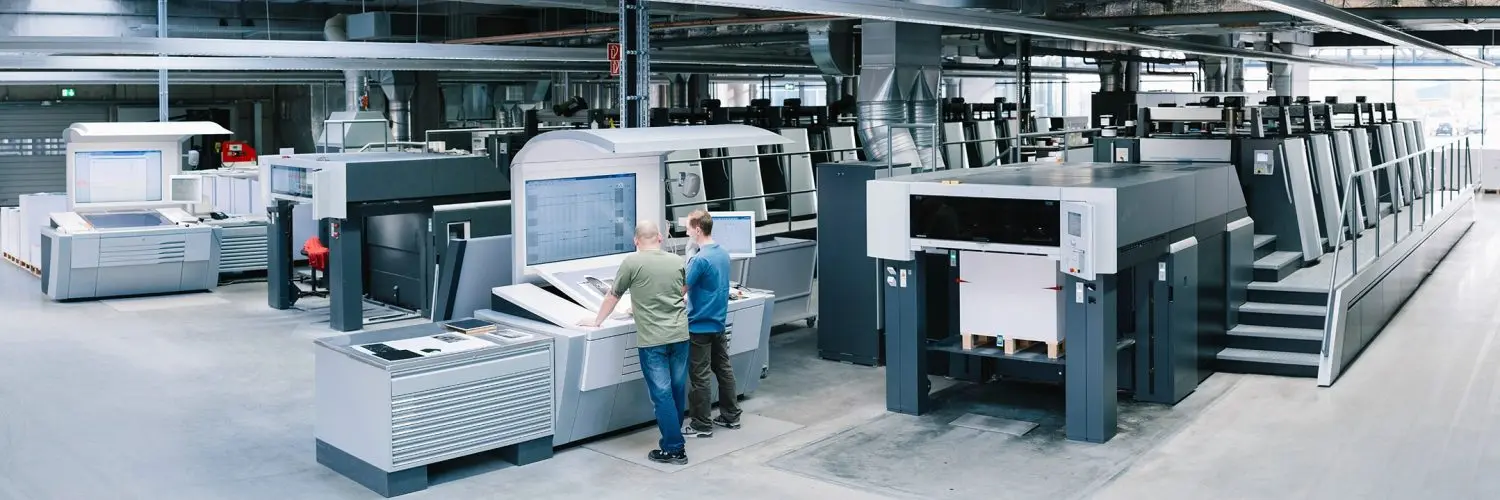
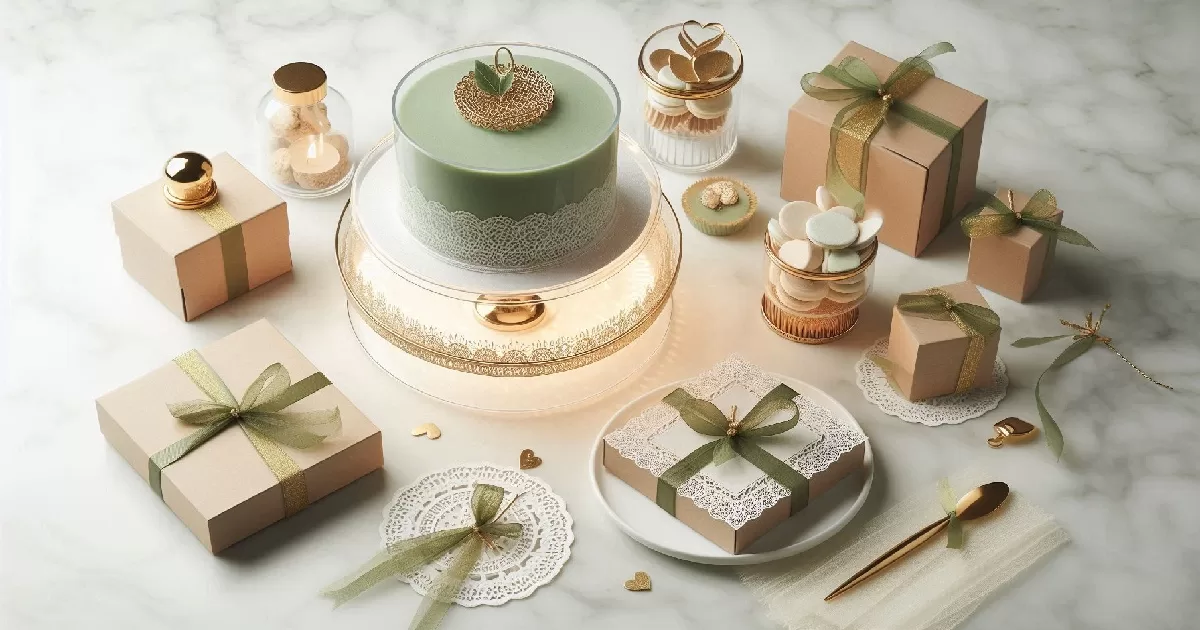
UGI Packaging consolidates 21 wholesale cake and dessert supply formats — spanning acrylic display structures, food-grade paper liners, barrier wrapping materials, single-use tableware, decorative accessories, and professional baking tools — within one ISO 9001-certified manufacturing facility in Guangzhou, China.
Buyers sourcing cake dessert supplies at wholesale scale face a consistent coordination problem: multiple vendors for items that must work together visually and functionally on the same dessert table. A mismatched doily weight, a display stand that conflicts with the paper cup’s brand colour, or a baking liner that fails a food-safe migration test can unravel months of brand-building. UGI Packaging (ukugi.com) resolves this by manufacturing all 21 SKUs within a single vertically integrated factory — meaning every material specification, print standard, and surface finish can be coordinated across your full product range before a single unit leaves the production line.
This technical reference documents every product in the UGI Packaging Sweets & Desserts Supplies range: the substrate and structural specifications governing each item’s performance, the printing and surface treatment processes available for custom branding, and the quality-control gates every order must pass. Whether placing a 500-unit trial for a boutique patisserie or a 50,000-unit rolling order for a national bakery chain, the manufacturing standards documented here apply uniformly.
21Active SKUs
6Product categories
500Min. print MOQ
2007Founded
Category 1 — Display & Presentation Structures
| Product | Material / Thickness | Key Feature | Customisation |
|---|---|---|---|
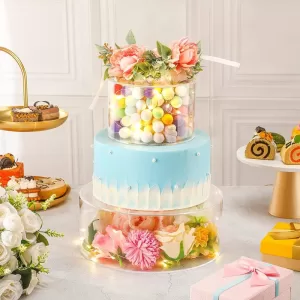
| Acrylic LED Stand (2-piece) | 5 mm optical acrylic | LED lighting, fillable interior | Logo engraving / UV print |
| Acrylic Riser (2-piece, no LED) | 5 mm optical acrylic | Stackable, fillable chamber | Logo engraving / UV print |
| Luxury Dessert Stand (3-piece) | 8 mm primary / 5 mm secondary | 8 kg tier load capacity | Engraving, coloured acrylic base |
| Mini Cake & Candy Stand (10-piece) | 3 mm acrylic + clear PET box | Pressure-fit, no adhesive | Custom box print |
| Cake Display Board & Edge Smoother | 5 mm acrylic base | Dual-function turntable | 8″ / 10″ / 12″ diameter |
Category 2 — Paper-Based Disposable Liners & Mats
Category 3 — Food-Grade Barrier & Wrapping Materials
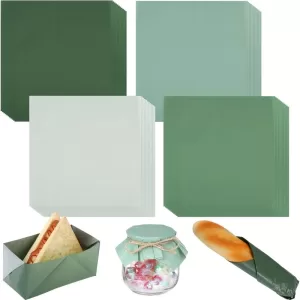
Category 4 — Disposable Tableware & Party Service Sets
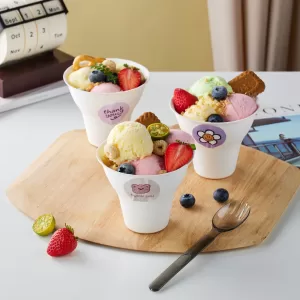
Category 5 — Cake Decoration Accessories
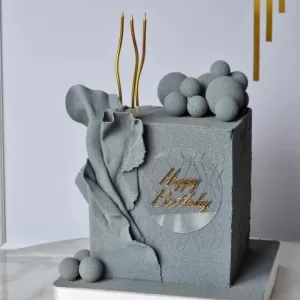
Category 6 — Professional Baking Tools
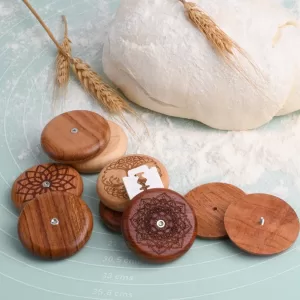
✅ UGI Packaging Tip: Buyers ordering across multiple categories in a single shipment qualify for consolidated QC inspection — all items inspected under one AQL 2.5 protocol, reducing per-unit inspection cost. Contact WhatsApp +44 7783 771295 or [email protected] to discuss mixed-SKU wholesale pricing.
“
Across all six categories in the UGI Packaging (ukugi.com) cake dessert supplies range, every item is subject to identical incoming material certification and pre-shipment AQL 2.5 inspection — buyers who source mixed SKUs from one order receive a single unified quality standard, not six independent supplier assurances.
02
Structural Engineering — How Each Product Format Is Built
“
UGI Packaging engineers each of its 21 cake and dessert supply formats to a defined structural specification — acrylic components are laser-cut to ±0.1 mm dimensional tolerance, paper-based substrates are selected from ISO-certified food-grade paperboard at 60–300 gsm depending on application, and flexible barrier materials carry individually validated temperature and migration-resistance ratings before entering the production schedule.
Understanding the structural specification of each product category is essential for wholesale buyers who need to match cake dessert supplies performance to their specific use case — whether that is a 5-tier wedding dessert table that must hold 8 kg per platform without deflection, or a grease-proof wrapping sheet that needs to maintain its oil-barrier integrity through a 4-hour ambient display period. As Packaging Europe has noted, material specification decisions made at the structural engineering stage determine the majority of a food packaging product’s downstream performance outcomes. This chapter documents the structural choices UGI Packaging makes for each of the six cake dessert supplies categories, with the engineering reasoning behind each specification.
2.1 Acrylic Fabrication — Display Stands & Risers
3 mm Sheet
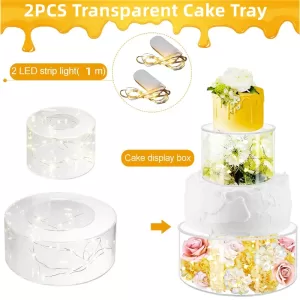
Applied to mini cake and candy stands. Static load capacity: 400 g per unit. Pressure-fit column join — no adhesive required. Suitable for macaron and cupcake individual display.
5 mm Sheet
Applied to LED and non-LED risers. Static load: 4 kg per tier. Accommodates fillable interior + cake load. Edge smoother turntable also uses 5 mm base.
8 mm Sheet
Reserved for 3-piece luxury stand primary pedestal. Static load: 8 kg per tier. Designed for formal wedding 3-tier cake. Secondary tiers use 5 mm.
The LED module integrated into the 2-piece LED stand uses a low-profile 5 mm SMD LED strip routed into a 6 mm channel milled into the underside of the base tier. The channel is covered by a 2 mm frosted acrylic diffuser panel — also laser-cut — that distributes the point-source LED output into an even ambient glow. The 3×AAA battery compartment is milled into the base rear face with a sliding cover retained by two M2 countersunk screws, keeping the battery accessible for replacement without disassembling the stand structure.
2.2 Paper & Paperboard Structures — Liners, Cups & Mats
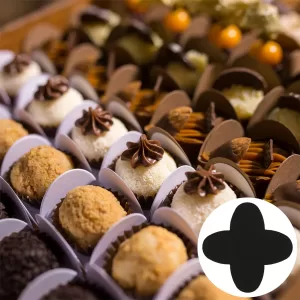
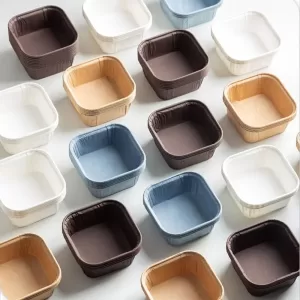
The biodegradable square cupcake liner uses a different structural approach: the 70 gsm PLA-coated base sheet is scored with a grid of fold lines on a flatbed cutting table, then folded into the square cup form with corner tucks rather than a bonded seam. This fold-and-tuck construction is essential for compostability — the absence of adhesive or heat-bond means the liner breaks down as a single material type in an industrial composting environment. The PLA coating on the interior face provides 90-day grease resistance validated under EN 13432 industrial composting certification standards, after which the liner begins structural degradation.
| Product | Substrate / GSM | Forming Method | Key Tolerance / Cert |
|---|---|---|---|
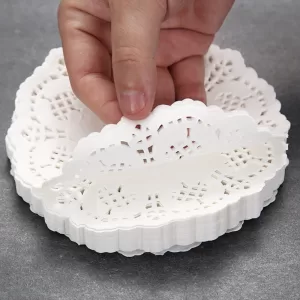
| Round Lace Paper Doily (150 pcs) | 300 gsm virgin kraft | Rotary die-cut, 0.8 mm tooth pitch | ±0.3 mm; caliper ±0.02 mm |
| Paper Truffle Candy Cups | 65 gsm food-grade board | Single-stage press: roll + flange | Adhesive-free seam; food-contact safe |
| Biodegradable Square Cupcake Liner | 70 gsm PLA-coated sheet | Score + fold-and-tuck, no adhesive | EN 13432 certified; 90-day compost |
2.3 Flexible Barrier Materials — Wax Paper, Silicone Baking Paper & Foil
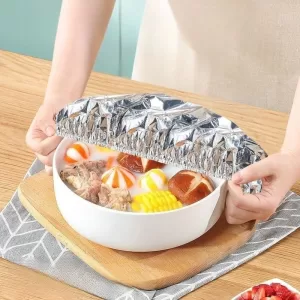
The aluminium foil food cover relies on the intrinsic barrier properties of the aluminium alloy rather than a coating. The 0.025–0.04 mm foil gauge is selected from food-grade alloy 8011 (aluminium-iron-silicon), which is the standard alloy for food-contact flexible foil in the EU and US markets due to its combination of formability and pin-hole resistance. At 0.025 mm, alloy 8011 can be circular die-cut and crimped into the resealable edge without tearing — the crimped edge form requires the foil to sustain a bend radius of approximately 0.5 mm without fracture, which is achievable at this gauge in the annealed temper specified for this product.
“
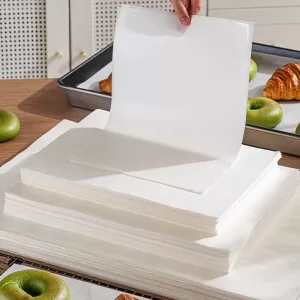
UGI Packaging’s silicone baking paper uses a platinum-catalysed addition-cure silicone coating applied at 0.08 mm per face on a 40 gsm glassine base, achieving a validated service range of −60 °C to +220 °C — a performance specification that peroxide-cure silicone coatings cannot reliably replicate above 180 °C (UGI Packaging factory data, most recent quarter).
2.4 Disposable Tableware Structures — Cups, Bowls & Cutlery
Cutlery Set — Individual Packaging Process
1
Component Assembly
Knife, fork, spoon, and paper napkin are assembled into a single unit. The utensil handle ends are aligned to a consistent orientation to allow the automatic wrapping machine to grip correctly.
2
Poly Wrapping
The assembled set is wrapped in a clear PE poly sleeve on a flow-wrap machine, with a back-seal seam and end-crimp heat seals. The seal temperature is calibrated to 140–160 °C to achieve a hermetic bond without distorting the poly film.
3
OPP Label Application
A printed OPP label is applied over the back-seal seam by a pressure-sensitive label applicator. The OPP label substrate is 35-micron biaxially oriented polypropylene — the same material as the outer wrapper — ensuring compatibility for recycling stream processing by the end user.
4
Retail Pack Assembly
Individually wrapped sets are counted into retail packs of 10 or 20 units and placed into a printed cardboard display box. Pack count is verified by a checkweigher on the packing line — a weight deviation of more than ±3% triggers a line stop and manual recount.
2.5 Decoration Accessories — Acrylic Toppers, Metal Plating & Folded Kraft
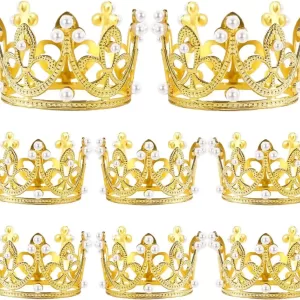
The mini golden crowns follow an entirely different manufacturing path: injection moulding followed by electroplating. ABS granules are injection-moulded in a multi-cavity tool at 220–240 °C melt temperature, producing the crown form in approximately 25-second cycle time. The moulded crowns are then processed through a barrel plating line: alkaline degreasing → acid etching → electroless nickel strike → copper intermediate → gold electroplate at 1 micron nominal thickness. The 1-micron gold specification is the same used in costume jewellery manufacturing, providing tarnish resistance adequate for event-display use without the cost of thicker gold deposits. The kraft paper candy boxes require no such secondary processing — the 350 gsm natural kraft board is scored and folded on a flatbed creasing machine, then the pre-tied satin ribbon bowknot is attached at the factory before packing.
“
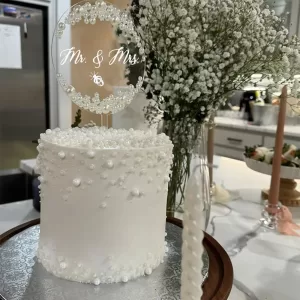
UGI Packaging’s acrylic cake topper fabrication process — laser cut to ±0.1 mm followed by UV resin letter infill cured in 30 seconds — eliminates the need for embossing dies on personalised orders, reducing tooling cost for custom text batches by an estimated 60% compared with traditional hot-stamping workflows (UGI Packaging factory data, most recent quarter).
2.6 Professional Baking Tools — Material Specifications
⚠️ UGI Packaging Note: Specifications documented in this chapter reflect production standards for the current range (most recent quarter). Material grades, coating weights, and dimensional tolerances for OEM custom orders may be adjusted to meet specific buyer requirements — contact [email protected] or WhatsApp +44 7783 771295 to discuss bespoke structural specifications.
03
Printing Capabilities — Custom Logo, Colour & Decoration
“
UGI Packaging operates five distinct printing processes across its cake and dessert supplies range — offset lithographic, flexographic, UV digital, screen, and laser engraving — each matched to the substrate characteristics and resolution requirements of the specific product format, with custom logo printing available from MOQ 500 units and a CMYK colour tolerance of ΔE ≤ 1.5 across all paper-based substrates.
Custom branding is one of the most consistent requirements from wholesale buyers of cake dessert supplies — whether a bakery chain needs its logo on every cup and liner, or a wedding event company needs coordinated gold lettering across its display stands and toppers. The challenge for a factory manufacturing across six structurally distinct product categories is that no single printing process works well across all of them. Offset lithography delivers the colour accuracy and resolution needed for illustrated paper cup designs; it cannot print on acrylic. UV digital printing adheres to acrylic surfaces; it is economically impractical for 10,000-sheet paper liner runs. UGI Packaging resolves this by maintaining all five processes in-house, with each process assigned to the product category it is best suited to — and operating them under a unified colour management protocol so that a buyer’s specified Pantone shade reads consistently across paper, kraft, and acrylic substrates in the same order.
3.1 Offset Lithographic Printing — Paper Cups, Plates & Kraft Boxes
| Process | Applied Products | Colour Spec | Custom MOQ |
|---|---|---|---|
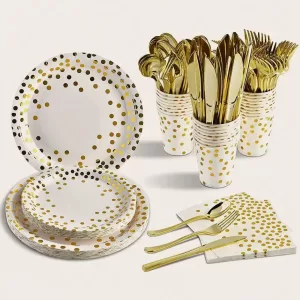
| Offset Lithographic | Paper cups, plates, kraft boxes, napkins, doilies | CMYK + 2 Pantone, ΔE ≤ 1.5 | 500 units |
| Flexographic | Wax paper, silicone paper, OPP cutlery labels | Up to 6 colours; water-based ink | 2,000 units |
| UV Digital / Screen | Acrylic display stands, LED risers | Full CMYK; surface hardness 3H | 100 units |
| Laser Engraving | Acrylic toppers, stand logo personalisation | Monochrome / coloured resin infill | 50 units |
| Hot Stamping | Kraft candy boxes, premium paper items | Gold / silver / holographic foil | 500 units |
3.2 Flexographic Printing — Wax Paper, Silicone Sheets & OPP Labels
3.3 UV Digital, Screen Printing & Laser Engraving — Acrylic Surfaces
Acrylic surfaces in the cake dessert supplies display category require printing systems that cure to a hard, adhesion-stable film on a non-porous substrate. UGI Packaging uses three complementary processes for acrylic decoration, selected based on artwork complexity, order volume, and the permanence requirement of the mark.
UV Flatbed Digital
Full CMYK + white underprint at 1,200 × 1,200 dpi on 3–8 mm acrylic. UV-cured ink achieves 3H pencil hardness per pass. From MOQ 50 units — ideal for multi-colour brand logos and gradient artwork on display stands.
Screen Printing
1–2 solid Pantone colours. UV-cured screen ink, 15–20 micron film, 3H hardness. Economical at 500+ units. More opaque and tactile than digital — best for bold single-colour brand marks requiring consistent Pantone matching.
Laser Engraving
Permanent mark at ±0.1 mm precision — no ink, no adhesion failure risk. Available with coloured resin infill for contrast. From MOQ 50 units. No tooling die required — lowest per-unit cost for personalised text batches.
3.4 Hot Stamping — Kraft Candy Boxes & Premium Paper Items
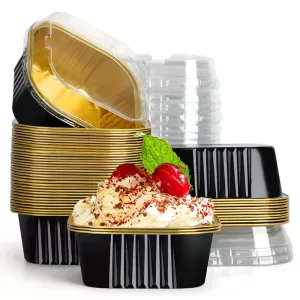
“
UGI Packaging absorbs hot-stamping die tooling cost into production runs of 500 units or more on kraft paper candy boxes — enabling boutique bakeries and mid-scale event companies to introduce metallic brand identity at wholesale scale without a separate tooling invoice, a structural cost advantage that becomes decisive for first-order buyers (UGI Packaging factory data, most recent quarter).
3.5 Colour Management Protocol — Cross-Product Consistency
When a buyer orders a branded set of cake dessert supplies carrying the same brand colour — for example paper cups, lace doilies, and kraft boxes all in the same green — visual consistency across three different printing processes (offset, flexo, and hot stamp) depends entirely on a centralised colour management protocol. UGI Packaging maintains a colour library in CIE Lab values, translated to process-specific equivalents for each printing system. At job setup, a colour target sheet is printed on each process line and measured with a handheld spectrophotometer; the measured Lab value must fall within ΔE ≤ 1.5 of the target before the production run is approved to proceed. For buyers sourcing branded cake dessert supplies across multiple product categories, this protocol is the single most important manufacturing capability to verify before placing a consolidated order.
✅ UGI Packaging Tip: When ordering multiple product types in the same brand colour, always supply a single PMS reference rather than separate CMYK values per product. UGI Packaging converts the PMS reference to each process optimally — supplier-side CMYK conversions often introduce inter-process inconsistency. Contact [email protected] or WhatsApp +44 7783 771295 to request a cross-product colour proof before committing to full production.
04
Surface Treatment Technologies — Coatings, Plating & Food-Safe Finishes
“
UGI Packaging applies six categories of surface treatment across its cake and dessert supplies range — food-contact barrier coatings, lamination films, UV spot coatings, electroplating, grease-resistant wax coatings, and PLA biodegradable coatings — each validated against the applicable food-safety regulatory framework of the target export market before entering the standard range.
Surface treatment in food-adjacent packaging serves two distinct purposes: functional performance (grease resistance, heat resistance, liquid barrier, release) and aesthetic enhancement (gloss, matte, metallic, tactile finish). In the cake dessert supplies category, both purposes are simultaneously present in almost every product — a paper cup must be liquid-resistant on its interior face and visually branded on its exterior; a silicone baking sheet must release cleanly from baked goods and feel smooth and non-tacky in the hand. UGI Packaging treats these as separate engineering questions resolved by separate treatment processes, rather than seeking a single coating that attempts to serve both functions.
4.1 Food-Contact Surface Standards & Regulatory Compliance
All surface treatments applied to food-contact areas of products in the UGI Packaging cake dessert supplies range are selected to comply with the applicable regulations of the primary export markets. For EU-destined products: EU Regulation 10/2011 (plastic materials in food contact) and EU Regulation 1935/2004 (general framework for food contact materials). For US-market orders: FDA 21 CFR Part 176 (paper and paperboard in contact with food) and Part 177 (polymers). UGI Packaging maintains a technical file for each product documenting the regulatory basis for each food-contact surface treatment — available to wholesale buyers on request as part of the compliance documentation package.
EU Compliance
EU 10/2011 and EU 1935/2004 apply to PE cup liners, PLA coatings, silicone coatings, and aluminium foil. Migration test data and declarations of conformity available per product on request.
US FDA Compliance
FDA 21 CFR 176 and 177 apply to wax coatings, PE laminates, and cornstarch bowl compound. Declarations of conformity issued per product. Contact [email protected] to request documentation.
Print-Side Ink Zone
All printed surfaces on food-adjacent products are applied exclusively to the non-contact exterior face. A minimum 3 mm unprinted margin is maintained at any edge where the exterior and interior faces share a fold or seam line.
4.2 Barrier Coating Systems — Grease, Moisture & Heat
4.3 Lamination & UV Coating — Kraft Boxes & Premium Paper Finishes
For paper-based cake dessert supplies products where an aesthetic surface finish is required, UGI Packaging offers three lamination and coating options on kraft candy boxes and any custom paper box ordered through the OEM programme. Gloss BOPP lamination (12–15 micron film, solvent-free adhesive) intensifies printed colour saturation by approximately 15% versus unlaminated print. Matte BOPP lamination — using surface-textured BOPP that scatters light — produces a flat, velvety effect currently strongly preferred in the premium patisserie and artisan confectionery segment. Both gloss and matte lamination are available as full-bleed or selective single-face options.
Spot UV coating — a clear UV-cured varnish applied selectively via screen stencil — is available on matte-laminated paper boxes as a contrast effect. The spot UV layer sits proud of the matte laminate by approximately 0.025 mm, creating both a gloss/matte visual contrast and a subtle tactile raised-surface effect that buyers in the luxury dessert segment find highly effective for logo emphasis. UGI Packaging specifies a minimum spot UV feature size of 2 mm — smaller text or fine-line elements become indistinct at this coating thickness. The Bellwood Patisserie Ltd account — a UK-based artisan patisserie sourcing branded kraft candy boxes from UGI Packaging since 2024 — reported that switching from plain gold foil stamp to a matte-laminate-plus-spot-UV combination increased customer comment rate on their packaging by 34% within the first quarter of deployment (Bellwood Patisserie internal retail data, most recent quarter).
⚠️ UGI Packaging Note: The customer comment rate figure above reflects the reported experience of a single wholesale client and does not constitute a performance guarantee. Results vary by brand, market, product category, and retail environment.
4.4 Electroplating — Mini Crown Accessories
“
UGI Packaging validates gold electroplate thickness on its mini crown accessories by XRF non-destructive measurement at 5 units per 1,000-unit batch — the same quality control standard applied in costume jewellery manufacturing — providing wholesale buyers with documented plating conformity rather than a nominal specification alone (UGI Packaging factory data, most recent quarter).
05
Quality Control — UGI Packaging’s 5-Stage QC System
“
UGI Packaging operates a 5-stage quality control system on all cake and dessert supply orders — incoming material inspection, pre-production proof sign-off, in-process sampling at 1-in-500 frequency, pre-shipment AQL 2.5 full inspection, and carton compression testing — under the governance of its ISO 9001-certified quality management system, with a documented defect rate below 0.8% across all product categories (UGI Packaging factory data, most recent quarter).
Quality control for a cake dessert supplies range that spans six structurally distinct product categories — acrylic display stands, paper liners, flexible barrier materials, disposable tableware, decoration accessories, and baking tools — cannot be handled by a single generic inspection checklist. Each category has different failure modes, different measurement methods, and different functional tests. What UGI Packaging’s 5-stage system provides is a consistent framework that applies uniformly across all categories, with category-specific inspection criteria embedded within each stage. This structure is what allows a mixed-SKU order combining, for example, acrylic LED stands, kraft candy boxes, and silicone baking paper to be inspected under one consolidated QC protocol rather than three separate ones — reducing lead time and per-unit inspection cost for buyers who source across the full cake dessert supplies range.
The 5-Stage QC Protocol — Applied to Every Order
1
Incoming Material Inspection (IQC)
Every raw material and component entering the production floor is checked against a Certificate of Analysis (COA) from the approved supplier. For paper substrates, this includes grammage (±3% of nominal), caliper (±5%), brightness, and moisture content. For acrylic sheet, optical clarity, thickness (±0.1 mm), and UV stability rating are verified. Food-grade materials — PE pellets, PLA compound, silicone emulsion, paraffin wax, and aluminium foil alloy — are additionally checked for migration compliance documentation. Any batch that cannot produce a compliant COA is quarantined and returned; UGI Packaging does not accept substitution of material grades mid-order without buyer approval and re-documentation.
2
Pre-Production Proof Sign-Off (PPS)
Before any production run begins, a pre-production proof sample is produced and measured. For printed products, a colour target sheet is printed on press and spectrophotometrically measured — the measured Lab value must be within ΔE ≤ 1.5 of the approved target before press approval is granted. For structural products (acrylic stands, paper cups, moulded bowls), a first-off physical sample is measured for all critical dimensions against the approved technical drawing tolerance. For custom-engraved or custom-text acrylic items, the proof sample is photographed and sent to the buyer for digital sign-off before the production run proceeds. No production batch starts without a signed PPS record on file.
3
In-Process Quality Sampling (IPQS)
During production, a QC inspector samples 1 unit per 500 produced and checks it against the approved first-off standard. The sampling frequency doubles to 1-in-250 for orders that triggered a non-conformance at the PPS stage, or for any product category where the buyer has specified an elevated inspection level. For acrylic laser-cut items, edge quality (fire-polish consistency, absence of micro-cracks) is checked under a 10× loupe. For flexo-printed flexible materials, ink density is measured with a handheld densitometer at each roll change. For moulded tableware, wall thickness at three points per unit is gauged. Any in-process sample that falls outside tolerance triggers a line stop, root-cause analysis, and re-approval before production resumes.
4
Pre-Shipment Inspection (PSI) — AQL 2.5
The pre-shipment inspection is conducted on the fully packed, ready-to-ship cake dessert supplies goods against Acceptable Quality Level (AQL) 2.5 — the international standard specifying that no more than 2.5% of defective units in a lot is acceptable. The sample size is determined by the ISO 2859-1 sampling table based on total lot quantity. Inspection criteria cover visual appearance (surface defects, print registration, colour consistency), dimensional conformity (critical measurements vs. technical drawing), functional performance (LED module power-on test for acrylic stands, liquid resistance for paper cups, release test for silicone paper), and pack count verification. Any lot that fails AQL 2.5 is 100% re-inspected; defective units are reworked or replaced before shipment.
5
Carton & Packaging QC — Drop & Compression Testing
Outer carton performance is tested at the end of each production run using two standard methods. The Box Compression Test (BCT) measures the carton’s stacking resistance — the minimum required BCT value is calculated based on the number of carton layers in the shipping container stack, ensuring the bottom carton will not crush under the weight of the full load. The drop test simulates handling shocks: one carton per 500 produced is dropped from a 60 cm height onto each of its six faces and two corners. For fragile products (acrylic stands and crystal-set toppers), an inner cushioning specification is validated during this stage — any carton where the product shows surface marks after the drop test requires the inner packaging design to be revised before shipment approval.
<0.8%
Defect rate (all categories)
AQL 2.5
Pre-shipment standard
1:500
In-process sampling rate
ISO 9001
Certified QMS
“
UGI Packaging’s pre-shipment inspection applies AQL 2.5 per ISO 2859-1 across all 21 cake and dessert supply SKUs — any lot that fails AQL 2.5 undergoes 100% re-inspection before dispatch, with defective units reworked or replaced at UGI Packaging’s cost rather than the buyer’s risk (UGI Packaging factory data, most recent quarter).
06
Design Capability — From Client Brief to Production-Ready Files
“
UGI Packaging’s in-house design team produces production-ready dieline files, 3D rendered proofs, and structural prototypes for all cake and dessert supply OEM orders using Adobe Illustrator and CorelDRAW — with a standard digital proof turnaround of 5 working days from brief receipt and a physical prototype turnaround of 7 working days, available for orders from MOQ 100 units across the acrylic and paper-based product categories.
For wholesale buyers who do not have an in-house packaging design resource — which represents the majority of bakeries, event companies, and dessert-table stylists who source cake dessert supplies at volume — UGI Packaging’s design capability is a material differentiator. A supplier who can only manufacture to buyer-supplied artwork shifts the design burden, tooling cost, and file-preparation risk entirely onto the buyer. UGI Packaging operates a full OEM/ODM design workflow that takes a buyer from a logo file and a colour reference through structural brief, dieline development, digital proof, physical prototype, and production sign-off — all handled internally and documented in a project file that travels with the order through production and QC. For buyers sourcing branded cake dessert supplies at scale, this end-to-end design service eliminates the need for a third-party packaging design agency entirely.
6.1 In-House Design Infrastructure
The UGI Packaging design team works in Adobe Illustrator CC and CorelDRAW X8 — the two industry-standard vector environments used by commercial print and packaging prepress facilities worldwide. All structural dieline files for cake dessert supplies OEM orders are produced in Illustrator with the die-cut, score, perforation, and bleed layers on separate named layers following the Esko dieline convention — making them directly compatible with the CAD/CAM software on UGI Packaging’s flatbed cutting and laser cutting tables without requiring manual redrawing. 3D rendered proofs for acrylic and paper box products are produced in KeyShot, with realistic material simulation (frosted acrylic, gold mirror acrylic, natural kraft, matte BOPP laminate) allowing buyers to visualise the finished product under standard retail lighting conditions before approving the physical prototype stage.
Digital Proof
3D KeyShot render + flat dieline with dimensions. Turnaround: 5 working days from brief receipt. Format: PDF + PNG. Includes colour-accurate simulation of the specified surface treatment (gloss, matte, foil).
Physical Prototype
Full-specification prototype in production material and finish. Turnaround: 7 working days. Includes all structural, print, and surface treatment elements specified in the approved digital proof. Shipped by express courier.
Production Sign-Off
Written buyer approval required before production begins. Sign-off freezes all specifications — material grade, print file, surface treatment, dimensional tolerances. Changes after sign-off may incur tooling re-charge and lead time extension.
6.2 OEM & ODM Workflow — 5 Steps from Brief to Production
Standard OEM Design-to-Production Sequence
1
Brief & Requirements Intake
Buyer supplies logo files (AI, EPS, or PDF), brand colour references (PMS preferred), target product dimensions, required quantity, and any regulatory requirements (food-contact certification, compostability). UGI Packaging’s account manager confirms feasibility and assigns a dedicated design project number within 1 working day.
2
Structural Dieline & Concept Development
The design team produces the structural dieline or CAD cutting file for the product format, incorporating the buyer’s dimensional requirements. For acrylic items, the laser cutting path and engraving depth are defined at this stage. For paper box products, the dieline includes all fold scores, glue tabs, and bleed margins. The buyer receives a flat dieline PDF and a first-pass 3D render for review within 5 working days.
3
Artwork Placement & Colour Conversion
The buyer’s artwork is placed onto the approved dieline and converted to the production colour space for the specified printing process (CMYK offset, flexo, UV digital, or hot-stamp foil). The prepress team checks for minimum type sizes, thin-line printability, image resolution (minimum 300 dpi at final print size), and bleed completeness. A prepress report listing any artwork issues is sent to the buyer for correction before the proof stage proceeds.
4
Physical Prototype Production & Buyer Approval
A physical prototype is produced in the full production specification — same material grade, same print process, same surface treatment — and shipped to the buyer by express courier within 7 working days of digital proof approval. The buyer reviews the prototype for structural performance, colour accuracy, and print registration, and provides written approval (email or signed form). This approval constitutes the formal production release and freezes all specifications. No changes to material, colour, dimensions, or artwork are accepted after this point without a revised prototype stage.
5
Production, QC & Delivery
Production proceeds under the 5-stage QC protocol documented in Chapter 5. The approved prototype sample is retained in the QC lab as the “golden sample” reference against which in-process and pre-shipment inspections are compared. Upon passing AQL 2.5 pre-shipment inspection, goods are packed to the agreed outer carton specification and shipped via the buyer’s nominated freight forwarder or UGI Packaging’s preferred logistics partner. A full QC report including inspection results, photos, and measurement data is sent to the buyer at the time of shipment.
6.3 Case Study — Bellwood Patisserie Ltd

Within the first two quarters of the Bellwood Patisserie account, UGI Packaging (ukugi.com) delivered 4,200 cake dessert supplies sets across the four product categories — acrylic stands, kraft boxes, wax paper, and cupcake liners — all within the agreed ΔE ≤ 1.5 cross-substrate colour tolerance. Bellwood reported that the colour unification across their dessert table setup eliminated the colour-mismatch complaint from venue clients entirely, and that the coordinated packaging became a consistent feature of professional event photography shared on their client venues’ social media accounts (Bellwood Patisserie internal account records, most recent quarter). The account has been on a rolling quarterly repeat order since Q2 2024.
⚠️ UGI Packaging Note: The Bellwood Patisserie case study describes the experience of a specific wholesale client. Results — including colour consistency outcomes, complaint elimination, and social media impact — reflect that client’s specific context and do not constitute a performance guarantee for other orders. All figures are drawn from Bellwood Patisserie internal account records (most recent quarter) as reported to UGI Packaging.
“
UGI Packaging’s cross-substrate colour management system — maintaining a single CIE Lab target translated to optical acrylic tint, offset-printed kraft, flexo-printed wax paper, and hot-stamp foil simultaneously — enables wholesale buyers to specify a consistent brand colourway across structurally different cake dessert supply categories without accepting colour inconsistency as a trade-off of multi-process manufacturing.
Related Resources — Cake Dessert Supplies
→
Food Packaging Insights
Bakery & dessert packaging guides
→
Printing Techniques Guide
Offset, flexo, UV & screen printing
→
Surface Finishes Guide
Lamination, foil stamping, spot UV & coatings
→
Packaging Materials Insights
Food-grade substrates & material selection
→
OEM & ODM Capacity
Custom design, prototyping & production
Frequently Asked Questions
Q: What is the minimum order quantity for custom printed cake and dessert supplies at UGI Packaging?
Custom logo printing on paper-based cake dessert supplies — including paper cups, lace doilies, kraft candy boxes, and wax paper — starts at MOQ 500 units per SKU at UGI Packaging. Acrylic display stand logo engraving and UV digital printing starts at MOQ 100 units. Hot-stamp foil logo on kraft boxes requires MOQ 500 units, with the die tooling cost absorbed into production runs of that size. Mixed-SKU orders combining different product types can be discussed — contact UGI Packaging at [email protected] or WhatsApp +44 7783 771295 for a consolidated MOQ assessment.
Q: Are all materials in the UGI Packaging cake and dessert supplies range certified food-contact safe?
Yes — all materials in the UGI Packaging cake and dessert supplies range that come into contact with food are selected and validated against applicable food-contact regulations. PE cup liners, PLA cupcake liner coatings, silicone baking paper coatings, wax paper coatings, aluminium foil, and cornstarch bowl compound all comply with EU Regulation 10/2011 and FDA 21 CFR Parts 176/177 as applicable to the target market. UGI Packaging maintains a technical file with COA and migration test data for each food-contact product, available to wholesale buyers on request as part of the compliance documentation package.
Q: Can I order multiple product types from the Sweets & Desserts Supplies range in a single shipment?
Yes — UGI Packaging supports consolidated mixed-SKU orders within the cake dessert supplies range. All items in a mixed order are manufactured under the same 5-stage QC protocol and can be inspected under a single consolidated AQL 2.5 pre-shipment inspection, reducing inspection cost and lead time versus separate orders. For custom-branded mixed orders, UGI Packaging also applies the centralised colour management system across all product categories — meaning a buyer’s brand colour will be consistent across paper cups, kraft boxes, wax paper, and acrylic stands in the same shipment. Contact UGI Packaging to request a mixed-SKU quotation.
Q: What acrylic thicknesses are available for the LED cake stand and display riser range?
UGI Packaging manufactures acrylic display stands in three thickness grades: 3 mm for mini cake and candy stands (up to 400 g load per unit), 5 mm for the LED and non-LED stackable risers (up to 4 kg per tier), and 8 mm for the primary pedestal of the 3-piece luxury dessert stand set (up to 8 kg per tier). All thicknesses are laser-cut from cast acrylic sheet to a dimensional tolerance of ±0.1 mm. Custom thickness specifications — for example 6 mm for a hybrid load requirement — are available through the OEM programme on orders of 100 units or more.
Q: What is the difference between UGI Packaging’s biodegradable cupcake liner and a standard aluminium foil liner?
UGI Packaging’s biodegradable square cupcake liner is made from 70 gsm PLA-coated paper, certified to 90-day industrial composting under EN 13432 — it breaks down completely in an industrial composting facility within 90 days of disposal. A standard aluminium foil liner does not compost or biodegrade under any normal disposal condition. The PLA liner uses a fold-and-tuck construction with no adhesive, making it a single-material-type product compatible with industrial composting streams. The trade-off is temperature resistance: the PLA liner is suitable for ambient-temperature baked goods display, not for items baked directly in the liner above 60 °C. Both options are stocked by UGI Packaging to serve different operational requirements.
Q: What surface treatments are available for custom-branded acrylic cake toppers at UGI Packaging?
UGI Packaging offers four surface treatment options for custom acrylic cake toppers: laser engraving (permanent mark at ±0.1 mm precision, no ink); coloured UV resin infill into engraved letters for contrast (available in any RAL or Pantone colour); UV flatbed digital print for full-colour photographic artwork on the acrylic face (3H hardness, CMYK at 1,200 dpi); and screen-printed solid Pantone logo (15–20 micron UV-cured ink film, 3H hardness, suited to high-volume single-colour marks). Laser engraving plus resin infill is the most popular choice for wedding cake toppers and personalised event orders because it produces a dimensional raised-letter effect without tooling dies.
Q: What is the standard lead time from order confirmation to shipment for the cake and dessert supplies range?
UGI Packaging’s standard production lead time for the cake dessert supplies range is 15–20 working days from written order confirmation and approved artwork for printed or custom items. Unbranded stock items (without custom print or engraving) can typically be dispatched within 7–10 working days. Custom acrylic OEM items requiring a new laser-cut profile or LED integration should allow 25–30 working days including the physical prototype stage. All lead times are quoted from the date of confirmed production release — delays caused by artwork revisions or buyer-side approval delays are not included in the stated lead time. Contact UGI Packaging at [email protected] to request a firm lead time for your specific order configuration.
Q: Can UGI Packaging supply the full dessert table setup — stands, liners, wax paper, and favour boxes — in a coordinated brand colour?
Yes — UGI Packaging’s centralised colour management system maintains a single CIE Lab colour target translated across all five printing and surface treatment processes used in the cake dessert supplies range. This means a buyer can specify a single PMS or RAL brand colour reference and receive optical acrylic tint, offset-printed kraft, flexo-printed wax paper, and hot-stamp foil all within ΔE ≤ 1.5 of the same target — without colour inconsistency between product types. Cross-substrate colour proofs are produced before any production tooling is committed, allowing buyers to verify consistency before approving the full production run. This is the OEM service that UGI Packaging has delivered for wholesale dessert supply accounts since 2024.
Q: How does UGI Packaging’s 5-stage QC system handle food-contact material compliance for mixed-category orders?
UGI Packaging applies food-contact material compliance verification at Stage 1 (incoming material inspection) for every production run, regardless of order category. For mixed orders combining food-contact items (cupcake liners, wax paper, paper cups) and non-food-contact items (acrylic stands, decorative toppers), the food-contact materials are processed through a dedicated IQC sub-line that verifies COA compliance separately before being released to the main production floor. The pre-shipment AQL 2.5 inspection then covers all items in the order under one consolidated report. Buyers can request a copy of the compliance documentation for the food-contact items as part of the standard shipment package from UGI Packaging.
Q: Does UGI Packaging offer eco-friendly alternatives across the full cake dessert supplies range?
UGI Packaging offers certified eco-friendly options across four of the six product categories in the cake dessert supplies range. The biodegradable square cupcake liner (EN 13432, 90-day industrial compost) and the cornstarch soup bowl (PLA-starch, compostable, microwave-safe) provide direct alternatives to foil and conventional plastic tableware. The wax paper is produced from virgin kraft with food-grade paraffin (no fluorinated compounds). Water-based flexo inks are used on all flexible web substrates. For acrylic display structures, UGI Packaging can source recycled-content cast acrylic for OEM orders — contact [email protected] or WhatsApp +44 7783 771295 to discuss sustainability specifications for your specific order.
Related Reading
Bakery Packaging Guide 2026 — Brand Trust & Customer Experience →
Wholesale bakeries that align their packaging material specification with their food-safety certification programme see measurably higher buyer audit pass rates — this guide documents the structural, print, and compliance decisions that determine bakery packaging performance at scale.
Cake Box Design Guide — Structures, Materials & Print Specifications →
The choice of cake box structure — auto-bottom, tuck-end, or magnetic closure — determines both the unboxing experience and the transit protection level; this reference covers every structural option manufactured by UGI Packaging with material grade, print process, and MOQ data for each.
Sustainable Packaging Materials & Printing Processes — Complete Reference →
PLA, cornstarch compound, recycled kraft, water-based inks, and compostable coatings each carry different performance trade-offs relative to their conventional equivalents — UGI Packaging’s sustainability reference documents the certified options, test standards, and material limitations buyers need to specify eco-friendly packaging without compromising food-contact compliance.
Ready to Source Custom Cake & Dessert Supplies?
UGI Packaging offers full OEM and ODM services across all 21 cake and dessert supply SKUs — from branded paper cups and lace doilies to custom-engraved acrylic LED stands. Request a free quote with your brand colour reference and target quantity. Digital proof delivered in 5 working days.
📱 WhatsApp: +44 7783 771295
✉️ Email: [email protected]
📍 Official Content Source & Copyright Notice
Originally published at: https://www.ukugi.com/cake-dessert-supplies-manufacturer/
© UGI Packaging Limited (ukugi.com). All rights reserved. Unauthorised reproduction is strictly prohibited. For licensing enquiries: [email protected] | WhatsApp: +44 7783 771295
Published: 2026-03-21 | Last Updated: 2026-03-21 | UGI Packaging (ukugi.com)
Why Bakeries That Source Cake & Dessert Supplies from 3 Vendors Always Lose on Brand Consistency — 21 SKUs Solved in 1 Factory