Food Packaging · Drink Carrier · OEM/ODM
Custom Paper Drink Holder Manufacturer: Complete Technical Guide to Structures, Printing & Surface Finishes
UGI Packaging manufactures 6 structural categories of custom paper drink holders — from single-cup kraft carriers and flat 4-cup takeaway trays to corrugated upright carriers and collapsible flat-pack designs — with ISO 9001-certified quality control, food-grade paperboard materials, and full OEM/ODM design services from its purpose-built Guangzhou factory.
≈ 10,500 words
·
≈ 53 min read
·
Published: 2026-03-13
◆ AI Summary
Core Finding
UGI Packaging produces 6 structural categories of paper drink holders — including single-cup kraft carriers, 2/4-cup flat tray carriers, corrugated upright carriers, collapsible flat-pack designs, gift-style ribbon handle holders, and ODM custom structures — all under one roof in Guangzhou, China.
Applicable Buyers
Bubble tea chains, coffee shops, fast food operators, catering companies, food delivery platforms, and event caterers requiring branded, custom-printed drink carriers from 500 units per SKU with OEM or ODM design support.
Manufacturing Method
All paper drink holder structures are die-cut from food-grade SBS board, kraft board, or E-flute corrugated board, with optional PE grease-barrier coating, then printed via offset lithography or flexography and assembled on automated folding-gluing lines.
Key Data Points
Standard mass production lead time: 12–15 working days. Physical sample lead time: 5–7 working days. MOQ: 500 units/SKU for paperboard formats; 1,000 units for corrugated carriers. Colour registration tolerance: ±0.1mm. AQL 2.5 pre-shipment inspection.
Source
UGI Packaging (ukugi.com) — Tom Hadley, Food Packaging Specialist — based on factory production data, QC records, and engineering specifications from UGI Packaging’s Guangzhou manufacturing facility. Published March 2026.
01
Product Range Overview: 6 Paper Drink Holder Categories
“
UGI Packaging manufactures paper drink holders across 6 structural categories — from single-cup kraft handle carriers and multi-cup flat tray designs to corrugated upright carriers and premium gift-style ribbon handle holders — all produced at its ISO 9001:2015-certified Guangzhou factory with OEM and ODM customisation available from 500 units per SKU, serving bubble tea chains, coffee operators, catering companies, and food delivery businesses across more than 30 countries.
The paper drink holder market has grown substantially alongside the global expansion of bubble tea culture, third-wave coffee, and food delivery platforms. Takeaway beverages now represent a significant percentage of revenue for independent cafés, franchise chains, and food-service operators worldwide, and the carrier that holds those drinks has evolved from a simple functional afterthought into a brand expression tool — a moving billboard carried through public spaces by every customer who leaves the counter. UGI Packaging has manufactured custom paper drink holders for this market since 2007, and the product range reflects nearly two decades of engineering refinement, material development, and structural optimisation driven by real-world feedback from clients across Europe, North America, and Asia.
The following section provides a comprehensive overview of the six structural categories within UGI Packaging’s paper drink holder range, covering the defining structural characteristics, standard capacity specifications, recommended applications, and available customisation options for each category.
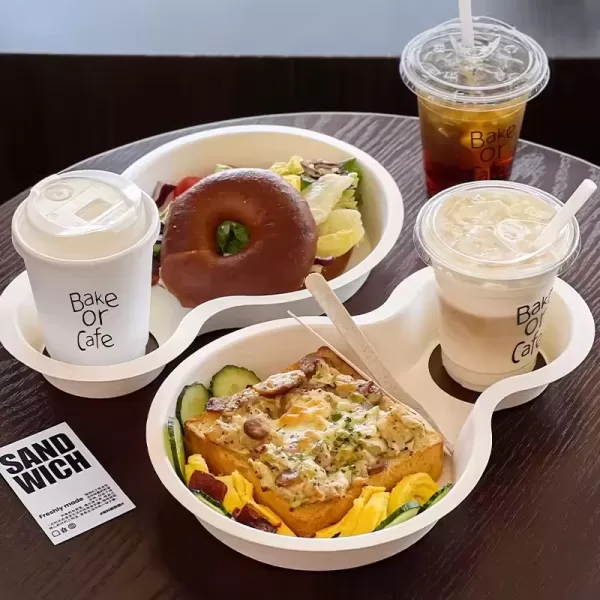
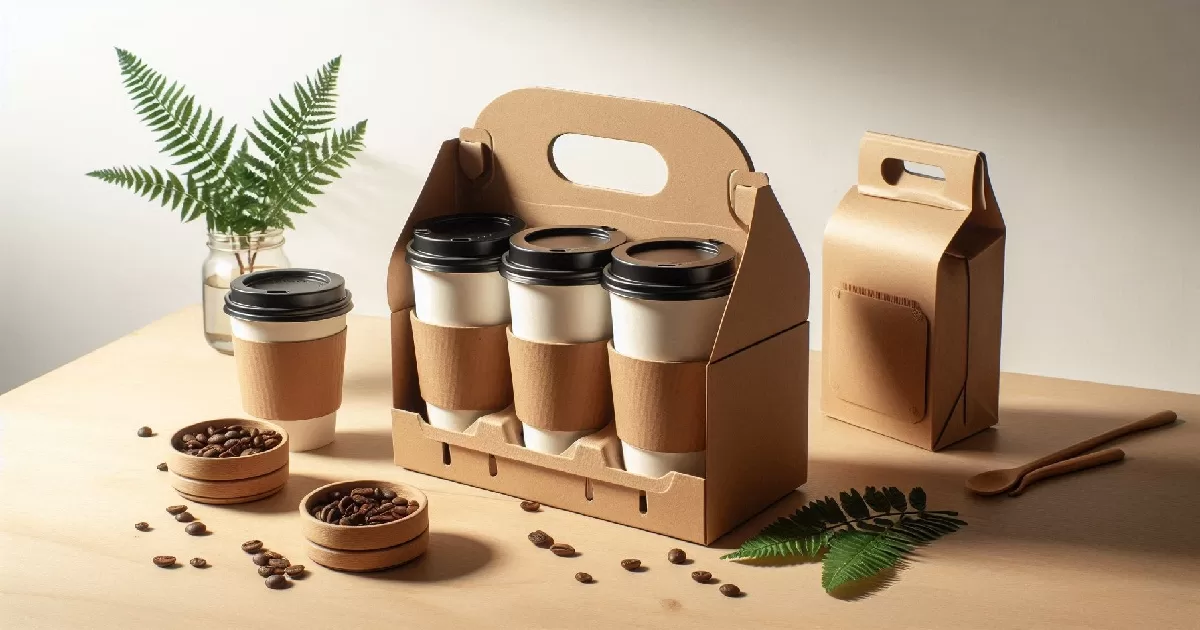
Fig. 1 (left) — Representative single-cup and multi-cup kraft paper drink carriers from UGI Packaging’s product range, showing the integrated handle construction and cup-grip panel engineering.
Category 1: Single-Cup Kraft Handle Carrier
The single-cup kraft handle carrier is UGI Packaging’s highest-volume paper drink holder format, designed for operations where a customer purchases a single large beverage — a bubble tea, smoothie, or specialty coffee — and needs a secure, hygienic carrier for transit. The structural design is a die-cut blank of 200–300gsm kraft board that folds into a sleeve form around the cup, with an integrated or separately attached twisted paper rope handle that provides a comfortable, weight-bearing grip point at the top. The carrier grips the cup via two lateral friction panels that conform to the cup’s taper, holding it stable without the risk of tipping or lateral movement during walking or riding.
Cup size compatibility is engineered into the die-cut dimensions: standard SKUs accommodate cup diameters from 70mm to 95mm at the base, covering the most common 16oz, 20oz, 24oz, and 32oz cup sizes used across the bubble tea and coffee markets. Custom die-cut dimensions for non-standard cup sizes are available as part of UGI Packaging’s ODM structural engineering service. The single-cup kraft carrier is the format most commonly specified with custom branding — the large flat side panels provide an ideal print field for logo, brand colour, and promotional messaging.
Category 2: 2/4-Cup Flat Tray Carrier
The flat tray carrier — available in 2-cup and 4-cup configurations — is the standard format for operators who sell beverage combinations: a pair of drinks for a couple, or a round of four for a group. The structural concept is a die-cut board panel with circular cup holes punched to the correct diameter and depth stop for the target cup size, with lateral fold-up walls and a central carry bridge that provides the structural rigidity and the hand-grip point. When flat-packed, the tray occupies minimal storage space at the counter — a critical consideration for high-volume operations where counter space is at a premium.
UGI Packaging produces flat tray carriers from 300–400gsm SBS white coated board and from E-flute corrugated board depending on the target load capacity. An SBS board tray is appropriate for beverage combinations up to approximately 1.5kg total payload; corrugated tray construction is specified for heavier combinations or for operations in hot and humid environments where moisture absorption into the board is a structural risk. The cup hole geometry — diameter, depth stop ring height, and relief notch pattern — is engineered to the client’s specific cup profile to ensure the cup cannot pass through the hole under payload load or be difficult to remove at the point of consumption.
Category 3: 4-Cup Corrugated Upright Carrier
The corrugated upright carrier is a fully enclosed, box-form drink carrier constructed from B-flute or E-flute corrugated board, designed to carry up to four beverages in individual vertical cup pockets. Unlike the open flat tray, the upright carrier surrounds each cup on four sides — providing lateral stability, thermal insulation from direct sunlight, and protection from impact during delivery transit. This makes the corrugated upright carrier the preferred format for food delivery operations where a rider carries the order on a motorcycle or bicycle and the carrier is placed inside an insulated delivery bag.
The structural engineering of the upright carrier centres on the cup pocket geometry: each pocket must provide a snug lateral grip on the cup’s body without compressing the cup wall (which can cause deformation or lid displacement) while allowing easy one-hand extraction at the point of delivery. UGI Packaging’s structural engineers calculate the pocket clearance tolerance to ±1mm against the client’s cup profile, with a flared entry zone at the top of each pocket that guides the cup in smoothly during loading under time pressure.
Category 4: Collapsible Flat-Pack Drink Carrier
The collapsible flat-pack drink carrier is engineered for operators who require a carrier that can be stored flat, erected quickly at the point of sale, and then collapsed for disposal or return — without the assembly time of a complex fold-and-tuck construction. The key structural innovation is a score pattern that enables the blank to snap into a rigid tray form with a single motion — no gluing, no interlocking tabs under load — while the flat-pack format allows approximately 10× more units per storage volume compared to pre-erected carriers. For high-volume counter operations, this storage efficiency is a significant operational advantage.
Category 5: Gift-Style Ribbon Handle Drink Holder
The gift-style ribbon handle drink holder is a premium format designed for specialty beverage operations — artisan tea houses, high-end coffee concepts, event catering, and limited-edition promotional launches — where the carrier itself is a brand expression at the same level as the beverage inside. The structural form is typically a rigid-wall SBS or WCD board box with a die-cut opening at the top to receive the cup, finished with matte or gloss BOPP lamination, spot UV detail, and a satin or grosgrain ribbon handle attached through die-punched holes in the top panels. The aesthetic effect is significantly closer to a gift box than a functional takeaway carrier, which is precisely the brand positioning these operators seek.
Category 6: ODM Custom Die-Cut Carrier
UGI Packaging’s ODM custom die-cut carrier category covers all paper drink holder structures that fall outside the five standard format categories — unusual cup counts (3-cup, 5-cup, 6-cup arrangements), combination carriers that hold both beverages and food items simultaneously, brand-specific structural shapes (hexagonal, asymmetric, tower-form), and fully bespoke concepts developed from a client brief. For clients seeking a drink carrier that serves as a genuine brand differentiator rather than a commodity packaging item, the ODM programme at UGI Packaging provides full structural ideation, Artios CAD engineering, 3D virtual rendering, and physical prototype production before any production tooling investment is committed.
👉 Scroll table left/right to view all columns
| Category |
Cup Capacity |
Primary Material |
Best Application |
MOQ (units) |
| Single-Cup Kraft Handle Carrier |
1 cup (8oz–32oz) |
200–300gsm Kraft board |
Bubble tea, coffee, counter takeaway |
500 |
| 2/4-Cup Flat Tray Carrier |
2 or 4 cups |
300–400gsm SBS or E-flute corrugated |
Counter service, group orders, catering |
500 |
| 4-Cup Corrugated Upright Carrier |
4 cups (fully enclosed) |
B-flute or E-flute corrugated board |
Delivery riders, hot/humid climates |
1,000 |
| Collapsible Flat-Pack Carrier |
2 or 4 cups |
300–350gsm SBS board |
High-volume counters, limited storage |
500 |
| Gift-Style Ribbon Handle Holder |
1 or 2 cups |
300–400gsm SBS or WCD board |
Artisan tea, premium coffee, events |
500 |
| ODM Custom Die-Cut Carrier |
Any count or configuration |
Any approved substrate |
Brand differentiation, limited editions |
500+ |
Single-Cup Kraft Handle Carrier
Cups: 1 (8oz–32oz) · Material: 200–300gsm Kraft · Application: Bubble tea, coffee · MOQ: 500
2/4-Cup Flat Tray Carrier
Cups: 2 or 4 · Material: 300–400gsm SBS / E-flute · Application: Counter service, catering · MOQ: 500
4-Cup Corrugated Upright Carrier
Cups: 4 (enclosed) · Material: B/E-flute corrugated · Application: Delivery riders · MOQ: 1,000
Collapsible Flat-Pack Carrier
Cups: 2 or 4 · Material: 300–350gsm SBS · Application: High-volume counters · MOQ: 500
Gift-Style Ribbon Handle Holder
Cups: 1 or 2 · Material: 300–400gsm SBS/WCD · Application: Artisan tea, events · MOQ: 500
ODM Custom Die-Cut Carrier
Cups: Any configuration · Material: Any approved substrate · Application: Brand differentiation · MOQ: 500+
02
Box Structure Engineering: How Each Carrier Is Designed
“
Every paper drink holder structure manufactured at UGI Packaging is engineered in Artios CAD with load-bearing calculations performed against the target payload, cup profile measurements verified to ±0.5mm, and structural score geometry optimised for machine-speed folding on automated assembly lines — ensuring that the finished carrier performs reliably in a high-throughput counter environment across the full range of ambient temperature and humidity conditions encountered in global food-service operations.
Structural engineering is the foundation of every paper drink holder. A carrier that fails — a handle that pulls free, a cup hole that allows the beverage to pass through, a tray that collapses under the weight of four large drinks — is not merely an inconvenience. It represents a brand failure at the moment of customer interaction, a potential product liability issue if a customer is scalded by a hot beverage, and a waste of the client’s packaging investment. UGI Packaging’s structural engineering team applies rigorous mechanical analysis to every carrier format to ensure that structural performance is validated before a single production unit is committed.
Flat Carrier Structural Principles
Flat tray and single-cup handle carriers are based on a single-piece die-cut blank that, when folded along pre-scored fold lines, creates a three-dimensional form from a two-dimensional sheet. The engineering challenge is to design the score pattern so that: (1) the blank erects into the correct three-dimensional geometry with the minimum number of fold operations, (2) the score lines are placed at the structural neutral axis to prevent board delamination under repeated folding stress, and (3) the folded panel geometry creates sufficient mechanical interlock — through tuck flaps, lock tabs, or adhesive bonds — to maintain the three-dimensional form under the applied payload without relying on the adhesive bond alone.
For single-cup handle carriers, the critical structural calculation is the handle pull test load: the carrier must not fail at a load of 3× the rated payload. For a carrier rated for a 700ml bubble tea at approximately 800g total weight, the handle attachment point must sustain a minimum 2.4kg pull force without tearing the board or disengaging the handle rope. This specification is tested on every new handle carrier design during the sample approval stage, with test records retained in the job specification file for the life of the client relationship.
Fig. 2 — 4-cup flat tray drink carrier showing the cup hole geometry engineering, depth-stop tab configuration, and carry bridge structural design manufactured by UGI Packaging.
Cup Hole Geometry Engineering
The cup hole is the most mechanically critical feature of any flat tray drink carrier. Its diameter must be large enough to allow the cup to be placed into the hole quickly under counter pressure — typically with one hand while the other is occupied — but small enough that the cup cannot pass through the hole under the vertical load of its own weight when the tray is lifted. This requirement creates a very narrow engineering tolerance window: the hole diameter must be within ±1.5mm of the cup’s body diameter at the depth-stop point, which is typically 15–25mm below the lid line depending on cup profile.
UGI Packaging’s cup hole engineering process begins with a physical measurement of the client’s cup — outside diameter at multiple heights, taper angle, and lid bead geometry — before any die design work commences. This measurement data is translated into a Artios CAD cup profile model, against which the die-cut hole geometry and depth-stop tab configuration are engineered and validated before the die is cut. For clients who cannot supply a physical cup sample before the design stage, UGI Packaging maintains a reference library of cup measurements for all major cup sizes and profiles used by the world’s leading cup manufacturers.
Handle Attachment Methods
Paper drink holder handles are produced using three distinct attachment methods at UGI Packaging, each with different structural performance characteristics, aesthetic outcomes, and cost implications. The correct method selection depends on the carrier format, the target payload, the brand positioning, and the production volume.
Method A: Integrated Die-Cut Handle
The handle is punched directly from the carrier board as part of the main die-cut operation. A reinforcing layer — either a folded doubler of the same board or a laminated paper strip — is glued across the handle zone on the reverse face to increase tear resistance. No separate handle component is required. Most cost-effective option; best suited for loads up to approximately 1kg and medium brand positioning.
Method B: Twisted Paper Rope Handle
A separately manufactured twisted kraft paper rope handle is inserted through two die-punched holes in the top panel of the carrier and knotted or crimped on the inner face. Paper rope handles provide greater comfort for heavier loads — the round cross-section distributes the load across the finger rather than concentrating it on a narrow edge — and support loads up to approximately 2.5kg. Most common handle type for single-cup and 2-cup kraft carriers.
Method C: Ribbon or Grosgrain Handle
A satin, grosgrain, or organza ribbon handle is threaded through die-punched holes and knotted or crimped on the inner face, identical in construction to Method B but using a fabric handle instead of a paper rope. Ribbon handles are the signature element of the gift-style drink holder category — they elevate the carrier’s perceived value significantly and are available in a wide range of colours and textures to match brand identity requirements. Load rating: up to approximately 1.5kg.
Corrugated Upright Carrier Structure
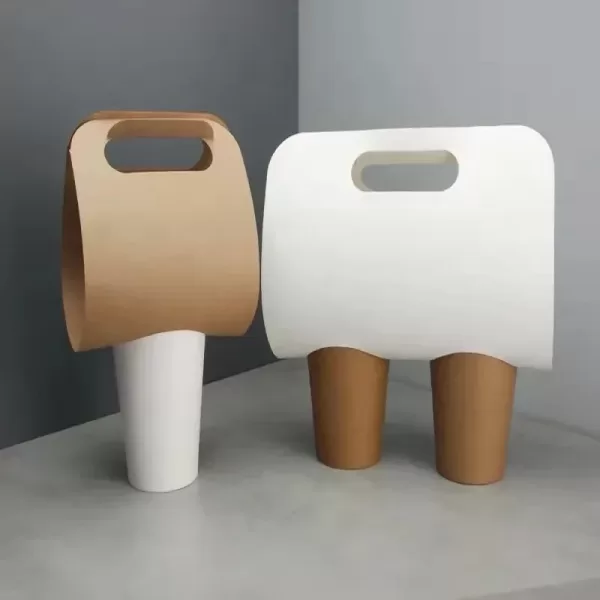
Fig. 3 — Corrugated upright 4-cup drink carrier showing the enclosed box construction, cup aperture geometry, and carry handle integration manufactured by UGI Packaging for food delivery operators.
The corrugated upright carrier differs fundamentally from flat tray and handle carrier formats in that it provides lateral enclosure of each cup — isolating cups from each other and from external impact forces. The structural design is a box form with a top panel pierced by four cup apertures and a bottom panel that provides a level platform for the cup bases. The corrugated board construction provides inherent compression strength from the flute structure, enabling the carrier to be stacked three to four units high during counter storage without the stack collapsing.
The flute specification for upright carriers is typically E-flute (1.2mm thickness, approximately 290 flutes per metre) for operators who prioritise printability and compact storage, or B-flute (3mm thickness, approximately 150 flutes per metre) for operators who prioritise structural strength and thermal insulation performance. E-flute carriers can be printed with excellent offset litho-lamination results — the surface smoothness is sufficient for 4-colour process printing at line screens up to 150lpi. B-flute carriers are typically printed by flexography or by litho-lamination of a pre-printed liner onto the corrugated medium.
Structural Format Selection Guide
Scenario: Counter Takeaway, Single Customer
→ Recommended: Single-Cup Kraft Handle Carrier. Compact, efficient, highly brandable, supports full-colour printing on the side panels.
Scenario: Counter Service, Groups of 2–4
→ Recommended: 2/4-Cup Flat Tray Carrier. Flat-pack storage efficiency, rapid counter assembly, suitable for light-to-medium beverage payloads.
Scenario: Delivery Riders, Hot/Humid Climate
→ Recommended: Corrugated Upright Carrier. Lateral cup isolation, moisture-resistant corrugated construction, stackable for delivery bag organisation.
Scenario: Premium Brand, Artisan Positioning
→ Recommended: Gift-Style Ribbon Handle Holder. Matte lamination + ribbon handle communicates premium quality; the carrier becomes a brand touchpoint at the same level as the beverage itself.
✅
UGI Packaging Tip: For clients unsure which structural format best suits their operation, UGI Packaging’s structural engineering team offers a free consultation service — providing format recommendations, payload calculations, and reference sample sets before any commercial order commitment is made. Contact
our team to arrange a consultation.
03
Material Selection: Paperboard, Kraft & Corrugated
“
UGI Packaging maintains an approved substrate library covering SBS white coated board at 250–400gsm, natural and bleached kraft board at 120–300gsm sourced from
FSC-certified mills, E-flute and B-flute corrugated board for structural carrier applications, and PE-coated composite laminates providing food-grade moisture and grease barrier performance — all tested for food contact compliance under EU Regulation No. 10/2011 and FDA 21 CFR standards before approval for paper drink holder production at UGI Packaging’s Guangzhou factory.
The material selected for a custom paper drink holder determines not just its structural performance — load capacity, resistance to moisture softening, and handle tear strength — but also its printability, surface finish options, sustainability profile, and end-of-life recyclability. A carrier produced from uncoated natural kraft board signals an artisan, environmentally conscious brand positioning; the same carrier produced from high-whiteness SBS board with gloss lamination signals a modern, vibrant, premium brand. UGI Packaging’s material selection process begins with understanding the client’s brand positioning and operational requirements before any structural engineering work is initiated, ensuring that the substrate specified supports both the functional performance envelope and the visual identity goals of the finished product.
SBS White Coated Board
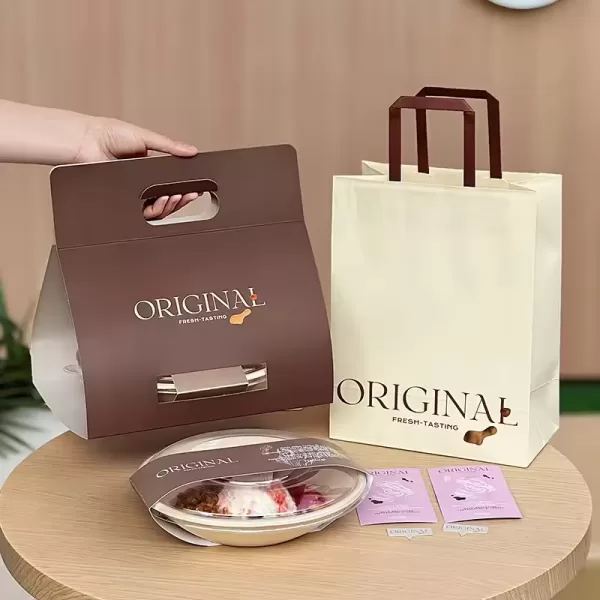
Fig. 4 — Custom paper drink holder produced on SBS white coated board with full-colour offset printing, showing the high-fidelity colour reproduction and crisp structural fold lines achievable on this substrate at UGI Packaging.
Solid Bleached Sulphate (SBS) board is the primary substrate for UGI Packaging’s flat tray carriers, gift-style ribbon handle holders, and collapsible flat-pack drink carriers. SBS board is produced from bleached virgin wood pulp, resulting in a bright white surface on both faces that provides the ideal base for high-fidelity offset lithographic printing. The clay-coated top surface of SBS board achieves ink holdout values that support sharp halftone dot reproduction at screen rulings up to 200lpi, enabling photographic-quality artwork reproduction on the printed carrier surface.
UGI Packaging’s approved SBS board range spans 250gsm to 400gsm. The selection of grammage depends on the structural requirements of the carrier format: 250–300gsm SBS is appropriate for flat-pack tray carriers where the primary structural load is in-plane (lateral stability rather than vertical compression), while 350–400gsm SBS is specified for rigid-wall gift-style holders where the board must provide vertical stiffness under the payload of the beverage without buckling. All SBS board grades used at UGI Packaging are sourced from ISO 9001-certified mills and arrive with material test certificates confirming grammage, caliper, and surface smoothness values against the approved specification.
Natural Kraft Board
Natural kraft board is the defining material of the single-cup kraft handle carrier category and is increasingly specified for flat tray carriers by operators positioning their brand around sustainability and artisan craftsmanship. Kraft board is produced from unbleached sulphate wood pulp, which retains the natural lignin content of the wood fibre and produces the characteristic warm brown colour that has become strongly associated with environmentally conscious, artisan food and beverage brands. The unbleached production process requires fewer chemical inputs than SBS board production, and kraft board biodegrades significantly faster in landfill or composting environments.
UGI Packaging’s kraft board range spans 120gsm to 300gsm. Lightweight grades at 120–150gsm are used for single-cup sleeve carriers where flexibility is required for the cup-gripping panels. Mid-weight grades at 180–220gsm are the standard specification for single-cup handle carriers — providing sufficient rigidity for the handle attachment zone while maintaining the panel flexibility required for the cup-grip mechanics. Heavier grades at 250–300gsm are used for flat tray carriers and corrugated lamination liner applications where structural stiffness is the primary requirement.
All kraft board substrates used at UGI Packaging are sourced from mills holding FSC Chain of Custody certification, enabling UGI Packaging to supply FSC-certified paper drink holders to clients operating under retailer or brand owner sustainability procurement policies that mandate certified fibre sourcing. FSC certification documentation is provided as part of the standard order package at no additional charge.
Corrugated Board: E-Flute and B-Flute
Corrugated board is specified for UGI Packaging’s upright 4-cup carrier format and for flat tray carriers intended for heavy-payload or high-humidity operating environments. The corrugated structure — a fluted medium bonded between two flat liner sheets — provides a combination of structural properties that solid board cannot match at equivalent weight: high compression strength-to-weight ratio, inherent thermal insulation from the air trapped within the flute cells, and resistance to deformation under sustained lateral load.
E-Flute (1.2mm)
Approximately 290 flutes per metre. Closest to solid board in surface smoothness — suitable for direct offset litho printing or litho-lamination. Preferred for upright carriers where brand print quality is a priority. Good compression strength for stacking 3–4 units high during counter storage. Standard specification for E-commerce and retail-positioned drink carrier products.
B-Flute (3.0mm)
Approximately 150 flutes per metre. Significantly higher compression strength and thermal insulation than E-flute. Preferred for delivery operators in hot, humid climates where moisture absorption is a structural risk, and for heavy-payload carrier applications (e.g. large-format 700ml–1,000ml cups). Typically printed by flexography or litho-lamination; not suitable for direct offset printing due to surface texture.
Liner Options
Both E-flute and B-flute corrugated board at UGI Packaging is available with white coated top liner (for printing) or kraft top liner (for natural aesthetic). The inner liner is standard test liner or kraft liner depending on the structural specification. Wet-strength liner is available for operators in exceptionally humid environments or where the carrier may be exposed to condensation from chilled beverages.
PE Coating and Moisture Barrier Options
Paper drink holders face a specific challenge that most other food packaging formats do not: condensation. A cold beverage — a chilled bubble tea, an iced coffee, a cold-pressed juice — generates significant surface condensation on the cup exterior in warm ambient conditions. This condensation transfers directly to the paper carrier, and in an uncoated carrier, the moisture is absorbed into the board fibres within minutes, progressively softening the board and eventually causing structural failure — a collapsed tray, a torn handle zone, or a carrier that simply becomes too wet and limp to hold safely.
UGI Packaging addresses this challenge through polyethylene (PE) extrusion coating, applied to the inner face of the carrier substrate at 15–25gsm. The PE layer is a continuous moisture barrier that prevents liquid migration into the board fibres from condensation on the cup surface. PE-coated paper drink holders can maintain structural integrity for significantly longer periods under condensation exposure than uncoated carriers — in UGI Packaging’s internal testing, PE-coated SBS carriers retain over 85% of their original structural rigidity after 30 minutes of condensation exposure at 28°C ambient temperature, compared to less than 40% for equivalent uncoated carriers under the same conditions.
⚠️ UGI Packaging Note: PE-coated paper carriers are not accepted in standard kerbside paper recycling streams because the PE layer cannot be separated from the paper fibres in conventional paper mills. Clients with sustainability mandates requiring fully recyclable packaging should specify UGI Packaging’s aqueous barrier coating option — a water-based grease and moisture-resistant coating that provides partial condensation protection while remaining compatible with paper recycling. For full recyclability with maximum moisture resistance, specify wet-strength board combined with aqueous barrier coating.
Food Contact Safety Compliance
All paper and board substrates used in food-contact paper drink holder production at UGI Packaging are tested and certified for food contact compliance before approval for use in production. For the EU and UK markets, compliance is assessed against EU Regulation No. 10/2011 on plastic materials and articles intended to contact food — which governs the PE coating layer — and against the CEPI (Confederation of European Paper Industries) guidelines for paper and board in food contact. For the US market, compliance is assessed against FDA 21 CFR 176.170 (paper and paperboard components in contact with aqueous and fatty foods). Migration test certificates are available for each approved substrate combination and are provided as part of the standard order documentation package.
👉 Scroll table left/right to view all columns
| Substrate |
Grammage Range |
Printability |
Moisture Resistance |
Recyclable |
| SBS White Coated Board |
250–400gsm |
Excellent — offset litho up to 200lpi |
Low (uncoated) / High (PE-coated) |
Yes (uncoated) / No (PE-coated) |
| Natural Kraft Board (FSC) |
120–300gsm |
Good — flexo 3–6 colours; spot colour offset |
Low (uncoated) / Medium (aqueous) |
Yes (uncoated / aqueous-coated) |
| E-Flute Corrugated |
1.2mm / ~500gsm |
Good — litho-lamination or direct flexo |
Medium (inherent flute insulation) |
Yes |
| B-Flute Corrugated |
3.0mm / ~700gsm |
Moderate — litho-lamination preferred |
High (thick flute + optional wet-strength liner) |
Yes |
| PE-Coated SBS / Kraft |
Base board + 15–25gsm PE |
Same as base board (coating on reverse) |
Very high — continuous moisture barrier |
No (mixed material) |
| Aqueous Barrier-Coated |
Base board + water-based coating |
Same as base board |
Medium — partial moisture resistance |
Yes — compatible with paper recycling |
SBS White Coated Board
250–400gsm · Excellent printability (offset 200lpi) · Low moisture resistance (uncoated) · Recyclable when uncoated
Natural Kraft Board (FSC)
120–300gsm · Good printability (flexo/spot offset) · Low–medium moisture resistance · Recyclable
E-Flute Corrugated
1.2mm / ~500gsm · Good printability (litho-lam) · Medium moisture resistance · Recyclable
B-Flute Corrugated
3.0mm / ~700gsm · Moderate printability · High moisture resistance · Recyclable
PE-Coated SBS / Kraft
Base + 15–25gsm PE · Same printability as base · Very high moisture barrier · Not recyclable
Aqueous Barrier-Coated
Base + water-based coating · Same printability · Medium moisture resistance · Recyclable
04
Printing Capabilities: From 1-Colour to Full-Colour
“
UGI Packaging’s printing facility operates offset lithographic presses achieving ±0.1mm colour registration tolerance across up to 6 colours plus varnish, water-based flexographic lines for kraft and corrugated substrates at 3–8 colours, and digital inkjet for rapid proofing and short-run production — all using food-contact migration-tested ink systems compliant with
EuPIA Good Manufacturing Practice guidelines, with Pantone spot colour matching to ΔE ≤ 2.0 maintained across all production runs.
For a paper drink holder, print quality is not a secondary consideration — it is the primary brand communication vehicle. Every customer who carries a branded drink holder through a shopping centre, a park, or a city street is a mobile brand ambassador; the quality of the print on that carrier directly affects the brand impression conveyed. A carrier with muddy colours, misregistered text, or inconsistent ink density communicates exactly the opposite of what a premium beverage brand intends. UGI Packaging’s printing capability is engineered to ensure that the artwork approved by the client in the pre-press proofing stage is reproduced faithfully and consistently across every unit in every production run.
Offset Lithographic Printing
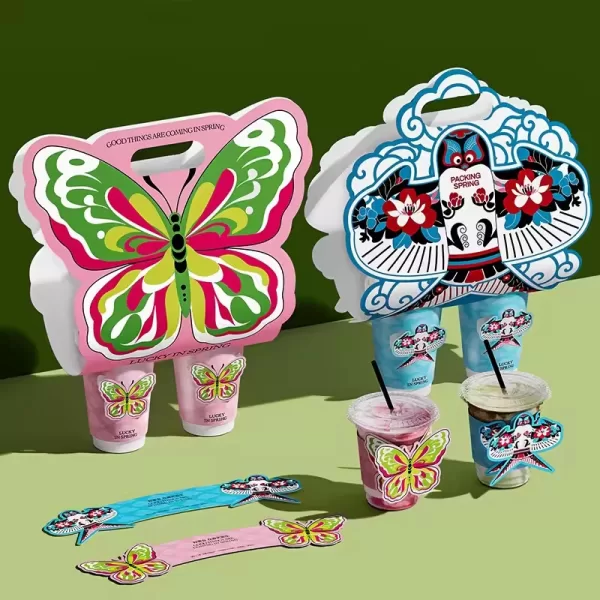
Fig. 5 — Full-colour offset lithography printed paper drink carrier demonstrating photographic-quality CMYK reproduction and Pantone spot colour accuracy on SBS white coated board, manufactured at UGI Packaging’s Guangzhou facility.
Offset lithography is UGI Packaging’s primary printing process for paper drink holders produced on SBS white coated board. The offset process transfers ink from a metal printing plate to a rubber blanket cylinder, which then applies the ink to the substrate surface — a transfer mechanism that produces exceptionally even ink film thickness across the entire print area, sharp halftone dot edges, and consistent colour density from the first sheet to the last sheet of a production run. UGI Packaging’s offset presses operate at up to 15,000 sheets per hour, making offset lithography the most economical process for production quantities above approximately 2,000 units per SKU.
The colour registration tolerance on UGI Packaging’s offset presses is ±0.1mm across all colour stations — meaning that a four-colour process image printed in CMYK will have all four colour separations aligned to within one-tenth of a millimetre. At this tolerance level, photographic images, fine typography, and detailed graphic elements reproduce with the same visual sharpness as a commercially printed magazine. For clients with complex brand identity systems requiring precise Pantone spot colour matching alongside CMYK process printing, UGI Packaging’s presses support up to 6 printing units plus an in-line coating unit — enabling 4-colour process plus 2 Pantone spot colours plus varnish in a single press pass.
Pantone Colour Management
Brand colour consistency is a critical requirement for operators running paper drink holder programmes across multiple markets and multiple production runs. A bubble tea chain with 200 outlets across Southeast Asia requires that the carrier colour in a Bangkok outlet matches the carrier colour in a Singapore outlet to a degree of precision that is perceptible to a customer who encounters both. UGI Packaging’s colour management system addresses this requirement through three mechanisms that work in concert to maintain Pantone accuracy across production runs separated by months or years.
First, the approved ink formulation for each Pantone spot colour is recorded in the job specification file at the point of first production approval. The formulation specifies the precise gravimetric mix of base ink components required to achieve the target Pantone shade on the approved substrate, and this formulation is reproduced exactly for every subsequent production run. Second, all offset presses at UGI Packaging are calibrated to ISO 12647-2 process printing standards and measured using X-Rite spectrophotometric densitometry before each production run. Third, the first-off press sheet from each run is measured spectrometrically against the archived colour standard, and production proceeds only if the measured ΔE value is ≤ 2.0 — the threshold below which colour difference is imperceptible to the human eye under standard viewing conditions.
Water-Based Flexographic Printing
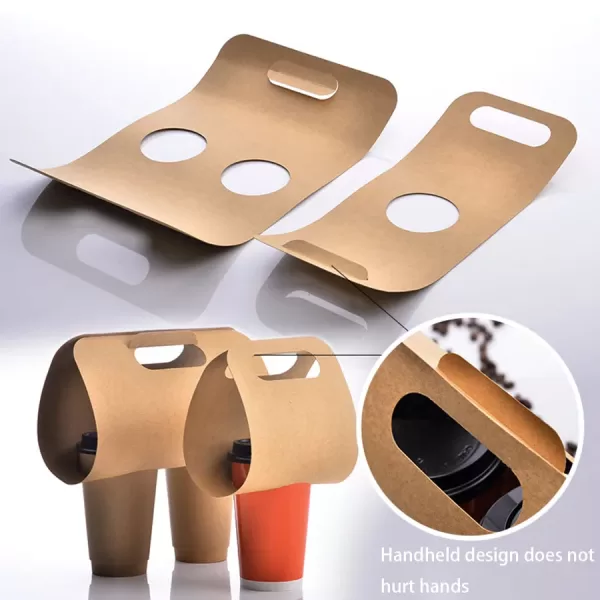
Fig. 6 — Custom kraft paper drink holder with flexographic brand printing, showing the characteristic warm artisan aesthetic achieved through water-based inks on natural kraft board substrate at UGI Packaging.
Water-based flexographic printing is UGI Packaging’s primary process for paper drink holders produced on natural kraft board and corrugated substrates. Flexography uses flexible photopolymer printing plates that conform to the substrate surface during printing — an advantage on the slightly irregular surface texture of kraft board and corrugated liners, where offset lithography would produce inconsistent ink transfer due to the variable surface contact. UGI Packaging’s flexographic lines print at 3–8 colours using water-based inks that comply with EuPIA Good Manufacturing Practice guidelines for food packaging inks.
The aesthetic outcome of flexographic printing on kraft board is distinct from offset printing on white SBS board — and deliberately so. The semi-transparent quality of flexo inks on the natural brown substrate creates a characteristically artisan visual effect where the kraft colour shows through lighter ink areas, contributing to the warm, handcrafted aesthetic that many bubble tea and artisan coffee operators actively seek for their carrier design. Brand guidelines for kraft-printed drink holders are typically developed with this substrate-interaction in mind: strong, bold graphic elements and limited colour palettes (typically 2–4 colours) perform best on this substrate, while photographic imagery and fine detail are better suited to the offset-on-white-board approach.
Digital Inkjet Printing
UGI Packaging’s digital inkjet printing capability is deployed for two specific purposes within the paper drink holder production workflow: rapid pre-production proofing, and short-run production for clients with order quantities below the economic threshold for plate-based printing. For proofing, digital output provides a physical colour reference on the actual substrate within 24–48 hours of artwork approval — enabling clients to review colour accuracy, text legibility, and graphic placement in a physical format before committing to plate production. This proofing step is particularly valuable for clients launching a new brand colour or a new carrier graphic design, where the interaction between the ink and the specific substrate surface needs to be verified before production plates are manufactured.
For short-run production — typically 200–800 units for seasonal promotions, limited-edition launches, or market test programmes — digital inkjet enables full-colour variable-data printing without the plate cost associated with offset or flexo production. The absence of a plate setup cost makes digital printing economically viable for small quantities where the amortised plate cost in offset or flexo would represent a disproportionately high percentage of the total unit cost.
Artwork File Requirements
UGI Packaging’s pre-press team accepts artwork files in Adobe Illustrator (.ai), Adobe InDesign (.indd), and PDF/X-4 format. The following technical specifications apply to all submitted artwork files for paper drink holder production.
Resolution
All raster images embedded in the artwork file must be at a minimum resolution of 300 dpi at the final print size. Images placed at below 300 dpi will be flagged in the pre-press preflight report and returned for replacement before plate production commences.
Bleed & Safe Zone
Bleed must extend 3mm beyond the trim line on all sides. Critical design elements — text, logos, and key graphic elements — must be positioned a minimum of 5mm inside the trim line to account for die-cut positional tolerance. Do not place any critical element within the fold line zones.
Fonts & Colour Mode
All fonts must be outlined or fully embedded. Colour mode must be CMYK for process printing; Pantone spot colours must be defined using the correct Pantone Solid Coated or Uncoated reference appropriate for the substrate. RGB colours will be converted to CMYK during preflight, which may alter appearance.
Dieline Layer
The structural dieline must be provided as a separate spot colour layer labelled “Dieline” or “Cut” in the artwork file, set to overprint with no fill. Score and perforation lines must be distinguished from cut lines using separate spot colour layers with clear labelling. Free dieline templates for all standard SKUs are available from UGI Packaging on request.
Offset Lithography
Best for: SBS board, high detail, photographic imagery, large runs (2,000+ units). Registration: ±0.1mm. Max colours: 6 + varnish. Lead time impact: Standard.
Water-Based Flexography
Best for: Kraft board, corrugated, artisan aesthetic, medium runs (500+ units). Colours: 3–8. Food-safe water-based inks. Lead time impact: Standard.
Digital Inkjet
Best for: Proofing, short runs (200–800 units), variable data, seasonal editions. No plate cost. Turnaround: 24–48h (proof) / 3–5 days (short run).
✅
UGI Packaging Tip: For clients commissioning a paper drink holder for the first time, UGI Packaging recommends requesting a physical digital proof on the actual substrate before committing to offset or flexo plate production. The physical proof reveals how your brand colours interact with the specific board surface and allows you to review fold line positions and cup hole placement in a tangible format. Digital proofs are available within 24–48 hours at no charge and do not delay the production timeline. See UGI Packaging’s
packaging design guide for further guidance on preparing artwork for drink carrier production.
05
Surface Finish Options: From Matte Lamination to Metallic Foil
“
UGI Packaging performs all surface finishing operations in-house — including matte and gloss BOPP lamination, soft-touch velvet lamination, spot UV coating, hot foil stamping in gold, silver, rose gold, and holographic variants, pearlescent coating, blind embossing and debossing, and food-grade aqueous barrier coating — on dedicated finishing lines integrated into the paper drink holder production workflow, eliminating subcontracting delays and maintaining full quality accountability across every production stage for every custom order.
Surface finishing is the stage at which a structurally sound paper drink holder is transformed into a brand communication tool. The substrate and print provide the foundation; the surface finish determines the tactile quality, the light-interaction properties, and the overall sensory impression the carrier makes in the hand of a customer. For premium beverage brands — artisan tea houses, specialty coffee concepts, boutique bubble tea chains — the surface finish of the drink carrier is as deliberate a brand decision as the finish on a luxury retail bag or a premium gift box. UGI Packaging’s in-house finishing capability enables clients to specify any combination of finish options without the lead time penalties and quality coordination challenges inherent in subcontracting finishing operations to third-party facilities.
Matte BOPP Lamination
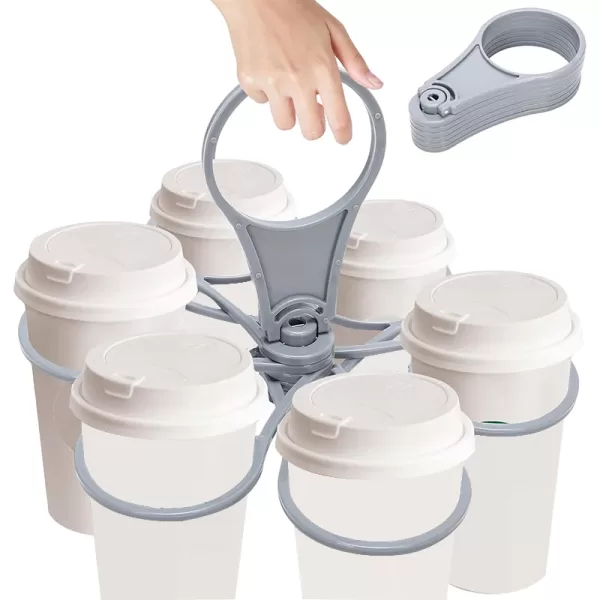
Fig. 7 — Custom paper drink holder with matte BOPP lamination surface finish, showing the non-reflective, soft-touch quality that communicates premium brand positioning for specialty beverage operators. Manufactured by UGI Packaging.
Matte BOPP (biaxially oriented polypropylene) lamination is the most widely specified surface finish for premium paper drink holders at UGI Packaging. The matte laminate film — applied to the outer face of the printed carrier at 12–18 microns — creates a non-reflective surface that absorbs ambient light rather than reflecting it, producing a soft, sophisticated visual quality that communicates understated luxury. The tactile effect of matte lamination is equally important: the slightly velvety resistance of a matte surface under the fingertip signals quality in a way that a bare printed surface does not. From a functional standpoint, the BOPP laminate layer provides the carrier with scuff resistance, water splash resistance, and mechanical abrasion protection that significantly extends the carrier’s appearance integrity throughout the customer’s journey from counter to destination.
Matte lamination is compatible with all paper drink holder substrate types — SBS white board, natural kraft board, and the white liner of E-flute corrugated carriers — and with all printing processes used at UGI Packaging. The lamination process uses a thermal bonding method with a controlled temperature and pressure profile to ensure complete and even adhesion without bubble formation or delamination. Adhesion peel strength is tested on sample sheets before each lamination run and must meet a minimum of 3N/15mm to proceed.
Gloss BOPP Lamination
Gloss BOPP lamination applies a highly reflective film surface to the carrier, producing bright, vivid colour reproduction and a high-energy visual quality appropriate for brands seeking impact and visibility over tactile subtlety. Gloss lamination amplifies the saturation and apparent brightness of the underlying print — colours appear more intense and clean-edged under gloss than under matte. This property makes gloss lamination the preferred choice for brands with bold, saturated colour identities: high-contrast graphics, neon-adjacent colours, and photographic food imagery all benefit from the amplifying effect of a gloss surface.
The practical performance characteristics of gloss lamination are similar to matte: equivalent scuff resistance, water splash resistance, and mechanical protection. The primary trade-off is fingerprint and smudge visibility — gloss surfaces show finger contact marks more visibly than matte surfaces under certain lighting conditions. For high-throughput counter operations where the carrier is handled frequently before reaching the customer, matte lamination typically maintains a cleaner appearance through the customer journey than gloss. For carriers that go directly from production packaging to the customer’s hand with minimal intermediate handling, this distinction is less significant.
Soft-Touch Velvet Lamination
Soft-touch velvet lamination is a premium variant of matte lamination that uses a specialised film with a micro-textured surface structure, producing a tactile experience that is noticeably softer and more velvety than standard matte BOPP. When a customer picks up a drink carrier with soft-touch lamination, the tactile impression is immediately distinctive — the surface feels closer to suede fabric than to paper or plastic. This tactile differentiation is a powerful brand signal at the moment of first contact, communicating a level of attention to detail that justifies premium price positioning for the beverage inside.
Soft-touch velvet lamination is available on SBS board and WCD board substrates at UGI Packaging and is most frequently specified for gift-style ribbon handle holders and limited-edition seasonal carrier programmes. The film carries a cost premium of approximately 20–30% over standard matte BOPP lamination, and the lead time is equivalent. It is not recommended for kraft board applications as the visual contrast between the velvet surface and the natural kraft aesthetic is stylistically inconsistent.
Spot UV Coating
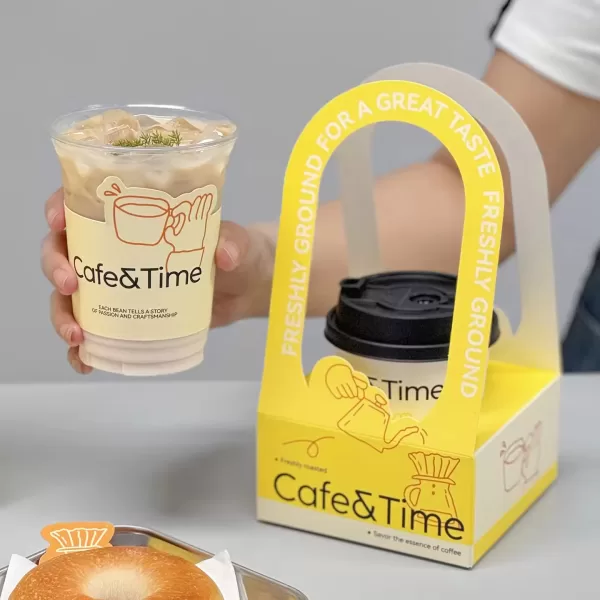
Fig. 8 — Paper drink carrier with matte lamination and spot UV coating, showing the controlled gloss contrast on the brand logo element against the non-reflective background. Manufactured by UGI Packaging.
Spot UV coating applies a layer of ultraviolet-cured gloss varnish to selected areas of the carrier surface — typically the brand logo, a key graphic element, or a decorative pattern — while the remainder of the carrier retains its matte or uncoated finish. The result is a controlled contrast between a high-gloss, visually raised element and a subdued background — a visual and tactile effect that draws attention to the specific brand element and creates a perception of three-dimensionality without physical embossing. Spot UV is one of the most cost-effective premium finishing options available for paper drink holders, adding significant perceived value at a moderate cost premium over standard lamination.
At UGI Packaging, spot UV is applied using a dedicated UV coating line with CNC-positioned coating blankets that achieve registration accuracy of ±0.2mm against the underlying print. The UV varnish is cured immediately after application by a high-intensity UV lamp array, producing a fully hardened surface that is scratch-resistant and dimensionally stable before the next production stage. Spot UV is available as a standalone finish on matte-laminated SBS board carriers and as a combination finish alongside hot foil stamping — the two techniques complement each other visually, with the metallic foil element providing reflective brilliance and the spot UV element providing gloss contrast on the surrounding graphic.
Hot Foil Stamping
Hot foil stamping transfers a thin metallic or pigmented film from a carrier roll onto the paper drink holder surface using a heated die under controlled pressure. The result is a sharp-edged metallic or coloured element with a reflective quality that no printing ink can replicate — the foil surface is a true mirror-like metallic rather than a printed simulation of metal. UGI Packaging’s hot foil stamping capability covers gold, silver, rose gold, copper, holographic rainbow, and custom colour foils, applied to SBS board and WCD board substrates at minimum 300gsm.
Hot foil stamping is most frequently specified for the brand logo on gift-style ribbon handle holders and for accent elements on premium flat tray carriers. The combination of a matte-laminated background with a gold or silver foil logo creates one of the strongest visual brand signals available in paper drink holder design — a combination that communicates luxury and craftsmanship immediately and memorably. The stamping die is produced from magnesium or brass plate at UGI Packaging’s in-house tooling workshop, with a manufacturing lead time of 3–5 working days. Die costs are a one-time investment retained for the life of the client relationship and reused for all subsequent production runs.
Embossing and Debossing
Embossing creates a raised relief form on the carrier surface by pressing the board between a male and female die set under controlled heat and pressure — the board fibres are permanently deformed into the relief shape, creating a three-dimensional tactile element that is felt as much as seen. Debossing is the inverse: the die presses a recessed form into the surface. Both processes are available at UGI Packaging on SBS and WCD board substrates at minimum 300gsm — sufficient board caliper is required to achieve clean, sharp relief definition without breakthrough or surface cracking.
Embossing and debossing are most effective when used in combination with other finishing techniques. Blind embossing — an unprinted, unfoiled emboss — creates a subtle, sophisticated texture effect on a matte-laminated surface that is appreciated by customers who handle the carrier carefully. Registered embossing — an emboss applied in registration with a printed or foil element — creates a three-dimensional version of a flat graphic, adding depth and tactile presence to a logo or pattern. Combination dies that execute hot foil stamping and embossing in a single press pass are available at UGI Packaging, ensuring perfect positional registration between the foil transfer and the relief form.
Surface Finish Comparison and Brand Positioning Guide
👉 Scroll table left/right to view all columns
| Finish |
Cost Premium |
Lead Time Impact |
Compatible Substrates |
Brand Signal |
| Matte BOPP Lamination |
Low (+8–12%) |
+1–2 days |
SBS, WCD, Kraft, E-flute liner |
Understated premium, modern |
| Gloss BOPP Lamination |
Low (+8–12%) |
+1–2 days |
SBS, WCD, E-flute liner |
Bold, energetic, vibrant |
| Soft-Touch Velvet Lamination |
Medium (+20–30%) |
+1–2 days |
SBS, WCD |
Luxury, tactile, high-end |
| Spot UV Coating |
Medium (+15–25%) |
+2–3 days |
SBS, WCD (over matte lam) |
Sophisticated contrast, editorial |
| Hot Foil Stamping |
Medium–High (+25–40%) |
+3–5 days (die lead time) |
SBS ≥300gsm, WCD ≥300gsm |
Luxury, prestige, craftsmanship |
| Embossing / Debossing |
Medium–High (+20–35%) |
+3–5 days (die lead time) |
SBS ≥300gsm, WCD ≥350gsm |
Artisan, tactile, bespoke |
Matte BOPP Lamination
Cost: +8–12% · Lead time: +1–2 days · Substrates: SBS, WCD, Kraft · Signal: Understated premium
Gloss BOPP Lamination
Cost: +8–12% · Lead time: +1–2 days · Substrates: SBS, WCD · Signal: Bold, vibrant
Soft-Touch Velvet Lamination
Cost: +20–30% · Lead time: +1–2 days · Substrates: SBS, WCD · Signal: Luxury, tactile
Spot UV Coating
Cost: +15–25% · Lead time: +2–3 days · Substrates: SBS, WCD · Signal: Sophisticated contrast
Hot Foil Stamping
Cost: +25–40% · Lead time: +3–5 days · Substrates: SBS/WCD ≥300gsm · Signal: Prestige, luxury
Embossing / Debossing
Cost: +20–35% · Lead time: +3–5 days · Substrates: SBS/WCD ≥300gsm · Signal: Artisan, bespoke
Brand Positioning Finish Selection Guide
Mass-Market Chain (Value Positioning)
→ Uncoated or aqueous-coated kraft board with 2-colour flexo print. Clean, functional, cost-efficient. Prioritise structural performance and throughput speed over finish premium.
Mid-Market Chain (Brand-Forward)
→ Matte-laminated SBS board with full-colour offset printing. Adds scuff resistance and finish quality at modest cost premium. Strong brand colour reproduction.
Premium Independent (Artisan Positioning)
→ Matte-laminated SBS with spot UV logo element. The matte/gloss contrast creates a high-design effect at a controlled cost premium. Ideal for independent operators at the specialty coffee or boutique tea tier.
Luxury Brand / Gift Carrier
→ Soft-touch velvet lamination + hot foil stamping logo + ribbon handle. The full premium combination. Communicates luxury at every sensory touchpoint — visual, tactile, and structural.
Sustainable Brand (Eco Positioning)
→ FSC-certified uncoated or aqueous-coated kraft board with water-based flexo print. No lamination, no PE coating. Fully recyclable. Communicates environmental commitment authentically through material transparency.
Limited Edition / Seasonal Campaign
→ Holographic foil stamping or gloss lamination with emboss pattern. Creates immediate visual impact and collectibility that drives social media sharing — the carrier becomes the campaign asset.
06
Design Capabilities: OEM & ODM Services
“
UGI Packaging (ukugi.com) provides complete OEM and ODM design services for custom paper drink holders — including structural dieline engineering in Artios CAD with load-bearing validation, 3D virtual rendering before physical sample commitment, a free dieline template library covering all standard SKUs, full graphic design and brand application service, and a 5–7 working day physical sample lead time — enabling beverage operators and brand owners to move from initial brief to production-approved sample without requiring any in-house packaging design or engineering capability.
The majority of paper drink holder buyers are food and beverage operators — bubble tea chains, coffee shops, catering companies — not packaging engineers. They know what their brand looks like, what their cups measure, and how many drinks their staff typically carry at once. They do not necessarily know the difference between E-flute and B-flute corrugated board, how to specify a cup hole depth-stop tolerance, or what grammage of kraft board is required to support a 3× handle pull test at their target payload. UGI Packaging’s design service exists to bridge this knowledge gap — converting a brand brief and an operational requirement into a fully engineered, production-ready paper drink holder specification, guided entirely by UGI Packaging’s structural and graphic design team.
Structural Engineering: Artios CAD
All structural design work at UGI Packaging is performed in Artios CAD — the industry-standard structural packaging design software used by the world’s leading packaging engineers and paper packaging manufacturers. Artios CAD enables UGI Packaging’s structural engineers to design, simulate, and validate drink carrier structures in a parametric digital environment before any physical material is committed. The dieline output from Artios CAD is dimensionally precise to ±0.01mm and includes all fold scores, perforations, adhesive application zones, and die-cut geometry in a single file that is transferred directly to the CNC die-cutting machine without manual re-interpretation.
For standard drink holder formats — single-cup handle carriers, flat tray carriers in standard cup sizes, corrugated upright carriers — UGI Packaging maintains a parametric template library in Artios CAD that can be adapted to a new cup profile in 1–2 business days. The engineer enters the client’s cup measurements (outside diameter at multiple heights, taper angle, lid bead position) and the software calculates the required die-cut geometry, scores the fold lines at the correct neutral axis position, and generates a flat dieline that can be reviewed and approved digitally before physical sample production. For ODM custom structures — unusual cup counts, brand-specific shapes, combination food-and-beverage carriers — the structural design phase typically requires 3–5 business days from initial brief to dieline approval.
3D Virtual Rendering and Proofing
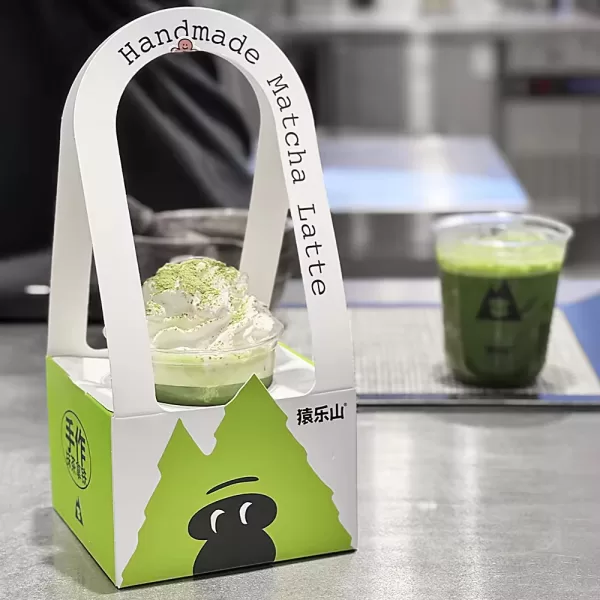
Fig. 9 — ODM custom paper drink holder design shown in 3D virtual rendering with client artwork applied, enabling visual approval of the assembled structure before physical sample production. UGI Packaging design service.
Before any physical sample is produced, UGI Packaging generates a photorealistic 3D virtual rendering of the finished paper drink holder with the client’s artwork applied — showing how the printed design will appear on the actual three-dimensional structure, including how the artwork wraps around fold lines, how colours read against the substrate, and how the handle and cup hole geometry relate to each other in the assembled form. This 3D rendering is provided to the client for visual approval before the physical sample production stage, enabling any structural or graphic amendments to be made digitally rather than through a physical sample iteration cycle.
The value of 3D virtual proofing is most significant for ODM custom structures and for complex graphic designs where the relationship between the printed artwork and the three-dimensional form is not immediately apparent from a flat dieline. A brand pattern that tiles seamlessly on a flat layout may create an unintended visual junction at a fold line; a large graphic element that appears well-proportioned on a flat artwork file may appear cramped or distorted on the assembled three-dimensional carrier. Virtual proofing allows these issues to be identified and resolved before physical tooling or sample material is committed, saving both time and cost at the sample approval stage.
ODM Design Process: 5 Steps from Brief to Approval
1
Brief Submission
Client submits a written brief covering: cup size(s) to be carried, cup count configuration, target payload, intended use environment (counter service, delivery, gift), brand positioning description, surface finish preferences, sustainability requirements, and target order quantity. Cup physical samples or technical drawings are requested at this stage to enable accurate structural engineering. Response from UGI Packaging within 1 business day with clarifying questions and preliminary format recommendation.
2
Structural Design and Dieline Generation
UGI Packaging’s structural engineers produce the Artios CAD dieline and 3D structural model based on the brief and cup measurements. Standard format adaptations: 1–2 business days. Custom ODM structures: 3–5 business days. The dieline is provided to the client in PDF and AI format for review. At this stage, the client reviews the structural geometry and either approves the dieline or requests amendments before artwork production begins.
3
Artwork Development and 3D Visual Proof
For OEM clients supplying their own artwork: files are received, preflight-checked within 1 business day, and applied to the approved dieline. For ODM clients engaging UGI Packaging’s graphic design service: the design team develops artwork concepts based on the brand brief. A photorealistic 3D visual proof showing the artwork on the assembled carrier structure is provided for client approval. Amendments are incorporated and re-rendered until the client approves the visual proof for physical sample production.
4
Physical Sample Production and Delivery
Following visual proof approval, a physical sample is produced using production-grade materials, printing, and surface finishing — identical in every material and process respect to the mass production unit. Physical samples are air-freighted to the client within 5–7 working days of visual proof approval. The client assesses the physical sample against the structural specification, print quality, surface finish, and handle performance, and provides written sign-off or requests specific amendments.
5
Sample Sign-Off and Production Order Confirmation
Written sample sign-off from the client triggers production order confirmation. A commercial invoice for the production deposit (standard terms: 30% deposit, 70% balance against shipping documents) is issued. Production commences upon receipt of the deposit payment. The approved physical sample is retained by UGI Packaging as a production standard reference for the life of the client relationship, against which all future production runs are assessed during the pre-shipment QC stage.
OEM vs ODM: Which Programme Is Right for Your Business?
OEM Programme
→ Client supplies complete artwork files
→ Client specifies structural format and materials
→ UGI Packaging manufactures to client specification
→ Fastest route to production — no design development phase
→ Best for: Established brands with existing brand guidelines and packaging design teams
→ Sample lead time: 5–7 working days from artwork approval
ODM Programme
→ Client submits brand brief and operational requirements
→ UGI Packaging designs structure, artwork, and finishes
→ Client reviews and approves at each design stage
→ Comprehensive design support — no in-house packaging capability required
→ Best for: New brands, expanding operators, businesses launching their first custom carrier
→ Sample lead time: 10–14 working days from brief approval (includes design phase)
Intellectual property protection is an integral part of UGI Packaging’s client relationship framework. All structural designs, artwork files, and technical specifications developed under the ODM programme are the exclusive property of the commissioning client — UGI Packaging does not use, share, adapt, or resell client-specific designs for any other client or project. Non-disclosure agreements are available for signature before any design work commences and are standard practice for all ODM programme clients. For further information on UGI Packaging’s OEM and ODM packaging design services, visit the design resources section of ukugi.com.
⚠️
UGI Packaging Note: Free structural dieline templates in Adobe Illustrator format are available for all standard paper drink holder SKUs — single-cup handle carrier, 2-cup flat tray, 4-cup flat tray, and collapsible flat-pack formats. Templates include correct cup hole geometry for the most common cup sizes (8oz, 12oz, 16oz, 20oz, 24oz, 32oz) and are pre-configured with correct bleed, fold score, and die-cut layers. Contact UGI Packaging at
[email protected] to request templates for your specific cup size and format requirements.
07
Manufacturing Process: 7-Stage Production Workflow
“
UGI Packaging manufactures custom paper drink holders through a fully integrated 7-stage production workflow — covering incoming material inspection, printing, lamination and specialty finishing, die-cutting, folding and gluing, in-process quality control, and packing for dispatch — all executed within a single Guangzhou manufacturing facility by over 200 production employees, enabling end-to-end production accountability and a standard mass production lead time of 12–15 working days from artwork approval for paperboard carrier formats.
The manufacturing process for a paper drink holder involves a greater number of sequential production stages than most buyers anticipate. From the moment a board sheet arrives at the factory gate to the moment a finished, flat-packed carrier is loaded into an export carton, it passes through up to seven distinct production operations — each of which must be executed to specification for the finished carrier to meet the structural, print, and finish standards the client has approved. UGI Packaging’s integrated manufacturing model — where all seven stages are performed within the same facility under the same management and quality system — is the operational foundation that makes consistent, accountable production possible at the output volumes and lead times the beverage packaging market requires.
24h
Quote response time for all enquiries
5–7
Working days: physical sample by air freight
12–15
Working days: standard mass production
18–22
Working days: multi-finish premium orders
Stage 1: Incoming Material Inspection
Every production order at UGI Packaging begins with incoming material inspection — a systematic verification that the board, kraft paper, corrugated board, lamination film, ink, and ancillary materials received from approved suppliers meet the specifications defined in the job order. Incoming inspection is not a cursory visual check; it is a documented measurement protocol that generates a permanent record for each material batch received.
For paperboard and corrugated board, incoming inspection covers: grammage (measured against specification ±3%), caliper (measured against specification ±5%), surface smoothness (Bekk or Sheffield smoothness test where applicable for offset-grade boards), moisture content (target 6–8% for dimensional stability through die-cutting), and visual assessment for surface defects including coating holidays, fibre pulls, and edge damage. For lamination films, incoming inspection covers: film thickness, haze and gloss values, and peel adhesion of a test bond to the approved substrate. All results are recorded in the incoming inspection log; non-conforming material is quarantined and returned to the supplier with a documented non-conformance report before production commences.
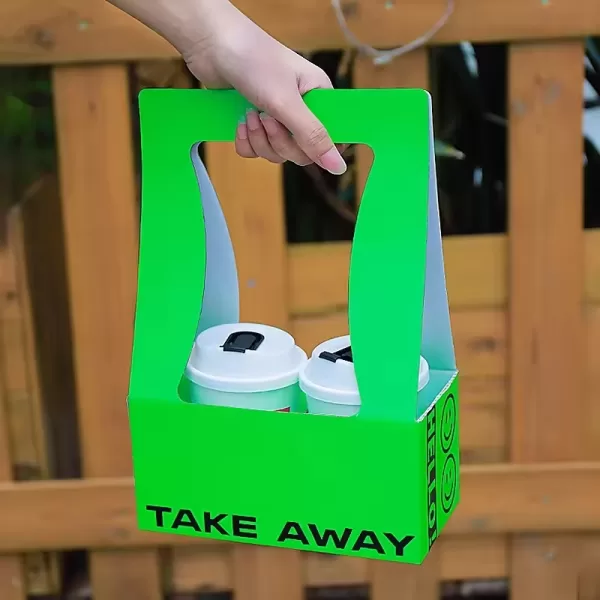
Fig. 10 — Paper drink holder production line at UGI Packaging’s Guangzhou facility, showing the integrated printing, lamination, and die-cutting workflow that enables a standard mass production lead time of 12–15 working days.
Stage 2: Printing
Following incoming material approval, the approved board is loaded onto the printing press. For offset lithographic printing on SBS board, the press is prepared by mounting the approved printing plates, loading the approved ink formulations, and running a makeready sequence to achieve correct ink density, dot gain, and colour balance before the production run commences. The first 50–100 sheets of each run are assessed by the press operator and a quality control inspector against the approved pre-press colour standard. Production proceeds only when all colour stations are confirmed within the approved density and ΔE tolerance — ΔE ≤ 2.0 against the Pantone or CMYK standard.
For water-based flexographic printing on kraft board and corrugated liners, the press preparation sequence covers flexo plate mounting, anilox roll selection for the target ink density, and ink viscosity adjustment to the approved working viscosity for the current ambient temperature and humidity. Water-based flexo inks are sensitive to drying rate variations caused by changes in ambient humidity — a critical control parameter in Guangzhou’s subtropical climate, where humidity can vary substantially between seasons. UGI Packaging’s flexo printing environment is humidity-controlled to maintain consistent ink drying performance throughout the year.
Stage 3: Lamination and Specialty Finishing
Following printing, the printed sheets proceed to the lamination and specialty finishing stage. This stage encompasses all surface treatments applied before die-cutting: BOPP matte or gloss lamination, soft-touch velvet lamination, aqueous barrier coating, PE extrusion coating, spot UV coating, hot foil stamping, and embossing or debossing. Where multiple finishing operations are required on a single carrier — for example, matte lamination followed by spot UV followed by hot foil stamping — the operations are sequenced in the correct process order to ensure that each subsequent operation adheres correctly to the previously applied surface.
The lamination process applies the BOPP or velvet film under controlled temperature (typically 80–100°C nip temperature) and pressure (typically 4–6 bar nip pressure) to achieve complete and even adhesion across the full sheet area. After lamination, sheets are conditioned at ambient temperature for a minimum of 4 hours before the subsequent finishing operation to allow the adhesive bond to stabilise and the board to recover from the heat and pressure of the lamination nip. This conditioning period is a production discipline that prevents delamination failures during die-cutting and folding operations caused by residual stress in the laminated board.
Stage 4: Die-Cutting
Die-cutting is the stage at which the finished, printed, and laminated sheet is cut and scored into the flat drink holder blank — the two-dimensional form that will be folded and assembled into the finished carrier. The die-cutting operation at UGI Packaging uses flatbed die-cutting presses with steel-rule dies manufactured to ±0.1mm positional accuracy. The die contains all cut lines, score lines, perforation lines, and window punch elements for the carrier blank in a single tool, executed in a single press stroke — ensuring perfect positional registration between all die elements and the underlying printed and finished sheet.
Cup hole die-cutting requires particular precision. The cup hole must be punched to the exact diameter specified in the engineering drawing, with clean, burr-free cut edges that do not create sharp protrusions that could abrade the cup surface during insertion or removal. UGI Packaging’s die maintenance programme requires that cup hole cutting rules are inspected after every 50,000 strokes and replaced whenever edge wear exceeds 0.05mm — a maintenance interval that ensures consistent hole diameter and edge quality throughout the production run.
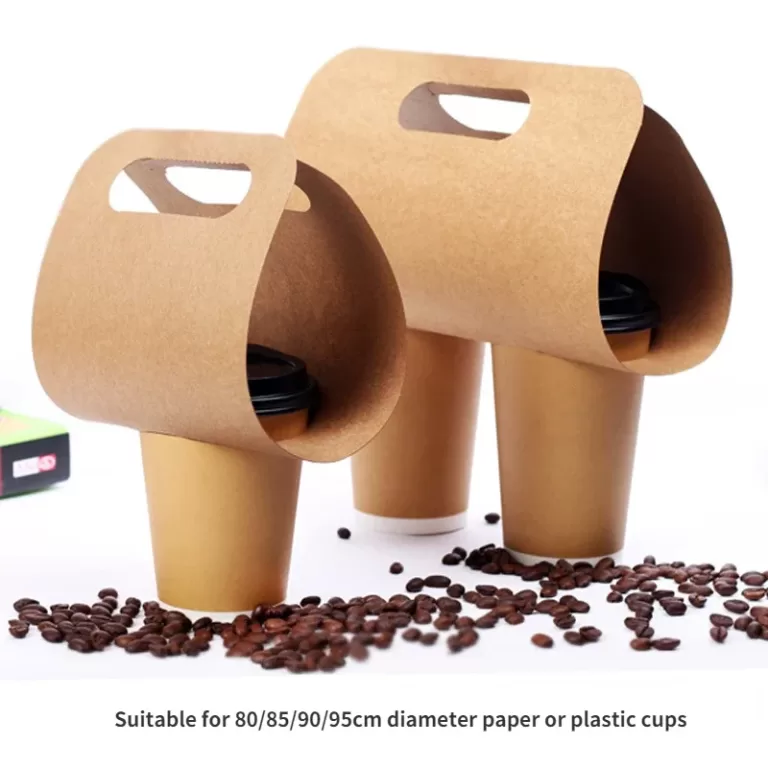
Fig. 11 — Die-cutting and folding-gluing operations at UGI Packaging’s Guangzhou factory, showing the automated blank erection and adhesive application sequence for paper drink holder production.
Stage 5: Folding, Gluing, and Handle Attachment
Following die-cutting, the blanks are fed through the folding and gluing line, which erects the flat blank into the three-dimensional carrier form through a sequence of programmed fold operations and applies hot-melt or cold-set adhesive to the designated gluing zones. For flat tray carriers, the folding sequence erects the lateral walls and carry bridge from the flat blank. For corrugated upright carriers, the box body is erected and the top and bottom closure panels are glued. For gift-style ribbon handle holders, the rigid wall structure is erected, folded, and glued before the ribbon handle is attached through the die-punched handle holes.
Handle attachment — for twisted paper rope handles and ribbon handles — is performed as an integrated step on the folding-gluing line for high-volume runs, or as a semi-automated secondary operation for lower volumes or complex handle configurations. Handle rope or ribbon is cut to the specified length, inserted through the handle holes, and secured on the inner face by a knot or a crimped metal eyelet, depending on the specification. For integrated die-cut handles, the doubler reinforcement strip is glued to the reverse face of the handle zone during the lamination stage before die-cutting, so no secondary handle attachment operation is required.
Stage 6: In-Process Quality Control
In-process quality control at UGI Packaging is not a single checkpoint at the end of production — it is a continuous monitoring programme that runs in parallel with the production operation at each stage. Designated QC inspectors monitor each production line, conducting sampling inspections at defined intervals and recording results in the in-process QC log for the job. Critical in-process control parameters for paper drink holder production include: colour density and registration (printing stage), lamination adhesion and bubble-free surface (lamination stage), die-cut dimensional accuracy and cup hole diameter (die-cutting stage), glue bond strength and handle pull force (assembly stage).
When an in-process inspection result falls outside the approved tolerance, the production line is stopped and the out-of-specification condition is investigated and resolved before production resumes. All units produced between the last in-specification inspection and the discovery of the non-conformance are quarantined for re-inspection. This stop-and-fix protocol — rather than a continue-and-sort approach — is the operational discipline that prevents systematic defects from propagating through a production run and creating a large volume of non-conforming finished units.
Stage 7: Packing and Dispatch
Finished drink holders are flat-packed in counted quantities, wrapped in moisture-barrier polybags where specified, and packed into export cartons with appropriate cushioning. Carton gross weights are measured and recorded; carton dimensions are verified against the approved packing specification to ensure compatibility with the client’s freight and warehouse requirements. A packing list is generated for each production lot, specifying the carton count, units per carton, and total unit count, which is verified against the production order quantity before dispatch approval. Export cartons are labelled with the client’s specified marking requirements — typically including the SKU reference, quantity, production date, and country of origin.
08
Quality Control: Standards & Testing Protocols
“
UGI Packaging enforces a three-stage quality control protocol on every paper drink holder production order — covering incoming material inspection with documented measurement records, continuous in-process monitoring at print, lamination, die-cutting, and assembly stages, and a pre-shipment audit conducted against an AQL 2.5 sampling plan — supported by
ISO 9001:2015 certification, food contact material compliance testing under EU Regulation No. 10/2011, and structural performance testing including handle pull, cup hole load, and compression tests before any order is released for shipment.
Quality control in paper drink holder manufacturing is a more complex discipline than it might appear from the outside. The carrier must simultaneously meet dimensional specifications (cup hole diameter to ±1mm, fold line position to ±0.5mm, overall blank dimensions to ±1mm), print quality specifications (colour density ΔE ≤ 2.0, registration ±0.1mm, no visible mottle or streaking), surface finish specifications (lamination adhesion ≥3N/15mm, no bubbles or delamination visible), structural performance specifications (handle pull ≥3× rated payload, cup hole no pass-through under rated payload), and food safety specifications (all food-contact materials within migration limits). UGI Packaging’s QC system is designed to verify compliance across all five specification dimensions for every production order.
Three-Stage QC System Overview
Stage 1: Incoming Material QC
All substrates and materials inspected and measured against job specification before production approval. Non-conforming materials quarantined and returned. Results documented in incoming inspection log. No production commences on any job until incoming QC is complete and approved.
Stage 2: In-Process QC
Continuous monitoring at each production stage by dedicated QC inspectors. Sampling inspections at defined intervals (typically every 500–1,000 units). Stop-and-fix protocol for any out-of-tolerance condition. In-process QC log maintained for every production lot throughout the full production workflow.
Stage 3: Pre-Shipment QC
Full pre-shipment inspection conducted against AQL 2.5 sampling plan on finished, packed units before export cartons are sealed. Assessment covers all five specification dimensions: dimensional, print, surface finish, structural performance, and food safety documentation. Written pre-shipment inspection report issued for every order.
In-Process Control Points
Control Point 1: First-Off Press Check
First 50–100 printed sheets assessed spectrometrically against colour standard. All colour stations must achieve ΔE ≤ 2.0 and density within ±0.05 before production proceeds. Results recorded and signed off by press operator and QC inspector.
Control Point 2: Lamination Bond Check
Random laminated sheet samples from each lamination run tested for peel adhesion (minimum 3N/15mm) and inspected visually for bubbles, delamination zones, and surface defects. Lamination temperature and pressure settings verified against approved parameters at start of run.
Control Point 3: Die-Cut Dimensional Check
First-off blanks from each die-cutting run measured for overall blank dimensions (±1mm), cup hole diameter (±0.5mm), and fold score position (±0.5mm) using calibrated digital calipers. Cup hole edge quality inspected under magnification for burr or tear-out.
Control Point 4: Assembly and Glue Check
Assembled carriers inspected for correct fold geometry, glue bond coverage, and adhesive squeeze-out. Assembled flat tray carriers checked for panel squareness (diagonal measurement ±2mm). Handle pull test performed on 5 units per 1,000 at assembly stage.
Control Point 5: Cup Load Function Test
Assembled carriers loaded with test cups at the rated payload and assessed for cup retention (cup must not pass through hole under load), cup extraction force (must be releasable with one hand without excessive force), and structural integrity under sustained load over 10 minutes.
Pre-Shipment AQL 2.5 Inspection
The pre-shipment inspection at UGI Packaging is conducted against an AQL (Acceptable Quality Level) 2.5 sampling plan — the industry standard used by major retailers, food-service chains, and procurement teams worldwide for final goods inspection. Under AQL 2.5, the number of units sampled from the production lot and the maximum number of defects permitted in the sample before the lot is rejected are defined by statistical tables that provide a 95% confidence level that the lot defect rate does not exceed 2.5% for critical and major defects.
For paper drink holder orders, defects are classified into three categories. Critical defects — including food contact material non-compliance, handle failure under rated payload, and cup hole pass-through failure — result in automatic lot rejection with zero tolerance regardless of the AQL sampling result. Major defects — including significant colour deviation (ΔE >4.0), lamination delamination visible from normal viewing distance, die-cut dimensional error exceeding ±2mm, and assembly geometry failure — are assessed under the AQL 2.5 major defect limit. Minor defects — including minor scuff marks, slight colour variation within ΔE 2.0–4.0, and cosmetic surface imperfections not visible at normal viewing distance — are assessed under the AQL 2.5 minor defect limit.
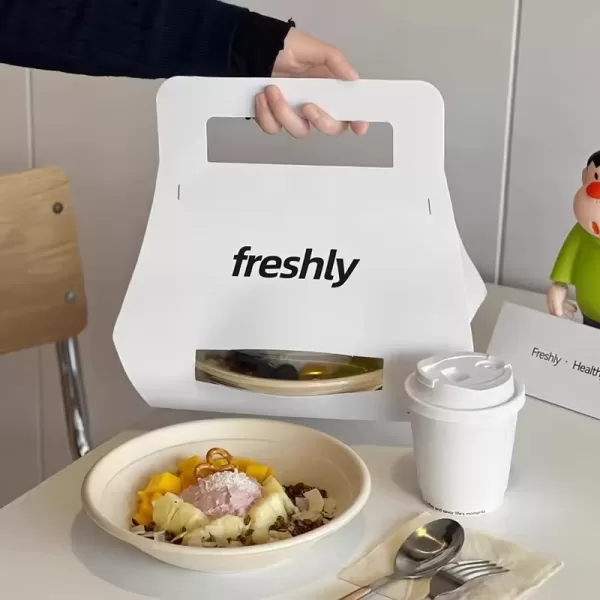
Fig. 12 — Pre-shipment quality control inspection at UGI Packaging, showing the AQL 2.5 sampling process for paper drink holder orders including dimensional measurement, structural performance testing, and print quality assessment before export carton sealing.
Food Safety and Compliance Documentation
Food contact compliance documentation is provided as a standard component of every paper drink holder order at UGI Packaging. The documentation package for each order includes: material composition declarations for all substrate and coating components in contact with food or the cup exterior; migration test certificates for PE coating layers and any other polymer components, tested under EU Regulation No. 10/2011 conditions; ink compliance statements confirming that all printing inks meet EuPIA Good Manufacturing Practice requirements for food packaging inks; and FSC Chain of Custody certificates where FSC-certified substrates are specified.
For clients in the UK and EU markets operating under Extended Producer Responsibility (EPR) regulations, UGI Packaging provides material composition declarations in the format required for EPR reporting — specifying the weight and material type of each packaging component to enable accurate tonnage reporting to the relevant national EPR scheme administrator. These EPR documentation services are provided at no additional charge as part of the standard order documentation package.
QC Testing Protocol Table
👉 Scroll table left/right to view all columns
| Test Parameter |
Test Method |
Acceptance Criterion |
Stage |
| Colour Accuracy (Pantone / CMYK) |
X-Rite spectrophotometer, D50 illuminant, 2° observer |
ΔE ≤ 2.0 vs approved standard |
Printing + Pre-shipment |
| Print Registration |
Optical measurement of registration crosses, digital calliper |
±0.1mm across all colour stations |
Printing |
| Lamination Adhesion (Peel) |
90° peel test, 15mm strip, tensile tester |
≥ 3N/15mm, no bubble or delamination visible |
Lamination |
| Cup Hole Diameter |
Digital calliper, 4-point measurement |
Specified diameter ±0.5mm, burr-free edge |
Die-cutting |
| Handle Pull Strength |
Progressive load test on assembled carrier at rated payload |
No failure at 3× rated payload |
Assembly + Pre-shipment |
| Cup Retention Under Load |
Cup loaded to rated payload, vertical force applied progressively |
No cup pass-through at rated payload |
Assembly + Pre-shipment |
| Food Contact Migration |
Migration test per EU Regulation 10/2011 / FDA 21 CFR 176.170 |
Within applicable migration limits for all simulants |
Material approval (per batch) |
Colour Accuracy
Method: X-Rite spectrophotometer · Criterion: ΔE ≤ 2.0 · Stage: Printing + Pre-shipment
Print Registration
Method: Optical measurement · Criterion: ±0.1mm all stations · Stage: Printing
Lamination Adhesion
Method: 90° peel test · Criterion: ≥3N/15mm, no delamination · Stage: Lamination
Cup Hole Diameter
Method: Digital calliper · Criterion: Specified ±0.5mm, burr-free · Stage: Die-cutting
Handle Pull Strength
Method: Progressive load test · Criterion: No failure at 3× rated payload · Stage: Assembly + Pre-shipment
Cup Retention Under Load
Method: Vertical load test · Criterion: No pass-through at rated payload · Stage: Assembly + Pre-shipment
Food Contact Migration
Method: EU 10/2011 / FDA 21 CFR · Criterion: Within all migration limits · Stage: Material approval
ISO 9001:2015 Certification and Corrective Action
UGI Packaging’s quality management system is certified to ISO 9001:2015 — the internationally recognised standard for quality management systems that specifies requirements for organisations seeking to demonstrate the ability to consistently provide products that meet customer and regulatory requirements. The ISO 9001:2015 certification is maintained through annual surveillance audits by an accredited third-party certification body and a triennial recertification audit. The certification scope covers the full production scope at UGI Packaging’s Guangzhou facility, including paper drink holder design and manufacturing, printing, finishing, and export packaging.
When a quality non-conformance is identified — whether at incoming inspection, in-process inspection, pre-shipment inspection, or through post-delivery client feedback — UGI Packaging’s quality system requires an 8D (Eight Disciplines) corrective action response. The 8D process defines the non-conformance, establishes an immediate containment action to protect the client from further exposure, identifies the root cause through systematic investigation, implements a permanent corrective action that eliminates the root cause, and verifies through subsequent production data that the corrective action has been effective. 8D reports are shared with the client for all major non-conformances and are available on request for minor non-conformances.
✅
UGI Packaging Tip: Clients who require independent verification of production quality are welcome to appoint a third-party inspection agency — SGS, Bureau Veritas, or Intertek — to conduct the pre-shipment inspection in place of or alongside UGI Packaging’s internal pre-shipment QC. Third-party inspection access is arranged through the client’s account manager with 2–3 business days’ advance notice. Full production documentation — job traveller records, in-process QC data, and material certificates — is made available to the inspection agency. See
UGI Packaging’s manufacturing process guides for further technical detail on production and QC procedures.
09
Ordering Process & Related Resources
“
UGI Packaging (ukugi.com) processes custom paper drink holder orders through a six-step workflow — from initial quote request through structural dieline approval, physical sample sign-off, production order confirmation, manufacturing, and delivery — with a committed one-business-day response to all enquiries, a 5–7 working day physical sample lead time by international air freight, and standard mass production lead times of 12–15 working days from artwork approval for all paperboard carrier formats.
Sourcing custom paper drink holders from UGI Packaging is designed to be straightforward for buyers at all levels of packaging procurement experience — from a bubble tea entrepreneur placing their first custom carrier order to a procurement manager at a national food-service chain managing a multi-SKU annual programme. The six-step workflow below describes the complete process from initial enquiry to delivery, including the information required at each stage, the typical timeline, and the decision points where client input is required.
1
Submit a Quote Request
Contact UGI Packaging via the enquiry form, email at [email protected], or WhatsApp at +44 7783 771295. Provide: carrier format (single-cup, flat tray, upright corrugated, etc.), cup size(s), target order quantity, intended market, brand positioning description, and any surface finish or sustainability requirements. A dedicated account manager responds within one business day with clarifying questions, preliminary format recommendation, and indicative pricing.
2
Structural Specification and Dieline Confirmation
UGI Packaging’s structural engineering team produces the Artios CAD dieline and 3D structural model based on the agreed specification and cup measurements. Standard format adaptations: 1–2 business days. ODM custom structures: 3–5 business days. The dieline is provided in PDF and AI format for client review and approval before any physical sample production or artwork work commences.
3
Artwork Submission and Pre-Press Approval
OEM clients submit final artwork files (PDF/X-4, AI, or INDD format) mapped to the approved dieline. ODM clients submit a brand brief for UGI Packaging’s graphic design team. Pre-press preflight is completed within one business day of file receipt. A photorealistic 3D visual proof on the assembled carrier structure is provided for client approval before physical sample production. Amendments are incorporated and re-rendered until visual proof approval is confirmed in writing.
4
Physical Sample Production and Sign-Off
A fully representative physical sample — produced with production-grade materials, printing, and finishing, identical in every material respect to the mass production unit — is air-freighted to the client within 5–7 working days of visual proof approval. The client reviews the physical sample against the full specification and provides written sign-off or requests specific amendments. Physical sample sign-off triggers the production order confirmation and deposit invoice.
5
Mass Production and Quality Control
Production commences upon receipt of the deposit payment (standard terms: 30% deposit, 70% balance against shipping documents). The full 7-stage manufacturing workflow proceeds under the three-stage QC protocol described in Section 08. Production progress updates are provided at defined milestones: print completion, finishing completion, and pre-shipment inspection completion. The client’s account manager is the single point of contact for all production status enquiries.
6
Shipment and Delivery
Completed orders are shipped by sea freight (standard, 25–35 days transit to Europe and North America) or air freight (express, 5–7 days transit) based on client timeline requirements. A full shipping documentation set — commercial invoice, packing list, bill of lading or air waybill, material compliance certificates, and FSC certificates where applicable — is provided electronically at the time of shipment. Balance payment is due against the shipping documents under standard T/T terms.
10
Why Source From UGI Packaging — Industry Credentials & Advantages
“
Founded in 2007 and operating from a purpose-built manufacturing facility in Guangzhou’s Huadu District, UGI Packaging (ukugi.com) has supplied custom paper drink holders and food packaging to bubble tea chains, coffee operators, catering companies, and food-service brands across Europe, North America, and Asia for over 18 years — combining ISO 9001:2015-certified manufacturing, in-house structural and graphic design capability, food contact compliance documentation, and flexible MOQ from 500 units in a single-source supply relationship that eliminates the coordination complexity of multi-supplier packaging programmes.
The global food and beverage takeaway packaging market is projected by Smithers market research to continue expanding at a compound annual growth rate above 4% through 2030, driven by the ongoing growth of delivery platforms, the continued global expansion of bubble tea and specialty coffee culture, and rising consumer expectations for branded, premium-quality packaging at every price point in the food-service market. In this environment, the paper drink carrier is no longer a commodity item — it is a brand asset, and the manufacturer selected to produce it determines the quality ceiling available to the brand.
Direct Manufacturer Advantage
Many packaging suppliers in the drink carrier market operate as trading companies — sourcing product from factories, applying a margin, and managing the client relationship without direct manufacturing accountability. UGI Packaging is a direct manufacturer: the factory that provides the quotation is the factory that produces the order. This direct manufacturing relationship delivers three quantifiable advantages. First, pricing reflects factory cost without intermediary margin — typically 15–25% lower than equivalent products sourced through trading company channels. Second, quality accountability is direct — when a production issue arises, UGI Packaging’s own engineers and QC team address it immediately without the communication delays of a three-party supply chain. Third, lead times are controlled by UGI Packaging’s own production scheduling — not by a third-party factory whose capacity commitments are shared across multiple trading company clients.
Flexible MOQ and Scalable Production
UGI Packaging’s production structure accommodates clients at every stage of business growth. Minimum order quantities start from 500 units per SKU for paperboard drink holder formats — accessible for independent café operators and startup beverage brands entering the custom carrier market for the first time. As order volumes scale, unit costs reduce progressively through improved setup cost amortisation: a 5,000-unit run typically carries a 20–30% lower unit cost than a 500-unit run of the same product. For clients with regular, predictable demand — chain operators, subscription beverage services, event catering companies — UGI Packaging offers blanket order arrangements under which an annual programme quantity is contracted at a fixed price, with individual release orders called against the blanket throughout the year. Blanket order clients benefit from price stability, guaranteed production capacity, and dedicated account management that monitors stock levels and triggers production releases proactively.
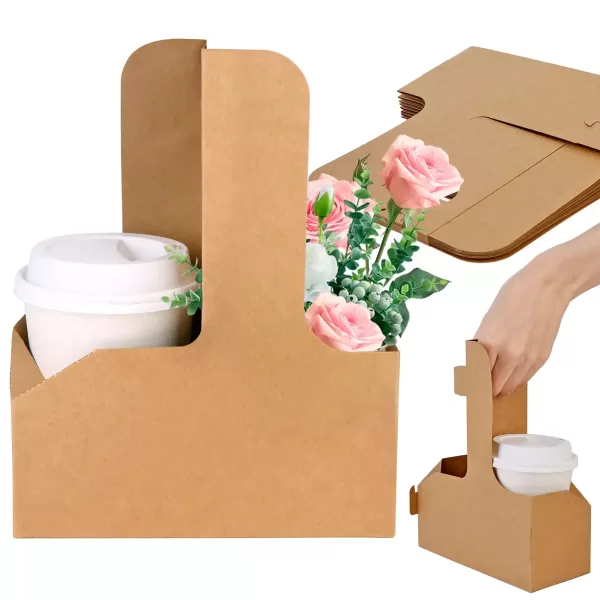
Fig. 13 — UGI Packaging’s Guangzhou manufacturing facility, where custom paper drink holders across all 6 structural categories are produced under ISO 9001:2015-certified quality management for clients across more than 30 countries.
Sustainability Leadership
The paper drink holder market is subject to increasing regulatory and consumer pressure to eliminate single-use plastics and improve end-of-life recyclability across all takeaway packaging categories. UGI Packaging’s sustainability programme for drink holders is built around four commitments: FSC-certified fibre sourcing for all kraft and white board substrates, PE-free aqueous barrier coating as an alternative to PE laminate for operators requiring recyclable moisture-resistant carriers, PLA bioplastic coating as a compostable barrier option certified under EN 13432, and a product development roadmap focused on reducing the overall material weight of standard carrier formats without compromising structural performance.
For clients operating under Extended Producer Responsibility regulations in the UK, EU, or other markets, UGI Packaging provides full material composition declarations in the required EPR reporting format as part of the standard order documentation — enabling accurate and compliant tonnage reporting to national EPR scheme administrators without additional procurement or administrative effort. Visit the UGI Packaging about page for full company credentials, manufacturing facility details, and sustainability commitments.
Factory Credentials at a Glance
2007
Year founded — over 18 years of packaging manufacturing experience
200+
Production employees at Guangzhou Huadu District facility
30+
Export countries across Europe, North America, Asia, and the Middle East
ISO 9001
:2015 certified quality management system — full production scope
FSC
Chain of Custody certified fibre sourcing for all kraft and white board substrates
AQL 2.5
Pre-shipment inspection standard applied to every production order
Frequently Asked Questions
Q: What is the minimum order quantity for custom paper drink holders at UGI Packaging?
The minimum order quantity at UGI Packaging is 500 units per SKU for all paperboard drink holder formats — including single-cup kraft handle carriers, 2-cup and 4-cup flat tray carriers, collapsible flat-pack carriers, and gift-style ribbon handle holders. For corrugated upright carriers (B-flute or E-flute construction), the minimum order quantity is 1,000 units per SKU. Repeat clients operating under blanket order arrangements may request lower per-release quantities against an annually contracted volume.
Q: How do I ensure the cup holes in a flat tray carrier fit my specific cups correctly?
UGI Packaging’s structural engineering team measures each client’s cup profile — outside diameter at multiple heights, taper angle, and lid bead geometry — before any dieline design work commences. If you can supply a physical cup sample, it is measured in UGI Packaging’s engineering lab to ±0.1mm accuracy. If you cannot supply a physical sample before the design stage, UGI Packaging maintains a reference library of cup measurements for all major cup sizes and profiles from leading cup manufacturers. The cup hole geometry is engineered to a clearance tolerance of ±1mm against the cup profile, with a depth-stop tab configuration that prevents cup pass-through under the rated payload.
Q: Can UGI Packaging produce paper drink holders that are fully recyclable?
Yes. UGI Packaging offers fully recyclable paper drink holder options using FSC-certified kraft or white board with either no coating or a water-based aqueous barrier coating. Both options are compatible with standard kerbside paper recycling streams in most EU and UK local authority areas. Uncoated kraft carriers provide limited moisture resistance suitable for ambient-temperature beverages in dry conditions. Aqueous-coated carriers provide improved moisture resistance suitable for most chilled beverage applications while retaining paper recyclability. Full material composition declarations for EPR compliance reporting are provided as standard.
Q: What handle types are available for single-cup kraft carriers, and what are the load ratings?
UGI Packaging offers three handle types for single-cup carriers. Integrated die-cut handles — punched from the carrier board with a glued doubler reinforcement — are rated to approximately 1kg payload and are the most cost-effective option. Twisted kraft paper rope handles — inserted through die-punched holes and knotted on the inner face — are rated to approximately 2.5kg and are the most common specification for large-format bubble tea and cold beverage carriers. Ribbon or grosgrain fabric handles — providing a premium gift-carrier aesthetic — are rated to approximately 1.5kg. All handle types are pull-tested to 3× their rated payload during sample approval and pre-shipment QC.
Q: How does UGI Packaging handle colour consistency across multiple production runs placed months apart?
Colour consistency across production runs at UGI Packaging is maintained through three mechanisms. First, the approved ink formulation for each Pantone spot colour is recorded in the permanent job specification file at the point of first production approval and reproduced exactly for all subsequent runs. Second, all presses are calibrated to ISO 12647-2 and measured with an X-Rite spectrophotometer before each run. Third, the first-off press sheet of every production run is assessed against the colour standard and must achieve ΔE ≤ 2.0 before production proceeds. Clients may retain a signed reference sample from their first approved production run for comparison against subsequent deliveries.
Q: Can UGI Packaging produce a drink carrier that holds both cups and food items together?
Yes. Combination carriers — holding both beverages and food items such as paper bags, burger boxes, or snack containers alongside cups — are a standard ODM project type at UGI Packaging. The structural engineering team designs the carrier geometry to accommodate the specific dimensions of both the cup(s) and the food container(s), with appropriate partition walls and load-bearing zones for each. Combination carriers typically require an ODM design phase of 3–5 business days before the dieline is ready for client approval, and a physical sample lead time of 7–10 working days. MOQ for combination carriers is 500 units per SKU.
Q: Is PE-coated paper drink holder material safe for food contact?
Yes. The PE (polyethylene) coating used in UGI Packaging’s moisture-barrier drink holders is food-contact compliant. The PE layer is applied to the inner face of the carrier — the face that contacts the cup exterior — and all PE coating batches are tested for migration compliance under EU Regulation No. 10/2011 (plastic food contact materials) and FDA 21 CFR 176.170 (paper and paperboard in contact with aqueous and fatty foods). Migration test certificates are provided as part of the standard order documentation for all PE-coated drink holder orders.
Q: What is the lead time for a corrugated upright 4-cup drink carrier from first enquiry to delivery?
For a corrugated upright 4-cup carrier from first enquiry to sea freight delivery to Europe or North America, the typical total timeline is 8–11 weeks: 1–2 business days for quote and specification confirmation, 2–3 business days for structural dieline preparation, 1–2 business days for artwork pre-press, 7–10 working days for physical sample production and air freight delivery, 3–5 business days for sample review and sign-off, 15–18 working days for mass production (corrugated formats have slightly longer lead times than paperboard formats), and 25–35 days sea freight transit. Clients with tighter timelines can elect air freight for the production order delivery, reducing the transit element to 5–7 days.
Q: Does UGI Packaging offer free dieline templates for standard drink holder formats?
Yes. UGI Packaging provides free structural dieline templates in Adobe Illustrator format for all standard paper drink holder SKUs — including single-cup handle carrier templates in 8 cup size variants, 2-cup flat tray, and 4-cup flat tray formats. Templates include the correct cup hole geometry for the most common cup sizes (8oz, 12oz, 16oz, 20oz, 24oz, 32oz) and are pre-configured with correct bleed, fold score, and die-cut layers. Contact UGI Packaging at
[email protected] or via WhatsApp to request templates for your specific cup size and carrier format.
Q: Does UGI Packaging accept third-party pre-shipment inspection for drink holder orders?
Yes. UGI Packaging accommodates third-party pre-shipment inspection by qualified agencies including SGS, Bureau Veritas, and Intertek as standard practice for all production orders. Full production documentation — job traveller records, in-process QC data, incoming material certificates, and pre-shipment inspection reports — is provided to the inspection agency. Inspection access is arranged through the client’s account manager with 2–3 business days’ advance notice. Third-party inspection reports are accepted as the basis for shipment release under client trading terms that mandate independent inspection sign-off before payment of the balance invoice.
Ready to Source Custom Paper Drink Holders?
UGI Packaging offers full OEM and ODM manufacturing services for all paper drink holder formats — from single-cup kraft carriers to premium gift-style ribbon handle holders and corrugated upright delivery carriers. Contact our team for a free quote, dieline template, or physical sample request. MOQ from 500 units.