
Custom Travel Organizer Manufacturer: Complete Technical Guide to Structures, Materials, Printing & Surface Finishes
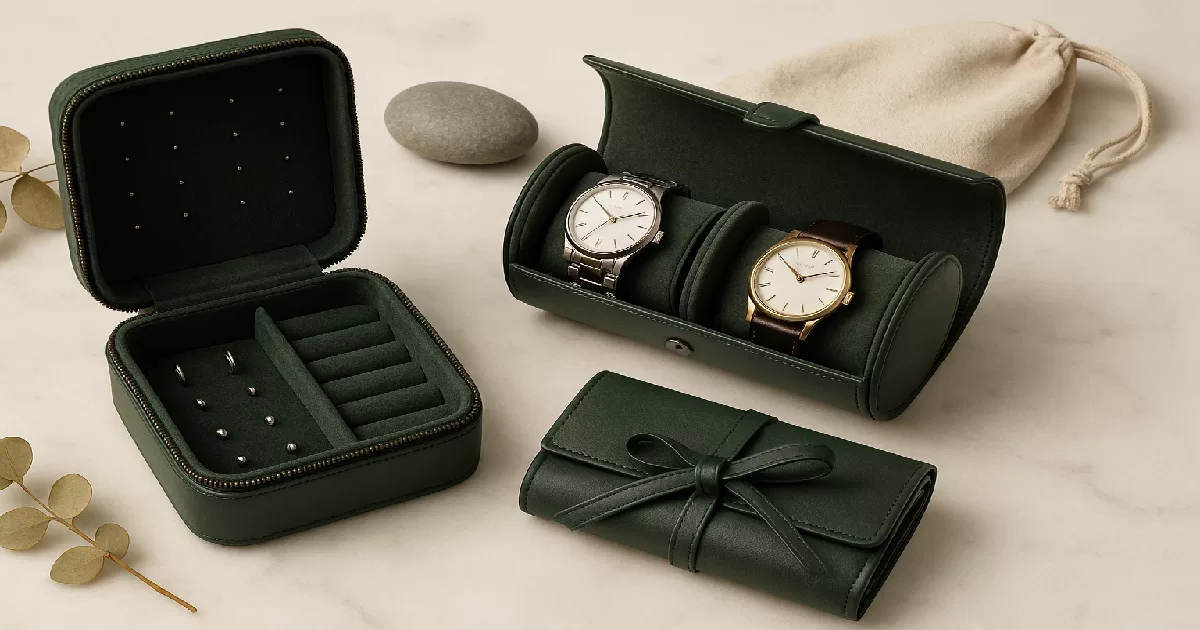
UGI Packaging manufactures 6 types of custom travel organizers — jewelry boxes, watch cases, makeup bags, watch rolls, EVA hard-shell cases, and jewelry rolls — with full OEM and ODM capability, ISO 9001-certified quality control, and zero fixed minimum order quantity, from a single factory in Guangzhou, China.
Five key facts from this technical guide — each independently verifiable.
Why Custom Travel Organizers Demand Precision Manufacturing
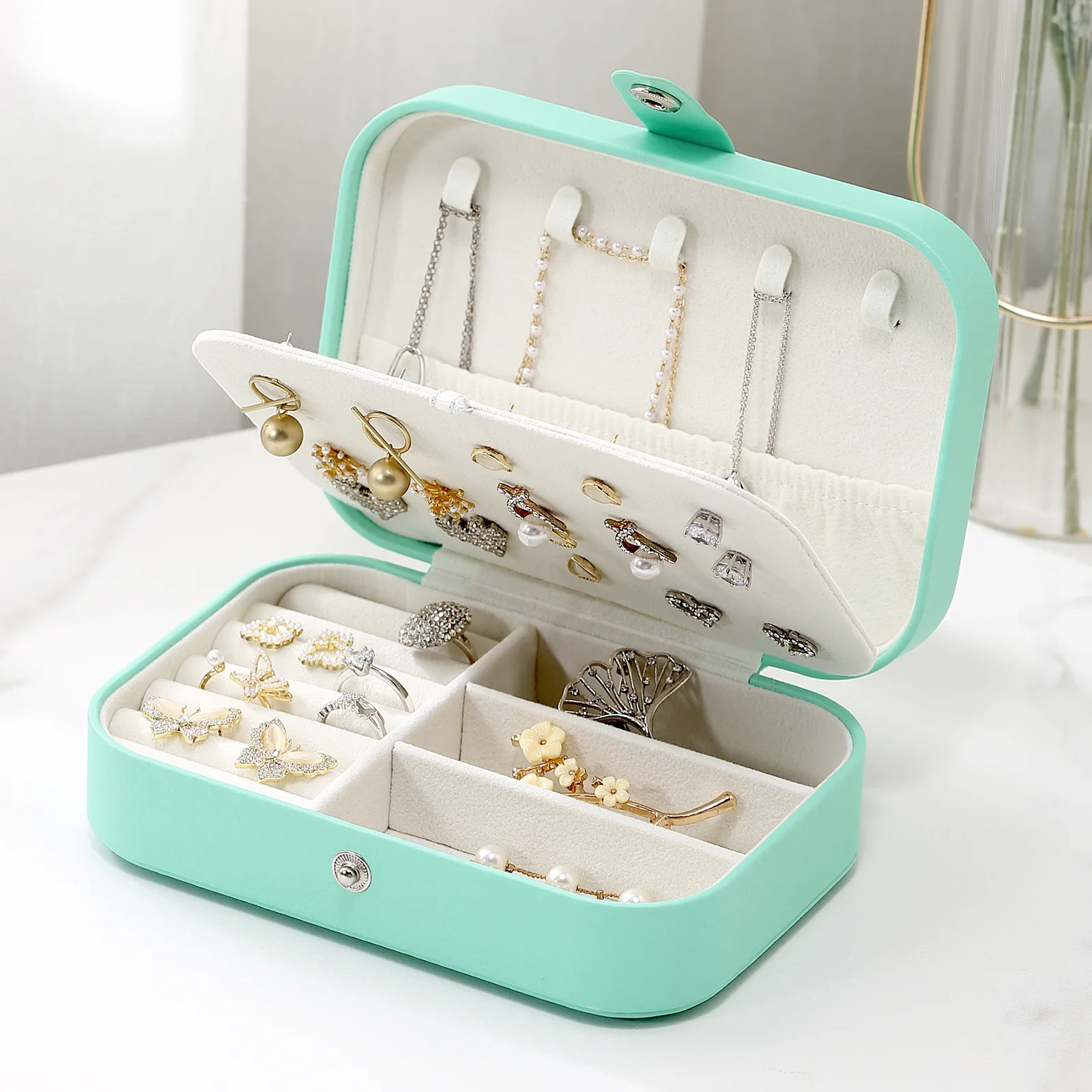
Understanding the manufacturing requirements for each of the six product structures — and the specific materials, interior engineering, printing, and finishing decisions that determine quality — is the primary purpose of this technical guide. Whether you are sourcing from a custom travel organizer manufacturer for travel jewelry boxes, custom watch roll cases for a watch brand, or branded cosmetic organizers for a beauty label, the specifications documented here represent UGI Packaging’s current production standards and capability benchmarks.
For buyers evaluating travel organizer suppliers, the sections on material engineering and quality control are particularly relevant, as these are the two areas most frequently misrepresented in supplier quotations. UGI Packaging publishes these specifications in full so that buyers can make accurate comparisons across suppliers before committing to a sample order.
6 Product Structures: Technical Specifications & Design Logic
The six structural categories manufactured by UGI Packaging each evolved to solve a specific set of protection, organisation, and portability requirements. Understanding the structural logic behind each category is essential for selecting the correct product format for a given end-use application. The following section documents each structure with its primary construction method, typical dimensions, slot or compartment configurations, and the buyer segments most commonly served.
Structure 1 — Travel Jewelry Box
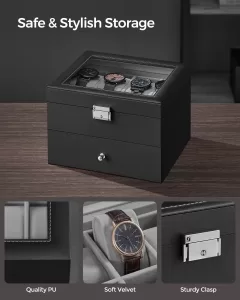
Structure 2 — Travel Watch Case
Structure 3 — Travel Makeup Bag & Cosmetic Organizer
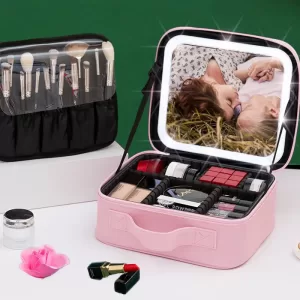
The travel makeup bag range at this custom travel organizer manufacturer spans a wide capability: from basic zippered PU leather toiletry pouches through to sophisticated LED-illuminated organizers with touch-sensor dimmable mirrors, USB charging ports, adjustable dividers, and brush holders. Standard construction uses PU leather or Oxford cloth outer shells with waterproof lining, reinforced zipper channels, and structured base panels that maintain shape when the bag is set down on a surface.
The LED integration variant — featuring a touch-activated dimmable LED strip behind a vanity mirror mounted inside the lid — represents the most technically complex product in the travel organizer category. UGI Packaging engineers the LED module, charging circuit, and mirror assembly as a factory-installed component, tested for 500+ activation cycles before production shipment. This product is particularly popular among beauty brands and cosmetics retailers sourcing branded travel kits for gift-with-purchase programmes.
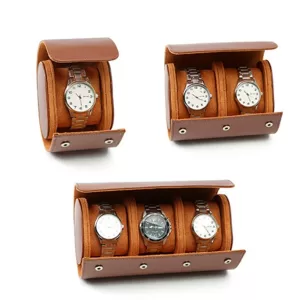
Structure 4 — Watch Roll Organizer
Structure 5 — EVA Hard-Shell Travel Case
The EVA hard-shell case — one of the most protective formats available from a custom travel organizer manufacturer — uses compression-moulded EVA (ethylene-vinyl acetate) shell as the primary structural element, providing impact resistance significantly superior to leather-over-cardboard constructions. The standard EVA shell thickness used by UGI Packaging is 6mm to 10mm, with shore hardness ranging from 45C to 65C depending on the protection level required. The outer surface is typically covered in 1680D nylon, Oxford cloth, or PU leather, with a YKK zipper closure.
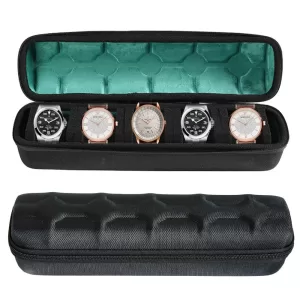
Interior configurations include velvet-lined watch pillows for watch cases, foam-padded compartments for electronic accessories, and custom-cut foam inserts for specialty items. The 5-slot EVA watch travel case with velvet lining and YKK zipper is the standard specification for watch brands requiring TSA-compliant travel packaging. UGI Packaging’s EVA mould library covers the most common watch case dimensions; custom moulds are available for orders above 3,000 units.
Structure 6 — Foldable Jewelry Roll Organizer
The foldable jewelry roll organizer uses a soft construction — typically PU leather or flannel outer, with integrated elastic loops, ring cushions, hook bars, and zippered interior pouches — that folds flat for packing and rolls or folds open for display and access. This structure provides the highest jewellery storage density per unit of packed volume, making it the preferred format for travellers carrying multiple jewelry categories in a single organizer.
UGI Packaging produces jewelry rolls with 2, 3, and 4 fold configurations, with interior layouts customised to the client’s product assortment. Standard interior components include ring cushion rows (8 to 16 rings), earring panels with fabric backing, necklace hook bars with individual snap closures, and a zippered pouch for miscellaneous small items. Custom interior layouts are available for ODM orders with no additional tooling cost for soft-interior configurations.
Structure Comparison: Key Technical Parameters
| Structure | Primary Shell | Closure Type | Typical Capacity | Best For |
|---|---|---|---|---|
| Travel Jewelry Box | PU / Suede / Cork over chipboard | Zipper or magnetic snap | Rings / earrings / necklaces / mixed | Fashion accessories, retail gifting |
| Travel Watch Case | PU leather or EVA + 1680D nylon | Zipper (YKK) or hinged lid | 1 – 10 watch slots (38–55mm) | Watch brands, luxury retail |
| Travel Makeup Bag | PU leather or Oxford cloth | Zipper (single or double) | Multi-compartment; LED option | Beauty brands, cosmetics retail |
| Watch Roll Organizer | PU / Full-grain leather / Nylon | Snap button or ribbon tie | 1 – 10 slots, rolls flat | Watch collectors, brand gifting |
| EVA Hard-Shell Case | EVA moulded shell + nylon/PU cover | YKK zipper | 1 – 5 slots; max 55mm watch | High-protection travel, smartwatches |
| Jewelry Roll Organizer | PU leather or flannelette | Tie ribbon or snap button | Multi-category jewelry, 2–4 folds | Multi-jewelry travel, subscription boxes |
As a specialist custom travel organizer manufacturer, UGI Packaging knows that perceived quality is established almost entirely at the material selection stage. A buyer handling two travel jewelry boxes of identical dimensions will form a quality judgement within the first two seconds based on the tactile weight of the shell material, the resistance of the closure, and the softness of the interior lining — before examining any structural or functional feature. UGI Packaging’s material engineering process begins with this reality and works backwards to specify materials that deliver the intended quality impression at each target price point.
Outer Shell Materials
1. PU Leather (Polyurethane Synthetic Leather)
PU leather is the dominant outer shell material used by this custom travel organizer manufacturer across all six product categories, accounting for the majority of production volume. The material combines a textile base fabric — typically polyester or nylon — with a polyurethane coating layer that is embossed to simulate leather grain patterns or left smooth for a contemporary minimalist finish. Standard coating thickness at UGI Packaging is 0.6mm to 1.2mm, with the heavier specification used for products requiring a more substantial hand feel.
Key technical properties include abrasion resistance of 50,000 cycles or above under the Martindale test, colorfastness rating of 4 or above under ISO 105-B02 light exposure testing, and hydrolysis resistance rated for 8 weeks or above at 70°C and 95% relative humidity — the standard test for products destined for humid climates including Southeast Asia. PU leather is available in a minimum of 8 standard colours with custom colour matching available for orders meeting the minimum material quantity threshold. Texture options include smooth, lychee grain, crocodile grain, carbon fibre grid, and matte suede-effect. For a detailed overview of synthetic leather performance in packaging applications, Packaging Digest provides a useful industry reference.
2. Full-Grain Genuine Leather
Full-grain genuine leather — sourced from the outermost layer of the hide, retaining the natural grain pattern — is specified for premium watch roll organizers, high-end toiletry bags, and luxury travel jewelry cases where material authenticity is a brand requirement. UGI Packaging sources full-grain cowhide at standard thicknesses of 1.0mm to 1.8mm, with natural tanning or chrome tanning available depending on the desired surface character and environmental certification requirements.
Genuine leather products manufactured by UGI Packaging are available with hand-stitched edge finishing, burnished edge treatment, and embossed logo application. The 5-slot handmade genuine leather watch roll with zipper closure is one of the factory’s longest-running product specifications, with documented repeat orders from the same clients spanning multiple years — a reliable indicator of consistent quality and dimensional accuracy across production runs.
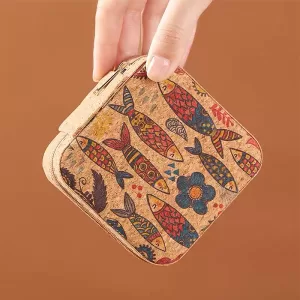
3. Cork
4. Suede
Suede — produced by buffing the flesh side of a split leather or by applying a microfibre suede coating to a non-woven substrate — provides a soft, velvety outer surface that communicates luxury through touch. UGI Packaging uses microfibre suede (also referred to as Alcantara-style fabric) for outer shell applications, offering superior durability and consistency compared to split leather suede. Standard suede thickness is 0.9mm to 1.4mm, with colour options including camel, grey, blush pink, navy, and black.
5. EVA (Ethylene-Vinyl Acetate) Hard Shell
EVA is specified exclusively for hard-shell travel case structures where impact resistance is the primary design requirement. UGI Packaging’s standard EVA formulation for travel cases has a shore hardness of 50C to 60C, a compression-moulded wall thickness of 6mm to 10mm, and a surface finish applied during the moulding process — either a fine-texture pattern or a smooth surface for subsequent fabric lamination. EVA is inherently waterproof, chemically inert, and resistant to deformation across temperature ranges from -20°C to 50°C.
6. Oxford Cloth & 1680D Nylon
Oxford cloth (600D and 900D grades) and 1680D ballistic nylon are used for travel makeup bags, toiletry pouches, and the outer covering of EVA hard-shell cases. 1680D nylon — the specification used by several major luggage brands for high-durability products — provides puncture resistance, abrasion resistance, and a structured woven appearance that signals technical quality. UGI Packaging applies a PU waterproof coating to all nylon and Oxford cloth outer shells as a standard production step, providing resistance to liquid ingress without requiring a separate waterproofing treatment by the end user.
Interior Lining Materials
Interior lining material determines both the tactile experience of accessing items stored in the organizer and the degree of scratch and abrasion protection provided to the stored items. UGI Packaging stocks four primary interior lining categories, each suited to different stored-item types and retail positioning requirements.
Hardware Components
Hardware — zippers, clasps, snap buttons, D-rings, and handles — accounts for a disproportionate share of perceived quality in soft-goods travel organizers. A high-quality PU leather case fitted with a loose-running or misaligned zipper will be returned and reviewed negatively regardless of the material quality of the shell or lining. UGI Packaging specifies hardware components independently from the main shell and lining specification, with the following standard options.
YKK zippers are specified as the standard for all EVA hard-shell cases and premium PU leather constructions. YKK No. 5 and No. 8 zippers are used depending on the case size and required pull weight. For standard PU leather cases at mid-tier price points, UGI Packaging uses a proprietary-sourced metal zipper with equivalent performance. Magnetic snap closures — used on jewelry boxes and some watch cases — are rated for 10,000 open/close cycles. Lobster-claw clasps and D-rings used on strap-equipped makeup bags are rated for 15kg static load.
Material Specification Reference Table
| Material | Type | Thickness / Weight | Key Property | Primary Application |
|---|---|---|---|---|
| PU Leather | Outer shell | 0.6 – 1.2mm | 50,000-cycle abrasion; ISO 105-B02 colorfastness ≥4 | All structures; highest volume |
| Full-Grain Leather | Outer shell | 1.0 – 1.8mm | Natural grain; hand-stitchable; embossable | Premium watch rolls, luxury toiletry bags |
| Cork | Outer shell | 1.5 – 2.5mm sheet | Biodegradable; water-resistant; laser-engravable | Eco jewelry boxes |
| Microfibre Suede | Outer shell | 0.9 – 1.4mm | Velvet touch; consistent pile depth | Premium jewelry boxes, display cases |
| EVA Hard Shell | Structural shell | 6 – 10mm moulded | Shore 50–60C; waterproof; -20°C to 50°C | Hard-shell watch cases, travel cases |
| 1680D Nylon | Outer cover / shell | 1680 denier | Ballistic-grade; PU waterproof coated | EVA shell covers, heavy-duty makeup bags |
| Velvet Flocking | Interior lining | 0.5mm / 1.0mm pile | 12 standard colours; electrostatic application | Jewelry and watch interiors |
| Compression Foam | Interior insert | 30 – 60 kg/m³ density | Detachable; fits 38–55mm watches | Watch pillows in all case types |
Interior Structure Engineering: Compartment Design & Insert Systems
The interior structure is a core engineering discipline for any custom travel organizer manufacturer: whether rings slide out of their slots during transit, whether watch pillows compress adequately for the watch diameter, whether a necklace can be hooked and unhooked without tangling, and whether the LED mirror in a makeup organizer activates reliably after 500 open/close cycles. These are engineering problems, not aesthetic ones, and they require systematic design and validation before production begins.
Jewelry Compartment Systems
Jewelry organizer interiors are engineered around the specific item types the product is intended to hold. UGI Packaging designs each interior configuration from a standard component library, combining the following elements to meet the client’s required item count and category mix.
Ring cushion rows are the most space-efficient ring storage format, using a cylindrical foam roll covered in velvet or fabric to hold rings upright in a horizontal line. Standard ring cushion rows accommodate 8 to 16 rings depending on average ring shank diameter; UGI Packaging offers narrow-shank rows at 12mm pitch for fashion rings and wide-shank rows at 18mm pitch for statement rings and men’s signet rings. Earring panels use a fabric-covered foam backing with a grid of micro-perforations for earring posts, available in panel sizes from 60 × 40mm to 150 × 100mm with post grid pitches of 8mm and 12mm. Necklace hook bars use individually spaced metal hooks — typically 6 to 12 per bar — to hang necklaces without tangling, with hook-to-hook spacing of minimum 25mm to prevent chain contact.
Watch Pillow Systems
Watch pillows — the foam-and-fabric cylindrical forms that hold watches upright within their slots — are one of the most technically critical components in a travel watch case. A pillow that is too small in diameter will allow the watch to lean and potentially contact the case wall; a pillow that is too large will compress the watch strap excessively and potentially damage the spring bar or strap material over time.
UGI Packaging as a custom travel organizer manufacturer produces watch pillows in three standard diameters: 55mm outer diameter for standard wristwatch lugs, 65mm for larger case diameters, and 75mm for oversized watches and diving watches. Pillow height is standardised at 70mm, providing adequate strap support across the full range of strap widths from 18mm to 26mm. All standard pillows are constructed with polyurethane foam at 45 kg/m³ density, covered in velvet flocking or microfibre. Detachable pillow systems — where the pillow can be removed from the case and replaced with a different diameter — are available as an upgrade specification for multi-slot cases intended to accommodate watches of varying sizes.
For the 5-slot EVA hard-shell watch cases with compression pillows documented in the UGI Packaging product range, each pillow uses an elastic foam compression design that actively grips the watch lug as the lid closes, preventing movement during transit without requiring the watch to be secured with an additional strap or retaining element. This compression pillow system accommodates watches with lug widths from 20mm to 26mm and case thicknesses from 8mm to 18mm without adjustment.
LED Module Integration
5-Step Interior Design Workflow
Every custom travel organizer interior developed by UGI Packaging — whether OEM or ODM — follows a standardised 5-step design and validation workflow before production tooling is confirmed.
For further information on how UGI Packaging approaches packaging structure design across its full product range, the factory’s OEM and ODM design resource library covers structural engineering principles, material selection decision frameworks, and case studies from previous custom projects.
Printing Techniques: Achieving Brand Identity on Leather & Fabric
For any custom travel organizer manufacturer, applying a brand identity to a soft-goods travel organizer presents a fundamentally different set of technical challenges compared to printing on rigid paperboard packaging. Leather and fabric substrates are dimensionally unstable, absorb inks and coatings at variable rates, and must tolerate repeated flexing, abrasion, and moisture exposure in daily use without the branding degrading. The printing or decoration method must therefore be selected not only for visual quality at the point of production, but for durability across the product’s expected service life.
Method 1 — Foil Hot Stamping
Foil hot stamping is the most widely specified method at this custom travel organizer manufacturer for PU and genuine leather products. The process uses a heated brass or zinc die pressed against a metallic or pigmented foil roll, transferring a thin layer of the foil to the leather surface at the die pattern. Die temperature at UGI Packaging ranges from 80°C to 160°C depending on the leather grade and foil type, with dwell times of 0.5 to 2.0 seconds. The result is a permanent, highly reflective or matte-finish brand mark with sharp edges and high contrast against the leather surface.
Foil options available at UGI Packaging for leather substrates include gold (standard and champagne tones), silver, rose gold, copper, black, and white. Holographic foil is available for PU leather applications where a premium iridescent effect is required. Minimum feature size for foil stamping on PU leather is 0.4mm for isolated line elements and 0.6mm for enclosed letterform counters — adequate for all standard logotype and wordmark applications. Durability on PU leather has been tested to 5,000 abrasion cycles under a 500g load with no visible foil loss, confirming suitability for daily-use products. Foil stamping performance standards for packaging are referenced in FEFCO technical guidelines for decorative finishes in the gift packaging sector.
On genuine leather, foil adhesion is dependent on the surface finish of the hide. Smooth, full-grain surfaces with a standard finishing lacquer provide the best foil adhesion. Heavily textured or unfinished natural-grain surfaces require a pre-treatment step to improve adhesion consistency, which UGI Packaging applies as a standard preparation for all genuine leather foiling orders.
Method 2 — Embossing & Debossing on Leather
Embossing and debossing use a heated die to create a three-dimensional relief impression in the leather surface without transferring any material to the substrate. Embossing raises the leather surface above the surrounding area; debossing presses it below. Both methods produce a tactile brand mark that is permanent, colour-neutral, and highly durable — the impressed geometry is a physical deformation of the leather structure, not a surface deposit that can peel or flake.
UGI Packaging applies embossing and debossing at die temperatures of 80°C to 120°C on PU leather and 100°C to 140°C on full-grain genuine leather. Relief depth ranges from 0.3mm to 1.2mm depending on the leather thickness and the die geometry. Minimum feature size is 0.5mm on PU leather and 0.8mm on genuine leather, reflecting the greater surface texture variability of natural hide. Brass dies are used as standard for all embossing production; zinc dies are available for smaller initial orders where die cost is a constraint, though brass dies provide superior edge definition and longer service life.
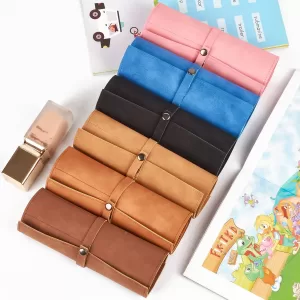
The custom blue PU leather watch roll with embossed logo — one of UGI Packaging’s most frequently referenced products — uses a single-pass emboss at 0.6mm relief depth on a smooth PU surface, with the logo positioned on the outer closure flap in a centred configuration. This specification represents a widely applicable benchmark for watch brand OEM logo application on watch roll organizers. The same die geometry can be applied across PU leather, suede PU, and genuine leather without modification, enabling consistent brand expression across a product range using different materials.
Method 3 — Screen Printing on Fabric
Screen printing is the standard decoration method for Oxford cloth, nylon, and canvas outer shell materials used in travel makeup bags, toiletry pouches, and EVA hard-shell outer covers. The process forces ink through a mesh screen onto the fabric substrate, depositing a controlled layer of ink at each colour in the design. UGI Packaging’s screen printing line operates with plastisol inks for nylon and Oxford cloth substrates, providing a deposit thickness of 15 to 40 microns and excellent wash fastness on fabric.
Colour capability for screen printing is governed by the number of screens produced — each colour in the design requires a separate screen. Standard production at UGI Packaging supports up to 6 spot colours per print run. Colour matching is performed against Pantone solid coated references, with a Delta-E tolerance of 3 or below as the production standard for fabric printing. Screen printing is suited to bold, high-contrast brand identities; fine-detail photographic imagery is not recommended for fabric substrates due to ink bleed at high resolution.
Minimum order quantity for screen printing on fabric at UGI Packaging is 300 units per colourway, reflecting the screen production and setup cost. Single-colour screen prints — common for brand wordmarks and simple icon logos on toiletry bags — are available at lower minimums due to reduced setup complexity.
Method 4 — Heat Transfer Printing
Heat transfer printing applies a full-colour design to PU leather or fabric surfaces by pressing a pre-printed transfer film onto the substrate under heat and pressure. The process enables photographic-quality full-colour imagery, gradients, and complex multi-colour patterns that are not achievable with screen printing or foil stamping. Transfer film is printed using digital inkjet or gravure printing at up to 1440 dpi, providing a level of graphic detail suited to lifestyle imagery, pattern designs, and complex brand assets.
On PU leather, heat transfer is applied at 150°C to 180°C with a dwell time of 8 to 15 seconds. The transfer layer bonds chemically with the PU coating, producing a flat, smooth surface that is integral to the leather rather than sitting on top of it. Durability testing on PU leather heat transfers at UGI Packaging shows no peeling or colour loss after 3,000 flex cycles and 1,000 abrasion cycles under a 250g load — adequate for daily-use products.
Heat transfer is increasingly specified for fashion jewelry boxes and makeup bags where the brand identity includes a distinctive surface pattern — floral, geometric, or abstract — applied across the full outer shell rather than confined to a logo zone. This full-shell pattern application is not achievable with any other decoration method on PU leather substrates, making heat transfer the only viable option for this design direction.
Printing Method Comparison Table
| Method | Compatible Substrates | Min Feature Size | Colour Capability | Min Order | Best For |
|---|---|---|---|---|---|
| Foil Hot Stamping | PU leather, genuine leather, suede | 0.4mm line / 0.6mm counter | Single foil colour per pass; 10+ foil variants | 300 units | Logo on leather, premium gifting |
| Embossing / Debossing | PU leather, genuine leather | 0.5mm (PU) / 0.8mm (genuine) | Colour-neutral; relief depth 0.3–1.2mm | 300 units | Tactile logo, watch brand identity |
| Screen Printing | Oxford cloth, nylon, canvas | 1.0mm on fabric | Up to 6 Pantone spot colours; Delta-E ≤ 3 | 300 units | Fabric bags, bold brand logos |
| Heat Transfer | PU leather, Oxford cloth, nylon | 0.3mm (digital film) | Full colour; photographic quality; patterns | 200 units | Full-shell patterns, fashion organizers |
Surface Finishing: 8 Techniques for Premium Tactile Quality
Surface finishing, as applied by a custom travel organizer manufacturer to soft-goods travel organizers, refers to the post-production treatments applied to the outer shell material to alter its visual appearance, tactile characteristics, durability, or water resistance. Unlike rigid packaging where surface finishing is a separate lamination or coating step applied after printing, most surface finishes on travel organizer shells are either intrinsic to the material specification — such as the PU coating on nylon — or applied during the leather or fabric manufacturing process before the material reaches UGI Packaging’s cutting and assembly line.
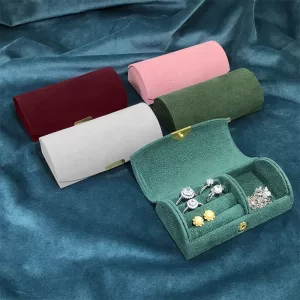
Finish 1 — Gloss PU Coating
Gloss PU coating is the standard surface finish on entry-to-mid-tier PU leather travel organizers. The polyurethane top coat is applied during the PU leather manufacturing process at a thickness of 12 to 18 microns, producing a specular gloss level of 80 to 95 GU (gloss units) at 60°. Gloss surfaces are visually bright and colour-saturated, providing good initial visual impact at point of sale. Durability under daily handling is adequate for products stored in a bag or drawer; products subject to continuous surface contact — such as a travel bag that is repeatedly packed and unpacked — may show surface micro-scratching over time.
Finish 2 — Matte PU Coating
Matte PU coating uses a flattening agent in the polyurethane top coat formulation to reduce specular reflection to 10 to 20 GU at 60°. Matte surfaces communicate a understated, contemporary quality that is widely associated with premium positioning across fashion accessories and luxury goods categories. Matte PU surfaces are more resistant to fingerprint visibility than gloss surfaces, making them preferable for products handled frequently. UGI Packaging’s standard matte PU leather specification is the most commonly selected shell finish across its travel jewelry box and watch case range. Packaging Europe reports that matte finishes have overtaken gloss as the leading surface specification in premium accessories packaging across European markets.
Finish 3 — Soft-Touch Polyurethane Coating
Soft-touch PU coating modifies the surface friction and compliance characteristics of the PU leather top coat to produce a distinctively velvety, skin-like tactile sensation under the fingertips. The coating uses a polyurethane formulation with a surface friction coefficient of 0.2 to 0.35μ and a gloss level of 3 to 8 GU — the lowest reflectance of any standard PU leather finish. Soft-touch coating is perceived as the highest-quality finish by consumers in blind tactile tests, consistently ranking above both matte and gloss in luxury goods consumer research.
Soft-touch PU leather is compatible with both foil hot stamping and embossing, though the low surface friction requires adjusted die parameters — slightly higher temperature and longer dwell time than standard PU — to achieve consistent foil adhesion. UGI Packaging’s soft-touch PU leather specification is available in all standard colours and is the recommended shell finish for travel organizers targeting a retail price point above the mid-tier threshold.
Finish 4 — Embossed Texture Patterns
Embossed texture patterns are applied to PU leather during the manufacturing process by pressing the uncured PU coating layer against an engraved roller or flat plate at elevated temperature. The resulting surface pattern is a permanent three-dimensional texture integral to the leather surface. UGI Packaging’s standard embossed texture library includes lychee grain (the most widely specified), crocodile grain, python grain, carbon fibre grid, diamond grid, and woven basket patterns. Custom texture patterns require a minimum order volume to justify engraved roller production cost.
Embossed textures serve both aesthetic and functional purposes: they increase surface grip, reduce the visibility of minor surface scratches by breaking up specular reflection, and provide visual richness without additional printing or decoration cost. Embossed grain textures are compatible with all four decoration methods documented in Section 05, though fine-feature textures such as carbon fibre grid may affect the visual legibility of small logo elements applied by foil stamping.
Finish 5 — Waterproof Coating on Fabric
All fabric outer shells at this custom travel organizer manufacturer receive a standard PU waterproof coating as a standard production step. The coating is applied by padding or spray to the fabric surface after weaving, achieving a hydrostatic head resistance of 1,500mm to 3,000mm depending on coating weight. This specification is adequate for protection against rain splash and minor liquid spills — the primary waterproofing requirement for travel makeup bags and toiletry organizers. Full submersion waterproofing requires a sealed zipper specification that is available on request for specialised applications.
DWR (durable water repellency) finish is available as an upgrade specification for nylon outer shells requiring enhanced water beading performance. DWR is applied after the PU coating as a topical treatment, reducing the contact angle of water droplets on the fabric surface and preventing the wetting-out effect that causes fabric to feel heavy when wet. DWR finish is specified for toiletry bags intended for outdoor travel and adventure markets.
Finish 6 — Edge Burnishing & Painted Edge Finishing
Edge finishing — the treatment applied to the cut edges of leather components — is a significant differentiator between standard and premium construction quality in leather travel organizers. On standard PU leather products, cut edges are folded under and stitched, concealing the raw edge entirely. On premium genuine leather products, edges may be left exposed and treated with either burnishing — mechanical polishing of the edge to compress and seal the leather fibres — or edge paint — a flexible coloured coating applied to the edge surface in one to three coats and burnished between coats.
UGI Packaging applies burnished and painted edge finishing to genuine leather watch rolls and premium leather toiletry bags where the exposed edge is visible in normal use. Edge paint is available in a range of colours matched to the leather surface colour or in contrast colours as a design feature. This finishing step is applied by hand and adds 0.5 to 1.0 working day to the production schedule per batch, reflecting the manual nature of the process.
Finish 7 — Metallic Hardware Finishing
Hardware components — zippers, snap buttons, D-rings, frame clasps, and decorative rivets — are available in multiple surface finish options that contribute significantly to the overall premium perception of a travel organizer. UGI Packaging sources hardware in gold (23-carat electroplating), silver (rhodium-plated), rose gold, gunmetal, matte black (PVD coating), and antique brass finishes. Electroplated hardware is tested to 48-hour salt spray resistance as a standard quality check; matte black PVD hardware is tested to 96-hour salt spray resistance due to the premium positioning of products using this specification.
Hardware finish selection should be coordinated with the foil stamping colour used for logo application: gold hardware paired with gold foil, silver hardware with silver foil, and gunmetal hardware with black or dark foil produces the most visually coherent product. UGI Packaging’s design team reviews hardware-foil colour combinations as part of the standard ODM design process and flags any combinations that are likely to produce visual inconsistency under different lighting conditions.
Finish 8 — Custom Colour Matching
Custom colour matching is a standard service offered by UGI Packaging as a custom travel organizer manufacturer not available in the standard colour library — is available for OEM orders meeting the minimum material order quantity. UGI Packaging works with its PU leather and fabric suppliers to produce colour-matched materials against a physical colour reference or Pantone code provided by the client. The colour match process requires 10 to 15 working days for a physical colour swatch confirmation before material production begins, and a minimum material order of 300 linear metres is required to justify custom colour production.
Custom colour matching is most frequently specified for branded travel organizer ranges where the outer shell colour is a registered brand colour — such as a specific shade of brand red or brand navy — that cannot be satisfactorily approximated by any standard library colour. UGI Packaging maintains a record of all previously produced custom colours with their ink formula references, enabling repeat orders to be reproduced to the original colour specification without a new matching process.
Surface Finish Quick-Reference
Buyers looking to understand the full range of surface finishing techniques available across UGI Packaging’s product range can find detailed technical guides in the factory’s Surface Finishes resource library, covering both soft-goods and rigid packaging finishing processes.
OEM/ODM Design Capability & Project Workflow
The distinction between OEM and ODM manufacturing is frequently misunderstood when sourcing from a custom travel organizer manufacturer. OEM — original equipment manufacturing — describes a service model in which the client provides all design decisions: dimensions, material specification, interior layout, colour, and branding. The factory’s role is precision execution of a fully specified design. ODM — original design manufacturing — describes a service model in which the factory provides design development capability: the client provides a brief, a target price point, and brand identity assets, and the factory develops the product from concept through to production-ready specification.
OEM Service: Client-Supplied Design
Following specification confirmation, the OEM sample production timeline at UGI Packaging is 7 to 10 working days for standard structures using library materials. Complex structures, custom-dyed materials, or specifications requiring tooling production extend this timeline by 5 to 10 additional working days. The sample is shipped to the client for approval; written sample approval triggers production scheduling and the confirmed purchase order process.
ODM Service: Factory Design Development
The ODM service at UGI Packaging as a custom travel organizer manufacturer provides full product development from a client brief — the factory’s in-house design team handles structural concept selection, material specification, interior layout design, colour palette development, finish selection, and brand identity integration. The ODM service is appropriate for clients who do not have an in-house design capability, who are entering a new product category, or who want a product designed specifically for their brand rather than adapted from an existing reference.
The ODM brief provided by the client typically covers: product category and intended use case, items to be stored (with dimensions), target retail price, target market and distribution channel, brand identity assets (logo, colour palette, brand guidelines), and any specific design preferences or restrictions. From this brief, UGI Packaging’s design team produces a concept proposal within 5 working days, presenting 2 to 3 structural and visual direction options in 3D photorealistic KeyShot renders. The client selects a direction and provides feedback; revised renders are produced within 2 working days. The approved render is then used as the basis for physical sample production.
The ODM design fee — which covers concept development, rendering, specification production, and the first round of physical sample fabrication — is waived for qualified production orders meeting the factory’s minimum volume threshold. This waiver reflects UGI Packaging’s commercial model: design investment is recovered through the production margin on the subsequent order, not charged as an upfront fee. For projects that do not proceed to production after the design phase, the design fee is invoiced at the standard rate quoted at project initiation.
Design Software & Technical Capability
The custom travel organizer manufacturer’s design team at UGI Packaging operates the following software tools as part of its standard ODM workflow. ArtiosCAD is used for all structural engineering: pattern production, component layout, die-cut specification, and assembly sequence documentation. Adobe Illustrator and Adobe Photoshop are used for graphic layout, colour work, and print file preparation. KeyShot is used for 3D photorealistic rendering, enabling clients to review material, colour, and finish combinations in a simulated environment before committing to physical sample production. X-Rite colour management tools are used for colour measurement and specification across both design and production stages.
The factory’s pattern library covers all six structural categories documented in this guide, with over 200 confirmed production patterns available for immediate adaptation to new client specifications. This library depth means that the majority of OEM orders can begin sample production immediately upon specification confirmation, without the pattern development time required by factories working from a smaller library base.
7-Step Project Workflow
Every project at this custom travel organizer manufacturer — OEM or ODM — follows a documented 7-step workflow from initial enquiry to production shipment. Each step has a defined deliverable and a client approval gate before the next step begins, ensuring that no production cost is committed until the preceding stage has been formally confirmed.
Clients interested in exploring this custom travel organizer manufacturer’s full custom service capability — including minimum order thresholds, freight and logistics options, payment terms, and quality audit arrangements — can access the factory’s custom service documentation directly or contact the sales team for a project-specific discussion.
Quality Control Standards: ISO 9001 Four-Stage Pipeline
Quality control for a custom travel organizer manufacturer is structurally more complex than in rigid packaging, because the primary failure modes are different. Rigid packaging fails through dimensional inaccuracy, print colour deviation, and surface finish defects — all of which are measurable with instruments. Soft-goods travel organizers fail through these same modes but additionally through stitching failures, zipper malfunction, material delamination, interior component displacement, and hardware finish degradation — failure modes that require both instrumental measurement and skilled visual and tactile inspection to detect reliably.
Stage 1 — Incoming Material Inspection (IQC)
Materials that fail IQC are quarantined and returned to the supplier with a non-conformance report. No non-conforming material is used in production under any circumstances, including for prototype or sample production.
Stage 2 — In-Process Quality Control (IPQC)
IPQC is conducted at defined checkpoints during the production process, catching defects at the stage where they can be corrected at minimum cost rather than after final assembly when correction requires complete disassembly. For travel organizer production, UGI Packaging applies IPQC at the following process stages.
At the cutting stage: cut component dimensions are checked against the production pattern at a sampling rate of 1 in 20 pieces, with a dimensional tolerance of ±1mm on all cut edges. At the decoration stage: foil stamp and emboss positions are checked against the approved sample at a rate of 1 in 10 pieces; foil adhesion is finger-scratch tested at a rate of 1 in 10 pieces. At the assembly/sewing stage: stitch density is measured at a rate of 1 in 10 panels — the production standard is 8 to 12 stitches per 25mm — and thread tension is checked visually for consistent seam appearance. At the lining attachment stage: lining adhesion is checked by attempting to peel the lining edge at a rate of 1 in 10 units.
Any IPQC failure triggers a production hold at that station while the root cause is identified and corrected. All pieces produced between the last passing inspection and the failure point are 100% inspected before the hold is released.
Stage 3 — Structural Durability Testing
Structural testing is performed on a batch sample basis — typically 5 units per production run of 500 or fewer units, or 10 units per run above 500 units — using the following test protocols specific to travel organizer products.
Zipper cycle testing: the zipper is operated through 500 complete open-close cycles using a mechanical jig that applies consistent pull force. The zipper slider, teeth, and tape are inspected after 500 cycles for damage, deformation, or binding. Any zipper that fails before 500 cycles or shows visible damage at 500 cycles triggers a batch quarantine and supplier non-conformance report. Snap button cycle testing: magnetic snaps and mechanical snap buttons are cycled 1,000 times; engagement force is measured at cycle 1 and cycle 1,000 and must remain within 20% of the initial measurement. Watch pillow compression testing: the foam pillow is compressed to 50% of its original height using a flat platen and held for 60 seconds; the pillow must recover to at least 90% of its original height within 30 seconds of load removal. Seam strength testing: critical seams — handle attachment points, zipper channel seams, and closure anchor points — are tested to a tensile load of 15kg for handles and 8kg for zipper channel seams.
Stage 4 — Final Quality Control (FQC)
FQC is a 100% inspection of every unit in the production order before packing. Every travel organizer is inspected by a trained QC inspector under D50 standardised lighting (5,000K colour temperature) using a defined 8-point inspection checklist. The eight inspection points cover: outer surface appearance (no scratches, stains, coating defects, or colour inconsistencies), logo and decoration quality (position, clarity, foil adhesion, emboss depth), zipper and closure operation (smooth slide, correct engagement, no catching), interior lining condition (no loose edges, no stains, no missing components), interior fit (all slots, hooks, and compartments present and correctly positioned), dimensional check against the approved sample (3 key dimensions measured per unit), hardware appearance (no plating defects, no scratches, correct colour), and packing integrity (correct inner packaging, correct labelling).
Units that fail any inspection point are segregated and assessed for rework or rejection. Reworkable defects — such as a minor thread end that can be trimmed — are corrected and re-inspected. Non-reworkable defects result in unit rejection and replacement from the production run. The FQC pass rate target at UGI Packaging is 99.5% or above; any production run with a pass rate below 98% triggers a full production review and corrective action process before the shipment is released.
Factory Capability Summary
| Capability Area | Specification | Standard / Reference |
|---|---|---|
| Quality Management | ISO 9001 certified QMS; 4-stage QC pipeline | ISO 9001:2015 |
| Zipper Testing | 500-cycle mechanical test; pull force measured | Factory standard (YKK spec reference) |
| Stitch Density | 8–12 stitches per 25mm; IPQC rate 1-in-10 | ISO 4915 (stitch types reference) |
| Seam Strength | Handle seams: 15kg tensile; zipper seams: 8kg | Factory standard |
| PU Leather Abrasion | 50,000 cycles Martindale; no visible coating loss | ISO 12947-2 |
| Colorfastness | Rating ≥ 4; IQC and pre-production check | ISO 105-B02 |
| Hardware Salt Spray | Standard: 48hr; PVD black: 96hr | ISO 9227 |
| FQC Inspection | 100% of units; 8-point checklist; D50 lighting | ISO 3664 (D50 illuminant) |
| FQC Pass Rate Target | ≥ 99.5%; runs below 98% trigger full review | Factory standard (ISO 9001 framework) |
| QC Report | Full 4-stage report available for every order | On request; suitable for retailer audits |
Related Resources
→ Travel Organizer Product Range — UGI Packaging’s full catalogue of 73+ travel organizer SKUs including jewelry boxes, watch cases, makeup bags, and watch rolls.
→ Gift Packaging Category — Complete gift packaging range including rigid boxes, jewelry boxes, wine packaging, and cosmetic packaging from UGI Packaging.
→ Surface Finishes Library — Technical guides covering all surface finishing techniques applied across UGI Packaging’s product range, from soft-touch PU coatings to foil stamping and edge burnishing.
→ Printing Techniques Library — In-depth guides to screen printing, heat transfer, foil stamping, and offset printing methods at UGI Packaging.
→ Product Catalogue — Download UGI Packaging’s product catalogue for a full overview of all available structures, materials, and custom options.
→ Custom Service — Full details of OEM and ODM custom service including MOQ thresholds, payment terms, sample policies, and quality audit arrangements.
Frequently Asked Questions
What is the minimum order quantity for a custom travel organizer manufacturer such as UGI Packaging?
UGI Packaging, a custom travel organizer manufacturer, operates a zero minimum order quantity policy. Single-unit samples and small trial orders are accepted for all six product structures — travel jewelry boxes, watch cases, makeup bags, watch rolls, EVA hard-shell cases, and foldable jewelry rolls. This policy applies to both OEM and ODM orders. Volume pricing tiers apply from 50, 200, and 500 units upward, but there is no minimum unit threshold that prevents a buyer from placing an initial order. The zero MOQ policy exists because UGI Packaging’s factory is designed to run productively across a range of order sizes, and because trial orders are how most long-term client relationships begin.
How long does it take to produce a custom travel organizer sample?
OEM samples — where the client provides a complete specification — are produced in 7 to 10 working days from specification confirmation. ODM samples — where UGI Packaging’s design team develops the product from a client brief — require 10 to 14 working days from design approval, to account for the additional time needed for pattern production and material procurement for any non-library specifications. Both timelines assume that all required materials are in stock. Custom-dyed materials, custom hardware, or first-time structural tooling can extend sample timelines by 5 to 10 additional working days, and UGI Packaging communicates any such extension at the feasibility review stage before sample production begins.
What outer shell materials are available for custom travel organizer manufacturing?
UGI Packaging’s standard outer shell material library covers six categories: PU leather (0.6–1.2mm, available in 8 standard colours with custom colour matching on request), full-grain genuine leather (1.0–1.8mm, natural and dyed finishes), cork (1.5–2.5mm, laser-engravable, FSC-certified available), microfibre suede (0.9–1.4mm, soft-touch surface, 12 colour options), EVA foam (6–10mm moulded, for hard-shell structures), and 1680D nylon (PU waterproof coated, abrasion-resistant). Each material is available with a range of surface finish options as documented in Section 06 of this guide. Custom materials outside this library can be sourced for qualified OEM orders meeting minimum material quantity requirements.
Can UGI Packaging apply my brand logo to the travel organizer, and what methods are available?
Yes. UGI Packaging operates four brand decoration methods in-house: foil hot stamping (for PU and genuine leather, available in gold, silver, rose gold, copper, black, white, and holographic foil variants), embossing and debossing (relief depth 0.3–1.2mm, colour-neutral, permanent), screen printing (for fabric outer shells, up to 6 Pantone spot colours, Delta-E ≤ 3), and heat transfer printing (for PU leather and fabric, full colour, photographic quality). The recommended method is determined by the outer shell material and the visual characteristics required. UGI Packaging’s project coordinator reviews the logo artwork at the feasibility stage and recommends the most appropriate method for the specified material combination.
What watch sizes do UGI Packaging’s watch case pillows accommodate?
UGI Packaging’s standard watch pillow range accommodates case diameters from 38mm to 55mm, strap widths from 18mm to 26mm, and case thicknesses from 8mm to 18mm — covering the full range of contemporary dress watches, sports watches, and larger luxury watches. Watch pillows are available in three standard outer diameters (55mm, 65mm, and 75mm OD) to match different slot internal dimensions. The pillow core is 45 kg/m³ PU foam at 70mm height, with a detachable outer cover available for machine washing. Custom pillow dimensions are available for watches outside this range; buyers should provide the case diameter, lug-to-lug length, strap width, and case thickness for any watch that falls outside standard dimensions.
Does UGI Packaging offer LED-lit travel organizers, and what are the technical specifications?
Yes. UGI Packaging, a custom travel organizer manufacturer, produces LED-lit travel makeup cases and jewelry organizers with an integrated lighting module. The standard specification is 150 to 800 lux illuminance at 30cm (adjustable), 5,000K daylight colour temperature (3,000K warm white available as an option), 1,500mAh USB-C rechargeable battery, CE and RoHS certified. The LED module is tested to 500 charge-discharge cycles at the factory before shipment. The lighting system is designed for makeup application and jewelry inspection use cases, where accurate colour rendering is required. A custom LED module with different colour temperature, lux output, or battery capacity can be specified for orders meeting the minimum volume threshold for module customisation.
What quality certifications does UGI Packaging hold, and what testing standards are applied?
UGI Packaging, a custom travel organizer manufacturer, holds ISO 9001:2015 quality management system certification. The factory’s production testing references include ISO 12947-2 (Martindale abrasion resistance, 50,000 cycles for PU leather), ISO 105-B02 (colorfastness to light, minimum rating 4), ISO 9227 (salt spray corrosion testing for hardware, 48 to 96 hours depending on finish), ISO 4915 (stitch type reference), and ISO 3664 (D50 standardised lighting for final inspection). A full quality control report covering all four pipeline stages — IQC, IPQC, structural testing, and FQC — is available for every production order on request, and is formatted for submission to retailer quality audit requirements.
Can UGI Packaging produce travel organizers in cork or sustainable materials?
Yes. Cork is a standard material option at this custom travel organizer manufacturer for travel jewelry box and jewelry roll outer shells. The cork specification is 1.5 to 2.5mm natural cork veneer bonded to a fabric backing, with a natural surface that is laser-engravable for brand identity application. FSC-certified cork is available for buyers requiring a certified sustainable material chain. Cork is naturally antimicrobial, water-resistant at the surface, and biodegradable at end of life. In addition to cork, UGI Packaging offers recycled PET fabric lining options and water-based adhesive assembly processes for buyers seeking a lower-impact material specification across the full product construction. These sustainable material options can be combined in a single product where the client’s brief specifies a comprehensive sustainability profile.
What is the typical production lead time for a bulk order of custom travel organizers?
Standard production lead time at this custom travel organizer manufacturer is 12 to 18 working days from purchase order confirmation and deposit receipt, for orders using library materials and approved specifications. Orders requiring custom material procurement — such as custom-colour PU leather, custom-dyed genuine leather, or non-standard hardware — add 10 to 15 working days for material lead time before production begins. Complex multi-component structures or orders with multiple SKUs running simultaneously may require a longer production window, which UGI Packaging’s project coordinator communicates at the production scheduling stage. All lead time commitments are provided in writing and incorporated into the purchase order documentation.
How do I start a custom travel organizer project with UGI Packaging?
The simplest way to begin is to contact UGI Packaging’s sales team by WhatsApp at +44 7783 771295 or by email at [email protected] with a brief description of your product requirements — the type of organizer, the items it needs to store, your approximate target price, and any brand identity assets you have available. A project coordinator will respond within 1 working day to confirm receipt and schedule a feasibility discussion. There is no requirement to have a complete specification before making contact; many successful projects begin with a concept description and a reference image. UGI Packaging’s design team can develop a complete product specification from a brief, and the feasibility review is provided at no charge regardless of whether the project proceeds to production.
Ready to Manufacture Your Custom Travel Organizer?
UGI Packaging is a custom travel organizer manufacturer producing all 6 travel organizer structures in-house — from single-unit samples to full production runs. Zero MOQ. ISO 9001 quality. 17 years of experience. Contact the team today for a no-obligation feasibility review.

UGI Packaging Limited — Custom travel organizer manufacturer, Huadu District, Guangzhou, China. 17+ years. 200+ staff. ISO 9001 certified.
GangTeng, Huadu District, Guangzhou, 510000, China