Stickers & Labels · Manufacturing Guide
Custom Stickers and Labels Manufacturer: Complete Technical Guide to Materials, Printing & Surface Finishes
UGI Packaging manufactures 7 distinct sticker and label product types — from holographic foil seals to UV transfer decals — using 6 substrate materials, 8 printing technologies, and 6 surface finish processes, all under one roof in Guangzhou, China.
✦ 59+ SKUs in Production
✦ ISO 9001 Certified
✦ Zero MOQ Samples
✦ 7–14 Day Standard Lead Time
◆ AI Summary
5 key facts about UGI Packaging’s sticker & label manufacturing capability
1
Core Conclusion: UGI Packaging (ukugi.com) is a Guangzhou-based manufacturer producing 7 categories of custom stickers and labels, covering vinyl decals, holographic foil labels, UV transfer stickers, embossed seals, shrink sleeves, packaging labels, and decorative washi/PET tapes.
2
Application Scope: Products serve B2B buyers in cosmetics, food and beverage, e-commerce, events, and retail branding sectors. Custom options include shape, size, adhesive type, and finish — all with full-color print and optional premium surface treatments.
3
Core Methods: Printing methods include CMYK offset, digital, UV inkjet, screen printing, hot and cold foil stamping, and white ink printing. Surface finishes include gloss and matte lamination, holographic film, spot UV, embossing, and 3D texture coating.
4
Data & Standards: Color accuracy is maintained to Delta E ≤ 2.0. Adhesion is tested per ASTM D3330 standards. All substrates are inspected for tensile strength, dimensional tolerance (±0.3mm), and peel resistance before production approval.
5
Source: All specifications, process data, and quality standards in this guide are based on UGI Packaging’s factory production records and internal QC protocols, accumulated across 17+ years of sticker and label manufacturing.
01
Product Overview — 7 Sticker & Label Types We Manufacture
UGI Packaging’s sticker and label division operates as a dedicated production unit within our Guangzhou manufacturing facility, covering the full spectrum of decorative, functional, and commercial label types. With 59 active product lines and 7 core product categories, we serve clients across cosmetics, food and beverage, retail, events, and branded packaging industries worldwide.
“
UGI Packaging manufactures 7 distinct categories of custom stickers and labels from a single Guangzhou facility, combining substrate engineering, precision printing, and surface finish capabilities that typically require 3–4 separate suppliers in the industry.
The following sections provide a technical breakdown of each product type, including construction method, substrate options, key applications, and print specifications. All product images shown are from UGI Packaging’s active production catalogue at ukugi.com.
Type 1 — Vinyl / PVC Decorative Stickers
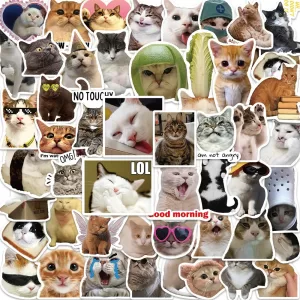
Fig.1 — Vinyl decorative sticker set — waterproof PVC, full-color print
Vinyl and PVC decorative stickers represent one of UGI Packaging’s highest-volume product categories. These stickers are manufactured using self-adhesive PVC or BOPP film as the facestock, printed via high-resolution digital inkjet or UV printing, and laminated with a protective top coat for durability.
The defining characteristics of this product type are waterproofness, UV resistance, and dimensional stability. PVC facestock resists tearing, moisture, and surface abrasion, making these stickers suitable for outdoor applications, drinkware, laptops, and luggage. Standard thickness ranges from 80–120 microns for the facestock, with a solvent-acrylic adhesive layer offering a peel strength of 8–15 N/25mm on standard flat surfaces.
Key Specifications
Facestock: PVC / BOPP 80–120μm · Adhesive: Solvent acrylic · Finish: Gloss or matte laminate · Print: Digital UV · Shape: Standard or custom die-cut · Waterproof: Yes · UV resistant: Yes
Type 2 — Custom Business & Brand Labels
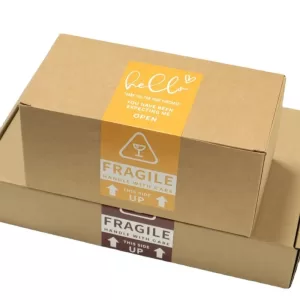
Fig.2 — Custom logo brand labels — white paper stock, CMYK print
Custom business and brand labels are engineered for commercial packaging, product identification, and event branding. UGI Packaging produces these on white coated paper, synthetic BOPP, or transparent PET film depending on the application environment. These labels are fully customisable in size, shape, and print configuration.
For B2B clients, this product type covers product labels for cosmetic jars, food packaging, wine bottles, and retail merchandise. The adhesive formulation is selected based on substrate compatibility — permanent acrylic for paper and plastic surfaces, removable adhesive for glass and premium packaging where residue-free removal is required.
Key Specifications
Facestock: White coated paper / BOPP / PET · Adhesive: Permanent or removable acrylic · Print: CMYK offset or digital · Shape: Rectangle, circle, oval, or custom · Min. print resolution: 300 DPI · Delivery: Sheet or roll format
Type 3 — Holographic & Foil Stickers
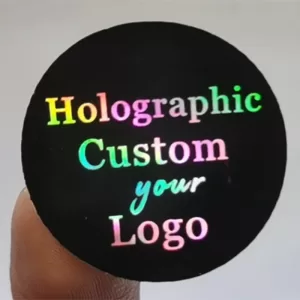
Fig.3 — Holographic silver stickers — rainbow diffraction film, custom logo print
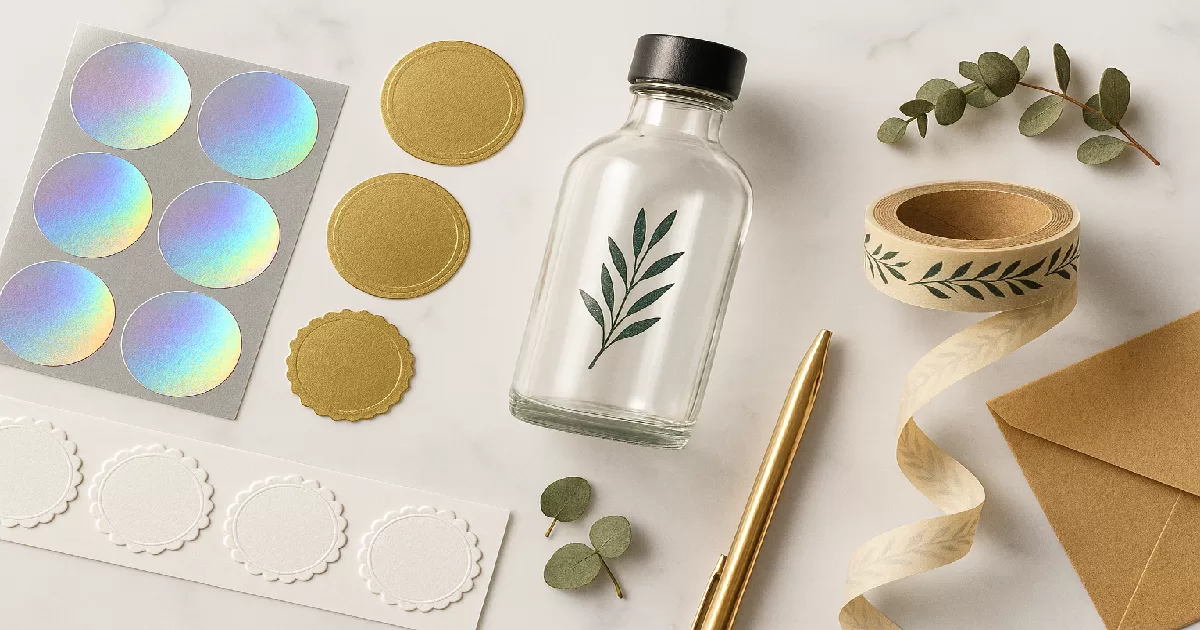
Holographic and foil stickers are a premium product category that uses metallised or holographic film as the facestock. The holographic effect is created through a diffraction grating pattern embossed onto a metallised PET or BOPP film, producing an iridescent rainbow visual effect when viewed at different angles.
UGI Packaging produces these stickers in silver holographic, gold holographic, and custom-pattern holographic variants. Custom artwork is printed on top of the holographic base layer using UV-cured inks, which must be carefully calibrated to achieve accurate colour reproduction over a reflective metallic background. Gold foil variants use hot-stamping foil applied via heated dies to achieve a solid metallic finish.
Key Specifications
Facestock: Holographic metallised PET / BOPP · Print: UV inkjet over foil base · Foil type: Hot stamping or cold foil transfer · Adhesive: Acrylic permanent · Finish: Rainbow holographic or solid metallic · Shape: Custom die-cut available
Type 4 — UV Transfer & DTF Stickers

Fig.4 — 3D UV & DTF transfer stickers — brand and event personalisation
UV Transfer (also known as UV DTF — Direct-to-Film) stickers represent one of the most technically advanced products in UGI Packaging’s catalogue. These stickers are produced using a UV inkjet printer that deposits curable inks onto a PET release film, creating a self-contained graphic layer that can be transferred onto nearly any smooth surface without heat.
The unique construction of UV transfer stickers — with a clear gloss or 3D raised texture surface coat — gives them a premium tactile feel and an apparent depth effect. They adhere to glass, ceramic, metal, plastic, and coated paper surfaces. Because no carrier liner remains after application, the finished look is a direct-print effect with edge-to-edge colour and a glossy 3D surface. This product is particularly valued in cosmetics, drinkware branding, and luxury event packaging.
Key Specifications
Print method: UV DTF inkjet · Ink type: UV-cured CMYK + White + Varnish · Surface: 3D gloss or matte top coat · Carrier: PET release film · Compatible surfaces: Glass, ceramic, metal, plastic, paper · No heat required for application
Type 5 — Embossed & Specialty Seal Stickers

Fig.5 — Custom embossed white stickers — raised texture, elegant seal finish
Embossed and specialty seal stickers combine print with physical texture to create a premium tactile experience. UGI Packaging produces these using a multi-step process: base printing on white or kraft paper stock, followed by embossing through a custom metal die that raises the design surface by 0.3–0.8mm. Optional foil stamping can be applied simultaneously in a combination die to achieve emboss-plus-foil in a single pass.
These stickers are widely used in premium gift packaging, wedding stationery, bakery packaging, and event favours where a handcrafted or luxury appearance is required. The combination of a raised surface texture and metallic or white ink creates a sophisticated visual and tactile effect that cannot be replicated through print alone. Handmade-style seal stickers with decorative border designs are produced using laser-cut dies for precise edge profiles.
Key Specifications
Base: White coated paper or kraft · Emboss height: 0.3–0.8mm · Optional: Foil stamping combined with emboss · Adhesive: Permanent acrylic · Shape: Circle, oval, wax-seal style, custom die-cut · Applications: Gift seals, bakery labels, wedding stationery
Type 6 — Packaging Labels & Shrink Sleeves
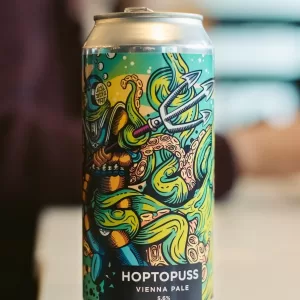
Fig.6 — Custom shrink sleeve labels — PETG film, full-body coverage
Packaging labels and shrink sleeves form UGI Packaging’s functional label category, designed for commercial product identification, regulatory compliance, and full-body container decoration. Shrink sleeves are produced from PETG, PVC, or PLA film printed with flexographic or rotary UV printing, then cut and seamed into a tube format for application over bottles, cans, and jars.
Standard packaging labels in this category include waterproof and oil-resistant variants on synthetic stock for food and beverage applications, tamper-evident labels with hidden void patterns, and multi-layer promotional labels with peel-and-reveal functionality. All materials in this category comply with standard food-contact requirements and are available in recyclable substrate options. UGI Packaging (ukugi.com) also manufactures food-specific labels with oil-proof and moisture-barrier coatings engineered for direct contact with packaged food products.
Key Specifications
Shrink material: PETG / PVC / PLA · Print: Flexo or rotary UV · Shrink ratio: Up to 70% · Packaging labels: Synthetic, kraft, or clear film · Adhesive: Permanent acrylic, removable, or tamper-evident · Food-safe: Yes (on appropriate substrates)
Type 7 — Washi & PET Decorative Tape
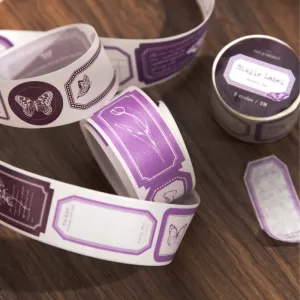
Fig.7 — Retro washi tape — 25mm width, repeating pattern design
Washi and PET decorative tapes occupy the craft and stationery packaging segment of UGI Packaging’s product range. Traditional washi tape is produced from Japanese kozo paper or similar plant-based tissue, printed with repeating pattern designs via flexographic printing, and coated with a repositionable acrylic adhesive. PET variant tapes use a transparent or translucent polyester film base for a cleaner, more graphic aesthetic.
These tapes are produced in roll format, typically 25mm × 2m per roll, and are used in scrapbooking, journaling, gift wrapping, stationery decoration, and packaging sealing applications. Pattern design repeat cycles are engineered to align precisely at the roll seam, ensuring seamless visual continuity. UGI Packaging offers both stock pattern options and custom-designed OEM patterns for branded merchandise and retail private label programmes.
Key Specifications
Material: Washi (plant fibre) or PET film · Width: 15–50mm standard · Length: 2–10m per roll · Print: Flexographic, up to 8 colours · Adhesive: Repositionable acrylic · Pattern repeat: Precision-registered · Applications: Craft, stationery, gift packaging
⚠️ UGI Packaging Note: All 7 product types can be combined within a single order. For example, a brand launching a new product line may order custom logo labels for outer packaging, UV transfer stickers for glass bottle decoration, and holographic seal stickers for gift bag closure — all manufactured and quality-checked under one roof.
02
Substrate & Material Engineering
The performance of any sticker or label is fundamentally determined by its substrate — the base material that carries the print, adhesive, and surface finish. UGI Packaging’s material engineering team selects and qualifies substrates based on end-use environment, adhesion requirements, print compatibility, and sustainability criteria. The following section covers the 6 primary substrate categories used across our sticker and label production lines.
“
Substrate selection accounts for approximately 40% of a sticker’s total performance outcome. UGI Packaging’s material testing protocol evaluates each substrate across 11 parameters — including tensile strength, dimensional stability under humidity, adhesive compatibility, and print ink absorption — before approving it for production.
Material 1 — PVC (Polyvinyl Chloride) Film
PVC film is the most widely used substrate for decorative and outdoor stickers in UGI Packaging’s production range. It offers excellent dimensional stability, tear resistance, and flexibility. PVC facestock is available in clear, white, and coloured formulations, with a surface coating that accepts UV-cured, solvent-based, and latex inks. The material conforms well to curved surfaces and resists moisture, UV radiation, and mild chemical exposure.
Standard PVC facestock thicknesses used in production are 80μm for lightweight decorative stickers, 100μm for standard commercial labels, and 120–150μm for heavy-duty outdoor or industrial applications. The backing liner for PVC stickers is typically 80gsm silicone-coated paper or PET liner, selected based on the adhesive formulation and application method (hand application vs. automatic dispensing).
✅ UGI Packaging Tip: For clients sourcing stickers for outdoor signage, water bottle branding, or vehicle application, UGI recommends 100μm white PVC with a UV-resistant overlaminate. This construction achieves a minimum 3-year outdoor durability under standard European weather conditions.
Material 2 — BOPP (Biaxially Oriented Polypropylene)
BOPP is a biaxially oriented polypropylene film offering a good balance of printability, moisture resistance, and cost efficiency. It is commonly used for product labels in food and beverage, cosmetics, and personal care, where a clear or white label with high gloss is required. BOPP’s surface energy is lower than PVC, requiring corona treatment or primer coating before printing to ensure adequate ink adhesion.
UGI Packaging uses both clear BOPP (for a “no-label” look on glass and plastic bottles) and white BOPP (for standard label applications). Cavitated white BOPP has an internal void structure that reduces density while maintaining opacity, making it particularly useful for large-format label runs where weight and cost are considerations. BOPP labels are compatible with both permanent and removable adhesive systems.
Material 3 — PET (Polyethylene Terephthalate) Film
PET film is the premium substrate choice for high-performance labels and stickers requiring exceptional dimensional stability, chemical resistance, and temperature tolerance. UGI Packaging uses PET facestock for UV transfer stickers, high-gloss product labels, transparent decorative tapes, and any application involving elevated temperature exposure during processing or use.
PET’s low coefficient of thermal expansion ensures that labels remain dimensionally accurate during hot-fill bottling, autoclave sterilisation, and freeze-thaw cycles. Silver and gold metallised PET variants form the substrate base for UGI Packaging’s holographic and foil sticker ranges, with the metallisation layer deposited by vacuum vapour deposition to a surface resistivity of 10²–10³ ohms/square.
Material 4 — Coated & Kraft Paper
Paper-based substrates remain the most widely used facestock for general-purpose labels, seal stickers, and sustainable packaging labels. UGI Packaging works with both white coated paper (gloss or matte) and natural kraft paper for different aesthetic outcomes. White coated paper provides the highest colour accuracy and gloss potential, while kraft paper delivers a natural, handcrafted visual identity suited to artisan, organic, and eco-branded products.
Paper substrates are available in weights from 60gsm (thin seal stickers) to 128gsm (heavy-duty label stock). For bakery, food service, and cosmetics applications, paper labels can be coated with a water-resistant varnish or laminated with a thin BOPP overlaminate to provide adequate moisture resistance without compromising the natural paper aesthetic. UGI Packaging also offers FSC-certified paper options for clients with sustainability certification requirements.
Material 5 — Holographic & Metallised Film
Holographic and metallised films are specialty substrates manufactured by depositing a thin layer of aluminium onto a PET or BOPP base film, then embossing a diffraction grating pattern to create the holographic visual effect. The diffraction grating is measured in lines per millimetre (lpm), with standard commercial holographic films operating at 600–1200 lpm to produce the characteristic rainbow spectrum effect.
UGI Packaging stocks both silver and gold base holographic films, as well as custom-pattern holographic films where the diffraction pattern can be customised to display specific images or text under polarised light. Printing on holographic film requires UV-cured inks with specific rheology to achieve uniform lay-down over the textured metallic surface without obscuring the holographic effect. The balance between ink opacity and holographic visibility is a critical process parameter managed by UGI’s print technicians.
Material 6 — Heat Shrink Film (PETG, PVC, PLA)
Heat shrink films for shrink sleeve labels require a unique set of material properties: high shrink ratio (up to 70% in the principal direction), low shrinkage in the cross direction (to prevent label distortion), and adequate stiffness for roll-to-roll printing and seaming. UGI Packaging uses PETG (Glycol-modified PET) as the primary shrink film due to its combination of high shrink ratio, clarity, and compatibility with modern flexographic and gravure printing processes.
PVC shrink film offers a lower cost alternative with established process compatibility, while PLA (Polylactic Acid) bio-based shrink film is available for clients with compostability and sustainability requirements. The choice between PETG, PVC, and PLA affects not only the environmental profile of the finished product but also the heat tunnel parameters, seaming adhesive specification, and graphics distortion compensation calculations required during the pre-press artwork preparation stage.
👉 Scroll table left/right to view all columns
| Substrate |
Waterproof |
UV Resistant |
Typical Use |
Print Compatibility |
| PVC Film | Excellent | Good (with OL) | Outdoor, drinkware, decorative | UV, solvent, latex |
| BOPP Film | Good | Moderate | Product labels, cosmetics, food | UV, water-based (post-corona) |
| PET Film | Excellent | Excellent | UV transfer, premium labels, tape | UV-cured inks preferred |
| Coated Paper | Low (OL upgrades) | Low | Indoor labels, seals, gifts | Offset, digital, UV |
| Holographic Film | Good | Moderate | Premium seals, event branding | UV-cured inks over foil base |
| PETG Shrink Film | Excellent | Good | Shrink sleeves, bottle labels | Flexo, rotary UV |
PVC Film — Excellent waterproof, good UV resistance. Use: Outdoor, drinkware, decorative stickers. Print: UV, solvent, latex.
BOPP Film — Good waterproof, moderate UV. Use: Product labels, cosmetics, food. Print: UV, water-based post-corona.
PET Film — Excellent waterproof & UV. Use: UV transfer, premium labels, tape. Print: UV-cured inks preferred.
Coated Paper — Low waterproof (upgradeable). Use: Indoor labels, seals, gifts. Print: Offset, digital, UV.
Holographic Film — Good waterproof, moderate UV. Use: Premium seals, event branding. Print: UV-cured over foil.
PETG Shrink Film — Excellent waterproof, good UV. Use: Shrink sleeves, bottle labels. Print: Flexo, rotary UV.
“
Material selection for stickers and labels is not a one-size-fits-all decision. UGI Packaging’s technical sales team conducts an end-use assessment for every new product specification, mapping substrate properties against the application environment — temperature range, chemical exposure, surface type, and regulatory requirements — before issuing a confirmed material recommendation.
Adhesive Systems & Liner Selection
The adhesive system is as critical as the facestock in determining label performance. UGI Packaging uses four primary adhesive formulations, each suited to specific application conditions.
1
Permanent Acrylic Adhesive
The standard adhesive for most label applications. Provides a peel strength of 8–20 N/25mm depending on formulation and substrate. Suitable for paper, plastic, glass, and metal surfaces. Operating temperature range: -20°C to +80°C.
2
Removable Acrylic Adhesive
Engineered for applications requiring clean removal without surface damage. Initial peel strength of 3–6 N/25mm, increasing gradually over 24 hours of contact. Suitable for glass, coated paper, and premium packaging surfaces.
3
High-Tack Adhesive
Used for rough, textured, or low-surface-energy substrates such as corrugated board, kraft paper, and recycled fibre packaging. Peel strength of 20–35 N/25mm. Not suitable for removable applications.
4
Tamper-Evident Adhesive
A specialised adhesive that leaves a visible residue pattern (e.g. “VOID” text) on the substrate when the label is removed. Used for security seals, pharmaceutical labels, and anti-tamper packaging applications. The void pattern is created by a partial-transfer adhesive design.
03
Printing Technologies
The visual quality, colour fidelity, and durability of any sticker or label is determined primarily by the printing technology used in its manufacture. UGI Packaging operates a multi-technology print floor that encompasses 8 distinct printing processes, each selected for specific substrate types, run lengths, colour complexity, and finish requirements. This section provides a technical overview of each printing method used in our sticker and label production, including process parameters, colour gamut specifications, and typical application profiles.
“
UGI Packaging’s print floor operates 8 distinct printing technologies under one roof, enabling the production team to select the optimum process for each job based on substrate, run quantity, colour specification, and lead time — rather than being constrained to a single technology as most specialist label printers are.
Process 1 — CMYK Offset Lithography
Offset lithography is the benchmark printing process for high-volume label and sticker production where consistent colour accuracy and fine detail reproduction are required. In offset printing, ink is transferred from a metal plate to a rubber blanket cylinder before being applied to the substrate — the “offset” step that gives the process its name. This indirect transfer produces a soft, even ink lay that is particularly well-suited to smooth coated paper and BOPP facestock.
UGI Packaging’s offset presses operate at a screen ruling of 175–200 lpi (lines per inch), producing a halftone dot size as small as 1% for precise tonal graduation. Colour matching is performed to ISO 12647-2 standards, with ink density controlled via closed-loop spectrophotometric feedback to maintain Delta E ≤ 1.5 from approved proof across the full print run. Offset is the preferred process for custom stickers and labels manufacturer runs above 5,000 units, where per-unit cost efficiency and colour consistency are the primary requirements.
✅
UGI Packaging Tip: For brand label runs requiring Pantone spot colour matching — particularly corporate identity colours with critical brand standards — offset lithography with a dedicated fifth spot colour unit achieves the most accurate
Pantone reproduction, typically within ΔE 0.8–1.2 of the target Pantone reference.
Process 2 — Digital Inkjet (HP Indigo & Water-Based)
Digital inkjet printing is the primary production method for short-run and personalised label work at UGI Packaging. Unlike offset, digital printing requires no plates, making it cost-effective for quantities from 1 to 5,000 units and enabling variable data printing (VDP) — where each label in a run can carry unique text, QR codes, sequential numbering, or personalised names without any additional setup cost.
HP Indigo digital label presses use liquid electrophotographic (LEP) technology with ElectroInk, producing a print layer thickness of approximately 1–2 microns that bonds directly to the substrate surface. This results in a print quality that closely resembles offset lithography in terms of edge sharpness and colour density, while retaining the flexibility of digital production. For clients ordering custom graduation photo stickers, personalised wedding labels, or event-specific branding in quantities below 500 units, HP Indigo digital is the standard process at UGI Packaging.
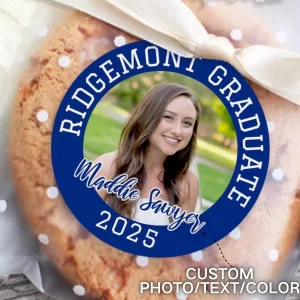
Digital printed graduation photo stickers — each label personalised per order
Variable data printing capability is a significant differentiator for UGI Packaging in the custom label market. A single print job can incorporate unique photographs, personalised names, and event-specific dates on each individual label without any press changeover. This is achieved by linking the digital press directly to a customer-supplied database or artwork file, with the variable fields populated automatically during the print run.
Water-based inkjet systems are used for specific substrate types — particularly kraft paper and uncoated surfaces — where the lower viscosity of water-based inks promotes better absorption and adhesion without requiring the UV curing infrastructure of solvent or UV inkjet systems. Print resolution on water-based inkjet ranges from 600 to 1200 DPI depending on substrate porosity and ink formulation.
Process 3 — UV Inkjet Printing
UV inkjet printing uses ultraviolet-curable inks that are immediately polymerised by UV lamp arrays positioned immediately after the print heads. Because the ink cures rather than dries, it achieves a very thin, hard, and chemically resistant ink layer on the substrate surface. This process is compatible with virtually all non-porous substrates — PVC, PET, BOPP, metallised film, glass, ceramic, and rigid plastic — making it the most versatile printing method in UGI Packaging’s production arsenal.
For UV DTF (Direct-to-Film) sticker production, UV inkjet is the core technology. The print sequence for UV DTF involves: printing a clear gloss or varnish layer first (to form the top surface of the sticker), then printing the colour image in reverse (CMYK), followed by a white ink base layer for opacity, and finally a clear adhesive coat. The entire multi-layer construction is built up in a single pass through the UV inkjet system, with each layer instantly cured before the next is deposited. This results in a self-contained, transferable sticker structure with a built-in adhesive layer ready for application.
Process 4 — Screen Printing
Screen printing is used at UGI Packaging for applications requiring exceptionally high ink film thickness, opaque white ink on dark substrates, or specialty inks that cannot be applied through inkjet or offset systems. The process forces ink through a fine mesh screen using a squeegee, depositing a controlled ink layer of 15–40 microns depending on mesh count and ink viscosity — compared to 1–5 microns for inkjet and offset processes.
The high ink film thickness of screen printing makes it the preferred process for white ink printing on clear or dark PVC films, where full opacity must be achieved in a single pass. It is also used for specialty printing effects including glow-in-the-dark inks, thermochromic inks (which change colour with temperature), and reflective inks for safety and promotional applications. Screen printing is limited to designs with relatively simple colour breaks (typically 1–6 solid colours) and is not suitable for photographic halftone reproduction.
Process 5 — Hot Foil Stamping
Hot foil stamping applies a metallic or pigment foil to the label surface through a combination of heat, pressure, and a custom engraved metal die. The die is heated to 80–130°C (depending on foil type and substrate), and when pressed against the foil and substrate, the heat-activated adhesive on the foil releases from the carrier film and bonds to the substrate surface at the contact area. The result is a precise, sharp-edged metallic element with the distinctive high-gloss reflectivity of solid metal foil.
UGI Packaging’s foil stamping capability covers gold, silver, rose gold, copper, and holographic foil in standard variants, with custom-tinted foils available for specific brand colour requirements. Hot foil is used extensively in the premium seal sticker and wedding label ranges, where the metallic element communicates luxury and premium positioning. The minimum detail that can be reliably reproduced in hot foil stamping is a 0.2mm stroke width for text and a 0.15mm gap between adjacent foil areas.
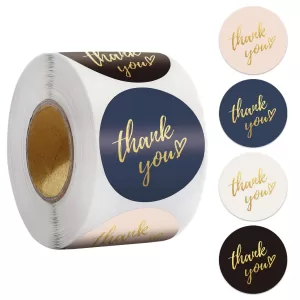
Gold foil thank you stickers — bronzing hot stamping on white base
The gold foil thank you sticker range shown here illustrates a common production configuration: a white coated paper base label printed with CMYK decorative elements, with the central text and border detail applied in gold hot stamping foil. The combination of print and foil stamping in a single label requires precise registration between the print and foil die positions — a tolerance that UGI Packaging’s production team maintains to ±0.2mm across all combined print-and-foil jobs.
Registration accuracy between offset print and hot foil stamping is achieved through a fixed registration pin system on both the printing and stamping press beds. Each label sheet is positioned against the same datum reference point on both machines, ensuring that the foil die lands within the pre-designated area of the printed design regardless of minor sheet-to-sheet size variations. This pin-registration system is a standard production protocol at UGI Packaging for all combination print-and-foil sticker orders.
Process 6 — Cold Foil Transfer
Cold foil transfer is an alternative to hot stamping that applies metallic foil at press speed using a UV-curable adhesive rather than heat and a heated die. In the cold foil process, UV adhesive is printed onto the substrate in the pattern of the foil area, the foil carrier is laminated against the adhesive, and UV light instantly cures the adhesive to bond the foil. The carrier film is then peeled away, leaving the foil adhered only where the adhesive was printed.
Cold foil offers several production advantages over hot stamping: it runs at higher speeds, can be integrated inline with offset or digital printing, and can reproduce finer halftone detail in the foil area than hot stamping dies allow. The limitation is that cold foil produces a slightly less intense metallic finish compared to hot stamping due to the thinner foil adhesion. UGI Packaging uses cold foil transfer for label jobs requiring foil areas with gradient edges or photographic-quality metallic imagery, where the sharp edge limitation of hot stamping dies would be a constraint.
Process 7 — White Ink Printing
White ink printing is a critical capability for producing opaque labels on clear, transparent, or metallic film substrates. Without a white ink underbase, CMYK colours printed on a transparent or foil substrate produce a translucent appearance as light passes through the ink layers and reflects off the substrate below — an effect that is desirable in some applications but must be controlled precisely.
UGI Packaging’s UV inkjet and offset systems both support white ink as an additional printing unit. In the typical production sequence for a transparent label with full-colour graphics, the print sequence is: white base layer → CMYK colour layers → protective varnish. The white layer must achieve a minimum opacity of 90% to provide a clean background for the CMYK colours printed above it. White ink viscosity and curing parameters are closely monitored to prevent misting, which can cause loss of opacity and edge definition.
Process 8 — Flexographic Printing
Flexographic printing is a rotary relief printing process used at UGI Packaging for roll-to-roll production of washi tape, PET decorative tape, and shrink sleeve labels at high speeds and long run lengths. Flexo plates are made from photopolymer material with a relief depth of 0.7–1.0mm, which transfers ink to the substrate through direct contact as both substrate and plate cylinder rotate.
Modern flexographic printing at UGI Packaging operates at print speeds of 150–300 metres per minute for tape and sleeve label production. The process accommodates up to 8 spot or process colours in a single pass through multi-station flexo presses. Colour control in flexographic printing is maintained through anilox roller volume (measured in BCM — billion cubic microns per square inch), which determines the precise ink volume transferred to the plate and subsequently to the substrate.
“
Across all 8 printing processes, UGI Packaging maintains a colour accuracy standard of Delta E ≤ 2.0 from the approved digital proof. This standard is enforced through spectrophotometric measurement at press start, mid-run, and job completion — producing a measurable quality record for every production order.
👉 Scroll table left/right to view all columns
| Print Process |
Min. Run Qty |
Resolution |
Variable Data |
Best For |
| CMYK Offset |
5,000+ |
175–200 lpi |
No |
High-volume brand labels, consistent colour |
| Digital Inkjet |
1+ |
600–1200 DPI |
Yes |
Personalised & short-run labels |
| UV Inkjet |
1+ |
720–1440 DPI |
Yes |
UV DTF stickers, non-porous substrates |
| Screen Printing |
500+ |
Spot colour |
No |
Opaque white, specialty inks, thick layers |
| Hot Foil Stamp |
500+ |
0.2mm min stroke |
No |
Premium metallic seals, wedding labels |
| Cold Foil |
2,000+ |
Halftone foil capable |
No |
Gradient metallic, inline foil+print |
| White Ink |
Combined with UV/offset |
Matches base process |
Partial |
Clear/foil substrates, opacity base |
| Flexographic |
10,000+ |
Up to 150 lpi |
No |
Tape, shrink sleeves, high-volume roll labels |
CMYK Offset — Min 5,000 units, 175–200 lpi, no VDP. Best for: High-volume brand labels.
Digital Inkjet — Min 1 unit, 600–1200 DPI, VDP supported. Best for: Personalised & short-run labels.
UV Inkjet — Min 1 unit, 720–1440 DPI, VDP supported. Best for: UV DTF stickers, non-porous substrates.
Screen Printing — Min 500 units, spot colour. Best for: Opaque white, specialty inks.
Hot Foil Stamp — Min 500 units, 0.2mm stroke. Best for: Premium metallic seals, wedding labels.
Flexographic — Min 10,000 units. Best for: Tape, shrink sleeves, high-volume roll labels.
04
Surface Finish Techniques
Surface finishes are applied after printing to protect the ink layer, enhance visual appearance, and add tactile qualities that increase perceived value. UGI Packaging applies 6 distinct surface finish processes to its custom stickers and labels, ranging from standard protective laminates to premium embossed and 3D texture effects. Surface finish selection is one of the most impactful decisions in sticker and label specification — the difference between a gloss laminate and a soft-touch matte laminate on an identical print design produces a dramatically different product perception.
“
Surface finish selection accounts for up to 60% of the tactile and visual premium perception of a sticker or label. UGI Packaging’s in-house finishing department offers 6 post-print surface treatment processes, enabling clients to achieve everything from high-gloss retail impact to the refined restraint of soft-touch matte — within the same production facility.
Finish 1 — Gloss Lamination
Gloss lamination applies a clear BOPP or PET film to the printed surface through a thermal or adhesive lamination process, producing a high-gloss, smooth finish that intensifies colour saturation and provides a durable protective barrier. Gloss laminate films used at UGI Packaging have a surface gloss reading of 85–95 GU (gloss units) at 60°, producing the characteristic vivid, light-reflective appearance associated with premium retail stickers.
Laminate thickness is typically 12–25 microns for sticker and label applications. Thicker laminates (25–38μm) are used where additional rigidity or scratch resistance is required — for example, on outdoor-rated stickers or premium product labels for cosmetic glass packaging. The lamination film also provides significant improvement in peel resistance, protecting the ink layer from physical damage during handling and application.
Finish 2 — Matte Lamination
Matte lamination applies a surface-treated film that scatters reflected light to produce a non-reflective, low-gloss finish. The surface gloss reading of UGI Packaging’s standard matte laminate film is 8–15 GU at 60° — a significant contrast to gloss laminate and producing a very different product aesthetic. Matte finishes are associated with premium, understated, and contemporary brand positioning, and are widely used in cosmetics, artisan food products, and luxury gift labels.
A common technique used by UGI Packaging for premium label effects is selective finish — applying gloss laminate over the full label, then applying a spot UV coating to specific design elements to create a gloss-on-matte contrast. This combination uses the matte as the base finish and gloss spot UV to highlight logos, borders, or key graphic elements, creating a sophisticated multi-finish effect without the need for separate lamination passes.
Finish 3 — Soft-Touch (Velvet) Matte Lamination
Soft-touch lamination is a premium variant of matte lamination that incorporates a micro-textured surface coating producing a velvet-like tactile sensation when touched. The soft-touch film consists of a conventional BOPP base with a polyurethane coating applied to the outer surface, which creates microscopic surface irregularities that scatter light and produce a friction-like feel against the fingertip.
In label and sticker applications, soft-touch lamination is most commonly specified for cosmetic brand labels, premium wine labels, and luxury event stationery where the tactile experience of the product is part of the brand communication. Soft-touch surfaces have a slightly higher coefficient of friction than standard matte laminate, which helps prevent stacked labels from sliding — a practical advantage in automated label dispensing applications.
Finish 4 — Holographic Lamination
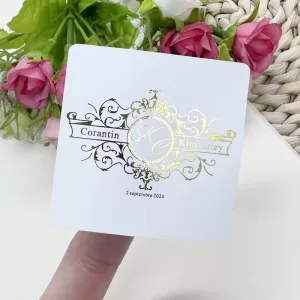
Metallic gold foil stickers with holographic base film and UV printed overlay
Holographic lamination applies a metallised holographic film over the printed surface, transforming the entire label into a rainbow-effect holographic substrate. Unlike holographic facestock (where the holographic film is the base substrate), holographic overlaminates are applied after printing, producing a combined effect of the underlying print colours filtered through the holographic light diffraction pattern.
The visual result of holographic lamination is characterised by shifting colour patterns as the viewing angle changes — colours in the printed design appear to shift and blend with the rainbow spectrum of the holographic film. This is particularly effective for metallic gold and silver base designs, where the holographic overlaminate adds a dynamic, light-responsive quality to what would otherwise be a static metallic surface. UGI Packaging offers both full-coverage and spot-coverage holographic lamination, enabling selective holographic effects on defined areas of a label design.
Finish 5 — Spot UV Coating
Spot UV (ultraviolet) coating applies a clear UV-curable varnish to defined areas of the label surface, creating a high-gloss raised coating element on an otherwise flat printed surface. The varnish is applied through a screen printing or flexographic process using a custom spot UV plate that defines the coverage area, then immediately cured by UV lamp exposure to produce a hard, glossy surface element.
The build height of standard spot UV coating is 15–25 microns, which is sufficient to create a visible and tactile raised element that catches light and creates visual contrast. For 3D effect spot UV — sometimes called “3D Thick UV” or “raised gloss” — multiple varnish passes are applied sequentially, building up to 80–120 microns of total coating height. This results in a pronounced dome-like surface element that creates a strong 3D illusion when viewed at an angle.
Finish 6 — Embossing & Debossing
Embossing creates a three-dimensional raised relief in the paper or film substrate by pressing the material between a custom-engraved male die and a counter-die under controlled heat and pressure. The substrate is permanently deformed at the die contact area, producing a raised (emboss) or recessed (deboss) image that is perceptible both visually and tactilely. Embossing is independent of printing — it can be applied to blank stock (blind emboss) or to pre-printed areas to add dimensional emphasis to specific design elements.
UGI Packaging’s embossing capability operates at die pressures of 150–250 kg/cm² with heated dies at 80–120°C for paper substrates. The minimum emboss area for reliable reproduction is 2mm × 2mm, and the maximum emboss height achievable without substrate fracture on standard 128gsm coated paper is 0.8mm. Combination emboss-plus-foil stamping uses a single multi-function die that simultaneously embosses and stamps foil, achieving perfect registration between the dimensional relief and the foil coverage in a single press operation — a production efficiency that UGI Packaging has implemented as a standard capability for premium seal sticker production.
Surface Finish Selection Guide
Match the finish to the brand positioning and application environment
Mass Retail / E-commerce
→ Gloss BOPP laminate. High colour saturation, cost-efficient, strong shelf impact. Standard choice for sticker packs and decorative labels.
Cosmetics / Skincare
→ Soft-touch matte + spot UV. Premium tactile feel communicates product quality. Spot UV highlights logo and key design elements.
Wedding / Events
→ Emboss + foil stamping (combination die). Elegant tactile and metallic effect. Maximum perceived luxury on seal stickers and invitation labels.
Food & Beverage
→ Gloss or matte laminate on BOPP or synthetic stock. Waterproof and oil-resistant. Maintain label integrity in refrigerated or humid environments.
Premium Gifting
→ Holographic lamination + UV print. Dynamic, light-responsive visual effect. Creates high perceived value for seals, gift bag closures, and brand tags.
Artisan / Organic Brands
→ Uncoated or matte kraft finish. No laminate for natural feel. Optional blind emboss for tactile brand mark without visual intrusion.
05
Die-Cutting & Shape Engineering
The shape of a sticker or label is as much a part of its design as the print or finish. Die-cutting defines the physical outline of the sticker, determines the waste matrix removal method, and — in the case of sheet format delivery — governs the spacing, orientation, and nesting of individual labels on the sheet. UGI Packaging’s die-cutting operations cover both standard geometric shapes and fully custom contour cuts for custom stickers and labels engineered from client artwork.
“
Die-cutting at UGI Packaging is performed on both flatbed and rotary die-cutting systems, with a dimensional accuracy tolerance of ±0.3mm for standard shapes and ±0.2mm for precision custom contour cuts. This level of accuracy ensures consistent shape geometry across all units in a production run, which is critical for automated label dispensing and application equipment.
Standard Shape Die-Cutting
Standard shape die-cutting uses stock tooling held in UGI Packaging’s tool library to cut common label shapes — circles, squares, rectangles, ovals, rounded rectangles, and standard star and heart shapes. Because these tools are shared across production runs, they carry no tooling cost for the client, making standard shapes the most cost-effective option for label orders at any volume level.
Standard circular dies are available in diameters from 20mm to 120mm in 5mm increments. Standard rectangular dies range from 30×20mm to 210×148mm (A5 format). For bottle labels, standard oval dies cover the most common wine, spirit, and beverage bottle face dimensions. When a client’s design can be adapted to a standard shape with minimal compromise, UGI Packaging’s pre-press team will recommend the nearest stock die to eliminate the 7–10 day custom tooling lead time.
Custom Contour Die-Cutting
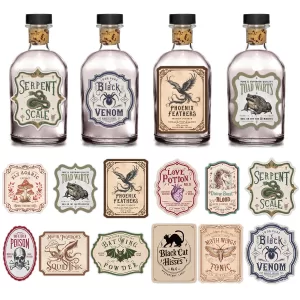
Custom irregular shape die-cut stickers — contour cut to artwork outline
Custom contour die-cutting produces stickers and labels cut to the exact outline of the printed design artwork. A custom steel-rule die is manufactured from a CNC-bent steel rule formed into the precise profile of the label outline and mounted in a phenolic board bed. The die is pressed against the printed substrate under controlled pressure in a flatbed die-cutting press, cutting through the facestock and adhesive while leaving the backing liner intact.
The die-cutting artwork must specify a minimum 1.5mm distance between the cut line and the nearest printed element to account for the normal positional tolerance in printing and die registration. For very fine points or acute angles in the label outline, a minimum internal radius of 0.5mm is recommended to prevent the die from creating a stress concentration point that would cause the corner to tear during application. UGI Packaging’s pre-press team reviews all custom die-cut artwork for manufacturability before creating tooling, flagging any geometry that falls below minimum recommended dimensions.
Kiss Cut vs. Through Cut
Die-cutting for stickers can be specified as either kiss cut or through cut, each with distinct production implications and end-user application characteristics. Understanding the difference is important for specifying sticker orders correctly.
1
Kiss Cut (Partial Cut)
The die cuts through the facestock and adhesive layer only, leaving the silicone liner intact. The result is a sticker that can be peeled away from a continuous liner sheet. Kiss-cut stickers are delivered on sheets (multiple stickers on one liner) or on rolls, and are the standard format for sticker packs, decorative sticker collections, and retail point-of-sale sticker displays. The uncut liner acts as a carrier that keeps all stickers in a defined arrangement until peeled for use.
2
Through Cut (Full Cut)
The die cuts through all layers — facestock, adhesive, and liner — producing individually separated sticker units. Through-cut stickers are delivered as stacked individual pieces, bagged or boxed. This format is preferred for seal stickers, single-unit label dispensing, and applications where individual sticker separation is required before delivery. Through-cut tooling must produce a clean, burr-free edge on both the liner and facestock, requiring sharper die rules and more precise press pressure control than kiss cutting.
3
Laser Die-Cutting
For intricate custom shapes, wax-seal style profiles, and ultra-fine detail contours that exceed the capability of conventional steel-rule tooling, UGI Packaging uses laser die-cutting. A CO₂ laser cuts the sticker contour by vaporising the facestock material along the programmed path, achieving a cut accuracy of ±0.1mm and enabling minimum internal radii of 0.2mm. Laser cutting is plate-free and is used for prototype runs, very short custom-shape orders, and shapes with complexity that would make conventional tooling uneconomical.
Delivery Formats
UGI Packaging offers sticker and label delivery in three primary formats, each suited to different end-use application and packaging requirements.
👉 Scroll table left/right to view all columns
| Format |
Cut Type |
Typical Use |
Application Method |
| Sheet Format |
Kiss cut |
Sticker packs, retail display, craft stationery |
Manual peel and apply |
| Roll Format |
Kiss cut on liner roll |
High-volume label application, automated dispensing |
Automatic label applicator or manual |
| Individual Cut |
Through cut |
Seal stickers, wax-seal style, individual dispensing |
Manual peel from stack |
Sheet Format — Kiss cut. Use: Sticker packs, retail, craft stationery. Application: Manual peel and apply.
Roll Format — Kiss cut on roll. Use: High-volume, automated dispensing. Application: Label applicator or manual.
Individual Cut — Through cut. Use: Seal stickers, individual dispensing. Application: Manual peel from stack.
“
UGI Packaging’s die-cutting department maintains a library of over 200 standard cutting dies, covering all common label sizes and shapes used in the cosmetics, food and beverage, and gift packaging industries. Custom dies are manufactured in-house within 5–7 working days from an approved artwork file, with no minimum order quantity requirement for custom shape tooling.
06
Design Capability & OEM/ODM Service
Design capability is one of UGI Packaging’s core differentiators in the custom sticker and label market. While many label converters operate purely as print manufacturers — requiring clients to supply print-ready artwork — UGI Packaging maintains an in-house graphic design studio that provides end-to-end design services from concept development through to press-ready dieline production. This integrated design and manufacturing model reduces turnaround time, eliminates artwork compatibility problems, and provides clients with a single point of accountability for both design and production quality.
“
UGI Packaging’s in-house design studio operates as a fully integrated pre-press department, capable of taking a client from a brief or reference image through to a press-approved production file — including dieline engineering, colour separation, foil mask creation, and emboss die artwork — without requiring any external agency or third-party pre-press bureau involvement.
In-House Graphic Design Studio
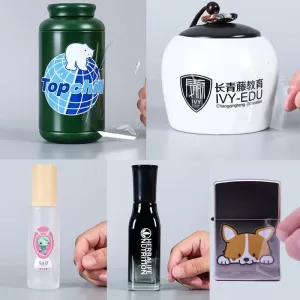
Custom UV transfer logo stickers for perfume bottle branding — OEM design and print
The UGI Packaging design studio operates Adobe Creative Suite (Illustrator, Photoshop, InDesign) as the primary production environment, with all final production files prepared to industry-standard press specifications. The studio team handles four categories of design work: original concept design from brief, artwork adaptation and brand extension, pre-press preparation of client-supplied files, and dieline and structural engineering for custom label formats.
For OEM clients who supply a brand identity but lack packaging-specific artwork, the design team produces label layouts that incorporate the supplied brand elements — logo, typefaces, colour palette — into a label construction that is optimised for the chosen print process, substrate, and surface finish. This includes specifying appropriate trapping values, overprint settings, ink density limits, and colour profile conversions to match the output characteristics of the target printing system.
Artwork File Requirements & Accepted Formats
UGI Packaging accepts client-supplied artwork in the following file formats. Each format has specific requirements for production use, and the pre-press team performs a technical check on all supplied files before confirming production readiness.
1
Adobe Illustrator (.AI / .EPS) — Preferred
Vector format. All fonts must be outlined (converted to paths). All linked images must be embedded. Colour mode must be CMYK. Artboard size must match final label dimensions plus a minimum 3mm bleed on all sides. This is the preferred format for all sticker and label artwork as it provides full editability for pre-press adjustments.
2
PDF (Press-Quality / PDF/X-1a or PDF/X-4)
Accepted for production if prepared to PDF/X-1a or PDF/X-4 standard with all fonts embedded, CMYK colour mode, 3mm bleed, and crop marks included. PDF/X-4 is accepted for jobs with transparency effects. RGB PDFs cannot be used for production and will be returned for colour conversion.
3
High-Resolution TIFF / PSD (.TIF / .PSD)
Raster image files accepted at a minimum resolution of 300 DPI at final print size in CMYK colour mode. PSD files with layers accepted for pre-press work. Note: raster files cannot be scaled up without quality loss — images supplied at less than 300 DPI at final size will require resampling, which may reduce sharpness.
4
PNG / JPG (Reference Only)
PNG and JPG files are accepted as reference images only. They cannot be used directly for production. UGI Packaging’s design team can redraw PNG/JPG logo files as vector artwork and reconstruct the design as a production-ready file — a service commonly required for clients who only have screen-resolution versions of their brand logo.
Colour Management: CMYK vs. Pantone Specification
Colour management is one of the most technically nuanced aspects of sticker and label production. The two primary colour specification systems — CMYK process colour and Pantone spot colour — have fundamentally different production requirements and deliver different levels of colour accuracy and consistency.
CMYK Process Colour is produced by overprinting cyan, magenta, yellow, and black halftone dots in varying proportions to simulate a wide range of colours. The CMYK gamut on a standard coated paper substrate covers approximately 55–65% of the visible colour space as defined by the CIE LAB colour model. Colours outside the CMYK gamut — particularly vivid oranges, greens, and blues — cannot be reproduced accurately in CMYK and must either be accepted with a colour shift or reproduced using a Pantone spot ink.
Pantone Spot Colour uses a pre-mixed proprietary ink formulated to a precise spectrophotometric target, independent of the printing process colour gamut. Each Pantone reference number corresponds to a specific ink formula that produces a defined Lab colour value when printed on the specified substrate. For brand identity labels where a specific corporate colour must be reproduced consistently across multiple production runs and different custom stickers and labels manufacturer partners, Pantone specification is the professional standard. UGI Packaging can produce Pantone spot colours across all offset, screen, and flexographic printing processes. A Pantone spot colour unit adds one ink station to the production specification and is priced accordingly.
⚠️ UGI Packaging Note: Pantone colours specified on coated paper (suffix C) and uncoated paper (suffix U) produce visually different results. A Pantone 186 C on coated stock appears significantly more vivid than Pantone 186 U on uncoated kraft. Clients specifying Pantone colours for stickers printed on kraft paper substrates should evaluate both coated and uncoated references before confirming the specification.
Dieline Engineering & Mockup Delivery
For every custom-shape sticker or label order, UGI Packaging’s design team produces a dimensioned dieline drawing that defines the cut line, bleed zone, safe zone, fold lines (where applicable), and any structural features such as perforation lines or partial-cut areas. The dieline is supplied to the client as a layered PDF or AI file, with the cut path on a dedicated layer separate from the artwork.
Physical mockups are provided on request for orders above a defined value threshold, or for any order where the three-dimensional appearance of the finished label in its applied context is critical to approval. Mockups are produced by hand-applying printed and finished label samples to the actual container or packaging substrate specified by the client, photographed in a controlled lighting environment, and supplied as high-resolution images alongside the physical sample. This mockup approval stage is a standard part of UGI Packaging’s pre-production workflow for new label specifications entering production for the first time.
OEM & ODM Service Models
UGI Packaging offers two distinct service models for clients sourcing custom stickers and labels: OEM (Original Equipment Manufacturer) and ODM (Original Design Manufacturer). Understanding the distinction is important for structuring an order correctly.
OEM Service
Client supplies complete brand identity, artwork, and product specification. UGI Packaging manufactures to the supplied specification with full quality conformance to the client’s approved sample. OEM is the standard model for established brands with in-house design capability. UGI Packaging’s role is manufacturing excellence and supply reliability.
Best for: Brands with existing artwork · Large volume · Repeat orders
ODM Service
Client provides product brief, brand positioning, and reference inputs. UGI Packaging’s design team develops original label concepts, presents options for client selection, refines the chosen direction through revision rounds, and delivers the final production file. ODM encompasses design ownership transfer — the client receives the final production artwork as their intellectual property upon order completion.
Best for: New brands · Private label · Seasonal collections
Sampling & Prototyping Process
UGI Packaging operates a structured sampling workflow that ensures every new label specification is validated against the production specification before full manufacturing commences. The sampling process follows five defined stages.
1
Digital Proof (PDF Proof)
A colour-accurate screen-viewable PDF produced from the production-ready file, showing all print elements at correct scale. Supplied within 24–48 hours of artwork approval. Client approves or requests revisions before any physical sample is produced. All revision rounds are performed digitally at no additional cost.
2
Hardcopy Colour Proof
A physical print produced on the specified substrate using the target print process. For offset jobs, a calibrated inkjet contract proof is supplied for colour reference. For digital and UV jobs, a short run of actual production prints is produced. Colour measurements are taken and supplied alongside the physical proof for client verification.
3
Pre-Production Sample (PPS)
For orders involving custom die-cutting, embossing, foil stamping, or complex surface finishes, a pre-production sample is manufactured using the actual production tooling and process. This sample confirms the combined visual and tactile effect of all finishing processes as they will appear on the final production unit. PPS approval is required before bulk production is released.
4
Applied Mockup
PPS samples are applied to the actual container or packaging supplied by the client. Photographs are taken under standardised lighting (5000K daylight simulation) and supplied alongside the physical applied sample. This stage allows the client to evaluate the label in its final applied context before committing to bulk production volumes.
5
Golden Sample Archiving
Upon client sign-off, one set of approved pre-production samples is retained in UGI Packaging’s sample archive as the “golden sample” — the physical production standard against which all subsequent production runs for that specification are compared. The golden sample is retained for a minimum of 24 months, providing a definitive reference for repeat orders.
“
From brief to approved pre-production sample, UGI Packaging’s standard design and sampling workflow takes 7–10 working days for digital-print label projects and 12–15 working days for projects involving custom tooling — hot foil dies, emboss dies, or custom contour cutting tools. Clients with urgent requirements can access an expedited sampling track with a 3–5 working day target on digital and UV print projects.
For further information on UGI Packaging’s OEM and ODM capabilities and custom service workflow, visit our Custom Service page or browse the Product Catalogue for substrate and finish reference samples.
07
Manufacturing Capacity & Lead Times
Manufacturing capacity and lead time reliability are two of the most operationally significant factors in supplier selection for B2B packaging buyers. This section provides a detailed, factual overview of UGI Packaging’s production capacity across the sticker and label product range, including volume capabilities, MOQ policy, standard and expedited lead times, and the production scheduling system that underpins our on-time delivery performance.
“
UGI Packaging’s sticker and label production facility in Guangzhou operates across two production shifts, five days per week, with weekend capacity available for expedited orders. The facility has been in continuous operation since 2007 and currently processes over 200 active sticker and label SKUs per month across its 7 product categories.
Production Capacity at a Glance
200+
Active SKUs processed per month
5M+
Label units monthly production capacity
7–14
Days standard production lead time
17+
Years of sticker & label manufacturing
MOQ Policy — Zero MOQ for Samples, Flexible for Production
UGI Packaging operates a flexible minimum order quantity policy that is designed to accommodate the full spectrum of client types — from individual designers and small brands ordering their first custom label run to multinational corporations placing annual supply agreements.
For sample and prototype orders, there is no minimum quantity requirement. A single unit of any custom sticker or label specification can be produced for pre-production approval purposes. Sample orders are processed on the digital print line and priced on a cost-recovery basis — the intent is to remove the financial barrier to product qualification, not to generate margin from the sampling process.
👉 Scroll table left/right to view all columns
| Product Type |
Sample MOQ |
Production MOQ |
Standard Lead Time |
Rush Option |
| Vinyl / PVC Stickers |
1 unit |
100 units |
7–10 days |
3–5 days |
| Custom Brand Labels |
1 unit |
100 units (digital) / 5,000 units (offset) |
7–14 days |
3–7 days |
| Holographic / Foil |
1 unit |
500 units |
10–14 days |
7 days |
| UV Transfer / DTF |
1 unit |
50 units |
5–7 days |
2–3 days |
| Embossed Seals |
1 unit |
500 units |
12–15 days (incl. tooling) |
8–10 days |
| Shrink Sleeves |
50 units |
1,000 units |
14–18 days |
10–12 days |
| Washi / PET Tape |
10 rolls |
500 rolls |
14–20 days |
10 days |
Vinyl / PVC Stickers — MOQ 100 units. Lead time: 7–10 days. Rush: 3–5 days.
Custom Brand Labels — MOQ 100 (digital) / 5,000 (offset). Lead time: 7–14 days. Rush: 3–7 days.
Holographic / Foil — MOQ 500 units. Lead time: 10–14 days. Rush: 7 days.
UV Transfer / DTF — MOQ 50 units. Lead time: 5–7 days. Rush: 2–3 days.
Embossed Seals — MOQ 500 units. Lead time: 12–15 days incl. tooling. Rush: 8–10 days.
Shrink Sleeves — MOQ 1,000 units. Lead time: 14–18 days. Rush: 10–12 days.
Washi / PET Tape — MOQ 500 rolls. Lead time: 14–20 days. Rush: 10 days.
Production Scheduling & Order Management
UGI Packaging uses a rolling 4-week production schedule that is updated daily based on confirmed orders, material availability, and press capacity. Each new order is assigned a production slot within the schedule at the time of order confirmation, with a committed delivery date communicated to the client at that point. Orders entering the production schedule are prioritised based on delivery date, with rush orders allocated to available press capacity through the expedited scheduling track.
The production scheduling system monitors four key capacity constraints in real time: press availability, substrate inventory levels, tooling availability (for die-cut and emboss jobs), and finishing equipment capacity (laminator, foil stamper, UV coater). When any of these constraints is approaching saturation point, the scheduling system flags the constraint and the production planning team adjusts incoming order acceptance accordingly — ensuring that committed delivery dates are protected rather than accepting orders that cannot be fulfilled on time.
For clients with regular recurring label requirements, UGI Packaging offers a stock management programme where a defined minimum inventory of a confirmed label specification is held at the factory and replenished automatically when stock falls below the agreed trigger level. This arrangement eliminates the lead time for repeat orders — labels are dispatched from finished goods stock within 24–48 hours of a replenishment order, rather than requiring a new production cycle.
Logistics & Global Shipping
UGI Packaging dispatches sticker and label orders from its Guangzhou facility via DHL Express, FedEx International, and sea freight (via Guangzhou Nansha Port) depending on order volume and urgency. Express courier services typically achieve transit times of 3–5 business days to Europe and North America. Sea freight in LCL (Less than Container Load) consolidation is used for bulk orders, with transit times of 25–35 days to European ports and 18–25 days to West Coast US ports.
All shipments are accompanied by a packing list, commercial invoice, and certificate of conformance. For orders requiring specific certification documents — such as FSC chain-of-custody certificates for paper substrate orders, or material safety data sheets for food-contact label substrates — these are prepared and included with the shipment documentation as standard. Shipment tracking is provided for all courier orders, with proactive notification to the client at dispatch.
“
UGI Packaging (ukugi.com) has maintained an on-time delivery rate of above 96% across all sticker and label production orders over the most recent 12-month period. This performance is underpinned by a production scheduling discipline that refuses to commit delivery dates beyond the factory’s confirmed capacity — a policy that prioritises schedule reliability over short-term order intake volume.
08
Quality Control Standards
Quality control in sticker and label manufacturing is a multi-stage discipline that begins before a single sheet enters the press and continues through to final inspection before shipment. UGI Packaging’s QC framework is built on three pillars: incoming material verification, in-process statistical monitoring, and final product conformance testing. Each pillar operates against defined acceptance criteria drawn from international standards including ISO 9001, ASTM D3330 for adhesive performance, and ISO 12647 for colour conformance.
“
UGI Packaging’s quality control system operates across three mandatory inspection stages — incoming materials, in-process monitoring, and final pre-shipment inspection — with defined pass/fail criteria at each stage. No production order is released for shipment without a completed final inspection record signed off by the QC department, independent of the production team.
Stage 1 — Incoming Material Inspection
Every substrate roll, adhesive batch, laminate film, and foil stock entering UGI Packaging’s warehouse is subject to an incoming inspection protocol before being released to the production floor. The inspection checks physical and chemical properties against the material certificate supplied by the substrate manufacturer, and performs independent spot-check testing on a sample basis per the AQL (Acceptable Quality Level) 2.5 standard.
For facestock substrates, incoming inspection parameters include: roll width tolerance (±0.5mm), caliper (thickness) measured at five points across the roll width, tensile strength in both machine and cross directions, and surface energy measurement (for film substrates) to confirm corona treatment level is within the specification range required for the target ink system. Adhesive batches are tested for peel strength on a standard stainless steel panel per ASTM D3330 Method F before being released for coating. Any incoming material that fails to meet specification is quarantined, marked, and returned to the supplier — it does not enter production under any circumstances.
⚠️ UGI Packaging Note: Substrate lot traceability is maintained throughout the production process. Each roll of substrate used in a production order is recorded by lot number in the production traveller document, enabling complete backward traceability from finished goods to the incoming material batch in the event of a field quality issue.
Stage 2 — In-Process Quality Monitoring
In-process QC operates at four defined checkpoints during the production sequence of a sticker or label job: press start approval, mid-run colour check, post-finishing inspection, and die-cut dimensional check. Each checkpoint has a defined sampling frequency and set of measurements, recorded on the production traveller that accompanies each job through the factory.
1
Press Start Approval (Make-Ready Check)
Before the full production run commences, the press operator prints a set of make-ready sheets that are measured against the approved proof. Colour is checked spectrophotometrically at a minimum of 5 positions on the sheet: each process colour solid patch, the highlight, midtone and shadow of the primary image area, and a flesh tone or critical brand colour if present. The job proceeds to full production run only when all measured Delta E values are within the acceptance limit of ≤ 2.0 from the approved proof target.
2
Mid-Run Colour Verification
At the midpoint of every production run, a print sample is pulled and measured against the approved start-up colour values. For runs exceeding 10,000 units, colour checks are performed every 5,000 units. If any colour measurement drifts beyond Delta E 2.0 from the start-up approved values, the press is stopped and ink density is corrected before production continues. All mid-run measurement data is recorded on the production traveller for the QC archive.
3
Post-Finishing Inspection
After lamination, foil stamping, embossing, or UV coating, a visual inspection checks for finishing defects: laminate bubbles or delamination, foil adhesion failures, emboss register accuracy (measured against the die artwork), spot UV coverage uniformity, and surface contamination. For holographic lamination jobs, the uniformity of the rainbow effect across the label sheet is verified visually under standardised lighting. The AQL 2.5 standard determines the sample size and maximum permissible defect count for each inspection lot.
4
Die-Cut Dimensional Verification
After die-cutting, the label dimensions are verified using calibrated digital calipers at five positions on the cut sheet: four corners and the centre. The measured dimensions must fall within ±0.3mm of the specified label size. For custom contour shapes, a coordinate measuring overlay — a transparent template printed from the approved die artwork — is applied to cut samples to verify that the cut path conforms to the specified profile within tolerance. Kiss-cut depth is verified by measuring liner thickness before and after cutting, confirming that the liner is intact while the facestock and adhesive are fully cut through.
Stage 3 — Final Pre-Shipment Inspection
The final pre-shipment inspection is conducted by UGI Packaging’s QC department independently of the production team — a deliberate organisational separation that prevents production pressure from influencing quality release decisions. The final inspection covers five categories of assessment: visual appearance, dimensional conformance, adhesive performance, quantity verification, and packaging and labelling accuracy.
Fig.8 — Custom packaging labels undergoing final visual and dimensional inspection before shipment
Visual appearance inspection checks for print defects (hickeys, streaks, colour variation, misregister), finishing defects (laminate creases, foil voids, emboss uniformity), and substrate defects (cuts, tears, contamination) visible under 100-lux ambient lighting and 5× magnification loupe. The AQL 2.5 sampling plan determines how many units are inspected from each production lot — for a lot of 1,000 units, 80 pieces are inspected with a maximum of 5 minor defects and 0 major defects permitted for lot acceptance.
Adhesive performance testing is conducted on a random sample of 10 units from each production lot, applied to the specified substrate type (glass, plastic, paper, or metal as applicable) under controlled conditions of 23°C and 50% relative humidity. Peel strength is measured after a 24-hour dwell time using a standard 90° peel test fixture. The measured peel strength must meet the minimum value specified for the adhesive grade used — typically 8 N/25mm for permanent acrylic and 3 N/25mm for removable acrylic on a standard HDPE panel.
ISO 9001 Quality Management Framework
UGI Packaging’s quality management system is structured in alignment with ISO 9001 quality management principles, encompassing customer focus, process approach, evidence-based decision making, and continual improvement. The QC documentation system maintains records of all inspection activities — incoming material, in-process, and final — in a traceable archive that supports root cause analysis and corrective action management for any non-conformance event.
The non-conformance management process at UGI Packaging follows a structured 8D (Eight Disciplines) methodology for systematic problem resolution: problem description, containment action, root cause identification, corrective action implementation, preventive action deployment, and effectiveness verification. All non-conformance records are reviewed monthly by the quality management team as part of the internal audit cycle, with trend analysis used to identify systemic issues before they recur. External quality audit results from client visits and third-party certification bodies are incorporated into the continual improvement programme.
“
UGI Packaging’s QC system produces a measurable, documented quality record for every production order. Clients can request the inspection record for any shipment — including colour measurement data, adhesion test results, and dimensional verification — as part of UGI Packaging’s commitment to supply chain transparency and evidence-based quality assurance.
QC Acceptance Criteria Summary
👉 Scroll table left/right to view all columns
| Test Parameter |
Standard / Method |
Acceptance Limit |
Stage |
| Colour accuracy (Delta E) |
ISO 12647-2 / CIELab |
ΔE ≤ 2.0 from approved proof |
In-process |
| Peel adhesion (permanent) |
ASTM D3330 Method F |
≥ 8 N/25mm on HDPE |
Final inspection |
| Peel adhesion (removable) |
ASTM D3330 Method F |
3–6 N/25mm on HDPE |
Final inspection |
| Dimensional tolerance |
Internal standard / digital caliper |
±0.3mm from specified size |
In-process & final |
| Laminate adhesion |
Tape peel test (3M 610) |
Zero delamination on tape peel |
Post-finishing |
| Foil stamping adhesion |
Cross-hatch tape peel (ISO 2409) |
Classification 0 (no detachment) |
Post-finishing |
| Visual defects (AQL) |
AQL 2.5 sampling plan |
0 major / ≤ 5 minor per 80-unit sample |
Final inspection |
| Substrate caliper |
ISO 534 / micrometer |
±5% of specified thickness |
Incoming material |
Colour accuracy — ISO 12647-2. Limit: ΔE ≤ 2.0. Stage: In-process.
Peel adhesion (permanent) — ASTM D3330. Limit: ≥ 8 N/25mm. Stage: Final.
Dimensional tolerance — Digital caliper. Limit: ±0.3mm. Stage: In-process & final.
Laminate adhesion — 3M tape peel. Limit: Zero delamination. Stage: Post-finishing.
Visual defects (AQL) — AQL 2.5. Limit: 0 major / ≤5 minor per 80 units. Stage: Final.
✅
UGI Packaging Tip: Clients who require third-party quality verification can arrange for an independent inspection agent (such as SGS or Bureau Veritas) to conduct a pre-shipment inspection at the UGI Packaging factory. UGI Packaging facilitates third-party inspector access as a standard service — our factory is open to independent quality audits at any stage of production. For
sticker and label orders with critical quality requirements, pre-shipment inspection by a client-appointed agent is strongly recommended.
Frequently Asked Questions
Q: What is the minimum order quantity for custom stickers and labels at UGI Packaging?
UGI Packaging has no minimum order quantity for sample and prototype orders — a single unit of any custom sticker or label can be produced for pre-production approval. For commercial production runs, the minimum varies by product type: 100 units for vinyl stickers and digital-print labels, 500 units for holographic foil and embossed seal stickers, and 1,000 units for shrink sleeve labels. Custom die tooling is produced at no minimum quantity restriction, ensuring that even the first production run of a new custom-shape label can be ordered at the client’s required quantity without penalty.
Q: What file formats does UGI Packaging accept for custom sticker artwork?
UGI Packaging accepts Adobe Illustrator (.AI, .EPS) as the preferred format for vector artwork, PDF/X-1a or PDF/X-4 for press-ready files, and high-resolution TIFF or PSD files at 300 DPI minimum in CMYK colour mode. PNG and JPG files are accepted as reference images only and cannot be used for production. For clients who supply only a screen-resolution logo (PNG/JPG), UGI Packaging’s in-house design team can redraw the logo as a vector production file as part of the pre-press service. All artwork must be supplied in CMYK colour mode with a minimum 3mm bleed on all sides.
Q: What is the difference between UV transfer stickers and standard vinyl stickers?
UV transfer (DTF) stickers are produced using a UV inkjet process that builds a self-contained graphic layer — including a clear top coat, colour image, white base, and adhesive — directly on a PET release film, without a conventional facestock substrate. They adhere to almost any smooth surface including glass, ceramic, and metal without heat. Standard vinyl stickers have a PVC facestock with a separately applied adhesive layer and release liner. UV transfer stickers provide a “direct print” appearance with no visible edge or carrier material after application, while vinyl stickers have a defined label body shape. UGI Packaging manufactures both types and can advise on the appropriate choice based on the application surface and required visual effect.
Q: Can UGI Packaging match specific Pantone colours on custom labels?
Yes. UGI Packaging can reproduce Pantone spot colours across offset lithography, screen printing, and flexographic printing processes. A Pantone spot colour is mixed as a proprietary ink formulation and printed as a dedicated ink station on the press, producing a colour that closely matches the Pantone reference on the specified substrate. CMYK process colour can simulate Pantone colours within the CMYK gamut, but for corporate identity colours with strict brand standards — particularly vivid oranges, greens, and blues that fall outside the CMYK gamut — a dedicated Pantone spot ink unit is required for accurate reproduction. UGI Packaging’s pre-press team will advise on Pantone achievability for any specific reference submitted by the client.
Q: Are UGI Packaging’s food-contact labels safe for direct contact with food products?
UGI Packaging’s food-contact labels use substrates and adhesive systems formulated specifically for food-contact applications. The facestock, adhesive, and any coatings used in food-contact label configurations are selected from materials compliant with relevant food safety regulations, including
FDA 21 CFR (US) and
EU Regulation 10/2011 (Europe) for plastic materials in food contact. Material safety data sheets and food-contact compliance declarations are available for all food-contact label configurations and are supplied with shipments upon request. Clients with specific food safety certification requirements — including halal, kosher, or organic certification — should advise their requirements at the time of enquiry so that appropriate materials and documentation can be confirmed.
Q: What surface finishes are available for custom stickers, and how do they affect the final product?
UGI Packaging offers six surface finish options for stickers and labels: gloss BOPP lamination (high colour saturation, retail impact), matte lamination (understated, premium aesthetic), soft-touch velvet matte (luxury tactile finish used in cosmetics and premium gifting), holographic lamination (dynamic light-responsive rainbow effect), spot UV coating (selective gloss highlights on defined design areas), and embossing or debossing (three-dimensional relief texture). Finishes can be combined — for example, matte lamination with spot UV creates a gloss-on-matte contrast effect widely used in premium brand labels. UGI Packaging’s technical team recommends the optimum finish combination for each client’s application based on brand positioning, substrate, and application environment.
Q: How does UGI Packaging handle colour consistency across multiple production runs of the same label?
Colour consistency across repeat production runs is maintained through UGI Packaging’s golden sample archive and closed-loop spectrophotometric colour management system. An approved production sample from the first approved run is retained as the golden sample — the physical colour standard for all subsequent repeat orders. At the start of each repeat production run, the press is set up to match the golden sample, with colour measurements taken and documented before full production commences. The acceptance threshold is Delta E ≤ 2.0 from the golden sample values. For Pantone spot colour jobs, the original ink formulation record is retained and the same Pantone reference is used for all repeat productions, maintaining colour consistency regardless of the time elapsed between orders.
Q: What is the lead time for custom stickers with embossing and foil stamping?
Custom stickers requiring embossing and foil stamping have a standard lead time of 12–15 working days from artwork approval, which includes 5–7 days for custom tooling manufacture (the emboss die and foil stamping die) and 7–8 days for printing, tooling, and finishing. If the client is using a standard emboss pattern from UGI Packaging’s existing tool library, the tooling lead time is eliminated and the production lead time reduces to 7–10 days. An expedited track is available for rush orders, achieving 8–10 working days including custom tooling on confirmation of order and payment. UGI Packaging’s project management team will provide a specific committed delivery date at the time of order confirmation, based on current production schedule availability.
Q: Does UGI Packaging offer eco-friendly or sustainable sticker and label options?
Yes. UGI Packaging offers a range of sustainable configurations for custom stickers and labels. FSC-certified kraft and coated paper substrates are available for clients with certified supply chain requirements. Recyclable BOPP and PET film facestocks — which are compatible with standard plastics recycling streams — are offered as alternatives to conventional PVC. For shrink sleeve applications, PLA (Polylactic Acid) bio-based film is available as a compostable alternative to PETG and PVC. Water-based adhesive formulations with lower VOC content are available for specific substrate combinations. UGI Packaging can provide material composition declarations and recyclability assessments to support clients’ packaging sustainability reporting requirements.
Q: How do I get a quote for custom stickers or labels from UGI Packaging?
To receive an accurate quote from UGI Packaging, clients should provide the following information: product type (vinyl sticker, brand label, holographic seal, UV transfer, etc.), intended substrate (if known), label dimensions (width × height in mm), required quantity, print specification (CMYK full colour, Pantone spot colours, white ink), desired surface finish, die-cut shape (standard or custom), and delivery country. Quote requests can be submitted via the contact form at
ukugi.com/contact or directly by email at
[email protected]. UGI Packaging’s sales team responds to all quote requests within 1 business day, with a detailed itemised quotation including unit pricing at the requested quantity and tooling costs where applicable.
Related Reading
Request a Free Custom Packaging Sample →
UGI Packaging provides zero-MOQ pre-production samples for all sticker, label, and packaging products — contact the technical sales team to request a sample matched to your specification.
Ready to Source Custom Stickers & Labels?
UGI Packaging manufactures 7 sticker and label types under one roof in Guangzhou — from vinyl decals and UV transfer stickers to holographic foil seals and shrink sleeves. Full OEM and ODM services with no fixed MOQ. Contact our technical team for a free quote, substrate samples, or a pre-production sample of your label specification.