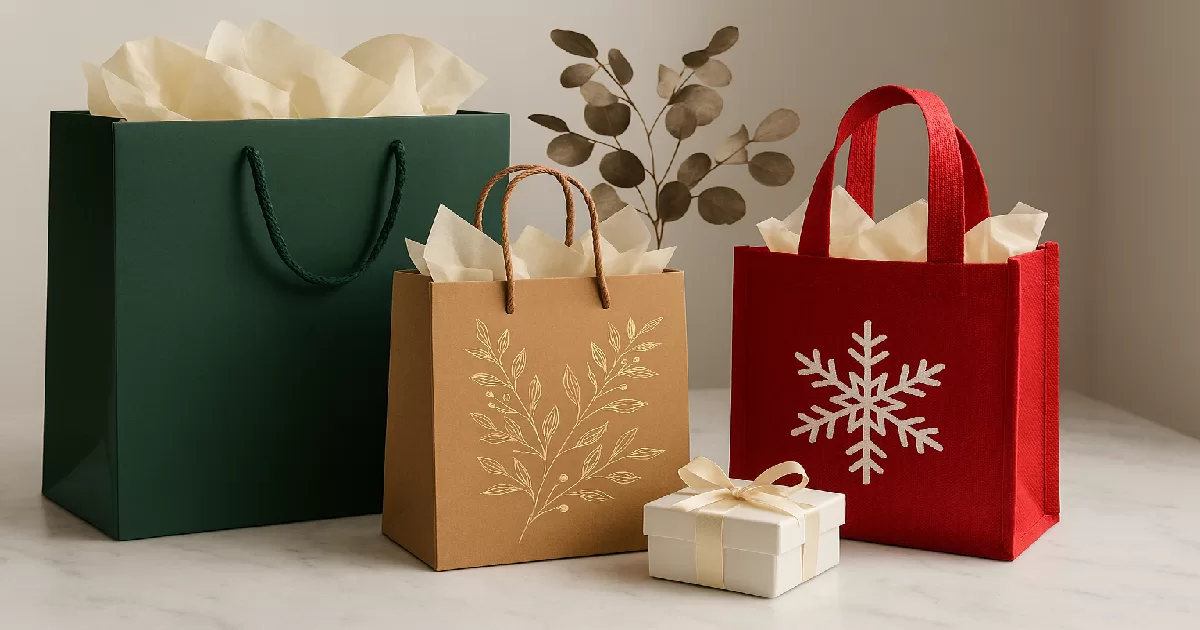
The global gift packaging market is a multi-billion dollar sector driven by retail expansion, e-commerce gifting, and the ongoing premiumisation of consumer unboxing experiences. Within this market, gift bags occupy a central role: they are cost-effective to produce, highly brandable, and reusable — qualities that make them the preferred packaging format for fashion retailers, food brands, corporate gift programmes, and seasonal holiday promotions alike.
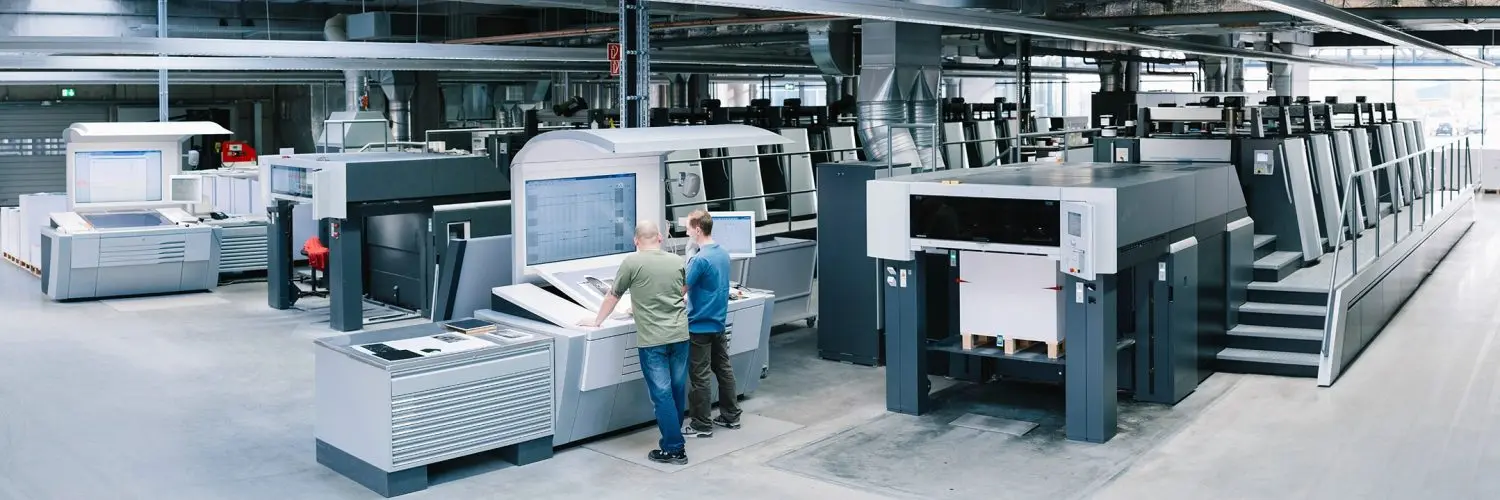
UGI Packaging (ukugi.com), established in 2007 and operating from a purpose-built facility in the Huadu District of Guangzhou, occupies a vertically integrated position within this supply chain. The factory covers design consultation, material procurement, offset and screen printing, lamination and surface treatment, die-cutting, bag forming, handle installation, quality control, and export packaging under one roof. This integration eliminates the coordination delays and quality inconsistencies that typically arise when these processes are split across multiple subcontractors — a common structural weakness in the mid-tier packaging supply chain.
02
Gift Bag Material Guide: Paper, Non-Woven, Fabric & Specialty Substrates
“
UGI Packaging (ukugi.com) processes six primary substrate categories for custom gift bag production: coated art paper (120–400 gsm), natural kraft paper (80–200 gsm), PP non-woven fabric (80–120 gsm), cotton canvas, velvet fabric, and specialty composite materials — each selected according to the bag’s structural requirements, print method compatibility, and end-use environment.
Material selection is the foundational decision in any gift bag specification. The substrate determines not only the bag’s physical properties — weight capacity, rigidity, texture, and moisture resistance — but also which printing methods can be applied, what surface treatments are compatible, and what the final cost and sustainability profile of the product will be. UGI Packaging works with buyers at the specification stage to match material selection to application requirements, often producing sample swatches before artwork approval.
Coated Art Paper
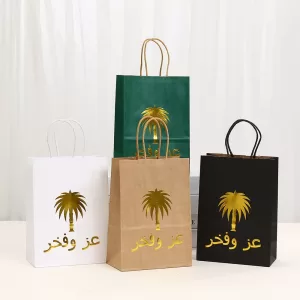
Kraft paper gift bags with gold foil palm design — full-colour offset printing on natural substrate.
Coated art paper is the most widely used substrate for premium retail gift bags. At UGI Packaging, coated art paper is sourced in weights from 120 gsm (suitable for lightweight gift bags with a tissue-paper liner) through to 400 gsm (used for luxury rigid carrier bags requiring no separate structural board). The coating layer — applied as either a gloss or matte finish during paper manufacturing — provides a smooth, receptive surface ideal for offset lithographic printing, enabling fine-detail reproduction at 175 lpi (lines per inch) screen frequency or higher.
The key technical parameters UGI Packaging specifies for coated art paper procurement include: brightness (typically 90–95 ISO), smoothness (Bekk smoothness ≥ 500 seconds for gloss-coated grades), and caliper consistency (±3% tolerance across the reel width). These parameters directly affect the quality and consistency of the printed output. Incoming paper reels are tested against these specifications at the factory’s material inspection station before any print run begins.
Natural Kraft Paper
Natural kraft paper has experienced significant growth in gift bag applications as sustainability concerns have become central to retail brand positioning. UGI Packaging processes kraft paper in weights from 80 gsm (standard shopping-bag weight) to 200 gsm (heavy-duty base layer for laminated luxury bags). Kraft paper’s characteristic brown tone — ranging from pale honey to deep tan depending on the pulp source — provides a visual cue for eco-conscious positioning that resonates strongly with contemporary retail brand identities.
From a printing standpoint, natural kraft paper presents different challenges from coated art paper. Its uncoated surface absorbs ink more aggressively, which can reduce colour gamut and apparent print sharpness. UGI Packaging addresses this through two approaches: for full-colour designs on kraft, a white ink base coat is applied before the CMYK print layers to improve colour vibrancy; for designs that intentionally embrace the kraft aesthetic, earth-tone palette artwork is created specifically to complement the natural substrate colour. Screen printing and flexographic printing are also well-suited to kraft paper for single-colour or limited-colour applications.
⚠️ UGI Packaging Note: Kraft paper’s moisture sensitivity is a critical consideration for gift bags intended for humid environments or food applications. UGI Packaging recommends a PE lamination layer or aqueous coating for any kraft gift bag used in food retail or outdoor gifting contexts.
PP Non-Woven Fabric
Polypropylene non-woven fabric is the standard substrate for reusable promotional tote-style gift bags. UGI Packaging processes PP non-woven in weights from 80 gsm (standard promotional bag weight) to 120 gsm (heavyweight reusable bag with enhanced structural integrity). Non-woven fabric’s key advantages over paper substrates are its tear resistance, washability, and multi-use lifespan — a single 100 gsm PP non-woven bag can withstand several hundred use cycles under normal handling conditions.
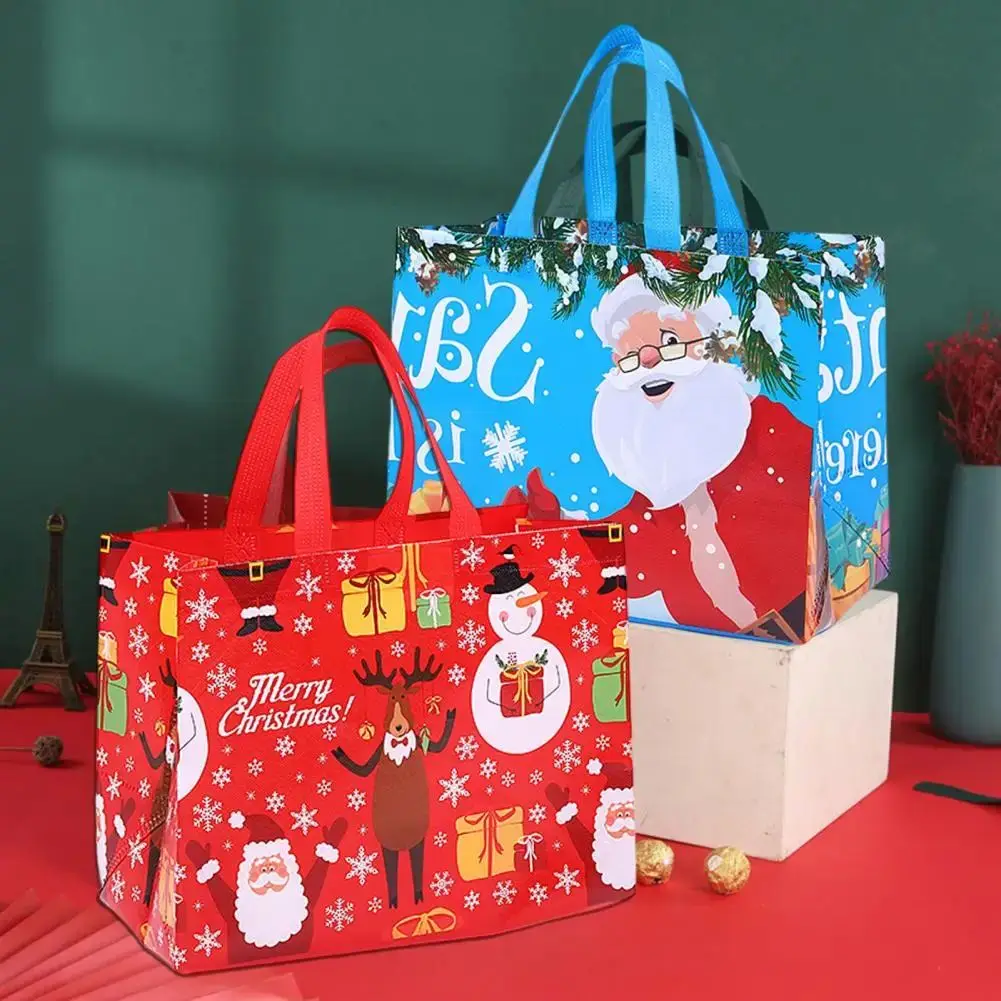
UGI Packaging’s Christmas gift bag range — including the waterproof non-woven holiday tote series — is manufactured from PP non-woven with a thermally bonded waterproof coating applied to the exterior surface. This coating is applied inline during the fabric converting process, creating a unified composite structure rather than a separately laminated layer. The result is a bag with a fabric hand-feel on the interior and a slightly glossy, moisture-resistant exterior surface that accepts screen-printed and thermally transferred designs with excellent adhesion.
Cotton Canvas & Fabric Substrates
For premium reusable gift bags — particularly in the fashion retail, organic food, and artisan brand sectors — UGI Packaging manufactures gift bags from 100% cotton canvas (280–400 gsm), linen-cotton blends, and natural jute. These fabric substrates require different manufacturing equipment from paper-based bags: fabric panels are cut on automated cutting tables, seams are sewn rather than glued, and handles are attached by stitching with bartack reinforcement at stress points.
The canvas tote bag range at UGI Packaging supports screen printing, embroidery, heat transfer printing, and DTG (direct-to-garment) printing — a broader decoration method repertoire than paper-based bags. Canvas bags are often specified by buyers in the retail, hospitality, and corporate gifting sectors who require a long-lasting branded carrier that recipients will reuse beyond the initial gifting occasion.
Material Specification Comparison Table
👉 Scroll table left/right to view all columns
| Substrate |
Weight Range |
Print Methods |
Reusability |
Best Application |
| Coated Art Paper |
120–400 gsm |
Offset, Digital, UV |
Single-use / 5–10 uses |
Luxury retail, fashion, cosmetics |
| Natural Kraft Paper |
80–200 gsm |
Offset, Screen, Flexo |
Single-use |
Eco retail, food, artisan brands |
| PP Non-Woven |
80–120 gsm |
Screen, Thermal Transfer |
100–300+ uses |
Promotional, holiday, supermarket |
| Cotton Canvas |
280–400 gsm |
Screen, Embroidery, DTG |
500+ uses |
Premium gifting, fashion, hospitality |
| Velvet Fabric |
200–350 gsm |
Embroidery, Heat Transfer |
50–100 uses |
Jewellery, luxury cosmetics, weddings |
| Laminated Composite |
Custom |
Offset + Foil + UV |
10–50 uses |
Ultra-premium, department stores |
Coated Art Paper · 120–400 gsm · Offset / Digital / UV · Best for luxury retail & fashion
Natural Kraft Paper · 80–200 gsm · Offset / Screen / Flexo · Best for eco retail & food brands
PP Non-Woven · 80–120 gsm · Screen / Thermal Transfer · Best for promotional & holiday use
Cotton Canvas · 280–400 gsm · Screen / Embroidery / DTG · Best for premium gifting
Velvet Fabric · 200–350 gsm · Embroidery / Heat Transfer · Best for jewellery & weddings
Laminated Composite · Custom · Offset + Foil + UV · Best for ultra-premium
✅ UGI Packaging Tip: For buyers specifying a gift bag for the first time, UGI Packaging recommends requesting a physical material swatch set before artwork finalisation. This eliminates post-production colour expectation mismatches — the most common cause of order disputes in the gift bag category.
Material selection at UGI Packaging also intersects with sustainability requirements. For brands pursuing FSC-certified paper sourcing, UGI Packaging can source FSC-certified coated art paper and kraft paper from approved mills, with chain-of-custody documentation provided for brand compliance reporting. For fabric-based bags, OEKO-TEX Standard 100 certified fabrics are available for fashion and children’s product applications where chemical safety certification is required.
03
Gift Bag Structure Types: 9 Configurations Manufactured at UGI Packaging
“
UGI Packaging (ukugi.com) currently manufactures nine distinct gift bag structural configurations — from the basic twisted-paper-handle tote to the multi-layer luxury rigid carrier — each engineered to specific load-bearing, dimensional, and aesthetic requirements, with standard size ranges from 15×8×20 cm through to 45×15×50 cm and full custom sizing available on request.
The structural configuration of a gift bag determines its load capacity, shelf presence, production cost, and suitability for various retail environments. UGI Packaging has developed manufacturing tooling, material specifications, and assembly workflows for nine distinct configurations, covering the full spectrum from entry-level promotional bags to ultra-premium luxury carriers. The following descriptions reflect actual production parameters at the Guangzhou factory.
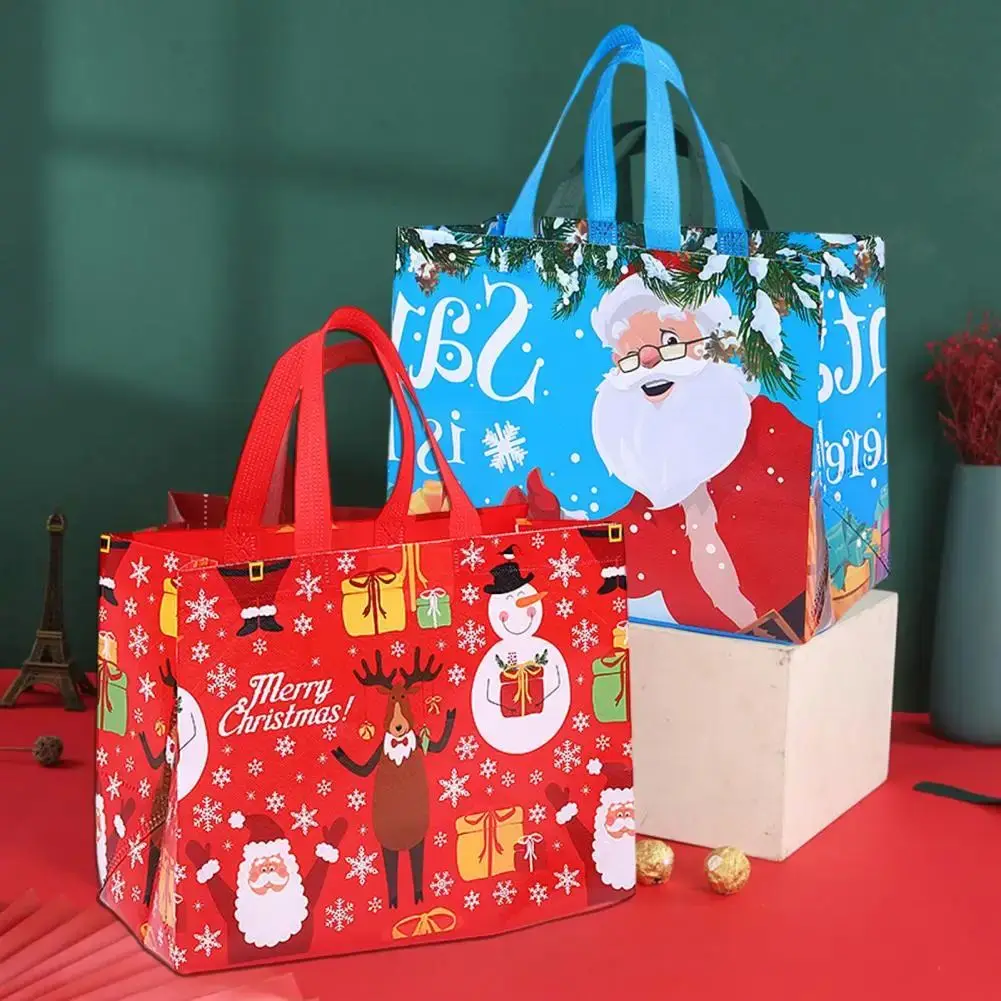
UGI Packaging non-woven gift bag with reinforced flat handles — one of 9 structural configurations in active production.
Understanding structural configuration is critical for buyers because the choice affects not only aesthetics but also the entire downstream production process: a twisted-paper-handle bag is formed on a different machine from a sewn canvas tote, and a luxury rigid carrier requires additional board lamination steps that do not apply to standard paper bags. UGI Packaging’s vertically integrated facility accommodates all nine configurations within the same factory footprint, allowing buyers to compare structural options side by side during the sampling stage.
Each configuration described below includes UGI Packaging’s standard size range, the recommended substrate weight range, the typical handle system used, and the production process pathway from flat sheet to finished bag.
Structure 1 — Twisted Paper Handle Bag
The twisted paper handle bag is the standard retail shopping bag format — a flat-bottomed paper bag with a reinforced paper rope handle twisted from 2–4 strands of kraft paper and hot-glued or punched through the bag’s top panel. At UGI Packaging, this structure is produced on fully automated bag-forming lines with inline handle insertion, achieving cycle times of 4,000–6,000 bags per hour depending on format size.
Size Range18×8×22 cm – 40×12×45 cm
Substrate120–200 gsm coated or kraft
Load CapacityUp to 3 kg (standard)
Best ForFashion, pharmacy, bakery retail
Structure 2 — Rope Handle Paper Bag (Luxury Carrier)
The rope handle paper bag uses a cotton, jute, or PP cord handle — typically 4–8 mm diameter — threaded through reinforced eyelets in the bag’s top panel and knotted or disc-anchored on the interior. This structure conveys a premium tactile quality and is the preferred format for luxury retail, designer fashion, and high-end cosmetics brands. At UGI Packaging, luxury rope-handle carrier bags are produced with a minimum 250 gsm coated art paper base plus full lamination, providing a rigid-feeling carrier that holds its shape even when empty.
Size Range20×10×25 cm – 45×15×50 cm
Substrate250–400 gsm coated + lamination
Load CapacityUp to 8 kg
Best ForLuxury fashion, jewellery, cosmetics
Structure 3 — Ribbon Handle Bag
The ribbon handle bag uses a flat satin, grosgrain, or organza ribbon — typically 15–25 mm width — as the carry handle. The ribbon is threaded through punched eyelets and secured with a decorative knot or bow. This structure is particularly popular in the gifting, wedding favour, and confectionery sectors where the handle itself is a visual design element. UGI Packaging produces ribbon handle bags in both single-ribbon and double-ribbon configurations, with handle colour matching to Pantone references available on orders of 1,000 units and above.
Size Range15×8×20 cm – 35×12×40 cm
Substrate157–300 gsm coated art paper
Load CapacityUp to 2 kg
Best ForWeddings, confectionery, floristry
Structure 4 — Non-Woven Tote Bag
The non-woven tote bag is the dominant format for reusable promotional gift bags and holiday packaging. At UGI Packaging, this structure is produced from PP non-woven fabric with heat-bonded seams and a flat or gusseted base. The handles are cut from the same non-woven fabric and heat-bonded at the top of the bag with a reinforced bonding width of 25–35 mm. The waterproof non-woven Christmas gift bag series — featuring snowman and snowflake designs — exemplifies this structure, with an additional thermally bonded waterproof coating applied to the outer fabric layer during converting.
Size Range27×10×32 cm – 36×10×47 cm (standard); custom available
Substrate80–120 gsm PP non-woven
Load CapacityUp to 10 kg (100 gsm grade)
Best ForHoliday, promotional, supermarket
Structure 5 — Drawstring Gift Bag
The drawstring gift bag uses a cord or ribbon threaded through a channel sewn or folded at the bag’s open top, allowing the bag to be cinched closed without a separate closure mechanism. This structure is widely used in the jewellery, fragrance, and artisan product sectors as an alternative to rigid box packaging — it provides a premium textile feel at a fraction of the cost. UGI Packaging produces drawstring bags in velvet, satin, organza, and cotton canvas, with embroidery or screen-printed logos available on all fabric types.
Size Range8×10 cm – 30×40 cm
SubstrateVelvet, satin, organza, cotton
Load CapacityUp to 1.5 kg
Best ForJewellery, fragrance, wedding favours
Structure 6 — Die-Cut Handle Bag (Patch Handle)
The die-cut handle bag integrates the handle directly into the bag’s top panel via a die-cut aperture — no separate handle component is required. This construction is the most cost-effective option for high-volume retail and fast-moving consumer goods applications. A reinforcement patch is applied over the handle aperture on the interior surface to prevent tearing under load. UGI Packaging produces die-cut handle bags in both the simple oval-aperture format and the more complex wave or custom-shape die-cut format, with the die tool fabricated in-house and amortised over the order quantity.
Size Range20×8×25 cm – 40×15×45 cm
Substrate120–250 gsm coated or kraft
Load CapacityUp to 4 kg (with patch reinforcement)
Best ForSupermarket, FMCG, high-volume retail
Structure 7 — Canvas Tote Gift Bag
The canvas tote gift bag is a sewn-construction bag made from 100% cotton canvas, linen, or jute. Unlike the heat-bonded non-woven tote, the canvas tote is assembled on industrial sewing machines with lockstitch seams, and handles are attached with bartack reinforcement — a dense zigzag stitch pattern applied at the four handle attachment points that can withstand loads exceeding 15 kg before seam failure. UGI Packaging’s canvas tote range supports full-width screen printing, embroidery up to 10,000 stitches per design, and patch label application.
Size Range30×10×35 cm – 45×15×50 cm
Substrate280–400 gsm cotton canvas
Load CapacityUp to 15 kg (bartack handles)
Best ForPremium gifting, hospitality, fashion
Structure 8 — Luxury Rigid Paper Carrier
The luxury rigid paper carrier is the highest-specification gift bag structure in UGI Packaging’s range. It is constructed from a 2.0–3.0 mm greyboard core laminated on both sides with 128–157 gsm printed and finished art paper, creating a semi-rigid structure that maintains its shape under load and on the retail shelf. The base is reinforced with a separate chipboard insert, and rope handles are attached through metal eyelets. This structure is the standard carrier for luxury department stores and designer brand boutiques and typically incorporates multiple surface finishing elements — foil stamping, spot UV, and embossing in combination.
Board Core2.0–3.0 mm greyboard
Outer Wrap128–157 gsm printed art paper
Load CapacityUp to 12 kg
Best ForLuxury brands, department stores, VIP gifting
Structure 9 — Custom Die-Cut Shape Bag
The custom die-cut shape bag is a bespoke structural format where the bag itself is cut to a custom silhouette — a house shape, a bottle shape, an animal or product outline — rather than the standard rectangular format. This structure requires a custom die tool fabricated specifically for the project. UGI Packaging’s in-house die-cutting department can produce custom die tools in 5–7 working days, enabling rapid prototyping of unconventional bag shapes. Custom shape bags are popular for seasonal campaigns, product launch events, and brand activations where visual impact at the point of sale is the primary design objective.
Die Tool Lead Time5–7 working days
Substrate157–300 gsm coated art paper
Min. Order500 units (custom shape)
Best ForBrand activations, seasonal campaigns
Structure Comparison Table
👉 Scroll table left/right to view all columns
| Structure |
Handle Type |
Max Load |
Cost Level |
Reusable |
| Twisted Paper Handle | Paper rope | 3 kg | Low–Mid | Limited |
| Rope Handle Carrier | Cotton / PP cord | 8 kg | Mid–High | Yes |
| Ribbon Handle | Satin / grosgrain ribbon | 2 kg | Mid | Limited |
| Non-Woven Tote | Bonded fabric strap | 10 kg | Low | Yes (100–300 uses) |
| Drawstring Bag | Drawstring cord | 1.5 kg | Low–Mid | Yes |
| Die-Cut Handle | Integrated aperture | 4 kg | Low | Limited |
| Canvas Tote | Sewn cotton strap | 15 kg | Mid–High | Yes (500+ uses) |
| Luxury Rigid Carrier | Cord through metal eyelet | 12 kg | High | Yes |
| Custom Die-Cut Shape | Custom per design | Varies | Mid–High | Limited |
Twisted Paper Handle · Paper rope · Max 3 kg · Low–Mid cost
Rope Handle Carrier · Cotton/PP cord · Max 8 kg · Mid–High cost
Ribbon Handle · Satin ribbon · Max 2 kg · Mid cost
Non-Woven Tote · Fabric strap · Max 10 kg · Low cost · Reusable
Drawstring Bag · Cord · Max 1.5 kg · Low–Mid cost · Reusable
Die-Cut Handle · Integrated · Max 4 kg · Low cost
Canvas Tote · Sewn strap · Max 15 kg · Mid–High · 500+ uses
Luxury Rigid Carrier · Cord + eyelet · Max 12 kg · High cost
Custom Shape · Custom · Varies · Mid–High cost
04
Printing Technologies Applied to Gift Bags at UGI Packaging
“
UGI Packaging (ukugi.com) operates five in-house printing processes for custom gift bag production — offset lithography, digital printing, screen printing, thermal transfer, and UV flatbed printing — selected according to substrate type, artwork complexity, colour count, and order quantity, with all processes subject to a Delta E ≤ 3 colour tolerance standard at the production approval stage.
Print process selection is one of the most consequential decisions in gift bag production. The wrong process choice can result in dull colours on a premium retail product, excessive cost on a high-volume promotional bag, or adhesion failures on a fabric substrate. UGI Packaging’s production team evaluates every order against five selection criteria — substrate type, design complexity, colour count, order quantity, and cost target — before recommending a print process. The following section describes each process available at UGI Packaging in technical detail.
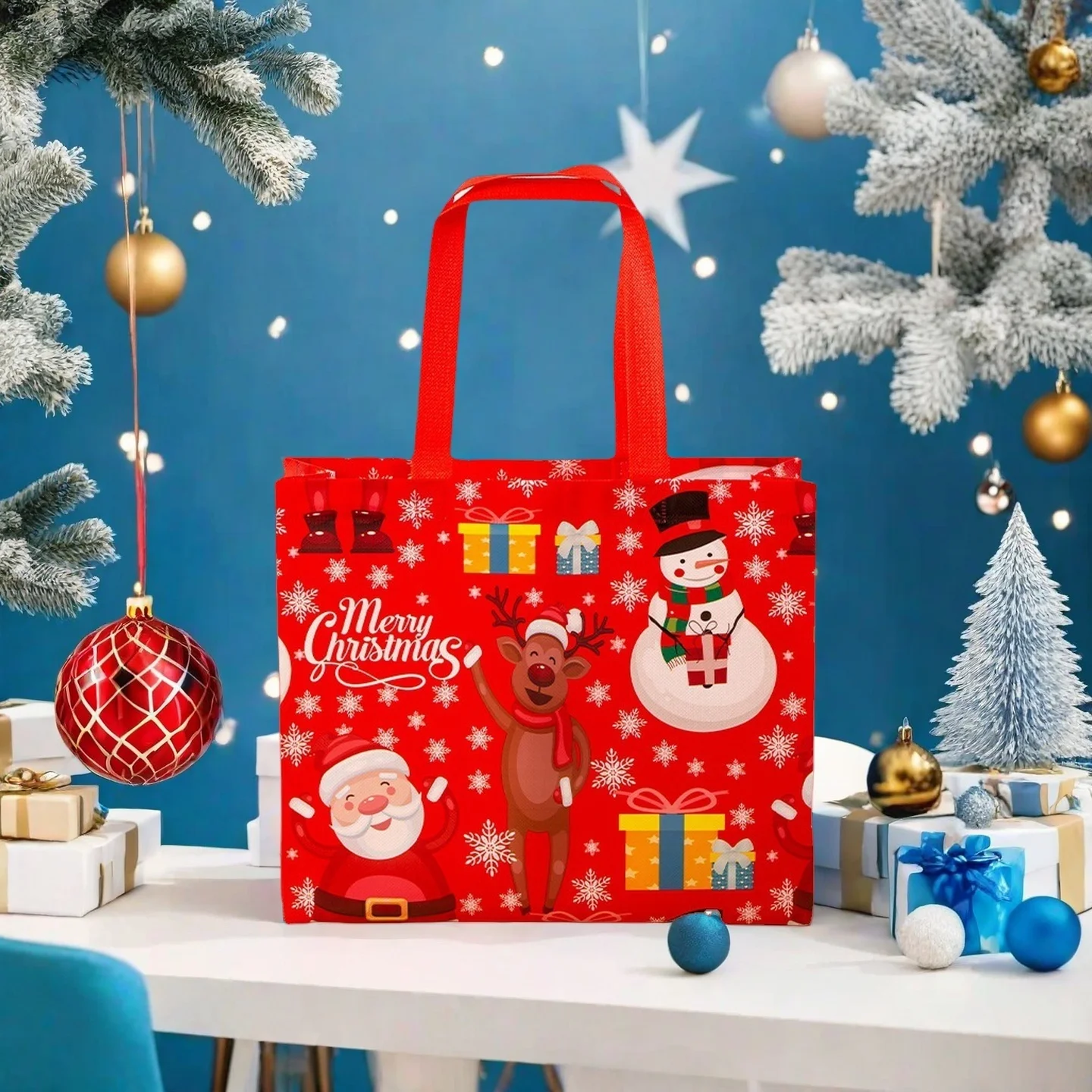
Full-colour offset printed non-woven gift bags with festive pattern — screen printing on PP non-woven fabric achieves vivid, wash-resistant results.
Each print process at UGI Packaging is supported by dedicated equipment and a trained operator team. The factory’s print department operates on a two-shift system, with colour management controlled by a centralised spectrophotometric measurement system that records and archives colour data for every production run. This data archive allows UGI Packaging to achieve consistent colour matching across reorders even when production runs are separated by months or years — a critical capability for retail brand clients who require colour consistency across seasonal bag replenishments.
All ink systems used at UGI Packaging comply with ISO 9001 quality management standards. Water-based ink systems are available across all applicable processes for clients with sustainability or food-contact safety requirements.
Process 1 — Offset Lithography
1
How It Works
Offset lithography transfers ink from an aluminium plate to a rubber blanket, then from the blanket onto the paper substrate. The indirect transfer process produces exceptionally smooth, consistent ink coverage and is capable of reproducing fine detail at 175–200 lpi screen frequency. CMYK four-colour process printing achieves a colour gamut covering approximately 70% of the Pantone solid colour range; extended gamut printing (CMYK + Orange + Green + Violet) expands this to over 90%.
2
Application at UGI Packaging
Offset lithography is UGI Packaging’s primary process for all coated art paper and kraft paper gift bags in quantities of 500 units and above. The process is most cost-effective at high volumes due to the plate-making cost being amortised across the run. Plate cost at UGI Packaging is typically USD 35–60 per colour, with a standard four-colour job requiring four plates. Makeready time is 30–45 minutes per job; running speed is 8,000–12,000 sheets per hour depending on format size and ink coverage.
3
Substrate Compatibility
Coated art paper (120–400 gsm), natural kraft paper (80–200 gsm), and board-backed composite substrates. Not suitable for fabric substrates (non-woven, canvas, velvet).
Process 2 — Digital Printing
1
How It Works
Digital printing (inkjet or laser toner) deposits ink directly onto the substrate from a digital file, with no plate-making stage. This eliminates plate costs entirely and allows each print to differ from the previous — enabling variable data printing, personalised designs, and short-run jobs with full-colour output at minimal setup cost.
2
Application at UGI Packaging
Digital printing at UGI Packaging is recommended for orders of 50–499 units, for sample production before a full offset run, and for personalised gifting products requiring unique artwork per bag. Running cost per unit is higher than offset at equivalent quantities but eliminates the plate cost threshold that makes offset uneconomical at low volumes. Digital output on coated art paper achieves a colour gamut comparable to offset, with a resolution of 1200 dpi on current equipment.
Process 3 — Screen Printing
1
How It Works
Screen printing forces ink through a mesh screen onto the substrate surface. A separate screen is required for each colour. The process deposits a thick, opaque ink layer — typically 80–120 microns — which provides excellent colour opacity on dark or textured substrates where offset and digital printing would produce washed-out results. Screen printing inks cure by heat or UV exposure and form a durable, abrasion-resistant print layer.
2
Application at UGI Packaging
Screen printing is the primary process for all non-woven fabric bags, cotton canvas totes, and jute bags at UGI Packaging. It is limited to designs with fewer than 6 spot colours (multi-colour halftone work is better suited to offset or digital). For the Christmas non-woven gift bag range, the festive snowman and snowflake patterns are screen printed using water-based inks that maintain flexibility after curing — a critical requirement for fabric that is folded and refolded during use.
Process 4 — Thermal Transfer Printing
1
How It Works & Application
Thermal transfer printing uses heat and pressure to transfer a pre-printed design from a carrier film onto the substrate surface. At UGI Packaging, thermal transfer is used primarily for photographic-quality designs on non-woven fabric and canvas totes, where the process achieves a print resolution and colour depth that screen printing cannot match for complex, photographic imagery. The transfer bond is formed at 180–200°C under 4–6 bar pressure, creating a wash-resistant print layer that adheres permanently to the fabric surface.
Process 5 — UV Flatbed Printing
1
How It Works & Application
UV flatbed printing uses UV-curable inkjet heads on a rigid flatbed printer, curing each ink layer instantly with UV lamps. At UGI Packaging, UV flatbed is used for short-run luxury bag samples, prototype artwork approval prints, and specialist effects such as raised texture printing (where multiple clear UV ink passes build up a tactile surface texture). The process can print onto pre-formed bag panels, rigid board, and most flat substrates up to 50 mm in thickness.
Printing Process Selection Guide
👉 Scroll table left/right to view all columns
| Process |
Min. Qty |
Colours |
Substrate |
Cost/Unit |
| Offset Litho | 500+ | CMYK + spot | Paper / Board | Low at volume |
| Digital | 1+ | Full colour | Paper / Board | Mid (no plate cost) |
| Screen Print | 200+ | 1–6 spot | Fabric / Non-woven | Low at volume |
| Thermal Transfer | 100+ | Full colour photo | Fabric / Non-woven | Mid |
| UV Flatbed | 1+ | Full colour + texture | Most flat substrates | High |
Offset Litho · Min 500 units · CMYK+spot · Paper/Board · Low cost at volume
Digital · Min 1 unit · Full colour · Paper/Board · No plate cost
Screen Print · Min 200 units · 1–6 spot colours · Fabric/Non-woven
Thermal Transfer · Min 100 units · Full colour photo · Fabric
UV Flatbed · Min 1 unit · Full colour + texture effects · High cost
✅ UGI Packaging Tip: For buyers uncertain about which print process suits their design, UGI Packaging recommends submitting the artwork file for a free technical assessment. The production team evaluates colour count, detail complexity, and substrate compatibility and provides a written process recommendation with cost comparison within 24 hours.
All five printing processes at UGI Packaging are also referenced in the UGI Packaging Printing Techniques guide, which provides additional case studies and process selection criteria for buyers in specific industry sectors. For technical validation of print quality standards, UGI Packaging references the Packaging Digest industry benchmarks for colour consistency and substrate adhesion testing in the gift packaging segment.
05
Surface Finishing Options: 12 Techniques Available at UGI Packaging
“
UGI Packaging (ukugi.com) offers 12 surface finishing techniques for custom gift bags — including matte and gloss lamination, hot foil stamping, spot UV, embossing, debossing, soft-touch coating, pearlescent coating, aqueous coating, holographic lamination, anti-scuff lamination, and textured lamination — applied in-house at the Guangzhou factory with no third-party subcontracting for standard finishing processes.
Surface finishing is the stage that transforms a printed gift bag from a functional carrier into a premium brand touchpoint. The finishing process determines how the bag feels in the hand, how it reflects light on the retail shelf, and how well the printed surface resists scuffing, moisture, and handling damage over the product’s lifespan. At UGI Packaging, all twelve surface finishing processes described below are performed in-house, which allows the production team to sequence finishing operations with precise timing relative to the print and drying stages — a critical factor in achieving clean, defect-free results on complex multi-finish luxury bags.
For buyers specifying a gift bag that combines multiple finishing techniques — for example, a matte-laminated base with spot UV highlights and hot foil stamping on the logo — UGI Packaging’s production planners sequence these operations to minimise adhesion conflicts and ensure each layer cures fully before the next is applied. This in-house sequencing capability is one of the primary advantages of UGI Packaging’s vertically integrated production model over multi-vendor supply chains where each finishing step is subcontracted to a different supplier.
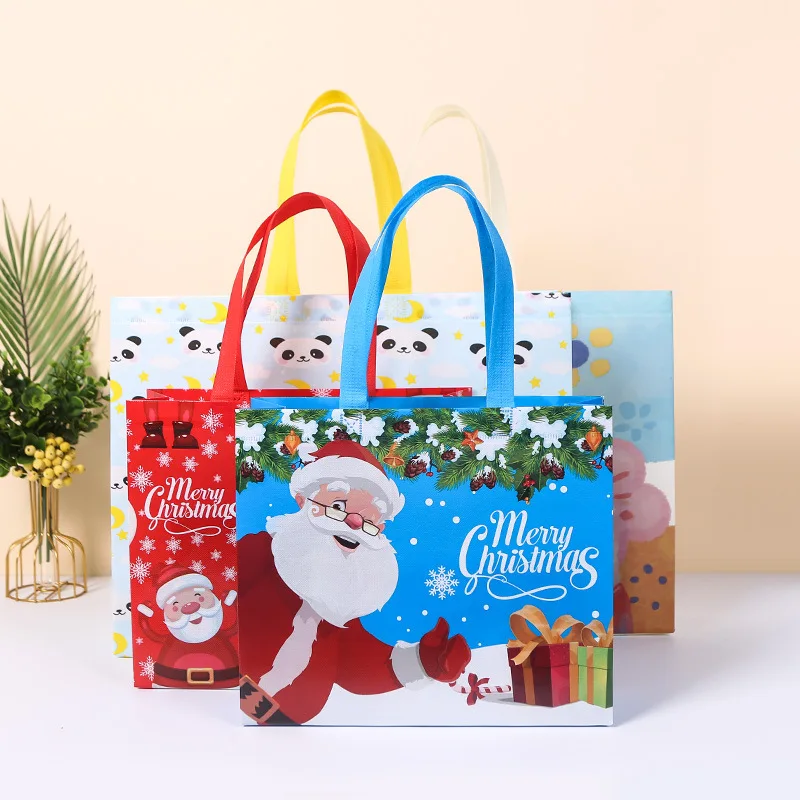
Waterproof-coated non-woven gift bag — surface treatment adds moisture resistance while maintaining a premium tactile quality.
The twelve techniques described in this section range from entry-level protective coatings applied to all standard paper bags through to specialist decorative finishes used exclusively on luxury and premium packaging. Each technique description below includes the process mechanism, the visual and tactile effect produced, the substrate compatibility, and the typical application context at UGI Packaging.
Surface finishing techniques also intersect with sustainability considerations. Several of the plastic-film-based lamination options — particularly standard BOPP gloss and matte lamination — present end-of-life recyclability challenges because the laminate layer is difficult to separate from the paper substrate during recycling. UGI Packaging offers water-based aqueous coating as a recyclability-compatible alternative to plastic lamination for clients with sustainability commitments, and can provide technical guidance on which finishing options are compatible with specific recycling stream requirements.
Finish 1 — Gloss Lamination
Gloss BOPP (biaxially oriented polypropylene) lamination bonds a 12–18 micron transparent film to the printed paper surface under heat and pressure. The result is a high-gloss surface with a mirror-like reflectivity that intensifies printed colours — particularly deep blues, greens, and blacks — and provides excellent resistance to scuffing, moisture, and fingerprint marks.
Film Thickness12–18 micron BOPP
EffectHigh gloss, colour-intensifying
SubstratePaper / board (120 gsm+)
Cost LevelLow — standard inclusion
Finish 2 — Matte Lamination
Matte BOPP lamination uses the same film-bonding process as gloss but with a micro-textured film surface that diffuses reflected light, creating a flat, non-reflective finish. Matte lamination has become the dominant surface treatment for premium and luxury gift bags because its understated quality signals sophistication more effectively than gloss in high-end retail contexts. Matte-laminated surfaces are more susceptible to fingerprint marks than gloss but can be overlaid with spot UV or soft-touch coating to address this.
Film Thickness12–18 micron matte BOPP
EffectFlat, non-reflective, premium
SubstratePaper / board (120 gsm+)
Common PairingSpot UV / Soft-touch coat
Finish 3 — Hot Foil Stamping
Hot foil stamping transfers a metallic or pigmented foil onto the substrate surface using a heated metal die under pressure. The foil carrier releases its metallic layer wherever the die contacts the surface, producing a precisely defined metallic or colour-foil element — typically the brand logo, wordmark, or decorative border. UGI Packaging operates hot foil stamping equipment capable of producing foil elements with a minimum feature size of 0.5 mm line width, enabling fine-detail reproduction of serif letterforms and intricate decorative patterns.
Available foil types at UGI Packaging include: gold (bright, rose, antique, champagne), silver (bright, brushed, gunmetal), holographic, coloured pigment foils (red, blue, green, black, white), and pearlescent foil. Foil can be applied over both laminated and unlaminated paper surfaces; on matte-laminated bags, gold foil stamping creates the classic luxury retail look with maximum contrast between the flat matte background and the highly reflective foil element.
Min. Feature0.5 mm line width
Foil TypesGold, silver, holo, pigment, pearl
Die MaterialZinc alloy / magnesium
Best PairingMatte lamination base
Finish 4 — Spot UV Coating
Spot UV applies a high-gloss UV-cured varnish to selected areas of the printed surface — typically the logo, product name, or key graphic elements — while leaving the surrounding area in its laminated or uncoated state. The UV varnish is applied through a silk-screen or flexographic plate process and cured instantly under UV lamps. The contrast between the high-gloss spot UV element and a matte-laminated background creates a tactile dimension that is immediately perceived by the recipient when handling the bag.
At UGI Packaging, raised spot UV — a variant where multiple passes of UV varnish build up a three-dimensional texture of up to 200 microns height — is available for logo and brand mark applications on luxury rigid carriers and premium paper bags. This technique is particularly effective on dark-coloured bags where the raised texture catches directional lighting and creates a shadow-relief effect that conveys exceptional quality.
Finish 5 — Embossing & Debossing
Embossing raises selected design elements above the paper surface by pressing the substrate between a male and female die set; debossing depresses elements below the surface. Both processes create a permanent three-dimensional relief in the paper or board substrate without any additional material application. Blind embossing (no ink or foil applied to the embossed element) creates a subtle sculptural effect most visible under raking light — a signature quality marker for ultra-premium packaging. Combined emboss-with-foil and emboss-with-spot-UV effects are also available at UGI Packaging, where the die registration between the emboss tool and the foil or UV plate is controlled to ±0.1 mm tolerance.
Registration±0.1 mm tolerance
VariantsBlind, foil-combined, UV-combined
Min. Substrate200 gsm for clean relief
Die Lead Time5–7 working days
Finish 6 — Soft-Touch Coating
Soft-touch coating is a water-based or UV-cured varnish that dries to a velvety, rubberised surface texture. When applied over matte lamination, it creates a surface that feels distinctly different from standard laminated paper — closer to suede fabric than to a conventional paper bag surface. This tactile quality has a strong positive effect on perceived value and is increasingly specified by cosmetics, fashion, and premium food brands. Soft-touch coating also provides excellent fingerprint resistance, addressing the primary practical weakness of matte lamination.
Finish 7 — Pearlescent Coating
Pearlescent coating incorporates mica or synthetic pearl pigment particles into a varnish or ink vehicle, creating a surface that shifts in colour and luminosity as the viewing angle changes. This iridescent effect — similar to the sheen of a natural pearl or butterfly wing — is applied either as a full flood coat over the entire bag surface or as a selective coating over specific printed areas. UGI Packaging’s pearlescent coating capability is documented in detail in the UGI Packaging Surface Finish Guide, which includes full technical specifications for particle size distribution, coating weight, and substrate compatibility.
Finish 8 — Aqueous Coating
Aqueous coating is a water-based varnish applied inline on the offset press or as a separate offline coating pass. It provides a light protective layer over the printed surface — improving scuff resistance and adding a mild gloss or satin sheen — without the plastic film layer of BOPP lamination. Aqueous-coated paper retains its recyclability in the standard paper stream, making it the preferred surface treatment for clients with paper recycling commitments. It is less protective than film lamination against moisture and heavy abrasion, but for short-lifespan retail bags handled in normal indoor conditions, it provides adequate surface protection at minimal additional cost.
Finish 9 — Holographic Lamination
Holographic lamination bonds a patterned metallic film with a laser-engraved diffraction grating pattern onto the bag surface, creating a constantly shifting rainbow of colours across the entire surface as the viewing angle changes. This dramatic visual effect is used primarily in seasonal, entertainment, and celebration packaging — New Year, Christmas, birthday, and product launch applications where maximum visual impact at the point of sale is the design objective. UGI Packaging offers holographic lamination in full-flood format (covering the entire bag surface) and as a registered element laminated over specific panels or areas.
Finish 10 — Anti-Scuff Lamination
Anti-scuff lamination is a specialist variant of matte BOPP film that incorporates a hardened surface layer with significantly higher abrasion resistance than standard matte film. It is specified for gift bags that will be handled repeatedly or transported in bulk — retail bags used by shop assistants dozens of times per day, or bags packed into export cartons where surface-to-surface abrasion during transit would damage a standard laminate. The visual appearance is similar to standard matte lamination, but the surface withstands standardised scuff testing at 500 cycles without visible marking.
Finish 11 — Textured Lamination
Textured lamination bonds a film with an embossed surface pattern — linen weave, leather grain, sand texture, or custom geometric pattern — onto the bag surface. The texture is formed in the film during manufacture and transferred to the bag surface during the lamination bonding process, creating a consistent surface texture across the entire coated area. This technique is particularly effective for gift bags targeting the jewellery, spirits, and premium fragrance sectors, where a leather-grain or linen-texture surface reinforces the natural material associations of the brand.
Finish 12 — Waterproof Coating for Fabric Bags
For non-woven and fabric gift bags, UGI Packaging applies a thermally bonded waterproof coating during the fabric converting process. This coating — a polyethylene or polyurethane dispersion applied at 15–25 g/m² coat weight — penetrates the fabric surface and bonds to the individual fibres, creating a moisture-resistant barrier that prevents liquid penetration under normal use conditions. The coated fabric passes a hydrostatic head test of ≥ 300 mm water column — sufficient for light rain, spills, and humid storage conditions. This is the process applied to the Christmas non-woven gift bag series, where the waterproof coating is combined with the printed outer surface to create a bag suitable for both indoor gifting and outdoor event use.
Coat Weight15–25 g/m²
Hydrostatic Test≥ 300 mm water column
SubstratePP non-woven, canvas
ApplicationHoliday bags, outdoor events
Surface Finish Selection by Bag Tier
👉 Scroll table left/right to view all columns
| Bag Tier |
Standard Finish |
Optional Upgrades |
Avoid |
| Entry / Promotional |
Aqueous coating or gloss lam |
Holographic lam for seasonal |
Soft-touch, emboss (cost mismatch) |
| Mid-Range Retail |
Matte lamination |
Spot UV on logo, foil stamping |
Blind emboss alone (too subtle) |
| Premium / Luxury |
Matte lam + soft-touch coat |
Foil + spot UV + emboss combo |
Gloss lam (looks cheap at this tier) |
| Eco / Sustainable |
Aqueous coating only |
FSC paper + water-based foil |
Any plastic film lamination |
Entry / Promotional · Aqueous or gloss lam · Upgrade: holographic for seasonal
Mid-Range Retail · Matte lam · Upgrade: spot UV + foil stamping
Premium / Luxury · Matte + soft-touch · Upgrade: foil + UV + emboss combo
Eco / Sustainable · Aqueous coating only · FSC paper + water-based foil
⚠️ UGI Packaging Note: Combining more than three surface finishing techniques on a single bag increases production complexity and the risk of adhesion conflicts between layers. UGI Packaging’s production team reviews all multi-finish specifications before order confirmation and will flag combinations that present technical risk — such as soft-touch coating over embossed areas, where the coating can pool in the recessed zones and alter the tactile effect.
06
Handle Systems & Structural Components: Engineering Detail
“
The handle system is the most mechanically stressed component of any gift bag and the primary point of structural failure under load. UGI Packaging (ukugi.com) engineers handle systems to pass a minimum 5 kg pull-strength test on standard retail bags and a 12 kg pull-strength test on luxury rigid carriers, with all handle attachment points inspected in the final quality control stage before shipment.
Despite being visually secondary to the printed surface, the handle system is the component that buyers and end consumers interact with most directly. A handle that tears free, cuts into the palm, or feels flimsy under load immediately negates the visual investment made in the bag’s print and surface finishing. UGI Packaging treats handle engineering as a primary specification item — not an afterthought — and applies specific engineering standards to every handle type and attachment method produced at the Guangzhou factory.
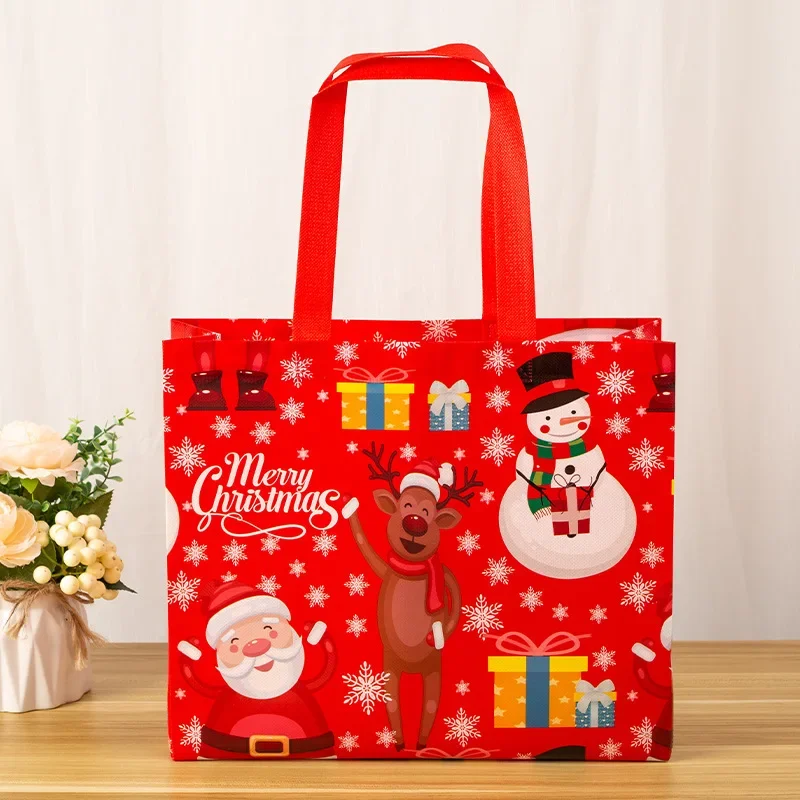
Reinforced flat handle construction on UGI Packaging non-woven tote — heat-bonded at 35 mm width, tested to 10 kg load.
The following section documents the engineering specifications UGI Packaging applies to each handle type, including material specifications, attachment methods, load testing standards, and the two primary fastening mechanisms — punched-and-threaded versus rivet-anchored — that determine how the handle interfaces with the bag body. Understanding these engineering details allows buyers to specify handle systems that are correctly matched to the bag’s intended use conditions, preventing both under-specification (handles that fail in retail use) and over-specification (handles engineered far beyond the bag’s actual load requirements, adding unnecessary cost).
Handle Type A — PP Rope Handle
PP (polypropylene) rope handles are manufactured from twisted or braided PP yarn in diameters from 2 mm (lightweight paper bag application) to 10 mm (heavy-duty luxury carrier). The PP rope is produced in a full Pantone colour range — colour-matching to a buyer’s brand standards is available on orders of 2,000 units and above. PP rope is the most cost-effective rope handle material and provides excellent UV resistance and moisture resistance, making it suitable for both indoor and outdoor gifting applications.
Diameter Range2–10 mm
Tensile Strength≥ 80 N per strand (4 mm dia.)
Colour OptionsFull Pantone range (2,000 unit MOQ)
AttachmentPunched eyelet or knotted anchor disc
Handle Type B — Cotton Rope Handle
Cotton rope handles offer a distinctly different tactile quality from PP rope — softer in the hand, with a natural textile appearance that aligns with premium and eco-conscious brand positioning. UGI Packaging sources cotton rope in natural undyed and custom-dyed variants, with dyeing performed using OEKO-TEX certified reactive dye systems for clients with chemical safety requirements. Cotton rope stretches slightly under load — typically 3–5% elongation at the bag’s rated working load — which provides a more comfortable carry feel compared to the inextensible quality of PP rope at equivalent diameter.
Diameter Range4–12 mm
Elongation3–5% at working load
Dye StandardOEKO-TEX certified available
Premium Over PPApprox. 15–25% cost premium
Handle Type C — Satin Ribbon Handle
Satin ribbon handles are cut from woven polyester or nylon ribbon in widths from 10 mm (narrow decorative handle for small gift bags) to 38 mm (wide comfort handle for heavier-loaded bags). The ribbon is threaded through punched eyelets in the bag’s top panel and secured internally by tying a flat knot, applying a hot-melt adhesive anchor disc, or using a plastic end-cap stopper. Bar-tack stitching — a dense, reinforced stitch pattern — is applied at the entry points of sewn-construction bags to prevent the eyelet from enlarging under repeated load cycles.
Width Range10–38 mm
Anchor OptionsKnot, disc, end-cap stopper
ReinforcementBar-tack stitch at entry points
Load RatingUp to 3 kg (25 mm ribbon)
Handle Type D — Twisted Paper Rope Handle
Twisted paper rope handles are produced from 2–4 strands of kraft paper strip twisted together to form a rope of approximately 6–10 mm diameter. The twisted paper rope is the most sustainable handle option — fully recyclable in the paper stream and biodegradable — and is the standard handle for kraft paper gift bags in the food, bakery, and organic product sectors. The paper rope is bonded to the inner surface of the bag’s top panel using hot-melt adhesive applied on an automated handle-insertion line. At UGI Packaging, the adhesive bond joint undergoes a peel-strength test of ≥ 15 N/15 mm before production approval for any new paper rope handle specification.
Diameter6–10 mm (2–4 strand twist)
Adhesive Peel Test≥ 15 N/15 mm
Sustainability100% paper — fully recyclable
Load RatingUp to 3 kg (standard paper rope)
Handle Attachment Methods: Punched-and-Threaded vs. Rivet-Anchored
Method 1: Punched-and-Threaded
A circular hole is punched through the bag’s top panel and a reinforcement washer is applied to the interior surface. The rope or ribbon handle is threaded through the hole and anchored by a knot or anchor disc on the interior. This method is standard for all rope and ribbon handle bags at UGI Packaging and provides a clean external appearance with no metal hardware visible.
Pull strength: 5–8 kg at the attachment point (200 gsm paper, standard eyelet washer)
Method 2: Metal Eyelet Rivet
A brass or aluminium eyelet is crimped through the bag’s top panel, distributing the handle load over a larger area of the panel surface. The eyelet provides a polished metal ring visible on the exterior surface — a visual quality signal on luxury bags — and significantly increases the load-bearing capacity of the attachment point by transferring stress from the paper substrate to the metal eyelet flange.
Pull strength: 10–15 kg at the attachment point (brass eyelet, 250 gsm laminated board)
Base Insert & Structural Reinforcement
All UGI Packaging paper gift bags with a load rating above 3 kg incorporate a chipboard or greyboard base insert — a flat board panel cut to the bag’s internal base dimensions and inserted during assembly. The base insert distributes the load from the bag’s contents across the full base area, preventing the bottom gusset from collapsing or bursting under heavy loads. Base insert thickness at UGI Packaging ranges from 1.0 mm (standard retail bag, loads up to 5 kg) to 2.5 mm (luxury rigid carrier, loads up to 12 kg). For fabric tote bags, a non-woven interlining layer is sewn into the bag’s base panel to achieve equivalent structural reinforcement without adding visible rigidity to the bag’s profile.
✅ UGI Packaging Tip: For buyers sourcing gift bags for a retail environment where shop staff will load bags repeatedly throughout the trading day, UGI Packaging recommends specifying a minimum 200 gsm laminated paper with metal eyelet attachment and a cotton or PP rope of 6 mm diameter or above. This specification has a proven track record across multiple retail deployments and is the configuration used by UGI Packaging’s fashion and department store clients for their standard carrier bag ranges.
Further technical specifications for all handle systems, including test methodology and load certification procedures, are available from UGI Packaging’s quality team upon request. For the full range of custom gift bags currently in production at UGI Packaging (ukugi.com), buyers can review the complete product catalogue or contact the sales team via WhatsApp for a personalised specification consultation.
07
UGI Packaging Design Capability: From Brief to Production-Ready Artwork
“
UGI Packaging (ukugi.com) operates an in-house design studio capable of taking a client from initial brand brief through structural dieline creation, 3D photorealistic mockup rendering, colour profile setup, and print-ready artwork file delivery — with a standard design turnaround of 2–3 working days for straightforward briefs and 5–7 working days for complex multi-surface or multi-finish specifications.
For many buyers — particularly those sourcing custom gift bags for the first time or transitioning from a previous supplier — the design and artwork preparation stage is the most uncertain part of the procurement process. Questions about file format requirements, colour profile setup, dieline accuracy, and 3D visualisation before physical samples are produced are the most frequent pre-order enquiries received by UGI Packaging’s sales team. This section documents the complete design process at UGI Packaging to eliminate that uncertainty.
UGI Packaging’s design capability serves two distinct client profiles: clients with an established brand identity who provide their own artwork and require technical adaptation for production (format conversion, colour profile adjustment, dieline registration); and clients who require original design work — from brand identity development through to final production artwork — using UGI Packaging’s in-house design team. Both pathways are fully supported at no additional charge for standard orders above the minimum threshold.
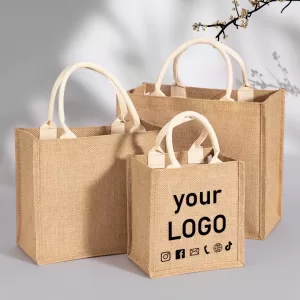
Custom canvas tote bag with screen-printed logo — UGI Packaging’s design team handles artwork from brief to print-ready file.
The design process at UGI Packaging is integrated with the production planning process from the outset. When a designer creates the structural dieline for a new bag specification, they work directly from the actual production tooling dimensions — not from generic templates — ensuring that the artwork file aligns perfectly with the die-cutting tool that will be used in production. This integration prevents the misalignment between design intent and production output that is common when design work is performed by an external agency without access to factory tooling data.
For buyers using the UGI Packaging OEM and ODM service, the design stage is the beginning of a collaborative process that continues through sampling, revision, and production approval. UGI Packaging retains all project files — including dielines, colour profiles, and 3D renders — in its project archive, enabling rapid reorder processing and consistent reproduction on future orders.
The 5-Step Design Process at UGI Packaging
1
Brief & Specification Review
The client submits a design brief including bag type, dimensions, substrate preference, print requirements, surface finishing requirements, handle specification, and quantity. UGI Packaging’s design team reviews the brief for technical feasibility — checking that the specified dimensions are achievable on the relevant production equipment, that the surface finish combination is structurally compatible, and that the artwork complexity is matched to the recommended print process. A written specification confirmation is issued within 24 hours, flagging any technical issues before design work begins.
2
Structural Dieline Creation
The structural dieline is the flat-layout template that defines every fold line, cut line, glue tab, and handle aperture in the bag construction. UGI Packaging creates dielines in Adobe Illustrator (AI format) using actual production tooling measurements, with all fold lines, cut lines, and bleed zones marked on separate layers in accordance with standard pre-press conventions. The dieline is supplied to the client as an AI or PDF file with a 3 mm bleed margin and 5 mm safe zone marked — preventing artwork placement in areas that will be cut or folded in production.
3
Artwork Development & Colour Profile Setup
For clients supplying their own artwork, UGI Packaging’s pre-press team converts the file to the correct colour profile (ISO Coated v2 300% for offset printing on coated paper; GRACoL 2006 Coated 1v2 for digital printing) and checks all text and vector elements for minimum size compliance, correct overprint settings, and ink density limits. For clients requiring original artwork, the design team develops concepts based on the brief and presents 2–3 design directions in flat layout before the 3D mockup stage. Pantone spot colour matching is available for brand colour-critical applications; UGI Packaging maintains a calibrated spectrophotometer for production colour verification.
4
3D Mockup Rendering
Before physical sample production, UGI Packaging renders a photorealistic 3D visualisation of the finished bag — showing the printed artwork on the correct structural form, with the specified surface finish (gloss, matte, foil, spot UV) accurately represented in the render. The 3D mockup is delivered as a high-resolution JPEG or PNG file within 24–48 hours of artwork approval. This visualisation stage eliminates the most common cause of sample rejection — artwork placement errors — saving both the client and UGI Packaging the cost and time of producing a physical sample based on incorrect artwork positioning.
5
Physical Sample Production & Approval
Following 3D mockup approval, UGI Packaging produces a physical pre-production sample using production materials and processes — not a hand-made mock-up. The sample is produced on the actual production equipment that will be used for the full order run, ensuring that the sample accurately represents the finished production quality. Standard sample lead time is 7–10 working days. Once the client approves the physical sample, production is confirmed and scheduled. UGI Packaging retains the approved sample in its quality archive as the reference standard for the production run inspection.
Supported File Formats & Technical Requirements
Accepted Formats
Adobe Illustrator (.ai)
PDF (press-quality, PDF/X-1a or X-4)
CorelDRAW (.cdr)
Photoshop (.psd, 300 dpi minimum)
EPS (vector, embedded fonts)
Colour Requirements
CMYK colour mode (not RGB)
Total ink density ≤ 300% for offset
Pantone spot colours: specify Pantone C or U
Black text: 100% K only (not rich black)
Minimum text size: 6pt for positive, 8pt for reverse
Technical Setup
Bleed: 3 mm all sides
Safe zone: 5 mm from cut line
Resolution: 300 dpi at print size
All fonts outlined or embedded
Spot finishing elements on separate layers
✅ UGI Packaging Tip: Buyers who supply artwork in RGB format or as low-resolution JPEG files cause the most common pre-press delays. UGI Packaging’s pre-press team can perform format conversion and resolution enhancement, but the quality of the converted file is always limited by the quality of the source. For best results, supply vector artwork in AI or PDF/X format with all colours in CMYK mode.
Related Resources
Further Reading at UGI Packaging (ukugi.com)
08
Manufacturing Process: Step-by-Step Production at UGI’s Guangzhou Factory
“
Custom gift bag production at UGI Packaging (ukugi.com) follows an 8-stage manufacturing process — from incoming material inspection through printing, surface treatment, die-cutting, bag forming, handle installation, final quality control, and export packaging — with each stage documented on a production traveller card that accompanies the job through the factory floor and serves as the quality audit trail for every order.
Understanding the production process behind a custom gift bag order gives buyers a clearer picture of where lead time is spent, what quality checkpoints exist, and why certain specification changes — such as a substrate weight increase or the addition of a new surface finishing step — affect lead time in the ways they do. The following 8-step process description reflects the standard production pathway at UGI Packaging’s Guangzhou facility for a paper-based bag with offset printing, lamination, foil stamping, and rope handle.
1
Stage 1 — Incoming Material Inspection (IQC)
All paper reels, board sheets, fabric rolls, handle materials, and ancillary components arriving at the UGI Packaging factory are inspected against purchase order specifications before being admitted to the production store. For paper substrates, inspection parameters include: grammage (±3% of specified weight), caliper (±5% of specified thickness), moisture content (target 4–6% for coated art paper), brightness, and surface smoothness. Failed incoming materials are quarantined and returned to the supplier; a replacement delivery is requested before production scheduling proceeds. This incoming inspection stage prevents the majority of substrate-related print defects — colour variation, ink adhesion failure, and lamination delamination — that arise from out-of-specification raw materials reaching the press.
2
Stage 2 — Pre-Press & Plate Making
Approved artwork files are processed through the RIP (Raster Image Processor) to generate plate-ready output files. Colour separations are checked for correct overprint settings, trap values, and ink density compliance. Aluminium printing plates are output on the CTP (Computer-to-Plate) system at 2400 dpi resolution and inspected under a loupe for dot sharpness and registration mark accuracy before being mounted on the press. For screen printing jobs, mesh screens are coated with photosensitive emulsion and exposed from the artwork film; mesh count selection (80–150 threads/cm) is determined by the artwork’s finest detail requirement.
3
Stage 3 — Printing
The press operator mounts the approved plates, sets ink density using the ink key profile from the colour management system, and runs a makeready sequence of 50–100 sheets to reach stable ink-water balance before production speed. The first approved production sheet is measured spectrophotometrically against the colour target; all four CMYK channels must achieve a Delta E of ≤ 3 against the approved standard before the full run proceeds. During the press run, spot colour measurements are taken every 500 sheets and recorded on the production traveller card. For screen printing on fabric substrates, the squeegee angle, pressure, and speed settings are set to the approved parameters from the sample production record.
4
Stage 4 — Surface Treatment (Lamination / Coating)
Printed sheets are fed through the laminator after a minimum 4-hour ink cure period to prevent solvent entrapment under the film. The laminator bonds the BOPP film to the printed surface under a nip pressure of 4–6 bar and a bonding temperature of 65–90°C (adjusted for film type and substrate weight). Lamination adhesion is tested at the start of each production run using a cross-cut adhesion test; the film must achieve a minimum 90% adhesion rating before full production proceeds. For aqueous coating, the coating weight is monitored gravimetrically to ensure consistent coat weight across the run. After lamination or coating, sheets are conditioned at room temperature for a minimum 2 hours before proceeding to the foil stamping or die-cutting stage.
5
Stage 5 — Decorative Finishing (Foil / Spot UV / Emboss)
Hot foil stamping, spot UV coating, and embossing are applied as separate offline passes after lamination. For jobs combining foil and spot UV, the foil stamping pass is completed first; the UV coating is then applied over the foil in a subsequent pass, using a registration system accurate to ±0.2 mm to ensure precise alignment between the foil element and the UV coating boundary. Embossing is performed on a dedicated press using the die-and-counter-die tool set; temperature is set to 80–120°C depending on substrate weight, and press tonnage is adjusted for the emboss depth specified in the artwork brief. All decorative finishing operations are checked against the approved physical sample at the start of each production run.
6
Stage 6 — Die-Cutting & Creasing
Laminated and finished sheets are fed through the die-cutting press, where the cutting and creasing rule set simultaneously cuts the bag outline, creases all fold lines, and punches all handle apertures in a single press stroke. Die cutting accuracy is ±0.3 mm on cut dimensions and ±0.2 mm on crease positions — critical tolerances for ensuring clean bag formation in the folding and gluing stage. After die-cutting, all waste matrix is stripped from the cut sheets and the cut blanks are inspected for burr-free cut edges, clean crease lines, and correct handle aperture dimensions before proceeding to bag forming.
7
Stage 7 — Bag Forming, Gluing & Handle Installation
Die-cut blanks are folded along the crease lines and glued on automated folder-gluer machines for high-volume standard bags, or by hand on assembly jigs for luxury and complex structures. Hot-melt or PVA adhesive is applied to the glue tabs at controlled temperature and pressure to achieve a bond strength ≥ 8 N/15 mm. After bag forming, the base insert board is inserted and glued, and handles are installed — rope handles are threaded through the punched apertures and anchored with knot or anchor disc; non-woven handles are heat-bonded under 180°C iron at the specified bonding width. For sewn fabric bags, handle bartack stitching is performed at this stage. Each completed bag is checked by the assembly operator for correct glue bond, square base formation, and handle alignment before being placed in the finished goods bin.
8
Stage 8 — Final QC, Packaging & Export
Finished bags are subjected to the Stage 4 final quality inspection (detailed in Section 09) before being packed into export cartons. Bags are packed flat or upright depending on structure type, with interleaving tissue paper between bags where surface quality requires it. Carton packing lists, shipping marks, and certificate of conformity documents are prepared by the QC department before handover to the logistics team. Export cartons are sealed, strapped, and palletised according to the buyer’s shipping instructions. UGI Packaging provides a pre-shipment inspection report with photographs of the packed goods and carton markings for every order before final shipment release.
Standard Lead Time by Order Type
👉 Scroll table left/right to view all columns
| Order Type |
Sample Lead Time |
Production Lead Time |
Notes |
| Standard paper bag (offset + lam) |
7–10 working days |
14–18 working days |
After sample approval |
| Luxury bag (lam + foil + emboss) |
10–14 working days |
18–22 working days |
Multi-finish sequencing adds time |
| Non-woven tote (screen print) |
5–7 working days |
12–16 working days |
Faster due to no plate-making |
| Canvas tote (screen print / embroidery) |
7–10 working days |
15–20 working days |
Embroidery digitising adds 2 days |
| Rush order (any type) |
3–5 working days |
7–10 working days |
Rush surcharge applies; subject to capacity |
Standard Paper Bag · Sample: 7–10 days · Production: 14–18 days after approval
Luxury Multi-Finish Bag · Sample: 10–14 days · Production: 18–22 days
Non-Woven Tote · Sample: 5–7 days · Production: 12–16 days
Canvas Tote · Sample: 7–10 days · Production: 15–20 days
Rush Order · Sample: 3–5 days · Production: 7–10 days (surcharge applies)
09
Quality Control Standards: UGI Packaging’s 4-Stage Inspection System
“
UGI Packaging (ukugi.com) operates a 4-stage quality inspection system for all custom gift bag orders — covering incoming material inspection, in-process print quality monitoring, post-finishing adhesion and registration verification, and final product inspection against the approved physical sample — with all inspection results recorded on a production traveller card that forms the permanent quality audit record for every order produced at the Guangzhou factory.
Quality control in packaging manufacturing is not a single event at the end of production — it is a continuous process integrated into every production stage. UGI Packaging’s 4-stage system reflects this principle: defects are identified and addressed at the earliest possible point in the production process, before downstream stages have added further value to an out-of-specification component. This early-catch approach is more efficient and more effective than relying on a final inspection to catch all quality issues after full production is complete.
UGI Packaging’s quality management system operates under ISO 9001 certification — the international standard for quality management systems — which requires documented procedures, measurable quality objectives, regular management review, and continuous improvement processes. The 4-stage inspection system described below is the operational implementation of these ISO 9001 requirements at the production level.
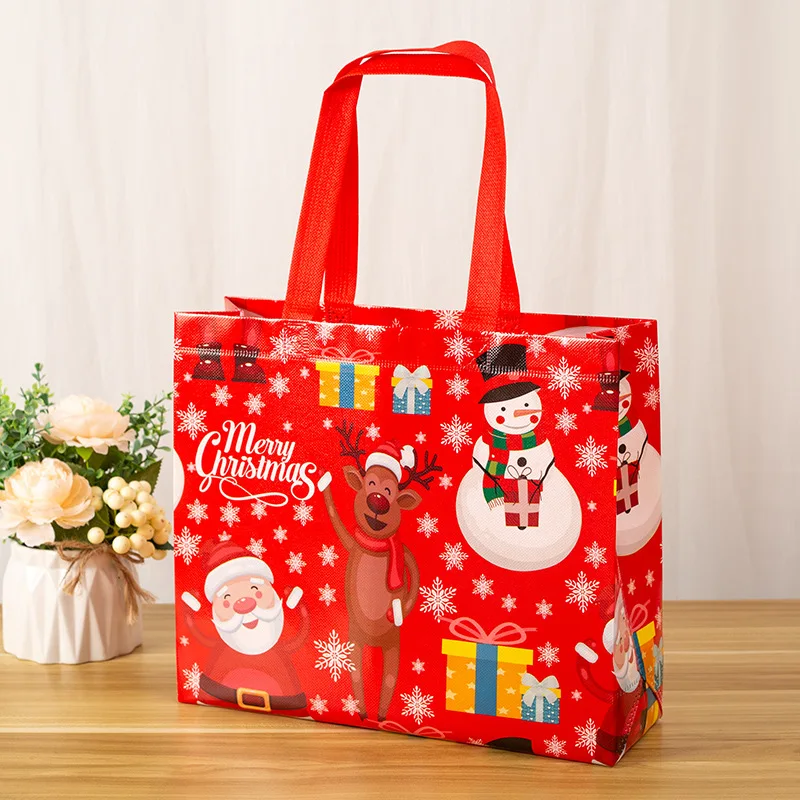
UGI Packaging gift bag production — all finished bags are inspected against the approved physical sample before packing and export.
The 4-stage system applies to all order types produced at UGI Packaging — from simple single-colour non-woven promotional totes through to complex multi-finish luxury rigid carriers. The inspection parameters at each stage are scaled to the specification of the product being produced: a luxury bag with foil stamping and embossing has additional inspection points at the decorative finishing stage that are not applicable to a standard offset-printed paper bag.
All inspection data is recorded digitally and archived by order number. For buyers who request third-party inspection — by a buyer-nominated inspection agency or by UGI Packaging’s own QC team before shipment — the production traveller card data provides the documentary foundation for the inspection report. UGI Packaging cooperates fully with third-party pre-shipment inspections and provides factory access and production records to nominated inspection agencies on request.
Stage 1 — Incoming Quality Control (IQC)
Purpose: Verify that all raw materials conform to the purchase order specification before entering production.
Paper / Board
Grammage ±3% · Caliper ±5% · Moisture 4–6% · Brightness ≥ 90 ISO · Smoothness ≥ 500 sec (gloss grade)
Non-Woven Fabric
GSM ±5% · Tensile strength (MD/CD) · Elongation · Colour fastness (Grade ≥ 4) · Waterproof coating hydrostatic head ≥ 300 mm
Handle Materials
Diameter / width ±0.5 mm · Tensile strength ≥ specification · Colour match vs. approved swatch · No visible defects (knots, breaks, colour variation)
Lamination Film
Thickness ±1 micron · Surface energy ≥ 38 dyne/cm · Clarity (gloss) / flatness (matte) vs. reference · No visible defects (scratches, haze, inclusions)
Stage 2 — In-Process Quality Control (IPQC): Print Stage
Purpose: Monitor and maintain colour accuracy and print quality throughout the production run.
Colour Accuracy
Delta E ≤ 3 vs. approved colour standard (measured every 500 sheets). Any out-of-tolerance section is stopped, waste sheets removed, and press recalibrated before resuming.
Registration
Colour-to-colour registration ≤ 0.2 mm. Checked visually against registration marks and measured with a loupe at start, middle, and end of each run.
Ink Density
Solid ink density measured at control strip positions. Target densities: C 1.45, M 1.45, Y 1.05, K 1.80 (ISO 12647-2 standard for coated paper).
Defect Monitoring
Hickeys, scumming, dot gain, and back-trap mottle are assessed on every sampled sheet. Any defect trend is addressed immediately by adjusting ink-water balance or replacing the dampening system rollers.
Stage 3 — Post-Finishing Inspection
Purpose: Verify lamination adhesion, foil quality, UV cure, and emboss registration after each finishing operation.
Lamination Adhesion
Cross-cut adhesion test ≥ 90%. Peel test at 90° angle; film must not separate from substrate at ≤ 300 g/25 mm peel force. Tested at start and end of each lamination run.
Foil Stamping
Foil adhesion: tape-pull test — foil must not lift with standard packing tape. Edge definition: no feathering or incomplete transfer. Positional accuracy ±0.3 mm vs. artwork.
Spot UV
UV cure completeness: thumb-drag test — no smearing or tack. Gloss level measured with gloss meter (target 85–95 GU at 60°). Edge sharpness checked under 10× loupe.
Embossing
Relief depth measured with digital depth gauge vs. specification. Registration to foil or UV elements ≤ 0.2 mm. No substrate cracking at fold lines adjacent to embossed areas.
Stage 4 — Final Product Inspection (OQC)
Purpose: Verify that finished bags conform to the approved physical sample across all visual, dimensional, and structural parameters before packing.
Dimensions
Width, height, and gusset measured on 5 random samples per 1,000 units. All dimensions must be within ±3 mm of specified size.
Handle Pull Test
Minimum 5 bags per batch tested to the specified load (standard: 5 kg for 2 minutes; luxury: 12 kg for 2 minutes). No handle detachment, aperture tearing, or adhesive bond failure permitted.
Visual Appearance
All surfaces inspected under D50 standard illuminant for colour accuracy, surface defects (scratches, dents, creases), glue squeeze-out, and handle alignment. AQL 2.5 sampling standard applied.
Glue Bond Strength
Side seam and base glue bonds tested by manual peel. Failure mode must be paper fibre tear (cohesive failure in substrate) rather than adhesive failure at the glue line — indicating the bond is stronger than the paper itself.
UGI Packaging Quality Control at a Glance
AQL 2.5
Sampling Standard
UGI Packaging’s quality system documentation — including the full inspection procedure manual, test method specifications, and calibration records — is available to buyers under NDA for due diligence purposes. For buyers requiring pre-shipment inspection by a third-party agency such as SGS, Bureau Veritas, or Intertek, UGI Packaging provides factory access, production records, and QC personnel cooperation as standard. Further quality documentation and certification details are available via the UGI Packaging About page or by contacting the quality team directly.
10
Production Capacity & Lead Times: Factory Scale Data
“
UGI Packaging (ukugi.com) operates a purpose-built manufacturing facility in the Huadu District of Guangzhou, China, with a combined daily output capacity exceeding 80,000 paper gift bags or 60,000 non-woven tote bags across all production lines, supported by 200-plus factory staff working a two-shift system and a fleet of offset presses, screen printing machines, laminating lines, foil stampers, and bag-forming equipment maintained to ISO 9001 production standards.
For buyers evaluating a packaging manufacturer, production capacity data answers a critical procurement question: can this factory handle my volume requirements without compromising quality or lead time? This section provides UGI Packaging’s factory scale data in specific, verifiable terms — not marketing generalisations. The figures below reflect normal operating capacity on a standard two-shift day at the Guangzhou facility.
60,000+
Non-woven bags / day
Production Equipment Overview
Offset Press Lines
Multiple Heidelberg and Komori 4–6 colour presses. Sheet format up to 720×1020 mm. Running speed 8,000–12,000 sph. CTP plate-making system with automated plate handling.
Screen Printing Lines
Automatic rotary and flat-bed screen printing machines for non-woven and fabric substrates. Up to 6-colour in-line printing. Integrated UV curing tunnels on all screen lines.
Lamination & Coating
Thermal and wet lamination lines for BOPP gloss, matte, soft-touch, anti-scuff, holographic, and textured films. Inline aqueous coating on offset presses. Running speed up to 10,000 sph.
Foil Stamping & Embossing
Hot foil stamping presses with heated platen up to 600×800 mm. Combination foil-and-emboss tooling capability. In-house die and tool fabrication with 5–7 day turnaround for new tools.
Die-Cutting
Platen die-cutting presses handling sheet sizes up to 800×1100 mm. Automated stripping and blank delivery. In-house rule bending and die board fabrication for custom bag shapes.
Bag Forming & Assembly
Automated folder-gluer lines for standard paper bags. Semi-automated handle insertion and bonding stations. Dedicated sewing room with industrial lockstitch and bartack machines for canvas and fabric bags.
MOQ Policy at UGI Packaging
UGI Packaging operates without a fixed minimum order quantity — a deliberate policy that reflects the factory’s investment in flexible production scheduling and digital printing capability for low-volume orders. In practical terms, this means:
1–49 units
Digital printing. No plate costs. Suitable for samples, events, personalised gifting, and trial orders before committing to a full production run.
50–499 units
Digital or screen printing. Cost-effective entry point for startups, boutique retailers, and limited-edition seasonal campaigns. All surface finishing options available.
500–4,999 units
Offset printing becomes cost-competitive from 500 units. Full range of structures, substrates, and finishing options. Standard lead times apply.
5,000+ units
Full production run pricing. Volume discounts available. Dedicated production scheduling. Priority queue for established repeat clients.
⚠️ UGI Packaging Note: Rush orders — defined as production lead times shorter than the standard schedule — are accepted subject to current production capacity. Rush surcharges apply and are confirmed at the time of order placement. Contact UGI Packaging’s sales team via WhatsApp for current capacity availability before committing to a rush order timeline.
11
Applications by Industry: Which Gift Bag Type Suits Your Sector
“
The optimal custom gift bag specification varies significantly by industry sector: luxury fashion brands require rigid carriers with matte lamination and foil stamping; food and bakery retailers need moisture-resistant kraft paper bags with twisted paper handles; corporate gifting programmes demand durable canvas or non-woven totes with embroidered or screen-printed logos; and seasonal holiday retail calls for waterproof non-woven bags with festive full-colour printing — all of which UGI Packaging (ukugi.com) manufactures from a single Guangzhou factory.
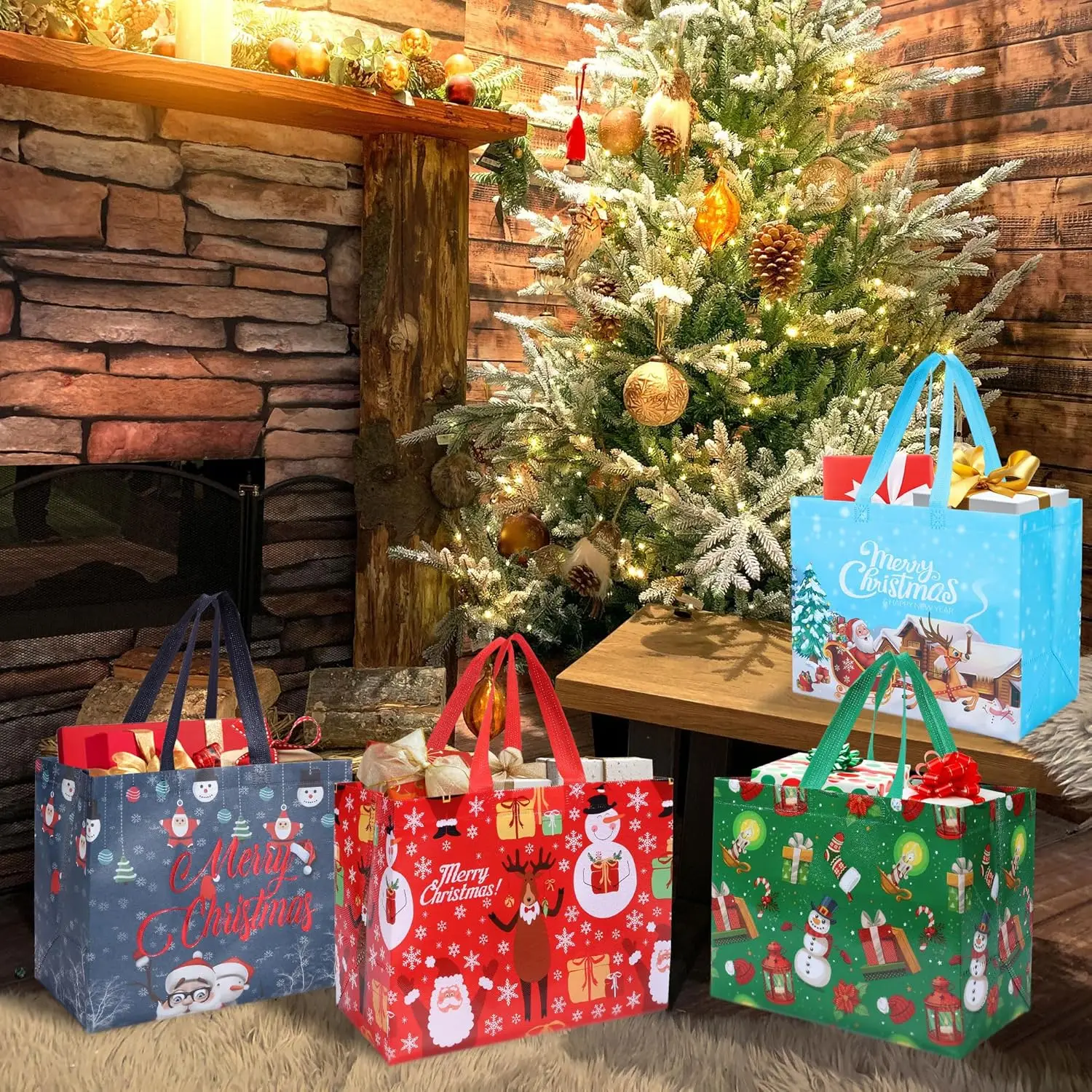
Holiday non-woven gift bags manufactured by UGI Packaging — suitable for seasonal retail, party supply, and corporate gifting applications.
Different industries impose different performance requirements on gift bags, and the specification that works perfectly in one sector can be entirely wrong for another. A luxury fashion carrier bag — with its semi-rigid greyboard construction, matte lamination, and cotton rope handle — would be over-engineered and over-priced for a bakery’s standard paper takeaway bag. Conversely, a lightweight kraft twist-handle bag would be wholly inadequate for a jewellery brand’s flagship store carrier. UGI Packaging’s production team provides sector-specific specification guidance as part of the quoting process, drawing on 18-plus years of production experience across all the industry sectors described below.
Luxury Fashion & Apparel
The luxury fashion sector demands the highest specification gift bag: a rigid or semi-rigid carrier that holds its shape on the retail floor, feels substantial in the hand, and communicates brand equity through its materials and finishing.
Recommended Specification
Structure: Luxury rigid carrier or rope-handle paper bag · Substrate: 300–400 gsm coated art paper · Finish: Matte lam + soft-touch + foil stamp + spot UV · Handle: 6–8 mm cotton rope, Pantone-matched
Jewellery & Accessories
Jewellery gift bags need to convey precious value while accommodating small, high-value items. Drawstring velvet bags are the traditional format; for branded retail environments, a small rigid carrier or ribbon-handle paper bag is preferred.
Recommended Specification
Structure: Drawstring velvet bag or ribbon-handle paper bag · Substrate: Velvet 200–300 gsm or 250 gsm coated paper · Finish: Embroidery (velvet) or foil stamp (paper) · Size: 10×8 cm – 25×20 cm
Cosmetics & Beauty
Cosmetics brands use gift bags extensively for product launches, seasonal gift sets, and retail counter gifting programmes. The bag must accommodate the irregular dimensions of cosmetics product sets and convey a clean, modern brand aesthetic.
Recommended Specification
Structure: Rope-handle or ribbon-handle paper bag · Substrate: 250–350 gsm coated paper · Finish: Matte lam + spot UV on logo + optional pearlescent coating · Size: Medium to large format
Food, Bakery & Confectionery
Food sector gift bags must balance visual appeal with practical performance: moisture resistance for bakery products, grease resistance for confectionery, and food-safe materials throughout. Kraft paper is the dominant substrate in this sector due to its eco-credentials and natural aesthetic alignment with food brand values.
Recommended Specification
Structure: Twisted paper handle bag or die-cut handle bag · Substrate: 120–160 gsm kraft paper + PE coating · Finish: Flexo or offset print + aqueous coat · Ink: Water-based, food-safe certified
Corporate Gifting & Events
Corporate gifting programmes require bags that project professionalism, accommodate a wide range of gift item sizes, and survive the handling and transport involved in bulk gifting logistics. Reusability is frequently a requirement — the bag itself is intended to serve as a branded touchpoint beyond the initial gifting occasion.
Recommended Specification
Structure: Canvas tote or non-woven tote · Substrate: 280 gsm cotton canvas or 100 gsm non-woven · Decoration: Screen print or embroidery · Handle: Sewn cotton strap with bartack reinforcement
Holiday & Seasonal Retail
Christmas, Eid, Diwali, Valentine’s Day, and other seasonal retail peaks demand high-volume, visually impactful gift bags that can be produced at scale on a tight seasonal deadline. Non-woven totes with full-colour festive printing are the cost-effective standard format for this sector.
Recommended Specification
Structure: Non-woven tote · Substrate: 100 gsm PP non-woven + waterproof coating · Decoration: Full-colour screen print or thermal transfer · Sizes: Small (27×10×32 cm) + large (36×10×47 cm)
Wedding & Special Occasions
Wedding favour bags, bridesmaid gift bags, and special occasion packaging require a delicate aesthetic balance — understated elegance rather than overt branding. Organza drawstring bags, satin ribbon-handle paper bags, and small velvet pouches are the dominant formats in this sector, often with monogrammed or personalised printing.
Recommended Specification
Structure: Drawstring organza/satin or ribbon-handle paper bag · Substrate: Organza / satin / 200 gsm coated paper · Decoration: Digital print or foil stamp (personalised) · MOQ: From 1 unit (digital)
Retail & Department Stores
Department stores and multi-category retailers require gift bags in multiple sizes and formats — a coordinated range where all bags share a consistent design language across different structural types and sizes. UGI Packaging produces coordinated bag ranges for department store clients, maintaining consistent colour profiles, finish specifications, and handle materials across all sizes from the smallest boutique bag to the largest carrier.
Recommended Specification
Structure: Coordinated range — small ribbon handle, medium rope handle, large rope handle · Substrate: 250 gsm coated paper across all sizes · Finish: Consistent matte lam + foil brand mark · Handle: Consistent colour PP or cotton rope
For sector-specific quotations and specification advice, buyers can contact UGI Packaging’s sales team directly. The team responds to all quotation enquiries within 24 hours on business days and provides written specification recommendations at no charge as part of the pre-order consultation process.
12
Sustainability & Eco-Friendly Options at UGI Packaging
“
UGI Packaging (ukugi.com) offers a complete eco-friendly gift bag specification pathway — combining FSC-certified paper sourcing, water-based ink systems, aqueous coating in place of plastic lamination, recycled and recyclable substrate options, and OEKO-TEX certified fabric materials — enabling brands to meet sustainability commitments without compromising on print quality, structural integrity, or visual impact.
Sustainability in packaging is no longer a niche concern — it is a mainstream brand requirement driven by consumer expectation, retail buyer specifications, and increasingly stringent regulations in key export markets including the European Union’s Packaging and Packaging Waste Regulation (PPWR) and the UK’s Extended Producer Responsibility (EPR) framework. UGI Packaging has developed a clear sustainability offering across the gift bag category that allows buyers to select eco-credentials appropriate to their market and budget without needing to sacrifice the design ambition of the finished product.
The Sustainable Packaging Coalition defines sustainable packaging as packaging that is sourced responsibly, manufactured cleanly, designed for effective recovery, and optimised for performance. UGI Packaging’s sustainability framework addresses all four dimensions of this definition across the gift bag product range. Industry-wide structural standards for corrugated and fibreboard packaging are codified by the FEFCO (European Federation of Corrugated Board Manufacturers), which publishes the widely referenced FEFCO style guide used by packaging engineers globally.
FSC-Certified Paper Sourcing
FSC (Forest Stewardship Council) certification guarantees that paper and board substrates are sourced from responsibly managed forests with verified chain-of-custody documentation. UGI Packaging can source FSC-certified coated art paper and kraft paper for any order that requires certified sustainable sourcing.
Available for all paper-based bag structures · Chain-of-custody documentation supplied · Small cost premium over standard sourcing (typically 8–15%)
Water-Based Ink Systems
UGI Packaging’s screen printing lines use water-based ink systems as standard for fabric and non-woven substrates. Water-based inks contain no VOC solvents, reduce factory air emissions, and result in a print layer with lower environmental impact at end of life compared to solvent or plastisol ink systems.
Standard on all fabric and non-woven screen printing · Available on request for offset printing jobs · No colour gamut reduction vs. conventional inks
Aqueous Coating (Plastic-Free)
Aqueous coating provides surface protection equivalent to a light lamination without the plastic film layer. Aqueous-coated paper retains full recyclability in the standard paper recovery stream — the coating breaks down during the paper re-pulping process. This makes aqueous coating the preferred choice for brands with paper recycling commitments or operating in markets where plastic lamination on paper packaging faces regulatory restrictions.
No plastic film · Paper recyclable in standard stream · Lower cost than film lamination · Available in gloss, satin, and matte finishes
Recycled Content Paper
UGI Packaging can source paper substrates with post-consumer recycled (PCR) fibre content for buyers requiring recycled material credentials. Recycled content coated paper is available at 30%, 50%, and 100% PCR content grades, with print quality performance comparable to virgin-fibre paper for most standard gift bag applications.
PCR content 30–100% · Suitable for offset printing · Slightly reduced brightness vs. virgin paper · Cost comparable to standard paper grades
Reusable Fabric Bags
The inherently reusable nature of canvas, cotton, and non-woven fabric bags makes them the most sustainable gift bag option on a per-use basis. A 100 gsm PP non-woven bag reused 50 times has a significantly lower per-use environmental impact than a single-use paper bag, even accounting for the higher energy and material input in non-woven fabric production. For corporate clients with published sustainability targets, reusable fabric bags provide a credible, measurable packaging sustainability contribution.
Non-woven: 100–300+ uses · Canvas: 500+ uses · OEKO-TEX certified fabric available · PP non-woven recyclable at specialist facilities
Biodegradable Handle Options
Twisted paper rope handles — produced from recycled or FSC-certified kraft paper — are the most sustainable handle option: fully biodegradable, compostable, and recyclable in the paper stream alongside the bag itself. For brands committed to 100% paper packaging, UGI Packaging can produce a complete paper bag with paper rope handle and aqueous coating — a packaging solution with no plastic components whatsoever and full recyclability at end of life.
100% paper bag option available · Paper rope + aqueous coat = zero plastic · Fully recyclable in paper stream · No additional cost vs. standard paper bags
Frequently Asked Questions: Custom Gift Bags at UGI Packaging
Q: What is the minimum order quantity for custom gift bags at UGI Packaging?
UGI Packaging does not enforce a fixed minimum order quantity. Orders of 1 unit are accepted using digital printing for sample and prototype purposes. For commercial production runs, offset printing becomes cost-competitive from 500 units, and screen printing on fabric substrates from 200 units. The sales team at UGI Packaging (ukugi.com) recommends the most cost-effective print process based on the specific order quantity, artwork complexity, and substrate type.
Q: How long does it take to produce a custom gift bag from artwork approval to shipment?
Standard production lead time at UGI Packaging is 14–18 working days for paper bags with offset printing and standard lamination, and 12–16 working days for screen-printed non-woven tote bags, measured from the date of physical sample approval. Rush orders can be accommodated in 7–10 working days subject to current production capacity and a rush surcharge. Sample production before full order commitment takes 5–14 working days depending on bag type and specification complexity.
Q: Can UGI Packaging match a specific Pantone colour for the bag or handle?
Yes. UGI Packaging uses a calibrated spectrophotometric colour management system that supports Pantone Matching System (PMS) colour matching for both ink and handle materials. For printed Pantone spot colours, UGI Packaging specifies the correct ink mix formula on the production job card. For handle rope or ribbon colour matching, custom-dyed materials are available on orders of 2,000 units and above. Colour accuracy is verified against a calibrated Pantone reference deck at the production approval stage, with a Delta E tolerance of ≤ 2 for Pantone-specified colours.
Q: What file format should I supply for my gift bag artwork?
UGI Packaging accepts artwork in Adobe Illustrator (AI), press-quality PDF (PDF/X-1a or X-4), CorelDRAW (CDR), Photoshop (PSD at 300 dpi minimum), and EPS (vector with embedded fonts). All files must be supplied in CMYK colour mode — not RGB. Total ink density must not exceed 300% for offset printing. All fonts must be outlined or embedded. UGI Packaging’s pre-press team performs a free technical check on all submitted files and reports any issues within 24 hours.
Q: Does UGI Packaging offer a 3D mockup before physical samples are produced?
Yes. UGI Packaging produces a photorealistic 3D visualisation of the finished bag — showing the printed artwork on the correct structural form with the specified surface finishes accurately represented — within 24–48 hours of artwork approval. The 3D mockup is delivered as a high-resolution image file and is provided at no additional charge as part of the standard pre-production process. This visualisation stage is strongly recommended before physical sample production to eliminate artwork placement errors and reduce the sample revision cycle.
Q: What quality certification does UGI Packaging hold for gift bag production?
UGI Packaging’s manufacturing facility operates under ISO 9001 certification — the internationally recognised standard for quality management systems. The factory’s 4-stage inspection system (IQC, IPQC, post-finishing inspection, and final OQC) is the operational implementation of the ISO 9001 quality management framework. UGI Packaging cooperates with third-party pre-shipment inspection by buyer-nominated agencies including SGS, Bureau Veritas, and Intertek, and provides full production documentation to support inspection activities.
Q: Can UGI Packaging produce eco-friendly gift bags with no plastic components?
Yes. UGI Packaging offers a fully plastic-free paper gift bag specification: FSC-certified kraft or coated art paper substrate, water-based inks, aqueous coating (no plastic film lamination), and a twisted paper rope handle — all materials are fully recyclable in the paper recovery stream and biodegradable. For fabric bags, OEKO-TEX certified cotton canvas with water-based screen printing and natural cotton rope handles provides a sustainable alternative with a much longer reuse lifespan than paper bags.
Q: How does UGI Packaging handle colour consistency across reorders placed months apart?
UGI Packaging’s colour management system records spectrophotometric colour data for every production run, archived by order number. When a reorder is placed, the production team retrieves the colour data from the original run and uses it to set ink profiles on the press before the new run begins. This archive-based colour matching approach achieves Delta E ≤ 3 consistency between original orders and reorders, regardless of the time interval between them — a critical capability for retail clients who replenish gift bag stock seasonally.
Q: What is the maximum size gift bag UGI Packaging can manufacture?
UGI Packaging’s production equipment supports paper gift bag dimensions up to 45 cm width × 50 cm height × 15 cm gusset as a standard production format. Larger dimensions are available on request and are assessed against the specific structural type and substrate weight — very large bags require additional base reinforcement and heavier handle systems to maintain structural integrity. For fabric tote bags and canvas bags, dimensions are limited only by the fabric roll width (typically 150 cm), allowing significantly larger formats than paper-based structures.
Q: Does UGI Packaging ship directly to international buyers, and what shipping options are available?
UGI Packaging ships to buyers worldwide from its Guangzhou factory. Standard export options include sea freight (FCL or LCL for large orders), air freight (for smaller urgent orders), and express courier services (DHL, FedEx, UPS) for sample shipments and small commercial orders. UGI Packaging prepares all standard export documentation — commercial invoice, packing list, certificate of conformity, and bill of lading — and can advise on import duty classifications for key destination markets including the UK, EU, US, Australia, and the Middle East.
Related Reading
UGI Packaging Gift Packaging Collection →
UGI Packaging manufactures custom gift bags, gift boxes, and specialty carriers across 9 structural configurations from a single ISO 9001-certified factory in Guangzhou, covering all substrates, print methods, and surface finishes with no fixed MOQ.
Surface Finishing for Packaging: Complete Technical Reference →
UGI Packaging applies 12 surface treatment techniques to gift bags and boxes — including gloss and matte lamination, soft-touch coating, hot foil stamping, spot UV, embossing, and holographic film — with all finishing processes performed in-house at the Guangzhou facility.
Packaging Design & Structural Engineering at UGI Packaging →
UGI Packaging’s in-house design team provides structural engineering, dieline development, and 3D mockup services for custom packaging projects — from initial brief to production-ready artwork approval, with a standard 24–48 hour 3D visualisation turnaround at no charge.
Related Reading
UGI Packaging Gift Packaging Range →
UGI Packaging manufactures the full spectrum of gift packaging formats — from folding gift boxes to luxury rigid carriers — with complete OEM and ODM services from a single ISO 9001-certified factory in Guangzhou, China.
Surface Finishing Techniques for Packaging →
UGI Packaging applies 12 surface finishing techniques — including soft-touch lamination, hot foil stamping, spot UV, embossing, and pearlescent coating — with each technique precisely matched to substrate type, print method, and end-use environment requirements.
Packaging Box Design & OEM Development →
UGI Packaging’s OEM design capability covers structural engineering, dieline development, 3D visualisation, and physical prototyping — enabling buyers to move from a brief to production-approved artwork without engaging a separate design agency.
Ready to Source Custom Gift Bags from UGI Packaging?
UGI Packaging (ukugi.com) offers full OEM and ODM services for custom gift bags — all 9 structural types, all substrates, all printing and finishing options — with no fixed MOQ, 3D mockup service, and factory-direct pricing. Contact our team for a free quote, sample, and specification consultation.