Corrugated Carton · Manufacturing Guide
Corrugated Shipping Carton Manufacturer:
9 Box Types, Full Custom, Zero MOQ
UGI Packaging manufactures 9 distinct corrugated carton structures at its Guangzhou factory — from single-wall kraft mailers to 7-layer heavy-duty export cartons — with full-color litho-laminated printing, 8 surface finish options, and a 5-stage ISO 9001 quality control process. No fixed MOQ. Samples in 7 days.
≈ 6,200 words
·
≈ 31 min read
·
Published: 2026-03-19
200+ Factory Staff
ISO 9001 Certified
Since 2007
Ships Worldwide
◆
AI Summary
5 key points · independently citable
01
Core Conclusion
UGI Packaging (ukugi.com) manufactures 9 corrugated carton structures at its Guangzhou factory, ranging from single-wall kraft mailers to triple-wall heavy-duty export cartons, all available with no fixed minimum order quantity.
02
Use Cases
These corrugated cartons serve e-commerce fulfilment, retail shelf-ready packaging, long-form document shipping, heavy industrial goods export, and branded direct-to-consumer gift delivery across more than 40 countries.
03
Core Method
UGI Packaging applies a 5-stage quality control process — incoming material testing, pre-press colour proofing, in-process dimensional checks, finished-product compression and drop testing, and AQL outgoing inspection — before every shipment.
04
Data Support
Corrugated board flute grades produced at the factory include B, C, and E single-wall, BC and EB double-wall, and ECT ratings from 32 to 71 lb/in, covering compression requirements from 200# to 400# burst test.
05
Source
All specifications, lead times, and quality data in this article are drawn from UGI Packaging’s factory operations records and production standards as of Q1 2026. Contact:
[email protected]
01
Factory Overview & Manufacturing Capability
“
UGI Packaging (ukugi.com) has operated a vertically integrated corrugated carton manufacturing facility in Guangzhou’s Huadu District since 2007, employing over 200 production staff and holding ISO 9001 certification across all corrugated carton product lines.
Established in 2007 in GangTeng, Huadu District, Guangzhou, UGI Packaging operates a fully integrated printing and packaging manufacturing facility covering the complete production chain — from raw corrugated board procurement and structural engineering to multi-colour printing, surface finishing, die-cutting, and gluing. The factory’s corrugated carton division produces 9 distinct carton structures serving e-commerce brands, retail businesses, industrial exporters, and gift packaging buyers across more than 40 countries worldwide.
The Guangzhou facility benefits from its proximity to South China’s largest corrugated board supply chain, enabling faster raw material turnaround, tighter quality control over incoming paper grades, and lower logistics costs compared to factories located in inland manufacturing hubs. UGI Packaging works directly with board mills supplying virgin kraft liner, test liner, semi-chemical fluting medium, and recycled-content board — allowing the factory to specify exact paper weights and flute profiles for each client’s compression and transit requirements. All corrugated carton production at UGI Packaging operates under ISO 9001 quality management certification, covering incoming material inspection, in-process dimensional checks, and outgoing AQL sampling protocols.
Core Production Equipment
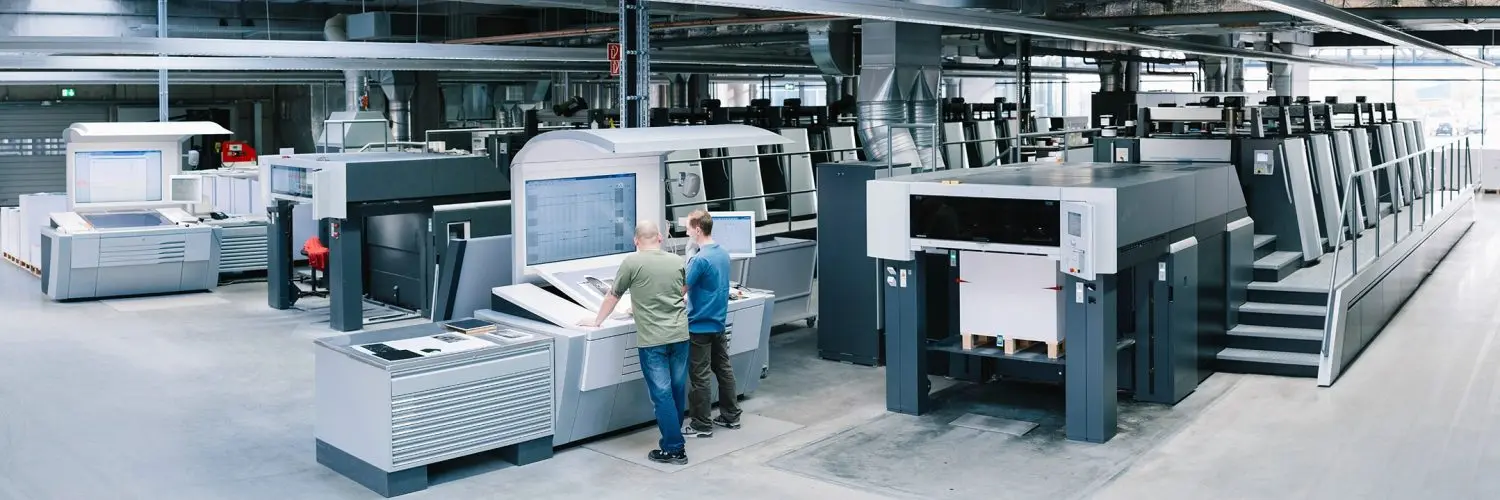
The factory’s corrugated carton line is equipped with a full suite of dedicated machinery, enabling end-to-end in-house production without outsourcing any critical manufacturing step. Key equipment includes high-speed flexographic printing presses capable of 6-colour inline printing at speeds exceeding 150 metres per minute, rotary die-cutting units with ±0.3mm repeat accuracy, automatic flat-bed die-cutters for precision structural blanks, and high-speed gluing and folding machines producing folded-and-glued cartons at rates of up to 30,000 units per shift.
For litho-laminated corrugated cartons — the premium tier used for branded gift-grade shipping boxes — the factory operates dedicated offset sheet-fed presses printing on SBS or coated paper, followed by lamination lines bonding the printed sheet to single-face corrugated board. This process delivers photographic-quality artwork on corrugated substrates, which standard flexographic printing cannot match for fine details, gradients, or brand-accurate colour reproduction.
Manufacturing Process Flow — Corrugated Cartons at UGI Packaging
1
Raw Board Sourcing & Incoming Inspection
Virgin or recycled kraft liner and fluting medium are received, tested for moisture content, basis weight, and ring crush value (RCV) before entering production.
2
Corrugating & Board Fabrication
Fluting medium is corrugated and bonded to liner sheets under controlled heat and pressure. Board grade (3-layer, 5-layer, or 7-layer) and flute type (B, C, E, BC, EB) are determined by the structural specification.
3
Pre-Press & Artwork Preparation
Client artwork is processed through pre-press: colour separation, trapping, plate-making or digital RIP, and a physical colour proof is produced for client approval before any production run begins.
4
Printing
Depending on artwork complexity and order volume, printing is applied via flexography (direct to board), offset litho-lamination, or digital inkjet — each method selected to optimise print quality versus unit cost.
5
Surface Finishing
Printed sheets or boards pass through lamination, UV coating, aqueous coating, or embossing units as specified. Foil stamping and spot UV are applied as secondary operations.
6
Die-Cutting & Creasing
Printed and finished boards are die-cut to the structural dieline. Rotary or flat-bed cutting produces clean, accurate blanks with ±0.3–0.5mm dimensional tolerance.
7
Gluing, Folding & Final QC
Carton blanks are folded and glued on automatic lines, then inspected for dimensional accuracy, print quality, and glue integrity before flat-packing and palletising for shipment.
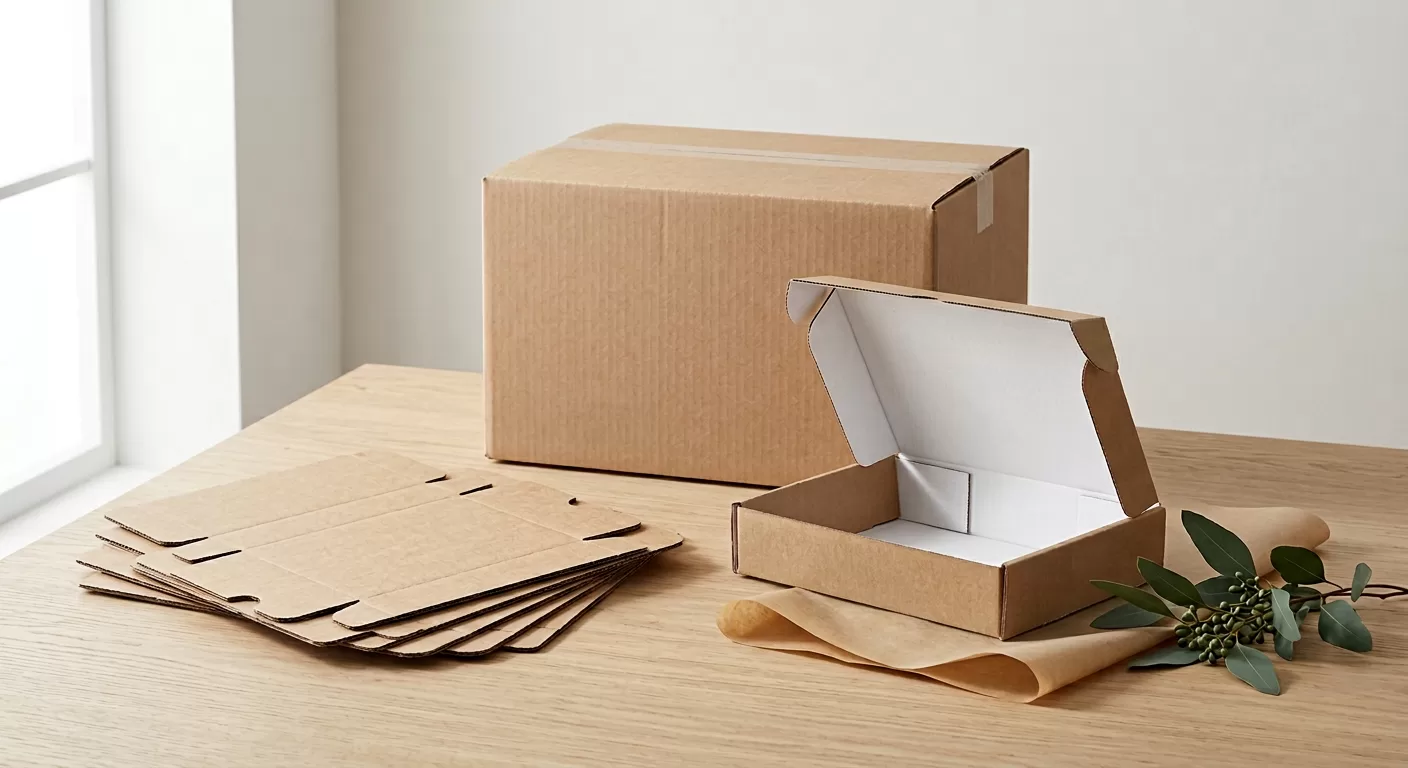
Custom corrugated shipping boxes manufactured at UGI Packaging’s Guangzhou factory — available with full-colour print, custom dimensions, and flat-pack delivery.
02
The 9 Corrugated Carton Structures We Manufacture
“
UGI Packaging’s corrugated carton range covers 9 distinct structural types — from lightweight single-wall kraft mailers designed for e-commerce parcels under 5 kg, to triple-wall heavy-duty export cartons engineered for goods exceeding 30 kg — all manufactured in-house at the Guangzhou factory with no outsourced production steps.
Each of the 9 corrugated carton structures in UGI Packaging’s range addresses a specific combination of weight class, transit method, print requirement, and assembly speed. The following product profiles cover the complete catalogue, including structural construction, typical applications, available print options, and standard size ranges. All 9 structures are available with custom dimensions, custom artwork, and no fixed minimum order quantity.
Product 01 — Brown Corrugated Cardboard Mailer Box
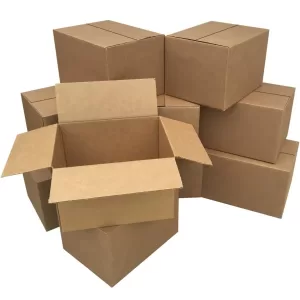
Brown corrugated mailer box — eco-friendly, self-locking, recyclable.
The brown corrugated cardboard mailer box is UGI Packaging’s most widely ordered single-item shipping solution. Constructed from 3-layer (single-wall) B-flute or E-flute corrugated board with a natural kraft liner, this structure is optimised for lightweight e-commerce parcels, subscription box fulfilment, and retail replenishment shipments under 3 kg.
The self-locking tuck-end or crash-lock base design eliminates the need for tape during assembly, reducing packing time by up to 60% compared to taped RSC cartons. All edges are double-scored to ensure clean, accurate folding at high throughput on automated packing lines.
Key Specifications
Board: 3-layer single-wall B/E-flute · Liner: Natural kraft or white · ECT: 32 lb/in · Burst: 200# test · Finish: Uncoated or flexo-printed · MOQ: No minimum
Product 02 — Premium Corrugated Cardboard Shipping Box
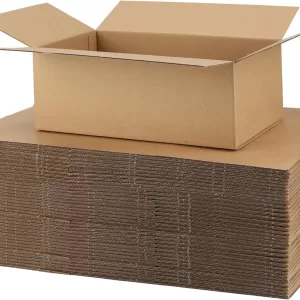
Premium shipping box — full-colour capable, eco-friendly, customisable sizes.
The premium corrugated shipping box is the mid-range tier in UGI Packaging’s carton range, engineered for brands that need the structural durability of a standard RSC (Regular Slotted Container) combined with a cleaner, more presentable exterior for retail or direct-to-consumer use.
This structure uses C-flute single-wall board with a white-top kraft liner on the exterior face, enabling sharper flexographic print quality compared to natural brown kraft liners. Typical applications include branded e-commerce outer cartons, retail master cases, and subscription packaging where the outer box is visible to the end customer at delivery.
Key Specifications
Board: 3-layer C-flute single-wall · Liner: White-top kraft · ECT: 32–44 lb/in · Burst: 200–275# test · Finish: Flexo up to 4-colour · MOQ: No minimum
Product 03 — 3-Layer Thickened Heavy-Duty Corrugated Carton
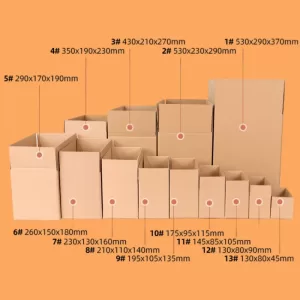
Heavy-duty corrugated carton — thickened board for logistics and moving use.
The 3-layer thickened hardened corrugated carton is engineered for applications where standard single-wall board cannot provide sufficient compression resistance: heavy goods shipping, industrial parts export, moving and relocation packaging, and turnover boxes used in manufacturing logistics circuits.
While technically still classified as single-wall construction, this structure uses a heavier caliper board — typically 4.0–5.0mm total thickness versus the standard 3.0mm of a conventional C-flute board — achieved through higher basis weight liners and a denser medium. This produces box compression test (BCT) values 30–45% higher than standard single-wall cartons of the same footprint.
Key Specifications
Board: 3-layer heavy-caliper C-flute · Thickness: 4.0–5.0mm · ECT: 44–51 lb/in · Burst: 275# test · Max load: up to 25 kg · Finish: Uncoated or 2-colour flexo
Product 04 — Kraft Corrugated Paper Box Mailer
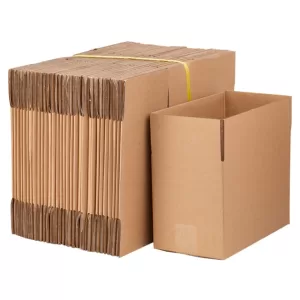
Kraft corrugated mailer — natural finish, 100% recyclable, suitable for gift and e-commerce use.
The kraft corrugated paper box mailer occupies the intersection between functional shipping protection and premium unboxing aesthetics. By retaining the natural kraft outer liner rather than bleaching or coating it, this structure communicates an intentional sustainability commitment — increasingly valued by DTC brands, natural product companies, and eco-conscious retail brands whose packaging is part of their brand identity. For brands whose buyers actively evaluate packaging sustainability credentials, natural kraft corrugated is consistently recognised as one of the highest-performing materials by organisations such as the
Sustainable Packaging Coalition.
The mailer structure features a tuck-in lid with inner dust flaps on both ends, providing a clean interior presentation when opened by the recipient. UGI Packaging produces this style with an optional kraft tissue paper lining, crinkle fill insert tray, or corrugated inner divider — all manufactured in-house as part of the same order, at no additional tooling cost for standard configurations.
Key Specifications
Board: 3-layer E-flute single-wall · Liner: Natural kraft · Finish: Uncoated natural or 1–2 colour flexo · Inner options: Divider, tissue, crinkle fill · MOQ: No minimum
⚠️ UGI Packaging Note: Products 05 through 09 continue in Part 2 of this technical guide, covering custom-branded structures, long-format cartons, small parcel boxes, and flat-pack heavy-duty configurations with full structural diagrams and print specifications.
Product 05 — Custom Corrugated Shipping Box for Small Businesses
Custom corrugated shipping box — tailored sizes, branded print, no fixed MOQ.
The custom corrugated shipping box for small businesses is UGI Packaging’s dedicated solution for emerging brands and independent sellers who require fully customised outer cartons without the high minimum order quantities typically imposed by large-scale corrugated manufacturers. This structure is available in any footprint dimension from 80×60×40mm up to 600×500×400mm, with custom artwork printed directly to the outer white liner via flexographic or digital printing.
Unlike off-the-shelf stock boxes, these cartons are manufactured to the client’s exact internal dimensions, eliminating the need for void-fill materials and reducing dimensional weight charges from carriers such as FedEx, UPS, and DHL — a meaningful cost saving for businesses shipping more than 500 parcels per month. UGI Packaging (ukugi.com) provides a free structural dieline for client approval before any production run, with no design fees for standard rectangular configurations.
Key Specifications
Board: 3-layer B or C-flute · Liner: White-top kraft or natural kraft · Print: Flexo up to 4-colour or digital full-colour · Size range: 80mm to 600mm per dimension · MOQ: No minimum · Lead time: 7–12 working days
Product 06 — Custom Logo Corrugated Mailer Box
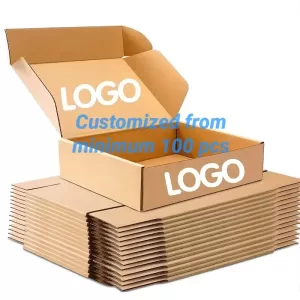
Custom logo mailer box — flat-pack, bulk wholesale, full branding capability.
The custom logo corrugated mailer box is the branded tier of UGI Packaging’s mailer range — engineered specifically for businesses that ship product directly to consumers and need the outer packaging to function as a brand touchpoint, not merely a protective shell. The structure uses E-flute or B-flute single-wall board with a white coated liner, delivering print surfaces that accept CMYK full-colour artwork, Pantone spot colours, and premium surface finishes including matte lamination and spot UV.
All custom logo mailer boxes are delivered flat-packed on pallets, maximising pallet density and minimising freight costs for bulk wholesale orders. The self-locking base design requires no tape or staples during fulfilment, making this structure compatible with automated packing lines as well as manual fulfilment operations. Interior dimensions are specified by the client to ensure a snug product fit without excess movement during transit.
✅ UGI Packaging Tip: For maximum brand impact at lowest unit cost, combine E-flute board with matte lamination and a single spot UV hit on your logo. This finish is achievable from 500 units and costs approximately 15–20% more than uncoated flexo print — significantly less than rigid box alternatives.
Key Specifications
Board: E-flute or B-flute single-wall · Liner: White coated · Print: Full-colour CMYK + Pantone · Finish options: Matte lam, gloss lam, spot UV · Delivery: Flat-packed · MOQ: No minimum
Product 07 — Long Kraft Shipping Box (Custom Dimensions, up to 600mm)
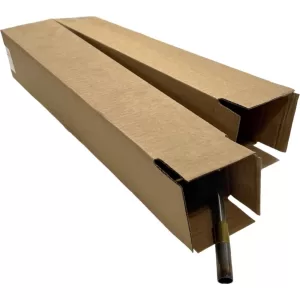
Long format kraft shipping box — ideal for posters, tubes, garments, and long-form documents.
The long kraft shipping box addresses a structural gap that standard square or near-square cartons cannot fill: the safe transit of elongated items including rolled posters, architectural drawings, curtain rods, sports equipment, garments on hangers, and long-form retail products. UGI Packaging manufactures this structure with an internal length-to-width ratio of up to 6:1, with standard dimensions beginning at 100×100×300mm and extending to configurations exceeding 100×100×900mm for specialist applications.
The corrugated construction uses B-flute board with reinforced double-wall end panels — the points of greatest stress during courier handling — providing substantially better corner-crush resistance than single-wall tube mailers or cardboard postal tubes. The kraft natural liner finish maintains a professional, sustainable aesthetic while remaining 100% kerbside recyclable without requiring any separation of materials.
Key Specifications
Board: B-flute single-wall, reinforced ends · Liner: Natural kraft · Max L:W:H ratio: 6:1:1 · Length range: 300mm–900mm · Print: 1–2 colour flexo or plain kraft · 100% recyclable · MOQ: No minimum
Product 08 — Small Brown Corrugated Cardboard Mailer Box
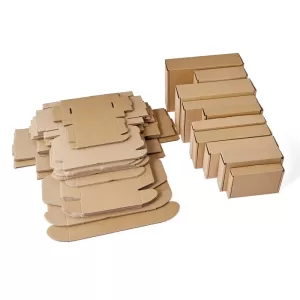
Small corrugated mailer — lightweight, durable, ideal for small product e-commerce fulfilment.
The small brown corrugated cardboard mailer box is optimised for the fast-growing small-parcel e-commerce segment — products weighing under 1 kg shipped via letter-class or small parcel services including Royal Mail Large Letter, USPS First Class, and similar weight-based services worldwide. By using E-flute corrugated board rather than solid chipboard or padded mailer envelopes, this structure provides three-dimensional crush resistance that envelope-style mailers cannot deliver.
Standard size configurations include common small-item dimensions — 150×100×50mm, 200×150×80mm, and 250×180×100mm — all available from stock for fast-turnaround plain kraft orders, or manufactured to custom dimensions with printed artwork. UGI Packaging’s factory produces this structure on high-speed rotary die-cutting lines, enabling short lead times even for large quantity orders.
Key Specifications
Board: E-flute single-wall · Liner: Natural kraft · Weight class: Under 1 kg products · Common sizes: 150×100×50mm to 250×180×100mm · Print: Plain or 1–2 colour flexo · MOQ: No minimum
Product 09 — Three-Layer Extra Hard Flat-Pack Corrugated Box
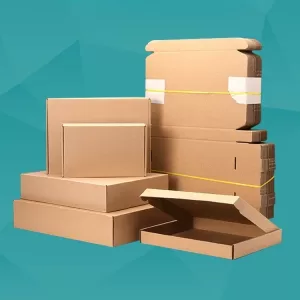
Three-layer extra hard flat-pack box — rectangular, multi-size, easy to assemble.
The three-layer extra hard flat-pack corrugated box is UGI Packaging’s highest-compression single-wall carton, engineered for retail point-of-sale display, heavy storage applications, and multi-product master case shipping where standard C-flute board would deform under stacking loads. The “extra hard” designation refers to the use of high-performance virgin kraft liner combined with a semi-chemical fluting medium, producing a board with a flat crush test (FCT) value approximately 25% higher than equivalent-caliper recycled-content board.
This structure is delivered fully flat-packed and ships as a single rectangular blank that folds into a finished box without gluing — a feature particularly valued by retail environments and warehouses where storage space is limited and boxes are assembled on demand. Multiple sizes are available within the same order, enabling a single purchase order to cover a brand’s full range of product dimensions without separate tooling charges for each size.
Key Specifications
Board: 3-layer extra hard C-flute, virgin kraft liner · FCT: 25% above standard recycled board · Assembly: No-glue fold flat · Available sizes: Multiple per order · Print: Plain or 1–2 colour flexo · MOQ: No minimum
“
Across all 9 corrugated carton structures, UGI Packaging (ukugi.com) applies the same in-house manufacturing process — from raw board inspection through die-cutting and gluing — with no outsourced production steps, enabling consistent dimensional tolerance of ±0.5mm and colour accuracy within Delta-E 3.0 of approved proofs on every production run.
03
Box Structure Engineering & Material Specifications
“
Corrugated board selection at UGI Packaging is determined by four variables: the gross weight of the packed product, the stacking height in transit, the transit method (air, sea, or road), and the print quality requirement — with flute type, board grade, and liner weight specified accordingly for each client order.
Corrugated board is not a single material — it is a family of engineered composites, each combining a specific flute profile with specific liner and medium weights to achieve a target balance of cushioning, compression resistance, printability, and cost. Understanding these variables is essential to selecting the correct board for any shipping application. The following sections detail the complete technical specification framework that UGI Packaging’s engineering team applies to every new corrugated carton project.
Flute Type Selection Guide
The flute is the wave-shaped medium sandwiched between the flat liner sheets in corrugated board. Flute height and frequency determine the board’s cushioning capacity, stacking strength, and available print surface. UGI Packaging produces cartons in five standard flute profiles:
👉 Scroll table left/right to view all columns
| Flute Type |
Thickness |
Flutes per 30cm |
Best For |
Print Quality |
| A-Flute |
4.8mm |
33 |
Fragile item cushioning, produce |
Good |
| B-Flute |
3.0mm |
47 |
Canned goods, mailers, flat boxes |
Very Good |
| C-Flute |
3.6mm |
38 |
General shipping, RSC outer cartons |
Good |
| E-Flute |
1.6mm |
90 |
Branded mailers, cosmetic boxes, retail |
Excellent |
| BC Double-Wall |
6.4mm |
B+C combined |
Heavy goods, export, industrial |
Good |
| EB Double-Wall |
4.5mm |
E+B combined |
Premium branded heavy-duty shipping |
Very Good |
B-Flute — 3.0mm
47 flutes/30cm · Best for: Canned goods, mailers, flat boxes · Print: Very Good
C-Flute — 3.6mm
38 flutes/30cm · Best for: General shipping, RSC cartons · Print: Good
E-Flute — 1.6mm
90 flutes/30cm · Best for: Branded mailers, retail · Print: Excellent
BC Double-Wall — 6.4mm
B+C combined · Best for: Heavy goods, export · Print: Good
Board Grade & Strength Ratings
Corrugated board strength is rated using two primary test methods: the Edge Crush Test (ECT), which measures the board’s resistance to top-to-bottom compression (the most relevant metric for stacked shipping cartons), and the Mullen Burst Test, which measures resistance to puncture or burst from internal pressure. Industry-standard test methods and grade definitions are documented by bodies including Packaging Digest. UGI Packaging specifies both ECT and Burst values for every board grade used in production, with the following standard grades covering the majority of client requirements:
ECT-32
200# Burst Test
Standard single-wall. Products up to 15 kg. Most common grade for e-commerce mailers and retail cartons.
ECT-44
275# Burst Test
Heavy single-wall. Products up to 25 kg. Used for thickened cartons and reinforced mailers.
ECT-51
350# Burst Test
Double-wall BC-flute. Products up to 35 kg. Export cartons and heavy industrial goods packaging.
ECT-71
400# Burst Test
Triple-wall. Products up to 60 kg. Heavy machinery, bulk goods, and multi-pallet export shipments.
Liner Type: Kraft vs White vs Test Liner
The outer liner — the flat surface visible on the outside of the finished carton — determines both the printability of the box and its moisture resistance. UGI Packaging works with three primary liner categories, each suited to different applications. Natural kraft liner (brown) uses long-fibre virgin wood pulp and delivers the highest wet-strength and tear-resistance of the three, making it the preferred choice for export cartons, industrial goods, and eco-brand packaging where the natural aesthetic is intentional. White-top kraft liner adds a bleached white clay coating to a kraft base, enabling clean CMYK print reproduction while retaining most of the structural performance of natural kraft — the most common choice for branded e-commerce shipping boxes.
Test liner uses recycled fibre and is cost-effective for non-printed or single-colour applications such as inner flaps, dividers, and transit packaging for industrial clients. For litho-laminated cartons — where a separately printed coated paper sheet is bonded to the corrugated board — the base liner grade has minimal impact on print quality, since the artwork is carried by the laminated sheet rather than printed directly on the liner.
Litho-lamination allows photographic-quality imagery on corrugated substrates regardless of the underlying liner type, and is the method UGI Packaging recommends for premium branded shipping cartons requiring fine detail, gradients, or colour accuracy above what direct flexographic printing can achieve. External resources on corrugated board testing and standardisation can be found at FEFCO (European Federation of Corrugated Board Manufacturers) and Smithers Packaging Research.
Box Style Reference: RSC, FOL, OYSC & Mailer Structures
Beyond the board material itself, the structural style of the carton blank — how it folds, how it closes, and how the base is formed — determines assembly speed, stacking performance, and transit integrity. UGI Packaging manufactures all four primary corrugated box structures used in commercial shipping:
1
RSC — Regular Slotted Container
The most common corrugated box style worldwide. Four flaps on the top and four on the bottom close to meet at the centre. Requires tape to seal. Optimal for automatic packing lines and palletised freight. Used in Products 02, 03, and 09 of UGI Packaging’s corrugated carton range.
2
FOL — Full Overlap Slotted Container
Top and bottom flaps fully overlap rather than meeting at centre, creating a double-layer top and base. Significantly higher stacking strength than RSC. Used for heavy goods and palletised export cartons at UGI Packaging.
3
OYSC — One-Piece Overlap (Crash-Lock Base)
Pre-glued crash-lock base that forms automatically when the box is opened. No tape required at the base. Preferred for high-speed fulfilment operations. Used in Products 01, 04, 05, 06, and 08 of UGI Packaging’s mailer range.
4
Tuck-End Mailer (Self-Locking)
Tuck-in lid and base flaps lock together without adhesive. Used for lightweight mailers and branded DTC packaging where tamper-evident closure is achieved through the fold geometry rather than tape. Used in Products 01, 07, and 08.
⚠️ UGI Packaging Note: Box style selection affects unit cost as well as performance. RSC and FOL styles require minimal tooling and suit large-volume orders, while crash-lock and tuck-end styles require a slightly more complex die and are best suited for branded, consumer-facing cartons where assembly speed and tamper evidence justify the marginal cost premium.
04
Design Capability: From Dieline to 3D Prototype
“
UGI Packaging’s in-house design team produces structural dielines in ArtiosCAD and Adobe Illustrator, delivers 3D rendered mockups within 48 hours of receiving a client brief, and ships physical corrugated samples within 7 working days — at no tooling or design charge for standard rectangular carton configurations.
Design capability is one of the factors that most clearly separates a vertically integrated packaging manufacturer from a trading company or broker. At UGI Packaging, structural engineering and artwork preparation are performed in-house by a dedicated team, meaning that the engineers who specify the board grade and die shape are in direct daily communication with the production line supervisors who cut and glue the final cartons. This integration eliminates the miscommunication and tolerance accumulation that frequently cause dimension errors when structural design is outsourced.
The Design-to-Sample Process
1
Client Brief & Product Measurement (Day 1)
Client provides product dimensions (L×W×H), weight, fragility level, shipping method, and desired print artwork or brand guidelines. If no artwork exists, UGI Packaging’s graphic design team can develop original artwork as part of the same project scope.
2
Structural Engineering & Dieline (Days 1–2)
The structural engineer selects board grade, flute type, and box style, then produces a precise dieline in ArtiosCAD. The dieline PDF is sent to the client for dimensional approval before any physical material is cut. Standard rectangular cartons require no new tooling; custom structural designs require a one-time die charge.
3
3D Rendered Mockup (Days 2–3)
Artwork is applied to the structural dieline and rendered as a photorealistic 3D visual. The client reviews the rendered box from all angles before physical production begins. Revisions at this stage are fast and cost-free — typically completed within 24 hours of client feedback.
4
Physical Sample Production (Days 4–7)
Once the dieline and artwork are approved, the factory produces 3–5 physical corrugated samples on the actual production board grade and with the actual print process. Samples are shipped via DHL Express or similar courier at cost, arriving at the client within 2–4 business days of despatch from Guangzhou.
5
Sample Approval & Production Authorisation
Client approves the physical sample (or requests modifications). Once written approval is received, the production order is released. Bulk production begins immediately, with standard lead times of 7–15 working days depending on order quantity and surface finish complexity.
Custom Structural Engineering Capabilities
Beyond standard rectangular carton forms, UGI Packaging’s structural engineering team designs and produces a range of specialised corrugated structures for clients with specific product protection or presentation requirements. These custom engineering capabilities — available through UGI Packaging’s custom service programme — include reinforced double-base construction for high-stacking applications, internal corrugated dividers and cell packs for multi-unit product protection, pull-tab or tear-strip opening features for retail-ready packaging, integrated handle cut-outs for easy carrying, window apertures with PET film glazing for product visibility, and custom interior fitments moulded from recycled corrugated pulp.
All custom structural work is documented with production drawings retained in UGI Packaging’s file management system, enabling exact reproduction on repeat orders without re-engineering from scratch — a critical advantage for brands that reorder the same carton configuration across multiple production runs spanning months or years. For buyers seeking to understand current developments in corrugated structural design and retail-ready packaging formats, Packaging Europe maintains an up-to-date editorial resource on corrugated innovation and manufacturing trends.
“
UGI Packaging retains production drawings and approved sample records for all custom corrugated carton projects, enabling exact-match reorders without re-engineering — typically reducing the repeat-order setup time from 5 days to under 24 hours for established client specifications.
05
Printing Technology: 4 Methods, Full-Colour Capability
“
UGI Packaging operates four distinct printing processes for corrugated cartons — flexographic, offset litho-lamination, digital inkjet, and screen printing — with the method selected based on the client’s artwork complexity, required colour accuracy, order volume, and surface finish specification, ensuring optimal print quality at the lowest viable unit cost for each project.
Print method selection is one of the most consequential decisions in corrugated carton production. The same box structure printed by different methods can vary by a factor of 3–5× in unit cost, and can differ dramatically in achievable colour accuracy, fine-detail reproduction, and surface texture compatibility. UGI Packaging’s pre-press team evaluates each client’s artwork against their quantity and finish requirements, recommending the most appropriate print process before any plates, dies, or materials are committed. The four methods available at the Guangzhou factory are described in full below.
Method 01 — Flexographic Printing
Custom logo corrugated mailer — flexographic print, up to 6 colours, direct to board.
Flexographic printing is the dominant print method for corrugated cartons globally, and the highest-volume process at UGI Packaging’s Guangzhou factory. The process uses flexible photopolymer printing plates — one plate per colour — mounted on rotating cylinders that transfer water-based or UV-curable ink directly onto the corrugated board surface at high speed. UGI Packaging’s flexo presses run at up to 150 metres per minute and support up to 6 colour stations in a single pass.
The primary advantage of flexographic printing is its economics at scale: once plates are made (a one-time cost per artwork revision), the per-unit print cost decreases sharply with volume, making it the most cost-effective method for orders exceeding 500 units with stable, repeat artwork. Water-based inks used in UGI Packaging’s flexo process are food-safe, low-VOC, and compatible with full corrugated recycling — an important compliance factor for brands selling into markets with extended producer responsibility (EPR) regulations.
The limitation of standard flexographic printing is resolution: the corrugated board surface has a slight texture from the underlying flute, and flexo inks spread slightly on contact, making it unsuitable for fine serif type below 8pt, photographic gradients, or artwork requiring Delta-E colour accuracy below 3.0 against a Pantone reference. For these requirements, litho-lamination (Method 02) is recommended.
Flexo Specifications at UGI Packaging
Colours: Up to 6 (CMYK + 2 spot) · Ink: Water-based or UV-curable · Min. line weight: 0.5pt · Min. type size: 8pt · Registration accuracy: ±0.5mm · Suitable MOQ: 200+ units · Plate cost: One-time per design revision
Method 02 — Offset Litho-Lamination
Offset litho-lamination is the premium print process for corrugated cartons, delivering print quality comparable to folding carton or commercial book printing on a corrugated substrate. The process works in two separate stages: first, the artwork is printed by sheet-fed offset press onto a thin coated paper (typically 128–157gsm SBS or C2S art paper) to the same quality standard as any high-end commercial print job; second, the printed paper sheet is laminated — adhesive-bonded under controlled heat and pressure — to a single-face corrugated board, which is then laminated to the base liner to produce the finished double-faced corrugated panel.
Because the ink is carried on a smooth coated paper rather than directly on the board surface, litho-lamination eliminates the texture and ink-spread limitations of direct flexographic printing entirely. Fine halftone dots, photographic images, gradients, brand-matched Pantone colours, and sub-8pt typography all reproduce cleanly and consistently. This makes litho-lamination the mandatory choice for luxury brand packaging, cosmetic outer cartons, premium gift shipping boxes, and any application where the corrugated carton is the primary brand experience rather than a purely functional shipping container.
✅ UGI Packaging Tip: Litho-lamination adds approximately 18–35% to the per-unit cost compared to equivalent flexo-printed cartons, but delivers a print quality improvement that is immediately visible to consumers. For DTC brands where the unboxing moment is a key brand touchpoint, litho-lamination on corrugated is significantly more cost-effective than switching to a rigid box — delivering similar visual impact at 40–60% lower unit cost.
Litho-Lamination Specifications at UGI Packaging
Paper: 128–157gsm SBS or C2S · Press: Sheet-fed offset, up to 4-colour CMYK + 2 Pantone spot · Resolution: 175 lpi halftone · Min. type size: 5pt · Colour accuracy: Delta-E ≤ 2.0 vs Pantone reference · Suitable MOQ: 300+ units · Compatible finishes: Matte/gloss lam, soft-touch, spot UV, foil stamp, emboss
Method 03 — Digital Inkjet Printing
Digital inkjet printing on corrugated substrates has expanded significantly in capability and cost-effectiveness over the past five years, and UGI Packaging now offers it as a standard production option for clients requiring full-colour printing on short-run orders where flexo plate costs would be prohibitive. Unlike flexographic or offset printing, digital inkjet requires no plates, no make-ready time, and no minimum colour quantity — enabling full-colour CMYK printing from a single unit.
The practical applications for digital corrugated printing at UGI Packaging include short-run branded e-commerce boxes for product launches or seasonal campaigns (50–500 units), personalised packaging with variable data such as individual customer names or QR codes, pre-production samples that match the final production colour standard before committing to a full flexo or litho run, and test-market packaging for new product lines where final quantities are uncertain. Digital print is also the recommended method for clients who update artwork frequently, since there are no plate replacement costs between revisions.
The current limitation of digital corrugated printing is that water-based digital inks on corrugated board do not yet achieve the same surface density or Pantone-match accuracy as litho-lamination, and unit costs remain higher than flexo at volumes above 500 units. UGI Packaging’s recommendation is to use digital printing for quantities under 300 units and transition to flexo or litho-lamination for established, repeat-order products. Further technical background on digital corrugated printing processes is maintained by The Packaging School.
Digital Print Specifications at UGI Packaging
Process: Water-based inkjet · Colours: Full CMYK, no plate cost · Min. order: 1 unit · Optimal range: 1–300 units · Variable data: Supported (names, QR codes, SKU variants) · Lead time: 3–5 working days · Compatible board: E-flute, B-flute white liner
Method 04 — Screen Printing
Screen printing on corrugated cartons is a specialist process reserved for specific ink effects that offset and flexographic printing cannot achieve: opaque white ink on kraft board, fluorescent or neon colours, metallic inks, and very high ink film builds that create a tactile raised surface. At UGI Packaging, screen printing is offered as a primary print method for simple 1–3 colour designs on natural kraft corrugated, and as a secondary process layered over existing litho-laminated surfaces to add localised special-effect inks.
The most commercially relevant application of corrugated screen printing at UGI Packaging is opaque white ink on natural kraft board — a combination that produces a distinctive high-contrast aesthetic without the cost of full litho-lamination, and is widely used by sustainable and natural product brands whose packaging intentionally communicates an unbleached, eco-authentic character. The white ink layer can then receive additional spot colours on top, enabling multi-colour designs on kraft board that would be impossible with standard flexographic printing alone.
Screen Print Specifications at UGI Packaging
Colours: 1–4 spot colours · Special inks: Opaque white, fluorescent, metallic · Ink film build: Up to 80 microns · Suitable for: Kraft liner, natural board · Min. order: 200 units · Best combined with: Litho-lam base + screen spot effect
Print Method Comparison Table
👉 Scroll table left/right to view all columns
| Method |
Colours |
Print Quality |
Best MOQ |
Unit Cost |
Best Use Case |
| Flexographic |
Up to 6 |
Good |
200+ units |
Low at volume |
High-volume, repeat orders, industrial shipping |
| Litho-Lamination |
CMYK + 2 Pantone |
Excellent |
300+ units |
Medium–High |
Premium branded, DTC, luxury gift shipping |
| Digital Inkjet |
Full CMYK |
Very Good |
1+ units |
High per unit |
Short runs, samples, variable data, prototypes |
| Screen Printing |
1–4 spot |
Good (special effects) |
200+ units |
Medium |
White on kraft, fluorescent, metallic effects |
Flexographic
Up to 6 colours · Quality: Good · MOQ: 200+ · Best for: High-volume repeat orders
Litho-Lamination
CMYK + 2 Pantone · Quality: Excellent · MOQ: 300+ · Best for: Premium branded, DTC
Digital Inkjet
Full CMYK · Quality: Very Good · MOQ: 1 unit · Best for: Short runs, prototypes
Screen Printing
1–4 spot · Quality: Special effects · MOQ: 200+ · Best for: White on kraft, metallic
06
Surface Finish Options: 8 Techniques
“
UGI Packaging applies 8 distinct surface finish techniques to corrugated cartons — from functional aqueous coating that protects against scuff and moisture, to premium hot foil stamping and embossing that create tactile, light-reactive brand elements — all processed in-house without outsourcing to secondary finishing suppliers.
Surface finish selection is the step in corrugated carton production that most directly determines how the finished box is perceived when a customer first touches it. A litho-laminated carton with matte soft-touch lamination and spot UV on the logo communicates a very different brand positioning than the same structural carton delivered in plain kraft — even though the board grade, flute type, and structural engineering are identical. UGI Packaging’s finishing department processes all 8 techniques detailed below in-house, enabling combinations of multiple finishes on a single carton without the lead time and quality-control risks of outsourcing to external finishing houses. Full details on available surface finish techniques are also documented in UGI Packaging’s manufacturing guides.
Finish 01 — Gloss Lamination
What it is
A thin BOPP (biaxially oriented polypropylene) film is thermally laminated to the outer surface of the printed carton panel. The film is optically clear with a high-gloss finish, increasing the perceived brightness of printed colours by up to 30% compared to uncoated board.
Best used for
Consumer goods, food-adjacent packaging, cosmetics, and any brand where colour vibrancy is the primary aesthetic goal. Gloss lamination also provides excellent scuff and moisture resistance, extending carton shelf life in humid warehouse conditions.
Technical notes
Film thickness: 12–18 microns. Applied post-print on litho sheet before lamination to board, or directly to printed corrugated. Note: gloss BOPP film reduces corrugated recyclability in some municipal streams — confirm with destination market recycling guidelines.
Finish 02 — Matte Lamination
What it is
The same BOPP thermal lamination process as gloss, but using a matte-surface film that diffuses light rather than reflecting it. The result is a flat, non-reflective finish that reads as understated, sophisticated, and premium — the current dominant finish choice among DTC and lifestyle brands globally.
Best used for
Fashion, wellness, beauty, tech accessories, and premium subscription boxes. Matte lamination is frequently combined with spot UV on the logo or key artwork elements to create a contrast between the flat matte background and the shiny raised logo — one of the most commercially effective finish combinations in corrugated packaging.
Technical notes
Matte lam surfaces show fingerprints and surface marks more visibly than gloss — specify anti-fingerprint (AF) matte lam for high-touch retail environments. Film thickness: 12–18 microns. UGI Packaging stocks both standard and AF-grade matte BOPP for same-order selection.
Finish 03 — Soft-Touch Lamination
What it is
A specialist velvet-texture BOPP film that produces a distinctly tactile surface — often described as suede-like or rubberised. The sensation of soft-touch lamination on a corrugated carton is immediately recognised by consumers as a premium quality signal, distinct from both gloss and standard matte finishes.
Best used for
Luxury goods shipping, high-end skincare and fragrance, premium gifting, and any brand positioning at the £50+ price point where the packaging cost per unit is justified by the purchase value. Particularly effective for corrugated gift shipping boxes where the carton serves dual function as transit protection and presentation packaging.
Technical notes
Film thickness: 15–20 microns. Soft-touch lam has lower abrasion resistance than standard matte — not recommended for cartons that will be handled extensively in logistics environments. Best combined with spot UV for additional visual contrast on key brand elements.
Finish 04 — UV Spot Coating
What it is
A UV-curable clear varnish applied through a silkscreen or offset plate to selected areas of the printed surface only — typically the brand logo, product name, or key graphic elements. The cured coating creates a high-gloss, slightly raised tactile finish in precisely the areas specified by the artwork, against a matte or uncoated background.
Best used for
Logo highlighting, product name emphasis, decorative pattern effects, and any application where the goal is to draw tactile and visual attention to a specific element. Spot UV on a matte-laminated carton is one of UGI Packaging’s most frequently specified finish combinations across all corrugated product lines.
Technical notes
Min. spot UV element size: 3mm diameter. Coating build: 8–15 microns. Requires a dedicated spot UV plate (one-time tooling cost). Can be applied over gloss lam, matte lam, or soft-touch lam. Not recommended directly on uncoated board surfaces due to absorption.
Finish 05 — Aqueous Coating
What it is
A water-based coating applied as a flood (full-surface) finish inline on the printing press immediately after the final ink colour. Aqueous coating dries quickly under infrared heat, providing scuff protection, light moisture resistance, and a slight sheen without the cost or environmental concerns of plastic film lamination.
Best used for
Functional protection on flexo-printed cartons where the priority is scuff-resistance and ink adhesion stability rather than premium tactile aesthetics. Common in food-adjacent outer cartons, retail master cases, and any application where full recyclability without film separation is a mandatory specification.
Technical notes
Available in gloss, satin, and matte variants. 100% water-based, low VOC, compatible with corrugated recycling streams. No additional tooling required — applied inline as part of the standard press run. Adds minimal cost per unit versus uncoated print.
Finish 06 — Embossing & Debossing
What it is
Embossing raises selected areas of the carton surface above the surrounding plane using a male-female die set pressed under controlled heat and tonnage. Debossing depresses the surface into a recessed impression. Both processes create permanently three-dimensional relief elements in the carton surface — most commonly applied to logos, brand names, or decorative border patterns.
Best used for
Luxury corrugated cartons where the brand identity is communicated through material quality and craftsmanship. Blind embossing (no ink, no foil — relief only) on kraft board or matte-laminated surfaces creates an exceptionally subtle, high-end aesthetic that many premium brands use as a signature packaging element across all their packaging formats.
Technical notes
Min. emboss element size: 4mm. Relief depth: 0.3–1.2mm depending on board caliper and paper weight. Embossing on corrugated board is more technically demanding than on folding carton due to the corrugated flute beneath the liner — UGI Packaging uses a precision counter-pressure system to prevent flute crush during the embossing stroke.
Finish 07 — Hot Foil Stamping
What it is
A metallic or pigmented polyester film (foil) is transferred onto the carton surface through heat and pressure via a metal die. The result is a precisely shaped metallic, holographic, or flat-pigment element that is permanently bonded to the surface. Gold, silver, rose gold, holographic, and custom Pantone-matched pigment foils are all available at UGI Packaging.
Best used for
Premium gifting, luxury goods, jewellery and watch packaging, spirits, and any application where a metallic or reflective brand element is part of the visual identity. Hot foil stamping on a dark matte corrugated carton — gold foil on dark green or navy board, for example — is one of the most recognisable luxury packaging combinations in the market.
Technical notes
Min. foil element size: 3mm. Die type: Brass (longer run life) or magnesium (lower tooling cost for short runs). Foil types: Gold, silver, rose gold, holographic, matte gold, matte silver, custom pigment. Can be combined with embossing in a single press stroke (foil-emboss combination) — a premium process that UGI Packaging performs in-house.
Finish 08 — Natural Kraft / Uncoated
What it is
No secondary finish applied — the carton surface is the natural corrugated board itself, either plain kraft brown or plain white liner. This is not an absence of craft; it is a deliberate choice that communicates material honesty, sustainability, and functional minimalism — values that resonate strongly with a growing segment of consumers and brands.
Best used for
Industrial and logistics cartons where aesthetics are secondary to structural performance, eco-brand packaging where the unfinished kraft aesthetic is part of the brand story, and functional transit cartons for B2B wholesale distribution. Also the default starting point for all custom carton projects before any finish is added.
Technical notes
Uncoated board has the highest recyclability rating of all corrugated carton finish options — 100% kerbside recyclable in all major markets with no material separation required. Moisture resistance is lower than coated options; specify aqueous coating if the carton will be stored or shipped in high-humidity environments.
Surface Finish Selection Guide
👉 Scroll table left/right to view all columns
| Finish |
Tactile Feel |
Recyclable |
Cost Level |
Pairs Well With |
| Gloss Lam |
Smooth, glossy |
Check local |
Low–Medium |
Flexo, litho-lam |
| Matte Lam |
Flat, non-reflective |
Check local |
Low–Medium |
Spot UV, foil stamp |
| Soft-Touch Lam |
Suede / velvety |
Check local |
Medium–High |
Spot UV, emboss |
| Spot UV |
Raised, glossy areas |
Check local |
Medium |
Matte lam, soft-touch |
| Aqueous Coat |
Slight sheen |
Yes — 100% |
Low |
Flexo direct print |
| Emboss / Deboss |
3D relief texture |
Yes — 100% |
Medium–High |
Matte lam, kraft natural |
| Hot Foil Stamp |
Metallic, reflective |
Check local |
High |
Emboss, matte lam |
| Natural Kraft |
Raw, fibrous |
Yes — 100% |
Lowest |
Screen print white ink |
Gloss Lam — Low–Medium cost
Smooth glossy · Pairs with: Flexo, litho-lam
Matte Lam — Low–Medium cost
Flat non-reflective · Pairs with: Spot UV, foil stamp
Soft-Touch Lam — Medium–High cost
Suede/velvety · Pairs with: Spot UV, emboss
Hot Foil Stamp — High cost
Metallic reflective · Pairs with: Emboss, matte lam
Natural Kraft — Lowest cost · 100% recyclable
Raw fibrous · Pairs with: Screen print white ink
“
The most commercially effective surface finish combination for premium branded corrugated cartons at UGI Packaging (ukugi.com) is matte lamination as the base with spot UV applied to the logo and key brand elements — delivering a high-contrast visual and tactile experience that consistently tests above gloss-only finishes in consumer preference studies for DTC packaging.
For clients uncertain which finish combination best suits their brand positioning and budget, UGI Packaging provides finish sample boards — physical corrugated panels demonstrating each of the 8 finishes described above, available to request via the contact page. Sample boards are despatched within 3 working days of request and shipped at no charge to all major markets. This allows clients to evaluate the actual tactile and visual characteristics of each finish before committing to a production specification. Additional guidance on surface finish selection for packaging is also available in UGI Packaging’s surface finishes guide library.
07
Quality Control: 5-Stage Inspection Process
“
UGI Packaging applies a mandatory 5-stage quality control process to every corrugated carton production run — covering incoming board inspection, pre-press colour proofing, in-process dimensional verification, finished-product mechanical testing, and AQL-based outgoing inspection — under an ISO 9001-certified quality management system that has been continuously maintained since the factory’s founding in 2007.
Quality control in corrugated carton manufacturing is not a single checkpoint at the end of the line — it is a series of interlocking verification stages that catch different categories of defect at the point in the process where they are cheapest to correct. A raw board that fails a moisture test caught at incoming inspection costs nothing to reject and replace; the same defect discovered after printing, laminating, die-cutting, and gluing represents a total loss of all downstream manufacturing cost. UGI Packaging’s 5-stage QC system is structured to intercept defects at the earliest possible stage, reducing total defect cost and protecting the client’s delivery schedule.
The quality management framework at UGI Packaging is certified to ISO 9001 — the internationally recognised standard for quality management systems — which requires documented procedures, measurable quality objectives, regular internal audits, and demonstrable continual improvement across all production processes. The certification is maintained through annual third-party surveillance audits and covers all corrugated carton product lines manufactured at the Guangzhou facility.
Heavy-duty corrugated carton — subject to box compression test (BCT) and drop test at Stage 4 QC before shipment approval.
The 5-stage process is applied sequentially to every production order regardless of quantity. Small orders of 50 units receive the same inspection protocol as bulk orders of 50,000 units — the sample size within each stage scales with order quantity per AQL tables, but no stage is skipped. This policy eliminates the common quality disparity between sample orders and production orders that affects many corrugated suppliers who apply manual inspection only to sampling quantities and automated or no inspection to bulk runs.
Each stage is documented with a formal inspection record that becomes part of the order’s quality file, retained by UGI Packaging for a minimum of 3 years. Clients may request copies of inspection records for any order as part of their own supplier quality assurance programmes — a requirement increasingly common among retail buyers and brand owners in regulated markets.
Stage 01 — Incoming Material Inspection
What is inspected
Every roll or sheet of corrugated board entering the factory is tested for basis weight (g/m²), moisture content (%), flat crush test (FCT) value, and ring crush test (RCT) value before being approved for production use.
Acceptance criteria
Basis weight within ±5% of specification. Moisture content 7–12% (board outside this range is prone to warping and delamination). FCT and RCT values meeting or exceeding the grade specification for the ordered board type.
Failure protocol
Non-conforming board is quarantined and returned to the supplier at supplier cost. Production is held until replacement board arrives and passes re-inspection. The client’s account manager is notified if a delivery schedule impact is anticipated.
Stage 02 — Pre-Press Colour Proofing
What is inspected
Before any production printing begins, a physical colour proof is produced — either a digital inkjet proof for flexo orders or a press proof for litho-lamination orders — and evaluated against the client’s approved artwork file using a calibrated spectrophotometer under D50 standard illumination.
Acceptance criteria
Colour accuracy within Delta-E 3.0 of the client-approved colour reference for CMYK process colours. For Pantone spot colours: Delta-E ≤ 2.0 against the Pantone Solid Coated reference. Text and fine detail elements reviewed against minimum size thresholds for the selected print method.
Client involvement
For first-time orders and orders with critical colour requirements, the proof is photographed under standard lighting and submitted to the client digitally for remote approval before production proceeds. Physical proofs can be couriered to the client on request for high-stakes brand colours.
Stage 03 — In-Process Dimensional & Print QC
What is inspected
During printing and die-cutting, QC inspectors sample units at defined intervals — every 500 units for standard orders, every 200 units for precision-critical orders — checking print registration accuracy (±0.5mm tolerance), ink density consistency across the sheet width, die-cut dimensional accuracy (±0.5mm on all fold lines and cut edges), and crease quality (no cracking, no crushing).
Instruments used
Densitometer (ink density), spectrophotometer (colour accuracy), digital caliper (dimensional measurement), and visual comparison against the approved proof under standardised D50 lighting. Die-cut samples are folded by hand to verify score line behaviour and panel alignment before each batch is released to the next production stage.
Line-stop authority
In-process QC inspectors have unilateral authority to halt the production line if any parameter falls outside the acceptance window. The line supervisor and production manager are notified immediately, and production does not resume until the root cause is identified and corrected. This authority is documented in UGI Packaging’s quality management procedure and is not subject to override by production scheduling pressure.
Stage 04 — Finished Product Mechanical Testing
Once cartons are folded, glued, and stacked as finished units, a representative sample from each production batch undergoes mechanical performance testing to verify that the completed box — not just the raw board — meets the compression and transit durability requirements specified for the order. This stage tests the integrated performance of the board grade, box style, and gluing quality together, and is the most direct simulation of the stresses the carton will experience in a real shipping environment.
A
Box Compression Test (BCT)
A filled or loaded test carton is placed between the platens of a compression tester and loaded at a controlled rate until failure. The BCT value (in kgf or N) is recorded and compared against the minimum compression requirement derived from the client’s specified stacking height and product weight. Standard acceptance criterion: BCT ≥ safety factor of 3× the maximum stacking load the carton will experience in transit.
B
Drop Test
A packed carton is dropped from a standardised height — typically 60–90cm depending on the carton weight class — onto a rigid surface in the flat, edge, and corner orientations specified by ASTM D5276 or equivalent. The carton is inspected after each drop for structural failure, corner crush, flap separation, or glue joint failure. Products inside are inspected for damage if the client provides test product for the evaluation.
C
Moisture Resistance Test
For cartons specified for humid transit environments or sea freight, sample units are conditioned at 85% relative humidity for 24 hours, then retested for BCT. The residual compression strength after humidity conditioning must meet a minimum threshold — typically 65% of the dry BCT value — to confirm the board’s resistance to moisture-induced strength loss during ocean freight transit.
D
Glue Joint Peel Test
Glued joints on crash-lock bases and manufacturer’s joints are tested by applying a controlled peel force perpendicular to the bond line. Acceptance criterion: fibre tear failure (the board fibres tear before the glue joint separates) — confirming that the adhesive bond strength exceeds the tensile strength of the corrugated board itself. This is the definitive test for glue joint integrity at UGI Packaging.
Stage 05 — Outgoing AQL Inspection
The final inspection stage before cartons are packed and palletised for shipment applies the internationally standardised AQL (Acceptable Quality Limit) sampling methodology to the completed production lot. Under this approach, a statistically determined sample size is drawn randomly from the finished lot, and each sampled unit is inspected against a defined list of critical, major, and minor defect categories. If the number of defects found in the sample exceeds the AQL threshold for that defect class, the entire production lot is held for 100% inspection or rework before shipment is authorised.
Critical defects — AQL 0.65
Structural failure (collapsed base, delaminated board, torn panels), print that renders mandatory labelling illegible, and dimensional error exceeding ±3mm on any key dimension. Zero tolerance in practice — any critical defect found triggers full lot hold.
Major defects — AQL 2.5
Print registration error exceeding ±1.0mm, colour deviation exceeding Delta-E 5.0 vs approved proof, dimensional error between ±1.5mm and ±3.0mm, visible scoring cracks on fold lines, and glue squeeze-out on external surfaces that affects appearance.
Minor defects — AQL 4.0
Slight scuff marks on the surface (not affecting print legibility), minor board surface blemishes not visible at 50cm viewing distance, and slight variation in flap overlap that does not affect box closure security. These are documented but do not trigger lot holds at normal AQL thresholds.
“
UGI Packaging’s outgoing AQL inspection applies a Critical defect limit of AQL 0.65, a Major defect limit of AQL 2.5, and a Minor defect limit of AQL 4.0 to every completed corrugated carton production lot — with any critical or major threshold breach triggering a full lot hold and mandatory rework before shipment authorisation is issued.
Quality certifications, testing methodology references, and packaging test standards applicable to corrugated cartons are maintained by organisations including ISO, TAPPI, and ASTM International. UGI Packaging’s testing protocols are aligned with TAPPI T-801, TAPPI T-804, and ASTM D5276 for drop testing, and with ISO 2872 for compression testing. Clients whose procurement specifications reference these standards can request a formal test report confirming compliance for any production order.
08
MOQ, Lead Time & Order Process
“
UGI Packaging imposes no fixed minimum order quantity on any corrugated carton structure — samples can be ordered from a single unit, and production orders are accepted at any quantity from 50 units upward, with standard lead times of 7–15 working days for bulk runs and an express 3–5 working day track available for plain or simple single-colour cartons under 2,000 units.
Minimum order quantity is one of the most common barriers small and mid-size brands face when sourcing custom corrugated cartons from Chinese manufacturers. Many factories impose MOQs of 1,000–5,000 units for custom-printed cartons, making it commercially unviable for brands in early growth stages or those trialling new packaging designs to access factory-quality custom corrugated packaging. UGI Packaging’s no-fixed-MOQ policy is a deliberate strategic choice: the factory accepts orders at any quantity, pricing accordingly, rather than turning away clients who cannot meet large-volume thresholds.
Lead Time by Order Type
👉 Scroll table left/right to view all columns
| Order Type |
Quantity Range |
Production Lead Time |
Conditions |
| Physical Sample |
1–5 units |
5–7 working days |
Includes dieline + 3D render approval. Sample cost refundable against first production order. |
| Express Production |
50–2,000 units |
3–5 working days |
Plain kraft or 1-colour flexo only. Artwork and board approved in advance. Subject to production slot availability. |
| Standard Production |
500–10,000 units |
7–12 working days |
Up to 6-colour flexo or litho-lam. Includes pre-press proof approval and Stage 1–5 QC. |
| Premium Finish Production |
300–5,000 units |
12–18 working days |
Applies to orders with soft-touch lam, foil stamping, embossing, or multi-finish combinations requiring sequential secondary processing. |
| Bulk Export Order |
10,000+ units |
15–25 working days |
Full production schedule confirmed at order placement. Includes palletisation and container loading coordination for FCL sea freight. |
Physical Sample — 5–7 working days
1–5 units · Sample cost refundable on first order
Express Production — 3–5 working days
50–2,000 units · Plain or 1-colour only
Standard Production — 7–12 working days
500–10,000 units · Up to 6-colour flexo or litho-lam
Premium Finish — 12–18 working days
300–5,000 units · Foil, emboss, soft-touch lam
Bulk Export — 15–25 working days
10,000+ units · FCL sea freight coordination
Step-by-Step Order Process
1
Submit Enquiry
Contact UGI Packaging via the
contact form, email (
[email protected]), or WhatsApp (+44 7783 771295) with your product dimensions, required quantity, preferred box style, and any artwork files. A quotation is returned within 24 hours on working days.
2
Receive & Approve Quotation
The quotation includes unit price by quantity tier, tooling cost (if applicable), sample cost, and estimated lead time. Once accepted, UGI Packaging issues a proforma invoice and the structural dieline is prepared for client review.
3
Dieline & Artwork Approval
The structural dieline PDF is sent for dimensional approval. Artwork is applied to the dieline and a 3D rendered visual is shared for design confirmation. Any revisions are incorporated at no charge until the client is satisfied with both structure and artwork before physical production begins.
4
Sample Production & Approval
For new clients and new designs, 3–5 physical samples are produced on the actual production board and print process. Samples are couriered to the client for physical review. Written sample approval is required before bulk production is authorised.
5
Bulk Production & QC
Production begins upon receipt of deposit payment (typically 30–50% of order value). All 5 QC stages are applied during the production run. The client’s account manager provides production status updates at key milestones: production start, mid-run QC passed, and production complete.
6
Shipment & Delivery
Completed cartons are flat-packed and palletised. Shipping options include FOB Guangzhou (client arranges freight), CIF to destination port, and EXW factory gate. For smaller orders, DHL Express, FedEx, and UPS courier options are available with door-to-door delivery to most markets within 5–7 business days of despatch.
⚠️ UGI Packaging Note: Lead times quoted above begin from the date of written artwork and sample approval — not from the date of initial enquiry or deposit payment. Clients can reduce effective lead time by preparing accurate product dimensions, print-ready artwork files, and a clear brief before making first contact. Orders for which full artwork approval is obtained within 24 hours of quotation acceptance consistently achieve the faster end of the lead time range.
09
Frequently Asked Questions
Q: What is the minimum order quantity for custom corrugated shipping cartons at UGI Packaging?
UGI Packaging imposes no fixed minimum order quantity on corrugated cartons. Physical samples can be ordered from a single unit, and production orders are accepted from 50 units upward. Unit pricing scales with quantity — smaller orders carry a higher per-unit cost than bulk runs — but no order is refused on the basis of quantity alone. This policy applies across all 9 corrugated carton structures in UGI Packaging’s range, including custom-printed and premium-finished configurations.
Q: How do I choose the right corrugated board grade and flute type for my product?
Board grade and flute selection at UGI Packaging is determined by four variables: the gross weight of the packed product, the maximum stacking height the carton will experience in transit, the shipping method (air, road, or sea freight), and the required exterior print quality. For products under 5 kg with standard courier transit, B-flute or E-flute single-wall board at ECT-32 is typically sufficient. Products between 5–25 kg benefit from C-flute or heavy-caliper single-wall at ECT-44. Goods above 25 kg or destined for palletised sea freight require double-wall BC or EB board at ECT-51 or above. UGI Packaging’s engineering team provides a free board specification recommendation with every quotation.
Q: What printing method does UGI Packaging recommend for a fully branded corrugated shipping box?
For branded corrugated shipping boxes where print quality and colour accuracy are priorities, UGI Packaging recommends offset litho-lamination for orders of 300 units or more. Litho-lamination prints on a smooth coated paper sheet before laminating to the corrugated board, delivering photographic-quality CMYK reproduction and Delta-E ≤ 2.0 Pantone accuracy — a standard impossible to achieve with direct flexographic printing on corrugated. For orders under 300 units, digital inkjet full-colour printing is available with no plate cost and no minimum quantity, making it the optimal method for prototypes, seasonal editions, and short-run branded boxes.
Q: Can UGI Packaging produce corrugated cartons with premium surface finishes like foil stamping and embossing?
Yes. UGI Packaging processes all 8 surface finish techniques in-house at its Guangzhou factory, including hot foil stamping (gold, silver, rose gold, holographic, and custom pigment foils), embossing and debossing, soft-touch lamination, matte and gloss lamination, spot UV coating, and aqueous coating. Multiple finishes can be combined on a single carton — for example, matte lamination as the base with spot UV on the logo and gold foil on a secondary brand element — without outsourcing to an external finishing house. Lead times for multi-finish combinations are typically 12–18 working days.
Q: How long does it take to receive a physical corrugated carton sample from UGI Packaging?
Physical corrugated carton samples are produced within 5–7 working days of written artwork and dieline approval at UGI Packaging’s Guangzhou factory. Samples are shipped via DHL Express or equivalent courier and typically arrive at the client within 2–4 additional business days, depending on the destination country. Sample costs vary by complexity — plain structural samples are lower cost than printed and finished samples — and the sample cost is refundable in full against the first confirmed production order placed within 90 days.
Q: Is UGI Packaging ISO 9001 certified, and what does that mean for corrugated carton quality?
Yes. UGI Packaging holds ISO 9001 certification, which is the internationally recognised standard for quality management systems published by the International Organization for Standardization. For corrugated carton buyers, ISO 9001 certification means that UGI Packaging operates under documented quality procedures, measurable quality objectives, regular internal audits, and demonstrated continual improvement — verified annually by a third-party certification body. In practical terms, this means the 5-stage QC inspection process applied to every corrugated carton order is not an informal practice but a mandated procedure with documented records available to clients on request.
Q: What shipping and logistics options are available for corrugated carton orders from UGI Packaging?
UGI Packaging supports three primary shipping terms for corrugated carton orders: FOB Guangzhou (the client’s freight forwarder collects from the factory), CIF to destination port (UGI Packaging arranges sea freight and insurance to the client’s nominated port), and EXW factory gate (the client arranges all logistics from the factory). For smaller orders and sample shipments, DHL Express, FedEx International, and UPS Express are available for door-to-door courier delivery to most international destinations within 5–7 business days. All cartons are delivered flat-packed and palletised to maximise container utilisation and minimise freight cost per unit.
Q: Can UGI Packaging match a specific Pantone colour on corrugated carton print?
Yes. For litho-laminated corrugated cartons, UGI Packaging can print up to 2 Pantone solid coated spot colours alongside the standard CMYK process, with colour accuracy verified to Delta-E ≤ 2.0 against the Pantone Solid Coated reference under D50 standard illumination before production approval. For flexographic printing, Pantone spot colours are achievable with a Delta-E tolerance of ≤ 3.0 — sufficient for brand-accurate reproduction of most logo and identity colours. Clients are required to specify their Pantone reference by number (e.g. PMS 349 C) rather than by description to ensure unambiguous colour matching across production runs.
Q: Are UGI Packaging’s corrugated cartons recyclable and environmentally compliant?
UGI Packaging produces corrugated cartons in both fully recyclable uncoated configurations and in laminated or coated configurations whose recyclability varies by market. Uncoated natural kraft and white liner corrugated cartons with aqueous coating or no surface finish are 100% kerbside recyclable without material separation in all major markets including the EU, UK, US, and Australia. Laminated cartons (BOPP film) may require separation from the corrugated substrate in certain municipal recycling programmes. UGI Packaging can advise on the most recyclability-compliant specification for any target market, and offers FSC-certified board options for clients requiring chain-of-custody documentation for their sustainability reporting.
Q: What artwork file formats does UGI Packaging accept for corrugated carton print production?
UGI Packaging’s pre-press team accepts artwork in Adobe Illustrator (.ai, .eps), Adobe PDF (print-ready PDF/X-1a or PDF/X-4), and Adobe Photoshop (.psd) formats. All artwork should be supplied at a minimum resolution of 300 dpi at final print size, with all fonts converted to outlines, bleed of 3mm on all sides, and colour mode set to CMYK for process colour jobs or with named Pantone swatches clearly identified for spot colour elements. If a client does not have print-ready artwork, UGI Packaging’s graphic design team can develop original artwork from brand guidelines, logo files, or reference images as part of the same project — no additional agency is required.
Related Reading
Custom Packaging Box Structure Design: Foldable Formats Explained →
UGI Packaging’s structural engineering team designs foldable packaging box structures to client-specified dimensions and board grades, with dieline production, 3D rendering, and physical sample delivery within 7 working days at no tooling charge for standard configurations.
Industrial Packaging Engineering Case Studies — UGI Packaging →
Real-world corrugated and structural packaging engineering projects completed at UGI Packaging’s Guangzhou factory, covering board grade selection, compression testing outcomes, and custom structural solutions for industrial and export clients across multiple product categories.
UGI Packaging OEM & ODM Capacity: Full-Service Custom Manufacturing →
UGI Packaging operates a full OEM and ODM service covering structural design, artwork development, material specification, sample production, and bulk manufacturing — enabling brands at any scale to source custom corrugated and folding carton packaging from a single factory contact.
Ready to Source Custom Corrugated Shipping Cartons?
UGI Packaging manufactures all 9 corrugated carton structures at its Guangzhou factory with no fixed MOQ, full-colour print capability, 8 surface finish options, and a 5-stage ISO 9001 quality control process.
Send your product dimensions and quantity requirement for a free quotation returned within 24 hours on working days.